What Do We Know About "Cossack" Metropolias?
Cossack state-building on the territory of modern Ukraine.
Yevhen Buket. Newspaper "Krymska Svitlytsia", 2016, issue No. 38
For a long time, historians unfairly downplayed the role of the southern territories of modern Ukraine in the processes of its state-building. In July 1667, in response to the separate Truce of Andrusovo between Muscovy and the Polish-Lithuanian Commonwealth, Hetman Petro Doroshenko initiated negotiations with the government of the Ottoman Empire on creating a military-political alliance. In January 1668, at the officers' council in Chyhyryn, a decision was made: "On both sides of the Dnieper, the inhabitants are to be in union and live separately and give tribute to the Turkish Emperor and the Crimean Khan, just as the Wallachian Prince pays, and from this time on not to be under the hand of the Grand Sovereign of Moscow and the Royal Majesty" [1].
On March 11, 1668, at the general council of the Zaporozhian Host near Korsun, it was officially proclaimed "submission to the Sultan" in the manner of the dependence of the Wallachian and Moldavian principalities on the Porte [2]. This treaty had a status no less significant for the Ukrainian Cossack state than the infamous Pereyaslav Articles of 1654.
And considering that the Pereyaslav agreements could generally be a later Moscow invention, Hetman Doroshenko's treaty with Sultan Mehmed IV had a decisive status for the Zaporozhian Host, because according to it, its state independence was recognized. At least all future legal acts leave no room for doubt about this.
After the signing of the Treaty of Korsun between the Zaporozhian Host and the Ottoman Empire, the then Metropolitan of Kyiv, Halych, and all Rus, Yosyp Tukalskyi-Neliubovych, ordered all Orthodox churches not to commemorate the Moscow Tsar as head of state [3]. But the desire of the Kyiv Metropolitan to create a separate "Cossack patriarchate" centered in Kyiv weakened his position before the Ecumenical See.
Thus, under the Treaty of Buchach – an agreement between the Polish-Lithuanian Commonwealth and the Ottoman Empire concluded on October 18, 1672, in the city of Buchach or its surroundings – the state independence of the Zaporozhian Host headed by Hetman Petro Doroshenko was once again confirmed. But it is known from Romanian sources that under the terms of the Treaty of Buchach, the territory of the Ukrainian Cossack state came under the jurisdiction of the Metropolia of Proilavia (Brăila) of the Ecumenical Patriarchate of Constantinople.
The Metropolia of Proilavia of the Ecumenical Patriarchate of Constantinople was an Orthodox metropolia on the territory of the Ottoman Empire, founded in 1540-1550. Its center was the city of Brăila on the left bank of the Danube in Romania. In 1751-1789, the residence of the Metropolitan of Brăila was the city of Izmail (now Odesa Oblast).
The lands of Dobrudja, Budzhak, Bendery belonged to the Metropolia of Proilavia, and after the signing of the Treaty of Buchach in 1672 – the Eparchy of Khotyn and all Orthodox territories and parishes of Right-Bank Ukraine under the protectorate of the Ottoman Empire, in particular Khan Ukraine (since the late 17th century, this was the name of the interfluve of the Dniester and the Southern Bug) and the Oleshky Sich [4]. The Orthodox parishes of Right-Bank Ukraine were subordinate to the Metropolia of Proilavia until 1793, when as a result of the second partition of the Polish-Lithuanian Commonwealth it was finally absorbed by the Russian Empire.
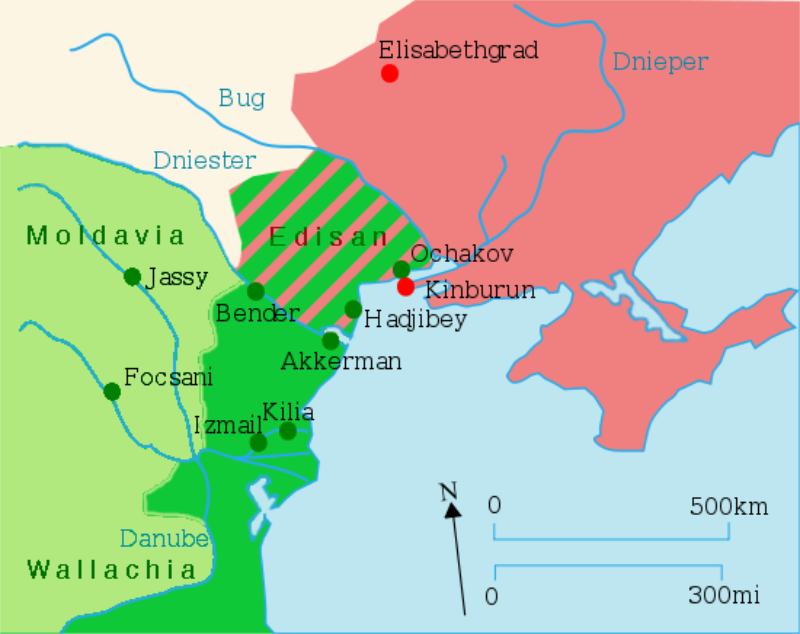
Russo-Turkish War, 1787 — 1792
The Patriarchate of Constantinople established a separate metropolia with its center in Kamianets in August 1681 [5]. At that time, this city was the center of the Kamianets Eyalet of the Ottoman Empire. Ecumenical Patriarch James (1679-1682) nominated for Kamianets-Podilskyi a Greek metropolitan named Pankratios, who, after the death of the last Metropolitan of Kyiv, Halych, and all Rus, Antoniy Vynnytskyi, took care of the territories entrusted to him. The title of the Metropolitan of Kamianets – "Exarch of all Little Rus" – indicated the actual separation of Right-Bank Ukraine from the Metropolia of Kyiv. Pankratios (1681-1690) was apparently the only head of the Kamianets Metropolia of the Patriarchate of Constantinople [6]. Afterward, its territories came under the jurisdiction of the Metropolitan of Brăila.
Modern Ukrainian historian Oleksandr Hurzhiy states that in the late 1720s and early 1730s, there were almost 20,000 Zaporozhians in the Ottoman-controlled territories [7].
Dmytro Yavornytskyi reports that the clergy of Ottoman Ukraine was appointed partly from Athens, but mostly from Jerusalem and Constantinople. Until 1728, the archimandrite Gabriel, a Greek by birth, was the rector of the entire military clergy of the Oleshky Zaporozhians [8]. Additional confirmation that there was a separate Orthodox church in the Northern Black Sea region that was subordinate to the Ecumenical Patriarch of Constantinople until the end of the 18th century is found in the work of Archpriest Arseniy Havrylovych Lebedyntsev "Khan Ukraine" (Odesa, 1913).
Thus, Metropolitan Daniel, who had his see in the city of Izmail from 1751 to 1773, signed in church charters as "Daniel, by the grace of God Metropolitan of Proilavia, Tomarovo, Khotyn, the entire coast of the Danube, Dnieper, and Dniester, and the whole of Khan's Ukraine." Daniel's successors, Joachim (1773-1780) and Cyril (1780-1792), signed with the title of Ukrainian metropolitan [9].
Motronyn, Moshnohirskyi, Medvedivskyi, Zhabotynskyi, Lebedynskyi, Mezhyhirskyi, and other Cossack monasteries were major centers of the Orthodox church in the Polish-Lithuanian Commonwealth. Sources mention their subordination rather vaguely. Even Feofan Lebedyntsev, in his work "Archimandrite Melchizedek Znachko-Yavorskyi," states that for the most part they did not belong to any of the eparchies subordinate to Moscow, although they maintained ties with both Kyiv and Pereyaslav, and received rectors "from Moldavia, Wallachia, and Khan's Ukraine" [10].
Thus, in 1724, Archimandrite Epiphaniy, assistant and head of the chancellery of the Archbishop of Kyiv, Varlaam (Vonatovych), was ordained Bishop of Chyhyryn by Metropolitan George of Iași without the approval of the Russian Synod. The charter presented by Epiphaniy, written on behalf of Archbishop Varlaam to the Moldavian Metropolitan of the Ecumenical Patriarchate, pointed to the Ukrainians' dissatisfaction with the removal of the Metropolia of Kyiv from the jurisdiction of Constantinople, the introduction of the "Spiritual Regulation" and synodal administration, as well as the reduction of the Metropolitans of Kyiv to the rank of archbishops.
Having received the rank of Bishop of Chyhyryn from the hierarchs of the Ecumenical Patriarchate, Epiphaniy returned to Ukraine, where he developed active work and ordained 14 priests and deacons. He was repeatedly imprisoned by the Russian authorities, but escaped from prisons each time. It is known that he served within the liberties of the Zaporozhian Host. During another exile to Siberia in 1733, the shackled Bishop Epiphaniy was rescued from his guards in the forest by Russian Old Believer Cossacks and hidden in Vetka in the Gomel region. However, in February 1735, Russian troops, on the orders of Empress Anna Ioannovna, surrounded Vetka, and Bishop Epiphaniy was arrested again. He died in the prison of the Kyiv fortress on April 1 of the same year and was buried as a layman near the Church of St. Theodosius in the Kyiv-Pechersk fortress [11].
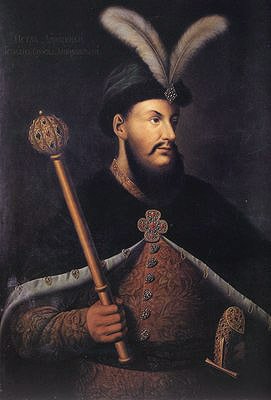
Petro Doroshenko
In 1759, Bishop Anatoliy (Meles) of Meletina, appointed by Ecumenical Patriarch Cyril V, acted as an independent hierarch in the Zaporozhian Sich. Supported by the Zaporozhian Cossacks and without the permission of the Russian Synod, he headed the Zaporozhian churches for a whole year and commemorated the Ecumenical Patriarchs. For this, he was imprisoned by the Russian authorities and exiled to Siberia, where he served his sentence for about nine years. According to researchers, Bishop Anatoliy (Meles) tried to create a separate autonomous Cossack eparchy in Zaporozhzhia under the omophorion of the Ecumenical Patriarchate [12].
After the events of 1686, an inner-church movement known as "wandering" or "wild priests" was widespread within Left-Bank Ukraine (Hetmanate). Throughout the 18th century, the Russian secular and ecclesiastical administration severely persecuted this movement and its representatives, catching and imprisoning "non-canonical" priests ordained by hierarchs of the Ecumenical Patriarchate [13].
The situation was similar in the parishes on the Right Bank. "The largest part of Orthodox priests was ordained in Wallachia," writes F. Lebedyntsev. "Without any outside recommendation and without a specific parish, but ordained in Wallachia, Moldavia, or in some other place (Khan's Ukraine – author) for 'vacancies', these priests wandered in Ukraine in dozens with charters in hand for several years, looking for parishes for themselves. The appointment of a priest to a parish depended solely on the will of the parishioners, but the consent of the local landowner, his governor, or any other official was required.
Upon entering a parish, the priest concluded a contract with the parishioners, which precisely determined the pay for services" [14]. But since 1733, the Pereyaslav-Boryspil Eparchy, "revived" by the Moscow church, claimed its "canonical" rights to Right-Bank Ukraine. The inter-confessional confrontation became particularly acute after the appointment of Gervasiy Lyntsevskyi as Bishop of Pereyaslav and Boryspil of the department of Orthodox confession of the Russian Empire in 1757.
The struggle against the "annexation" of the Orthodox parishes of the Right Bank by the Moscow church ended with the Zhabotyn Uprising (1765-1766) and the Koliivshchyna (1768-1770) [15]. Precisely because since at least the times of Hetman Petro Doroshenko the Zaporozhian Host had its own Orthodox metropolia, in the churches of those localities captured by the Koliivshchyna rebels in 1768, they prayed not for the king and landowners, not for the tsar and synod, but "for the Zaporozhian host" [16]. The Russian Empire, on the other hand, systematically destroyed documents about the relations of the Metropolia of Proilavia with the Zaporozhian Host.
Ultimately, it liquidated it under the terms of the Russo-Turkish Treaty of Adrianople of 1829, although de facto the Metropolia of Proilavia existed until 1840, or perhaps longer in the Danubian lands, where Cossacks lived who did not want to go under the Moscow yoke.
[1] Akty Yuzhno-Zapadnoy Rossii (Acts of South-Western Russia). – Vol. VII. – P. 30–31. [2] Chukhlib T. Proty Moskvy razom iz Turechchynoyu (Against Moscow together with Turkey) // Den. – 2015. – June 4. – No. 96. – Electronic resource. – Access mode: http://www.day.kiev.ua/uk/article/ukrayina-incogni... [3] Kovalenko S. Ukrayina pid bulavoyu Bohdana Khmelnytskoho. Entsyklopediya u 3-kh tomakh (Ukraine under the mace of Bohdan Khmelnytskyi. Encyclopedia in 3 volumes). – Volume 3. – K.: Stiks, 2009. – P. 256-258. [4] Ionel Manafu. Contribuțiuni la istoria Mitropoliei Proilaviei // Analele Brăilei. – Anul VIII. – nr. 1. – Brăila, 1936. – Cited from the source: https://ro.wikipedia.org/wiki/Mitropolia_Proilavie... [5] The original of the Greek-language charter of Patriarch James from August 1681 on the appointment of the Laodicean Bishop Pankratios as Metropolitan of Kamianets-Podilskyi and Exarch of "Little Russia" is kept in the Institute of Manuscript of the V. I. Vernadsky National Library of Ukraine, f. XVIII, No. 121, fol. 1. [6] Skochylias I. Terytoriya yak sakralnyy prostir ta rehionalnyy partykulyaryzm ruskoyi tserkvy: pryklad Podillya XIV–XVIII stolit (Territory as sacred space and regional particularism of the Ruthenian church: the example of Podillia in the 14th-18th centuries) // Kościół unicki w Rzeczypospolitej / red. W. Walczak. – Białystok, 2010. – S. 146-148. [7] Hurzhiy O. Oleshkivska Sich (1711-1728 rr.) v rosiysko-turetsko-polskomu trykutnyku (Oleshky Sich (1711-1728) in the Russian-Turkish-Polish triangle) // Krayeznavstvo. – 2011. – No. 2. – P. 235. [8] Yavornytskyi D.I. Istoriya zaporozkykh kozakiv: u 3 T. (History of the Zaporozhian Cossacks: in 3 vols.) – Vol. 2. – Lviv: Svit, 1991. – P. 98. [9] Lebedyntsev A.G., prot. Khanskaya Ukraina (Khan Ukraine). – Odessa, 1913. – P. 5-6. [10] Lebedyntsev Feofan. "Melkhisedek Znachko-Yavorskyi" / ed. Lavrynenko N. Preface: Lastovskyi V. – Cherkasy, 2012. – P. 11-12. [11] Melnikov-Pechersky P.I. Ocherki popovshchiny (Essays on popovshchina). – M.: Direct-media. – P. 48-71. [12] Shumylo S. V. "Dukhovnoye Zaporozhye" na Afone. Maloizvestnyy kazachiy skit "Chernyy Vyr" na Svyatoy Gore ("Spiritual Zaporozhzhia" on Athos. The little-known Cossack skete "Chornyi Vyr" on the Holy Mountain). – Kiev: Publishing Department of the UOC, International Institute of Athonite Heritage in Ukraine (MIANU), 2015. – P. 51-53. [13] Myrevskyi I. Arkhyiepyskop Telmiskyy Iov (Gecha): Ukrayina zavzhdy bula kanonichnoyu terytoriyeyu Vselenskoho patriarkhatu (Archbishop Job of Telmessos (Getcha): Ukraine has always been a canonical territory of the Ecumenical Patriarchate) // Glavcom. – 17.09.2018. – Electronic resource. – Access mode: https://glavcom.ua/interviews/arhijepiskop-telmisk... [14] Lebedyntsev Feofan. "Melkhisedek Znachko-Yavorskyi" / ed. Lavrynenko N. Preface: Lastovskyi V. – Cherkasy, 2012. – P. 11-12. [15] Buket Ye. Shvachka – feniks ukrayinskoho duhu (Shvachka – phoenix of the Ukrainian spirit). – K., 2016. – P. 88-89. [16] Buket Ye. Ivan Bondarenko – ostanniy polkovnyk Koliivshchyny (Ivan Bondarenko – the last colonel of Koliivshchyna). – K.: Stiks, 2014. – P. 37.