The Most Backward Branch in Post-War Crimea
The state of Crimean vegetable growing and horticulture in the post-war years.
Petro Volvach, Full Member of the Shevchenko Scientific Society (NTSh), Member of the National Writers' Union of Ukraine (NSPU), Honored Scientist and Engineer of the Autonomous Republic of Crimea, Crimean resident with 60 years of experience. Newspaper "Krymska Svitlytsia", 2018, issue No. 27
In hot and dry Crimea, the area of commercial vegetable growing, as well as horticulture, was determined by the possibility of irrigation. Traditionally, vegetable growing developed on the peninsula near large and small rivers and man-made reservoirs in the Crimean foothills. Once, Crimean vegetable and fruit markets in the midst of summer and autumn surprised residents and guests with the richness and variety of both fruit and vegetables.
However, the mass deportation of Crimean Tatars from the peninsula in May 1944, and later Greeks, Bulgarians, and other peoples, became a real disaster for the leading sectors of the Crimean economy: horticulture, viticulture, and vegetable growing. Deprived of care, agricultural land quickly became overgrown with weeds and shrubs. So there could be no question of rational farming and of restoring at least the pre-war level of development.
The yield of vegetable crops in the post-war years in the region, compared to 1940, decreased by almost half and amounted in 1950 to 50.9 c/ha, and in 1953 to 55 c/ha. While in 1940, the yield of vegetables in 4 Crimean farms reached 118.2 c/ha. As for a food crop quite important for Crimea, the second bread – potato, this position turned out to be quite a failure. Its area compared to 1940 was cut almost by half (from 10.7 thousand to 5.5-5.9 c/ha in 1950 and 1953).
In 1954, the areas of potato plantations in the region were planned to be brought to 8 thousand/ha, that is, almost 3 thousand/ha less compared to the pre-war level. The potato yield in Crimea, even in 1940, was the lowest in the country (69.4 c/ha). However, in the first post-war decade, it did not exceed 29-30 c/ha. Melons and gourds were in the same neglected state. In 1950, on average in the region, 16 c/ha of watermelons and melons were obtained (compared to 60 c/ha in 1940). Only in 1953, the harvest of melons and gourds reached a sufficient level.
So it is not accidental that back in January 1954, that is, a few months before the official transfer of the Crimean Oblast to Ukraine, the statistical data in the certificate provided to the First Secretary of the Central Committee of the CPU Oleksiy Kyrychenko "On the state of agriculture in the Crimean Oblast" testified to the hopelessly neglected state of agriculture during the ten post-war years of staying within the Russian Federation. Rather disappointing indicators are also presented for the state of horticulture, viticulture, and vegetable growing.
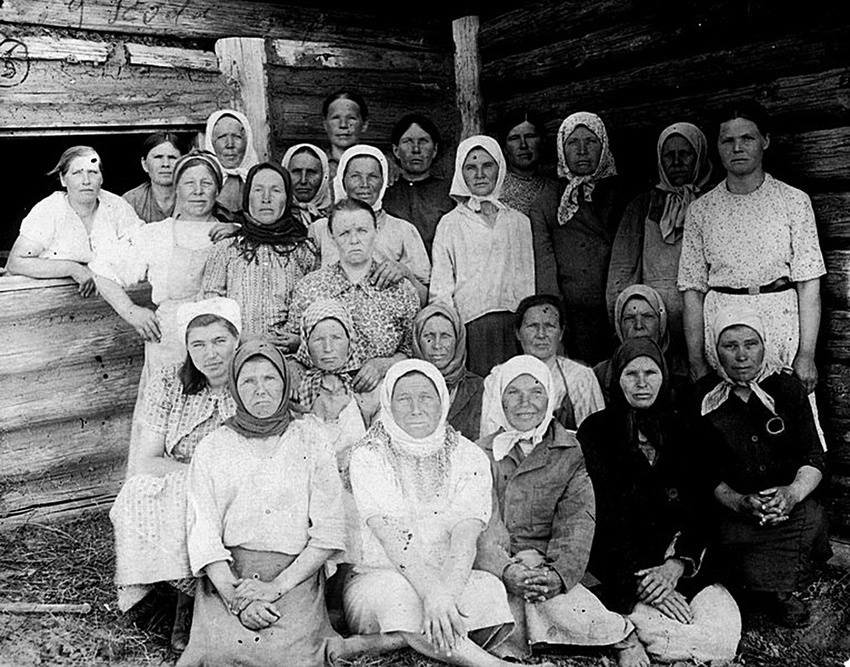
Brigade of migrant vegetable growers. 1940s
Already on April 7, 1954 (although the official transfer of the Crimean Oblast to Ukraine took place on April 26, 1954, at a session of the Supreme Soviet of the USSR), the Chairman of the Council of Ministers of the Ukrainian SSR Nykyfor Kalchenko and the First Secretary of the Central Committee of the CPU Oleksiy Kyrychenko prepared a letter addressed to the Chairman of the Council of Ministers of the USSR Georgy Malenkov and the First Secretary of the Central Committee of the CPSU Nikita Khrushchev "On the implementation of special measures for the restoration and development of agriculture, cities, and resorts of the Crimean Oblast." (Document No. 43. Collection "Crimea in conditions of socio-political transformations (1940-2015)." – Kyiv, "Klio", 2016. – P. 190-191).
This document states: "The Central Committee of the CPU and the Council of Ministers, having studied the state of affairs in the Crimean Oblast, believe that for the faster revival and development of agriculture, cities, and resorts of Crimea, it is necessary to carry out additional, special measures." As the first of the proposed measures, the Ukrainian government suggests "significantly expanding the sowing of vegetable crops in the region, planting new orchards, vineyards, and berry fields, taking measures to sharply increase the yield of all agricultural crops and livestock productivity." In the note to the draft resolution of the Union Government, the leadership of Ukraine proposed to transfer about 10 thousand hectares of land from the republican Ministry of State Farms to the Crimean Wine Trust to expand industrial vineyards. "To provide the population of cities and resorts with fresh vegetables, and the canning industry with raw materials," the report note stresses, "the development of vegetable growing in collective and state farms of the region is of great importance."
The task was set already in 1954 to bring the yield of vegetables to 20 c/ha, and in 1956 to 133 c/ha, respectively increasing the gross harvest of vegetables to 180 thousand tons in 1954 and 242 thousand tons in 1956. For the production of early vegetables and growing seedlings, Ukraine proposed that Crimea radically reconstruct the greenhouse sector, to bring the number of hotbed frames to 218 thousand in collective farms and to 76 thousand frames in state farms in 1956. A rather difficult task was set – to increase the area of greenhouses in collective farms to 15 thousand m2, and in state farms to 30 thousand m2 in two years (by 1956).
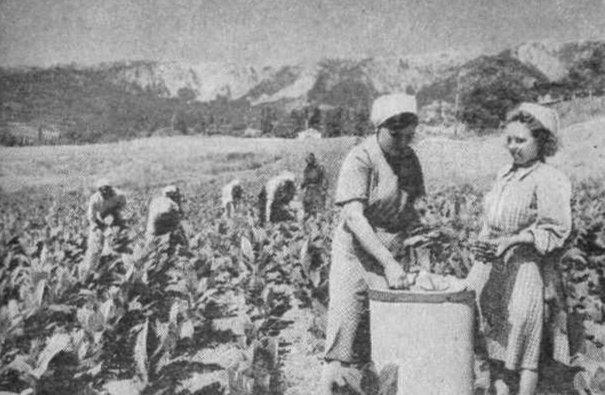
Tobacco harvesting in the Kalinin collective farm
The Union Government and the Central Committee of the CPSU by their resolution obliged the Council of Ministers of the Ukrainian SSR and the Crimean Oblast Executive Committee to bring the sowing area of vegetables to 18.6 thousand hectares in 1958. In addition, during 1954-1956, the Crimean Oblast was to sharply increase the area of irrigated lands by 3,600 ha in collective farms and by 3,900 ha in state farms. By the same resolution, the Union Government obliged the Ministry of State Farms of the USSR to sharply expand the greenhouse sector in the state farms of Krymptakhprom in 1955 by 18,000 m2, and in 1956 by another 20,000 m2; hotbed frames: by 24,800 in 1955 and by 39,550 in 1956, respectively.
By the same resolution, the government obliged the Gosplan of the USSR to allocate the necessary funds for building materials for the construction of greenhouses and the expansion of irrigated land areas to the Union Ministries of Agriculture and State Farms. According to this resolution, the area of irrigated lands in collective and state farms of the Crimean Oblast in 1956 was to increase by almost 17.2 thousand hectares and amount to 58.2 thousand hectares.
In order to improve the supply of vegetables and dairy products to the resorts of the region, at the proposal of the Ukrainian government, a specialized Crimean Trust of Vegetable and Dairy State Farms was created in the Ministry of State Farms. As subsequent life showed, it was this trust that radically improved the supply of vegetables and dairy products to Crimean resorts.
Thanks to the plan for the revival of gardening in Crimea worked out in Kyiv and the plan for the creation of a powerful greenhouse-industrial complex on the Southern Coast and in Foothill Crimea, a few decades later the peninsula was covered with a network of powerful greenhouse complexes. These complexes fully provided the local population, children's and school institutions, Crimean sanatoriums, and resorts with early vegetables and greens. From early spring to late autumn, freezer trucks with Crimean vegetables scurried all over Crimea and all the way to Kyiv, Moscow, and Leningrad (St. Petersburg).
Thus, in the development of gardening, Crimea, thanks to Ukraine, back in the early 60s of the last century carried out a real revolution in vegetable growing, which for several decades remained a leading sector of the Crimean economy.
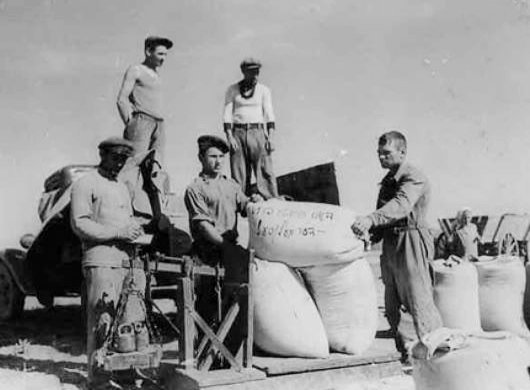
Collective farmers of the "Zavet Lenina" agricultural artel of the Dzhankoy district. 1940s