Germans of Crimea - Who Are They?
Settlement of the Crimean land by the German people.
Valeriy Verkhovskyi. Newspaper "Krymska Svitlytsia", 2017, issue No. 13
Is an antonym to an ethnonym possible? It turns out yes: in colloquial Russian, the antonym to the word "Russian" is the word "German". Who are they, the Germans of Crimea? German Russians or Soviet Germans? Do many Crimeans know that the village of Kolchuhyne was called Kronental until 1941, and Zolote Pole was Zurichthal?
Why was Colonel Bolbochan's raid so successful? And why was his regiment's withdrawal from Crimea so hasty? In both cases – due to the presence of the powerful German army.
Why on medieval maps did the Southern Coast of Crimea from Chembalo to Kaffa, populated by Italian (first Venetian, then Genoese) colonies, officially bear the name Captaincy of Gothia? Why do Crimean Tatars still give their children such completely non-Turkic names as Ernest and Erwin? The Goths ruled the Northern Black Sea region from the 3rd century AD. It is known for certain that Theodoro, a state that existed in the 12th-15th centuries in Crimea, was populated by people of the Byzantine religion who spoke a language very similar to German.
Information about this was preserved thanks to the Western diplomat de Busbecq, who in 1562 recorded a song in the Gothic language and 96 words heard from the Goths of Theodoro with whom he conversed in Constantinople. Apel (apple), hus (house), handa (hand) – words similar to the corresponding German and English ones, and first of all – to Swedish. But this was already after the fall of Theodoro, after the Turks destroyed 15 thousand Mangupians. Since the 17th century, there are no mentions of the Gothic language, although the Goths are mentioned.
Germans, descendants of the warlike Goths, joined the military service in many countries, fighting for their new homeland, sometimes even against the "Vaterland". Thus, in the First World War, the American army fighting against Germany and Austria was headed by an ethnic German, Pershing, and in the Second World War – by an ethnic German, Eisenhower. The defeat of Saddam's Iraq in 1991 was successfully carried out by General Schwarzkopf.
Germans are not just one of the peoples that took root all over the world. Wherever they lived, Germans always won the respect of other peoples and became an example for them. In Ukraine as well. The writer Olha Kobylianska, for example, was of mixed German-Ukrainian origin and wrote her first works in German.
Hardly had the Orthodox Goths-Crimeans, the last mentions of whom date back to 1779 – namely, the resettlement of Christians from the Crimean Khanate – become history, when the German language was heard on the peninsula again. The German Empress Catherine the Second invited Germans to resettle first to the lands of Tavria, and after the final annexation of Crimea – from 1805 – Germans began to settle here as well. In several waves during the 19th century, thirty thousand Germans moved to the peninsula. The colonists received sixty dessiatines of land each, were exempted from quitrents, and had the right to self-government.
These were mainly peasants and artisans. The former grew grapes or potatoes, the latter made furniture, implements, and carts. Their products were famous for high quality.
Germans in Crimea before the Second World War made up 6% of the population. There were national German villages and even two German districts: Telman and Biyuk-Onlar – now this is one Kurman (Krasnohvardiiske) district. Many Germans also lived in Simferopol, Seytler (Nyzhniohirskyi), and Ichki (Sovietskyi) districts.
Adolf Hitler had his own plans for Crimea. The peninsula was to be called Gotenland, and its German population was to be increased, in particular, at the expense of Germans from South Tyrol, a region that went to Italy under the redistribution of lands after the First World War. Sevastopol was named Theodorichshafen (Port-Theodoro), and Simferopol was named Gotenberg.
Whether the Soviet leadership knew about this or not, the Germans from the Ukrainian SSR and Crimea were expelled in advance, for "prophylaxis". Unlike the Crimean Tatars, Bulgarians, Greeks, and Armenians, formally the Crimean Germans were not deported from Crimea. The documents of August 15, 1941, speak only of "evacuation". More than 60 thousand people were taken to the Stavropol and Rostov regions. Later, when Hitler's troops pushed towards Baku and Stalingrad, these unfortunate people were sent to Siberia and Kazakhstan.
The living conditions of the "evacuated" can only be called terrible. In addition to the disenfranchised status and slave labor in the GULAG or the Labor Army, there was also the hatred that Soviet people found easier and safer to direct not at Gestapo members, Nazis, or Wehrmacht soldiers, but at fellow citizens born with the "wrong" nationality. For a long time, even in the post-war period, Germans in the USSR were afraid to speak German in the street – so gradually the language of their ancestors was forgotten.
Although after 1955 all accusations and restrictions were canceled, a mass return did not take place; only two and a half thousand Germans currently live in Crimea – twenty times less than before the so-called "evacuation". No compactly populated German settlements, let alone districts, were restored; the vast majority of residents of the former USSR with "German" written in the fifth column of their passports chose a future in their historical homeland, and not in Crimea.
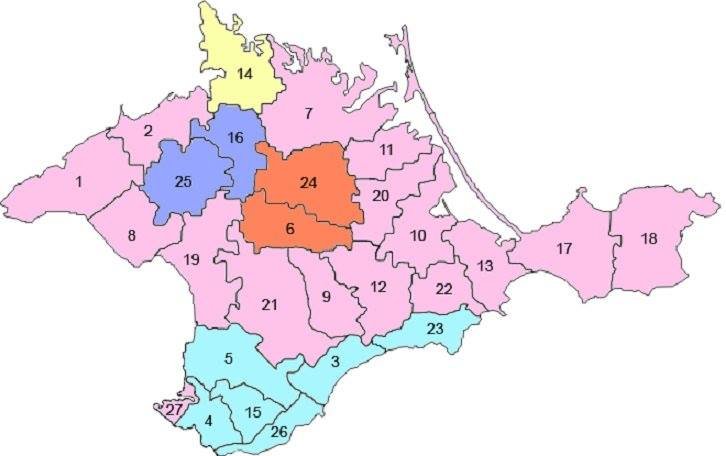
Administrative division of the Crimean ASSR. German national districts are highlighted in red (6 — Biyuk-Onlar, 24 — Telman (center Kurman-Kemelchi)
"Wiedergeburt", which means "Rebirth" – this is the name of the organization of Germans of Crimea created in 1993. Since 1995, there has also existed the Association of Deported Germans of Crimea. The newspaper "Hoffnung" ("Hope") is published in German and Russian. Three Lutheran churches are active: in Simferopol, Sudak, and Yalta. Before 1917, there were 186 Lutheran churches alone in Crimea, and there were also German Catholics, Mennonites, and Congregationalists.
The occupation and annexation of Crimea in 2014 by Russia proved to be full of surprises. Because the Germans were officially "evacuated" rather than expelled, they have to prove in Russia their right to the same status as Crimean Tatars, Greeks, Bulgarians, and Armenians. The descendants of the deported, born in the places of deportation, are considered, according to Russian ideas, residents of those "places of deportation", and only now is there talk of changes in legislation that would simplify the lives of peoples affected by deportations, which has long been the norm in Ukraine.
And the latest news, which could be called sensational: Russian Germans from Germany, where they went in the 1990s, have expressed a desire to resettle in Crimea. The head of "Wiedergeburt" Yuri Hempel speaks of several thousand ethnic Germans who will now gladly return to Crimea. Is history repeating itself?