A Little Poltava Region in the Middle of the Kerch Peninsula
The history of a Ukrainian village on the Crimean Peninsula.
Ivan Klepyk. Newspaper "Krymska Svitlytsia", 2018, issue No. 41
They said "Crimea is ours," and this was accepted as truth. They said that Crimea is "ancient Russian land," and they got away with it. But can one believe a stranger's word so easily?
Imagine: the middle of the 19th century. The first years after the Crimean War. Mass persecution of Crimean Tatars, who are accused of betraying the Russian Empire in favor of Turkey, and as a result, mass emigration from the peninsula. Instead, Ukrainians – landlords and serfs – move to Crimea in whole villages. They travel with all their belongings in search of a new life.
After the war, Crimea was not in the best state. In addition to the fact that Crimean cities were half-destroyed, a significant number of locals left, who nurtured this land, fought with blood and sweat for the right to life. Crimea was orphaned.
Less than a hundred years will pass, and everything will repeat: forced deportation and the same forced resettlement of Ukrainians to Crimean lands. But let's not get ahead of ourselves: it is the 19th century outside, and among others, the Klymenko family from Poltava goes to Crimea to build a house on the disobedient soil of the Kerch Peninsula. Along with their goods, the Poltava people brought the name of their native village. Thus, Novomykolaivka was founded. Not far from it was the Crimean Tatar settlement of Qoçan-Beş-Quuyu, so there is an assertion that the Poltava people came to the place of the Crimean Tatars. But in the 19th century, almost nothing remained of Qoçan-Beş-Quuyu, and the settlers built their houses in the middle of the open steppe.
The village of Novomykolaivka is located in the Lenine district, about 35 km from the district center and 35 km from Kerch. Today about a thousand people live here, including Yuriy Andriiovych Klymenko, known as a collector and keeper of the material and spiritual heritage of his family, a descendant of settlers from the Poltava region. On the territory of the Klymenko estate, you can see a Ukrainian house preserved from the 19th century. Inside is an authentic stove (pich), benches, dishes, folk clothing, as well as agricultural implements and various household devices – a butter churn, millstones, a loom, a comb for combing wool, and many other necessary things of that time.
The passion for family history grew into something more global: Yuriy assembled a collection of various items dedicated to the history of Novomykolaivka in particular and the Kerch Peninsula in general. The collection is kept within the village – in the Novomykolaivka Local History Museum.
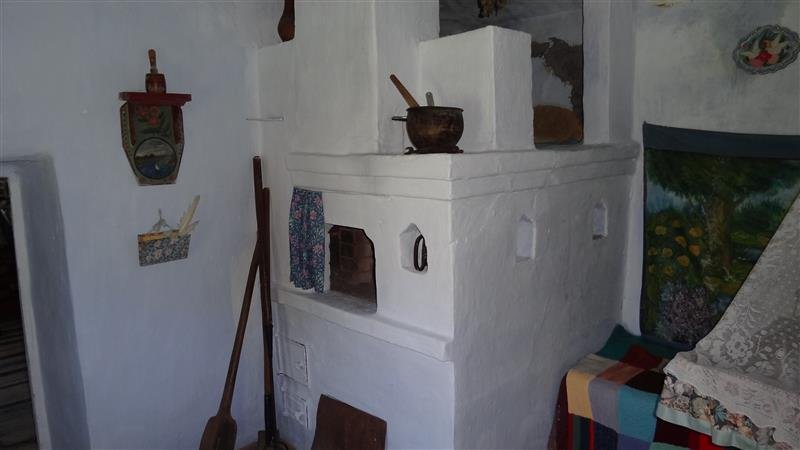
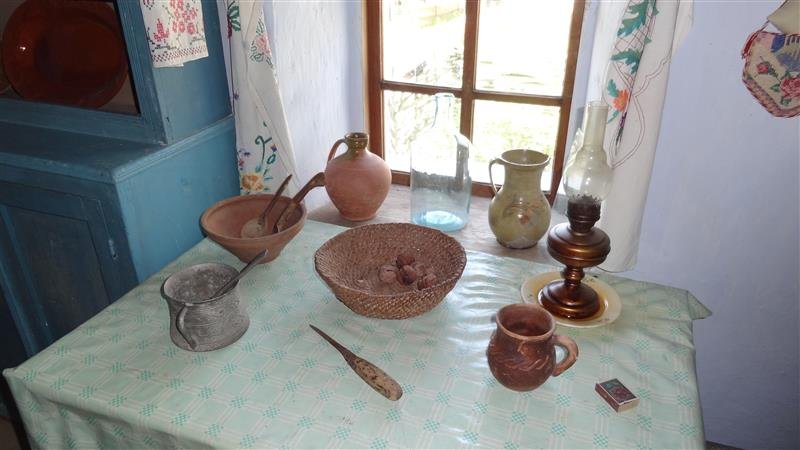
Author's photo
Yuriy Klymenko in a Ukrainian hospitable manner invites visitors to inspect the interior of the Poltava house, tells visitors the history of the resettlement of his family and the founding of the village. Yuriy does this absolutely free of charge, because the host has a higher goal: to preserve the memory of his family. And people willingly visit the Ukrainian house.
This seems to be a real wonder: how to explain the existence of this object on the territory of the Kerch Peninsula, which is so thoroughly "Russian"? This causes real cognitive dissonance, although in reality there is nothing strange: the Ukrainian presence in Crimea is much more significant than the Russian one. The connection between Ukraine and Crimea has a centuries-old history, but the true history has been rewritten many times. How many layers does this palimpsest have?