Prince Oleksandr Dabizha: Chronicler of Ukraine Buried in Yalta
Biography of the Poltava chronicler Oleksandr Dabizha.
Serhiy Konashevych. "Krymska Svitlytsa" newspaper, 2019, Issue No. 25–26
In 1899, the monthly magazine "Kievskaya Starina" (No. 8, pp. 61–63) reported the death from tuberculosis on June 16 (29) in Tsarskoye Selo near St. Petersburg of Prince Oleksandr Vasylovych Dabizha, who had repeatedly contributed to the magazine as a publicist with materials on the history of Left-Bank Ukraine.
Oleksandr Dabizha was born on September 13, 1860, in the village of Ivanytsia, Pryluky district of Poltava province, the same place as his mother, Anastasiya Horlenko—the daughter of an ancient Cossack officer family, from which Pryluky colonels and Saint Joasaph of Belgorod (Yakym Horlenko) originated. After graduating from the Imperial Alexander Lyceum in St. Petersburg, where children from aristocratic families were educated, he entered the service of the Ministry of Foreign Affairs. After spending some time in the chancellery, he was appointed junior secretary of the mission in Madrid, and two years later, secretary of the embassy in Cairo. For a long time he was treated for tuberculosis in Germany and Switzerland, but having lost hope of recovery, he returned to the Russian Empire to await death.
Even after graduating from the Lyceum, Oleksandr Dabizha took a great interest in studying the history of Ukraine. The bearer of the surname of the Kotromanić-Bosnian noble family, known since the 12th century, the young prince recognized his belonging to Ukraine. He spent a lot of time on the Romanivshchyna farmstead near Ichnia in the Chernihiv region, which was inherited by his mother.
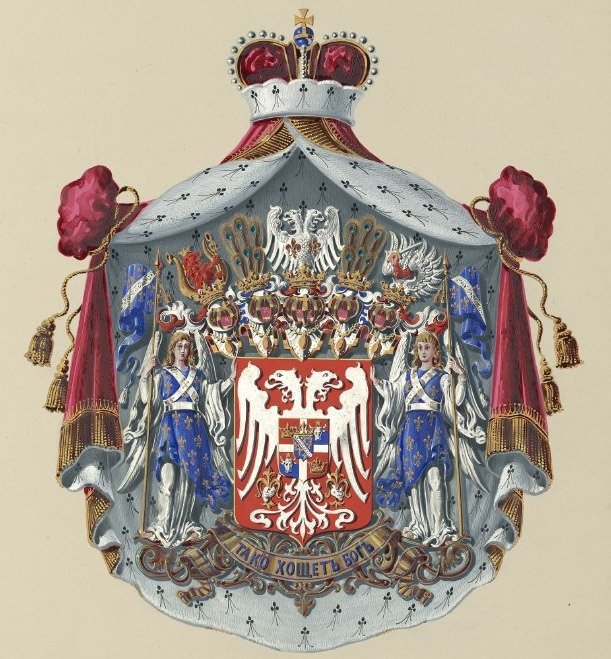
The coat of arms of the Dabizha family
The prince's first written attempts were family-related essays—"Registry of the Horlenko Family" dedicated to his mother, and a study of the Pryluky colonel Lazar Horlenko, a contemporary of Bohdan Khmelnytsky; for this essay, Dabizha searched for materials in Moscow archives. Many documentary sources were also used for the essay on the "Mazepist" colonel Dmytro Horlenko, which remained in manuscript form and featured very interesting universals (decrees) and letters. His father was also passionate about history and created his own home museum: the exhibits included universals of Hetmans Danylo Apostol, Ivan Skoropadsky, Kyrylo Rozumovsky and other documents, a portrait gallery, a library of several thousand volumes (one of the rooms was occupied by ethnographic materials), and even a collection of weapons that belonged to the Cossack leaders of the Horlenko family.
Oleksandr Dabizha also entered the then small circle of heraldry specialists. He created the work "Mazepa the Prince and His Noble and Princely Coats of Arms" with color photographs based on his drawings. He was also known as a wonderful watercolor artist, a student of the famous professor Premazzi; he received awards at many exhibitions and was elected an honorary free associate of the Imperial Academy of Arts. The themes of his works included landscapes and types of Ukraine, which, unfortunately, have disappeared without a trace.
On Mount Athos, the researcher found a "living corner of distant Ukraine"—the St. Elijah Skete founded by Paisius Velichkovsky, the "spiritual child of the Zaporozhians." He found another monument of Ukrainian origin—a silver chased antimins donated by Hetman Ivan Mazepa for the Holy Sepulchre—in Jerusalem, illustrating his study with a photograph, the permission for which had to be obtained from the Patriarch of Jerusalem.
During his short life, Prince Oleksandr Dabizha expressed a wish to be buried in Yalta. This wish was fulfilled. The deceased was only 38 years old. His grave, unfortunately, has not been preserved.