Olena Kysilevska – “Across the Native Land”
An excerpt from the book 'Across the Native Land' by Olena Kysilevska about Crimea.
"Krymska Svitlytsa" newspaper, 2019, Issue No. 29–30
The year 2019 marked the 150th anniversary of the birth of Olena Kysilevska—Ukrainian writer, journalist, editor and publisher, socio-political, cultural, and educational activist.
After World War II, Olena Kysilevska lived in Poland, in the Lemko region. Then she moved to Germany, and later emigrated to Canada.
Abroad, she published a collection of essays "Across the Native Land" (1955) and also published a series of memoirs about Olha Kobylianska, Nataliya Kobrynska, I. Kravchenko, Olena Teliha, O. Basarab, and A. Chaikovsky. Many of her artistic works, publicist articles, sketches, and memoirs are kept in the archive in Ottawa. We present to the readers' attention an excerpt from the preface to the book "Across the Native Land," which tells about the writer's life and activities, as well as an excerpt from her essay from the said collection about a trip to Crimea.
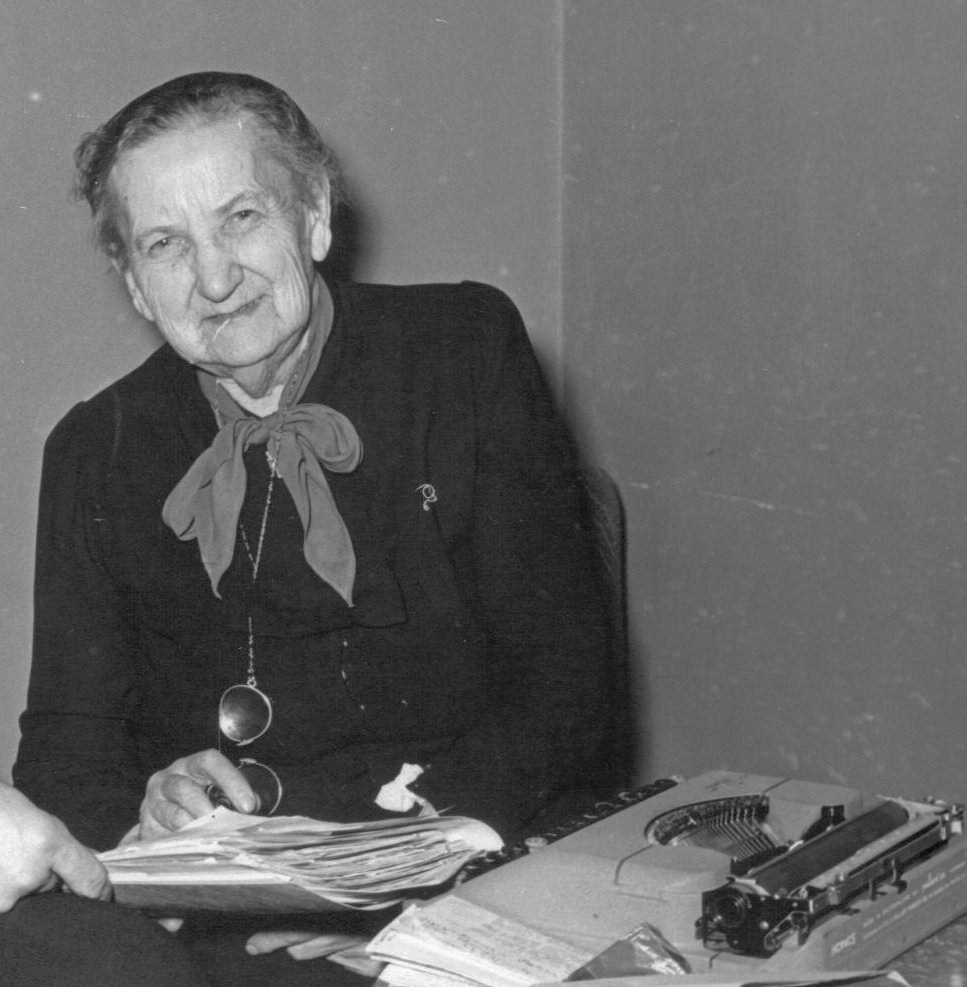
Olena Kysilevska in Canada, 1954
The author of this book, Olena Kysilevska, was born on March 23, 1869, into the family of a Ukrainian priest Lev Simenovych, in the beautiful small village of Filvarky, which was later annexed to the town of Monastyryska in Podolia, where Fr. Lev was then an assistant priest to his father Fr. Mykhailo Simenovych.
In the spring of 1954, the Ukrainian community abroad, particularly in America and Canada, worthily marked an exceptional path, worthy of admiration and deep respect—eighty-five years of life and seventy continuous years of dedicated service by Olena Kysilevska to Ukrainian culture. Since 1948, she had headed the World Federation of Ukrainian Women's Organizations, and the beginnings of her tireless activity date back to 1884, when, as a fifteen-year-old girl, she joined the first Ukrainian women's society in Stanyslaviv. From that time on, she did not deviate from that once-chosen, difficult, but pricelessly useful path of civic, cultural, educational, and literary activity.
Olena Kysilevska devoted most of her attention and literary talent to incomparable essays about the countries and localities she visited. And she traveled tirelessly all her life. She visited all parts of the globe, with the exception of Australia, and visited all the countries of Europe. She shared her impressions of distant journeys with the general readership and enriched the treasury of Ukrainian literature, in particular, travel literature.
The collection "Across the Native Land" is not only highly useful and pleasant reading for every soul, especially the young, but also a necessary textbook from which young readers will learn HOW TO LOVE THEIR NATIVE LAND.
We hope that the collection "Across the Native Land" will find its way to the widest circles of Ukrainian readers who long in soul and heart for the beauty of their Native Land, native nature, native villages, cities, and towns, from which fate separated them—whether long ago or very recently.
And we will also believe and hope that, even during the lifetime of the esteemed Author, the time will come when we will live to see, already in a free Ukraine, the publication of all the works of Olena Kysilevska, along with her complete biography, so that the Author's priceless contribution to the treasury of Ukrainian and universal culture will not go to waste, scattered across individual brochures or collections.
Oleksiy Voronyn
From the preface to Olena Kysilevska's book "Across the Native Land" (Ukrainian publishing house "Dobra Knyzhka". Issue 153. Toronto, Year of the Lord 1955).
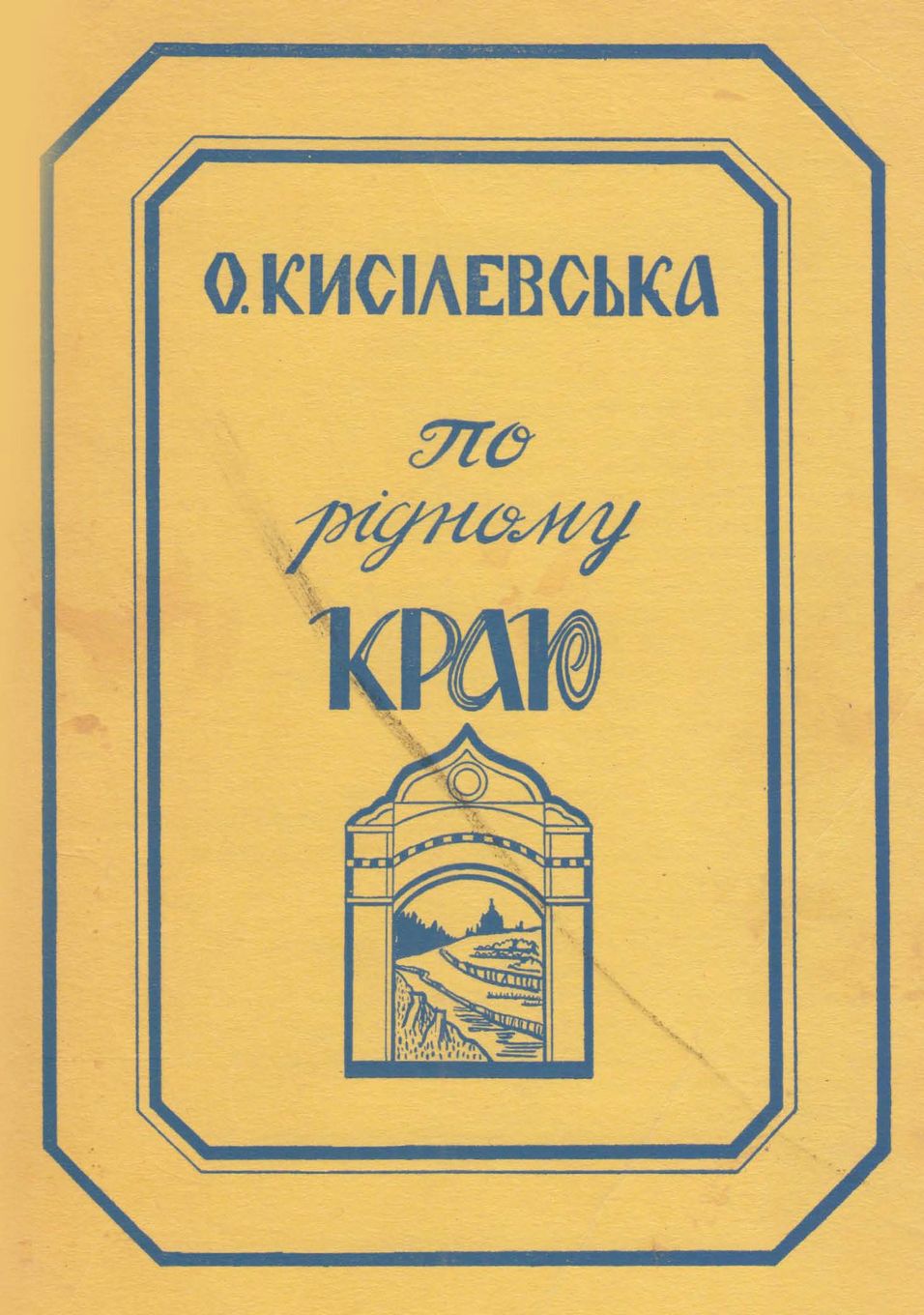
Book cover photo - "Diasporiana" http://diasporiana.org.ua
By Steamboat to Crimea by Olena Kysilevska (abridged)
…Only in the late morning, when the ship arrived in Yevpatoriya and the sailors cast anchor, did yesterday's sick passengers—and I with them—dare to come out into the light of day.
And here it is so beautiful, fresh, sunny, and joyful! The sea is so wonderful that yesterday's hatred of it and the all-night sickness seem like only an unpleasant dream. One does not want to believe that these clean, cornflower-blue, unusually transparent waves, which splash so gently against the white sides of our ship, could rise so menacingly and lift it on their arched crests.
The travelers, pale and with dark circles under their eyes, crawl one after another out of their cabins and look around, still unsure if the trouble has truly passed...
Due to the shallow water, we do not sail close to the shore; instead, our steamboat, like some huge white flower, is surrounded by a swarm of multi-colored butterflies—boats. “Nikolay,” “Elena,” “Olga,” “Tuzik,” “Bystry,” “Krasavchik,” and many others carry themselves gracefully on the crests of the blue waves and sail right up to the ship. A small steamboat brings us a mass of new guests, who carefully climb up to us using the steep stairs lowered from our vessel. Ladies, gentlemen, townspeople, Turks, Jews, and most of all Tatar merchants, who, with all kinds of goods, immediately scatter everywhere like ants.
Apricots, plump sweet cherries, fragrant oranges and lemons, strawberries as large as ripe apples, rings of crispy bubliki, fragrant “chebureks” (a kind of pastry with mutton meat), sweet Turkish delight, halva, even a drink made from rice—“boza”—everything can be found on their trays. The travelers, starved by a fast of more than a dozen hours, grab the delicious treats despite the high prices.
…Meanwhile, the bell rings once and then twice, announcing that the departure time of our steamboat is near. The Tatars, who had been bustling among the travelers with their baskets, hastily return to the boats that were waiting for them, tied to the side of the ship. Some of our travelers who went ashore to the town also return, and in a moment, pretty Yevpatoriya, like a luminous picture, moves further and further away until it disappears completely from our sight.
Now we do not sail out to the middle of the sea; the uneven shores do not disappear from our sight. Soon, in three hours, our “Knyaz Vladimir” will turn into the deep bays of Sevastopol, past which the most beautiful Crimean landscapes will begin.
In view of this, of course, there is no question of yesterday's sleepy peace on our steamboat. Experienced visitors of Crimea, surrounded by listeners, talk about the features of Sevastopol, Yalta, Livadia, etc. Practical tourists inquire about hotels, dachas, pensions, prices, and so on. A bookseller offers all kinds of “guidebooks” to Crimea; some indeed buy them and immediately get lost in all sorts of information. And before we knew it, beautiful Sevastopol loomed before us, spreading out like an amphitheater over the sea, shining with the golden roofs of its churches, flashing with the snow-white walls of its houses, which stand out so beautifully in the thick dark greenery of gardens, orchards, and boulevards.
But the first thing that catches the eye is the fortifications of Sevastopol—the thick, gray walls of huge barracks, high ramparts, a row of cannons that greet us with barrels pointed straight at the ship. A mass of steamboats with a dense forest of slender masts and chimneys, a large number of vessels and boats of various sizes. Some are steam-powered, heading far out to sea; further on are sailboats, which, like pigeons, have spread their white wings to fly; and further still are tiny, miniature, brightly painted ones that, like brilliant hummingbirds, soar gracefully over the blue-gold expanse. And everywhere movement and life are bustling. All sorts of goods are being unloaded and loaded from the ships, travelers are embarking and disembarking, and tourists, fishermen, and soldiers are being ferried in small boats.
Away from this market-like bustle is a line of powerful warships. Efficient, clean sailors are bustling lively on their “battleships,” torpedo boats, etc. Over there is a large white boat, without sails or chimney, operated only by soldiers in sailor uniforms. A dozen strong young men rhythmically move their oars like a machine, leaning back and forward so strongly that they seem to lie completely on top of one another.
Our steamboat stops right opposite the wide stone steps leading to the square where a large statue of General Nakhimov, facing the sea, greets visitors.
As soon as the gangplank is placed against the ship, everyone rushes in a crowd to the shore to make the best use of the few hours remaining before the ship departs. Some go to see the famous city, to walk along the beautiful boulevards (or to visit a good restaurant or café). Others visit the museum of defense, where everything related to the ancient siege of the city is collected. Still others look for aquariums where all kinds of Black Sea fish can be seen.
We go to the museum, where we already find many of our fellow travelers, and together we look at all the relics relating to the siege of Sevastopol by the French. On the walls are pictures, portraits, maps, views of the city and its surroundings, plans of the fortress, and major battles. There are even various witty caricatures, sketches, and Russian and French newspapers of those times. On the tables are models of the wooden ships of that era, which seem like children's toys compared to today's imposing iron giants. The weapons of that time, shot-through greatcoats, helmets, and various relics of Sevastopol's heroes can also be seen there.
We were out of luck with the aquarium, as this day was not one of those open for visits. Instead, walking along the coastal road, we came across some baths and had a wonderful bathe. And a sea bath is no ordinary luxury: the salty water makes swimming easier; the wave now recedes, lowering the water by almost half, then returns again, caressing the body, embracing the neck, sometimes as if playing, lifting you on its crest and then putting you back on the fine sand, of which every grain is visible deep under the water.
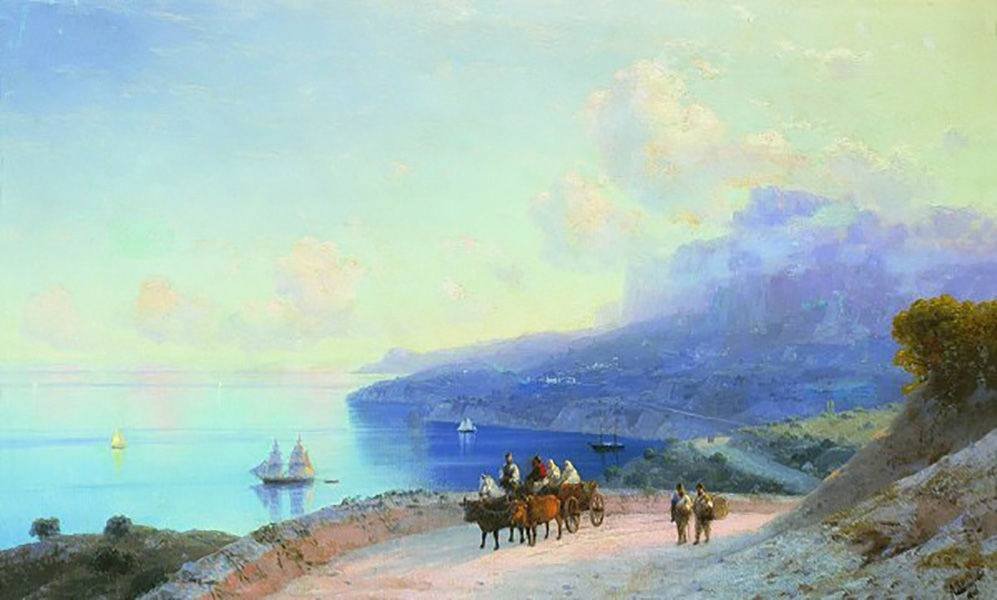
Sea Shore. Crimean Coast near Ay-Petri. I. Aivazovsky
Although the scheduled departure time had passed, and the travelers had gathered on the steamboat again, it did not set off quickly and continued for a long time to receive an endless number of bundles into its open belly. Meanwhile, the travelers were entertained by a peculiar sight: our steamboat was surrounded by small, unusually skillful boy swimmers. They held themselves in the water almost sitting up, with their arms tucked under their armpits and only slightly moving their legs, like fish with fins.
“Give us a kopeck, throw a kopeck!” they shout in high-pitched children's voices, stretching out their hands to us. We throw them, but, of course, the coin rarely lands in a hand. The kopecks sink into the water, and the children disappear after them into the blue depth for a while, only to emerge later with the coin in their teeth. And this was repeated continuously for more than an hour, until the steamboat left the Sevastopol pier.
The rest of the journey was one continuous, wonderful panorama moving before the viewers who were captivated by its beauty. From small, insignificant hills, the cliffs and mountains rose higher and higher. And since in the Crimean mountains there is a lot of dark clay shale, marble limestone, and a mass of various crystalline rocks, the cliffs shimmered with unusually beautiful yellow, dark red, chalky white, bluish, and lilac colors, which against the background of the blue-cornflower sky and dark green forests formed an enchanting whole.
In addition, these cliffs either rise slenderly to an unusual height or drop off suddenly, like a cut, trimmed wall, which makes them look like natural walls, fortresses, and towers, alternating with real, half-ruined towers—the remains of the fortresses of the Greeks and Genoese, the ancient rulers of this region.
But these wonderful mountains have not only aesthetic value; they have fenced off a narrow strip of the sea coast with a long, over a hundred-verst stone ridge, and, by protecting it from cold polar blizzards and dry steppe winds, with the help of a gentle sea breeze they turned it into a real paradise. This chain of mountains, four to five thousand feet high, divides Crimea into two halves unlike each other. While on one side of Yalta there are ordinary Russian willows, crack willows, and poplars, on the southern side cypresses grow, olives and grapes ripen, laurels turn green, and oleanders and magnolias bloom. While on one side it snows, and people heat their stoves and board up windows for the winter—on the other, all year round, cattle graze in the fields, and people get by without winter clothing.
The closer to Yalta, the more densely scattered are the villas, castles, and stone walls. Here, in the dark forest, the white walls of a monastery appear; over there is a little church on a high cliff; in the distance, a lighthouse is visible; and there, on a high, sharply sheer cliff, amid the dark greenery, hangs over a deep abyss a beautiful, pink, flower-like little castle, rightly named the “Swallow's Nest.”
And here is Yalta itself—cheerful, sun-drenched, decorated with blooming gardens, shining with a golden-domed little church on the hill, picturesquely situated on the sea coast, shielded by a semicircle of high green mountains…
From the book by Olena Kysilevska "Across the Native Land" (Ukrainian publishing house "Dobra Knyzhka". Issue 153. Toronto, Year of the Lord 1955).
Source - "Diasporiana" http://diasporiana.org.ua