The History and Legend of Oreanda by a Crimean Researcher and a Czech Poet
The romantic history of the Oreanda estate.
Serhiy Konashevych. "Krymska Svitlytsa" newspaper, 2017, Issue No. 43
At the beginning of September, Crimea marked the 175th anniversary of the birth of the "patriarch of Crimean studies"—the prominent researcher Alexander Berthier-Delagarde. No commemoration of his memory was heard of in mainland Ukraine.
According to researchers, Alexander Berthier-Delagarde was born on October 26, 1842, in Sevastopol into the family of a Russified military officer of French origin. After graduating from the Cadet Corps and the Military Engineering Academy, he successfully worked as a military engineer in many places of the Black Sea region, building bridges, fortresses, and port facilities. In particular, he constructed the ports of Odesa, Feodosia, Yalta, and Rostov-on-Don, the Alushta and Yalta water pipelines, the railway to Feodosia, and more. In 1877–1878, he participated in the work on the fortification of Sevastopol and designed the Primorsky Boulevard; under his leadership, the shipbuilding admiralty was constructed, a water pipeline was laid, and many other structures were built.
In 1887, Berthier-Delagarde retired with the rank of major general, and from then on devoted himself entirely to scientific work in the fields of ancient and medieval history, archaeology, and numismatics of the Black Sea region. He was directly involved in archaeological excavations and surveys, either directing them (the study of the necropolis in Feodosia, the ancient sanctuary near Yalta, etc.) or financing them at his own expense. From 1899, he was the vice-president of the Odesa Society of History and Antiquities and its de facto leader.
He took an active part in the work of the Taurida Scientific Archive Commission (Tvak) and other scientific societies. He created rich, and in some categories unique, collections of Crimean antiquities, which he gradually donated to museums—most often to the Odesa Archaeological Museum. His creation is also a library on the ancient and medieval history of Southern Ukraine and an exceptionally complete collection of geographical maps and views of Crimea. The researcher died on February 13, 1920, in Yalta; he was buried in Sevastopol.
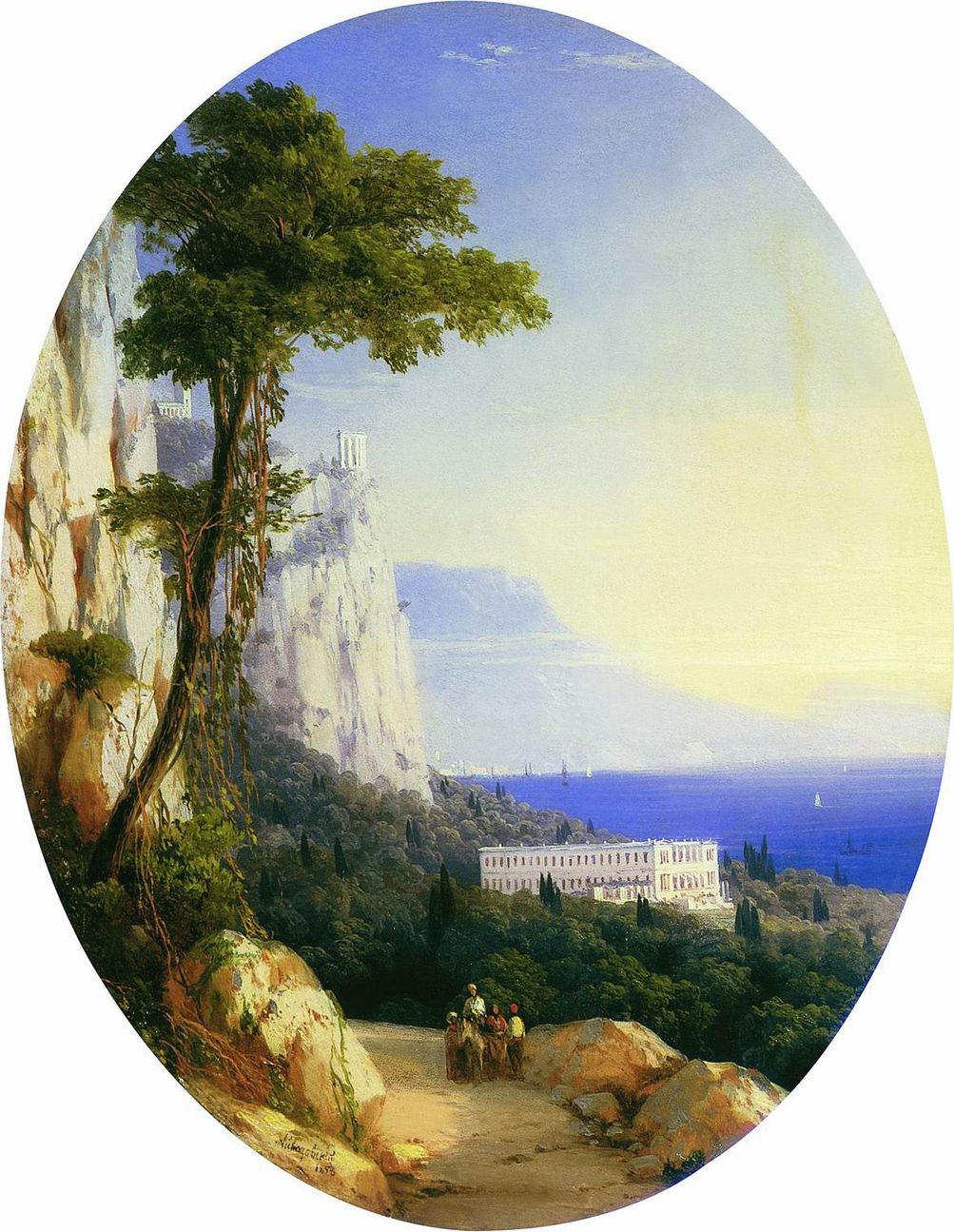
“View in Oreanda,” painting by I. Aivazovsky, 1858
In 1913, at the request of the then owner of Oreanda, Alexander Berthier-Delagarde undertook the task of recovering historical data about the settlement. The study "Notes on the Past of Oreanda" was published in the Tvak scientific journal in 1919. According to the scientist's findings, the earliest mention of this locality was preserved in a Genoese document from 1380, which lists a number of settlements on the Southern Coast of Crimea, including Oreanda: they were part of the captaincy of Gothia—an administrative Genoese district that spanned the territory between the consulates of Cembalo (Balaklava) and Soldaia (Sudak).
The locality of Oreanda was considered to be in the use and possession of the ranks of the Balaklava Greek Battalion, which maintained the customs border from Balaklava to Feodosia. At that time, there were no more than five hundred inhabitants in the entire desolate expanse from Laspi to the Alushta district inclusive. Upper and Lower Oreanda, along with Livadia, Alupka, Kikeneiz, part of Simeiz, and Kuchuk-Lambat, among many others, belonged until the 1820s to Theodosios Reveliotis, commander of the Balaklava Battalion from 1800 to 1831.
In 1825, Russian Emperor Alexander I visited Oreanda. The area pleased him so much with its beauty and solitude that he decided to build a palace here for his wife. After the death of Alexander I, in May 1826, Oreanda became the imperial estate of Nicholas I. The tsarist family visited here for the first time in September 1837. By that time, the estate had a wonderful park created with the help of the famous gardeners Kebach and Delinger, greenhouses, and a vineyard with a wine cellar. During the trip, the tsar presented Oreanda to his wife Alexandra Feodorovna; she often visited the settlement, planning to erect a palace in the style of Roman villas, and in time ordered a cross to be placed on the top of the western cliff, planting a laurel there with her own hands along with her daughter Maria and Count and Countess Vorontsov.
Construction of the palace began in 1842 (according to Berthier-Delagarde, in 1844) and was completed in 1850. The first building of the palace complex was a semi-rotunda of white Kerch stone on one of the cliffs of Oreanda, which was visible from afar. The palace itself was built mainly of Inkerman and Kerch stone, Miskhor and Oreanda marble; some columns and chimneys were carved from Crimean red marble (porphyry). From the road stretching above the estate, this first tsarist palace on the Southern Coast of Crimea appeared to contemporaries like a magical fortress.
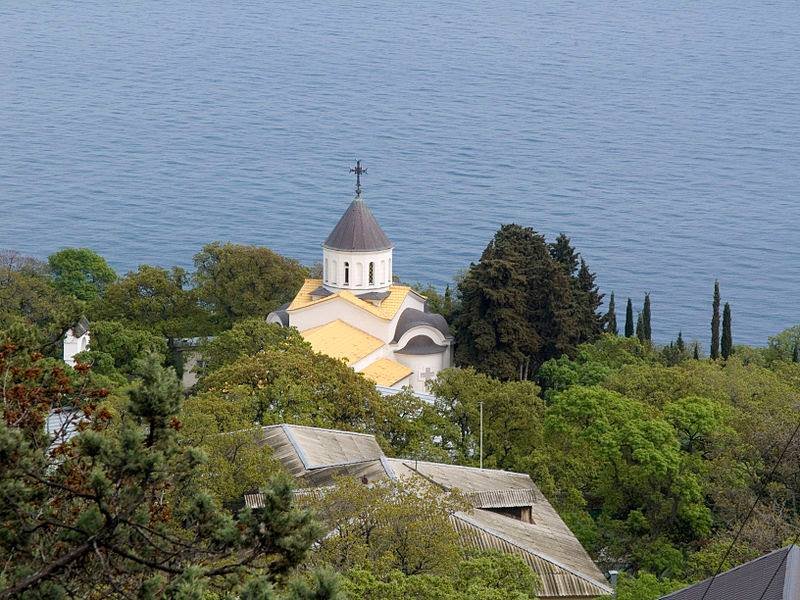
Lower Oreanda, modern view of the Church of the Intercession of the Holy Virgin
After the death of Alexandra Feodorovna, who never saw the completed palace during her lifetime, the estate was inherited under her will by her second son, Konstantin Nikolayevich. He often came to Oreanda, which he called an earthly paradise, and lived here almost constantly after falling out of favor when Alexander III ascended the throne. One August night in 1881 (according to Berthier-Delagarde, in the first winter of 1882), a fire destroyed the magnificent palace. According to one version, the fire broke out "due to careless handling of cigarettes by the children of court servants." On that day, there was a hurricane-force wind, and the flames quickly engulfed the entire building—only the stone shell survived.
Rebuilding the palace required large funds that the grand duke did not possess: “From my mother I received a wonderful palace, it is no more, and I will never be able to rebuild it. Let a temple of God rise from its remains.” From the stones remaining after the fire, he decided to build the Church of the Intercession of the Holy Virgin in Oreanda. Having an excellent knowledge of architecture, the grand duke planned to build the church in the Georgian-Byzantine style, which, in his opinion, best suited rocky Oreanda. The church turned out small, cross-shaped, with a single dome. A magnificent view of the sea opened from it.
Mighty centennial oaks grew around, and on the largest of them, a unique bell tower was made. The temple was solemnly consecrated in 1885. After the earthquake of 1927, the damaged temple was almost demolished, but it survived; prior to that, there were plans to turn it into a museum. In the 1950s, a new order was issued to demolish the temple because it "interfered" with the architectural ensemble of the "Nizhnyaya Oreanda" sanatorium, which was also built from the ruins of the tsarist palace. However, local historians stood up for the temple and succeeded in getting it recognized as an architectural monument. Subsequently, a warehouse of toxic chemicals was set up in the church, and a motor depot in its yard. Under independent Ukraine, in 1992, it was returned to the parishioners and restored.
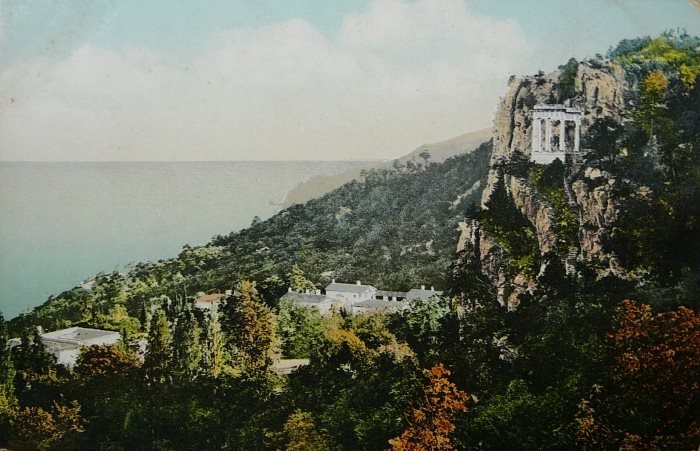
Oreanda in the 1900s
Alexander Berthier-Delagarde noted that the oldest name of the settlement is written as "Orianda" (in Latin and Italian), and insisted that the name of the settlement, which "over the last two decades has increasingly begun to be distorted," sounds like "Oryanda."
According to the scientist's conclusions, this word cannot be reliably translated from any known language: place names similar in pronunciation survived only in a few tracts of the Southern Coast of Crimea—Aunda, Karakunda, Panda, Urgenda, Murgunda, Marsanda, Voganda, etc. “The meaning of all these names is also completely incomprehensible, and since place names in Taurida are preserved for millennia, it is possible that these also survived from the language of some long-vanished people. The great Viennese scholar who wrote on the history of the Goths considered it possible to see traces of the language of the Tauri in these names, but there are no firm grounds for this,” the Crimean scholar wrote.
In 1899, the Czech poet Josef Machar wrote the poem "Oreanda," which was included in his collection "Vylet na Krym" (Prague, 1900), inspired by his impressions of visiting the peninsula. This poem, translated by Ivan Franko, was printed in the April 1905 issue of "Literaturno-Naukovy Visnyk"; for some reason, the author was named Jan there. In a footnote to the poem, Franko noted: “Oreanda is a magnificent place in Crimea near Yalta, where the palaces of the Russian grand dukes are located. These days, there was a report in the newspapers that a secret printing press and a warehouse of forbidden books and revolutionary proclamations were found there. From this point of view, Oreanda already has its legend. This beautiful poem by Machar is proof of that.”
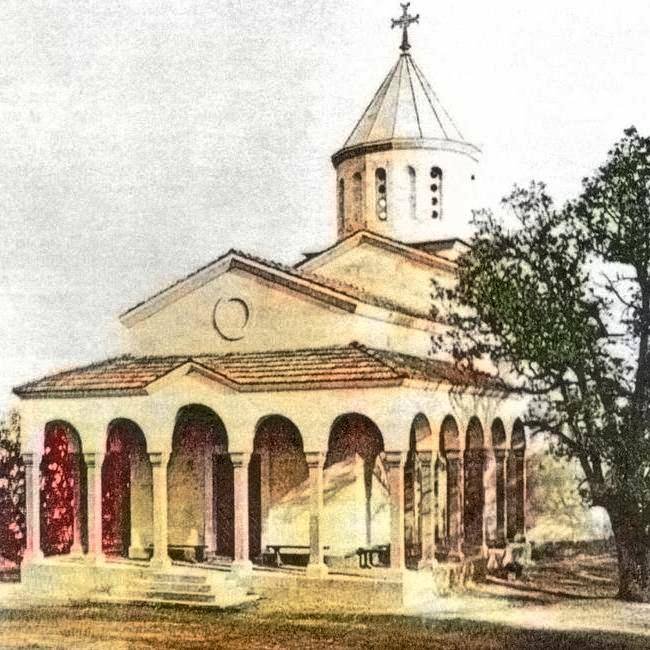
Church of the Intercession of the Holy Virgin, 1885
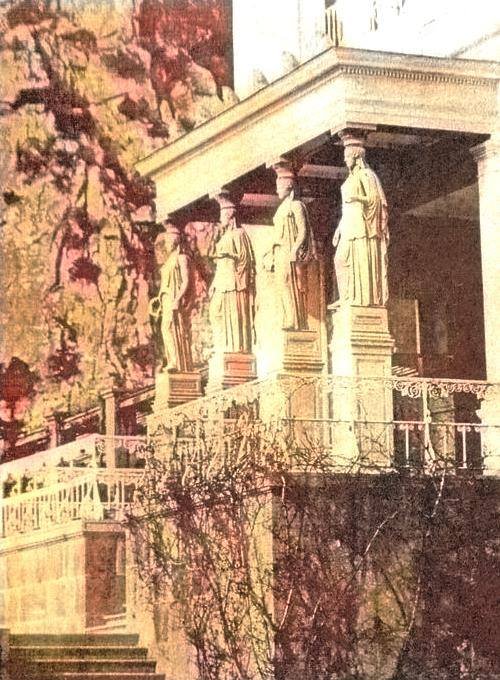
Fragment of the palace facade, late 19th century
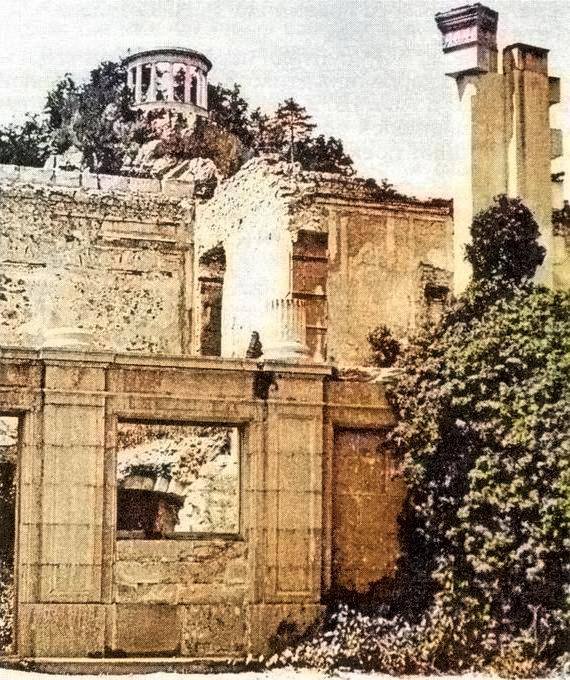
Ruins of the palace, 1899
– and so the grand duke lost his command over the fleet, and here, to Oreanda, his angry tsar-father sent him. For sinful plans were brewing in the gray grand-ducal forehead of uncle Konstantin, a spirit of rebellion lived in his giant body: he went astray, poor man, and, a royal offspring, listened to the nihilists. That the tsar's anger did not cast full punishment upon him—that was because our father was good and a righteous man: he judged and showed mercy, and waited for repentance and reform...
And our dear fellow sits in Oreanda, receives letters, writes secret manifestos; his messenger travels with a full bag from Yalta to Sevastopol; the grand duke proudly wrinkles his brow and flashes his eagle-like, unfathomable eyes maliciously. Until fate was fulfilled. Once stood our Konstantin Nikolayevich and waited, as was his custom, for a messenger from St. Petersburg; no messenger came; instead, a lean Englishman in plaid clothes rode in a carriage pulled by three horses, peering through his glasses into his little red book and staring around curiously, just as those Englishmen know how.
He orders to stop, approaches the grand duke like a stranger to a stranger—only winked secretly. This was a nihilist—whispered two or three words, that all was lost, the messenger captured, that the commandant of the “Third Section” himself was heading to Oreanda with a whole retinue—bowed, got into his carriage, and rode on.
The grand duke turned around at full speed, bounded up these stairs with long strides, ran into his study: opens the desk, the chests, dumps a heap of papers from them onto the floor, pours kerosene from the lamps—and strikes a match... And went out, and into the park; where he stood before, he stands again, crossing his hands behind his back. And waits. Until, look, that general in civilian clothes comes, unrecognizable. “Where to?” the grand duke thunders at him. “Here, to Oreanda, by the tsar's command.” “Come here, slave!” and nodded toward the stairs.
At that moment a golden tongue erupted onto the flat roof, others leaped out of the windows in dark cloaks and stretched up to the sky—Oreanda is burning. The grand duke laughs until tears come to his eyes, and even urges on the gendarme souls: “Go on, my dear fellows! Why have you stopped? Ah, lazy slaves, is this how you fulfill your tsar's will? And in my presence, the sovereign's uncle? Demoted you shall be! Siberia for you, dogs!”—Thus he mocked... Then what remained of Oreanda was what we see here... A rude guide, a professor in some Moscow school, was wiping away sweat. For those soot-stained walls, the blue sky was the ceiling.
Charred pillars lay beneath our feet. Carved rafters also rotted here. Broom-like grasses grew in the cracks of the mosaic floors of the halls, and in the holes in the wall grew ground ivy and straw protruded from sparrow nests...