Bakhchysarai Khan's Palace: Restoration or Reconstruction?
Cultural heritage in the modern world is a crucial factor in shaping a unified national identity and strengthening unifying values in society.
Elmira Ablyalimova, project coordinator of the Crimean Institute for Strategic Studies. "Krymska Svitlytsa" newspaper, 2019, Issue No. 43–44
Cultural heritage in the modern world is a crucial factor in forming a unified national identity and establishing unifying values in society.
Monuments, buildings, memorial complexes, museum expositions, individual burials, etc., which are the visual component of cultural heritage, not only reflect the historical past but also actively shape the social views of citizens. Therefore, today the protection of cultural heritage and the preservation of world cultural heritage are among the most important cultural problems in the world.
The occupation of the Autonomous Republic of Crimea by the Russian Federation in 2014 and the beginning of the armed conflict in eastern Ukraine raised, besides political and legal, a number of sectoral issues. The absence of military doctrines in Ukraine at the state level in the 20th century, and of militarized thinking at the social level, led to the unreadiness of Ukrainian society for armed actions in the 21st century, particularly in relation to its own cultural heritage. Given the scale of devastation caused by the military actions in Donbas and the occupation of Crimea—persecution, torture, enforced disappearances, sexual and gender-based violence, one and a half million internally displaced persons—and the expert and logistical unpreparedness of most state bodies to respond to such a number of violations of such complexity, it is quite expected that work on cultural heritage issues has not yet, unfortunately, become a top priority.
Experts record a number of violations of international humanitarian law by the occupying authorities in the sphere of cultural heritage that ended up on the territory of the ARC, including:
– destruction or damage; – loss of individual elements, which violates the authenticity (genuineness) of the item or object (including reconstruction, superstructure, etc.); – illegal transfer from the territory of the ARC or the city of Sevastopol to the Russian Federation or other countries; – change of ownership.
The most flagrant example of violation of international humanitarian law in the sphere of cultural heritage protection is the situation at the Bakhchysarai Khan's Palace.
Bakhchysarai Khan's Palace is the main residence of the rulers of the Crimean Khanate (from the first half of the 16th to the end of the 18th century), the only preserved example of Crimean Tatar palace architecture in the world, and the palace complex of the Genghisid dynasty. The founder of the residence is considered to be Khan Sahib Giray, with construction starting in 1532–1533. The oldest objects are the Portal of Aleviz de Montagnano (created in 1503), the "Sari Guzel" baths (1533), and the Big Khan Mosque (1532).
It was with this oldest object of the "Bakhchysarai Khan's Palace" ensemble—the Big Khan Mosque—that the "new government of Crimea" began works, which not only provoked indignation among Crimean activists but also became the subject of relevant reports by the United Nations Educational, Scientific and Cultural Organization. The objects of the ensemble certainly required restoration, which was supposed to be based on scientific principles demanding the maximum preservation of the monument's authenticity, the restoration of lost elements based on scientific justifications, and the justification of any restoration intervention. In addition, guided by the requirements of international charters on the protection of historical cultural values, design decisions and methods must be adopted that maximally preserve both individual elements of the building and the historical and artistic appearance of the entire ensemble as a whole; structural elements characteristic of construction at the time the object was built must be preserved.
According to the conclusion of the "UkrNDIproektrestavratsiya" Institute, which prepared the mosque restoration project back in 2014:
– out of 22 ceiling beams of L=9.5 m, the replacement of 3 and restoration of 1 beam was planned, as well as additional reinforcement of 4 beams with a metal corner on top; replacement of 1 transverse beam of L=9.5 m;
– out of 82 ceiling beams of L=6.5 m, the replacement of 3 and restoration of 4 beams was planned, as well as reinforcement of 6 beams with a metal corner.
During the study of the ceiling condition in 2015 and the installation of a temporary supporting structure over the entrance to the mosque from the Churuk-Su River, the results of the aforementioned conclusion were confirmed.
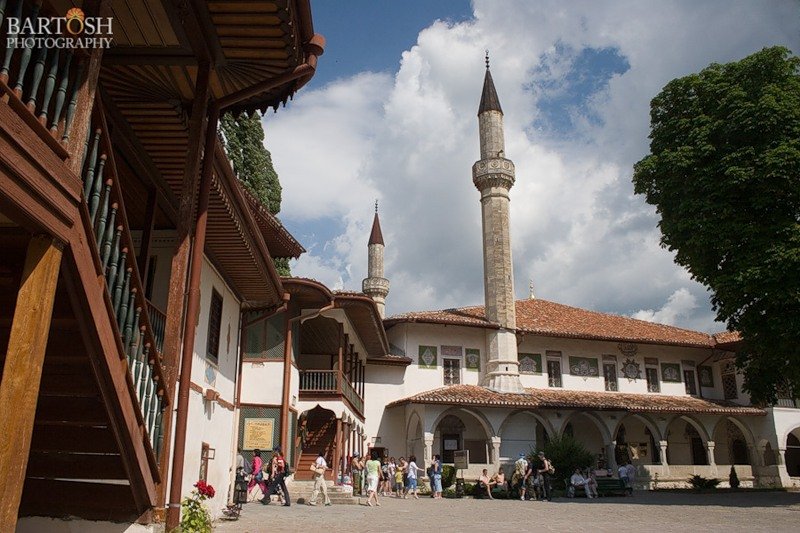
Big Khan Mosque
However, the occupying authorities, namely the general contractor (the company “ATTA-Group”), the subcontractor (LLC “Kiramet”), and the customer of the works (the so-called “Republican Committee for Cultural Heritage”), decided to completely dismantle the roof.
The dismantling was carried out using heavy construction machinery and jackhammers, which led to vibrations and the loss of part of the wall decoration. The authentic beam ceiling system, ceilings, and hipped roof were completely lost.
Authentic oak ceiling beams were dismantled and sawn; they were replaced with modern building materials—glued beams using OSB technology; a concrete reinforcing belt was used.
According to the so-called project, 100% of the ancient, hand-made trough tiles (“tatarka”) were replaced with factory-made Spanish tiles styled to look antique. At the same time, the ancient technology of laying tiles on clay was completely destroyed and replaced with modern fasteners.
According to the conclusion of the experts of ICCROM Ukraine (International Centre for the Study of the Preservation and Restoration of Cultural Property), the works carried out at this site are characteristic of new construction; the mass replacement of wooden structural elements with modern materials not inherent to the culture of Crimean Tatar construction distorts the historical authenticity of the entire ensemble and causes irreparable damage to the history and culture of the Crimean Tatars as a nation.
Additional loads on the walls and foundations of the buildings have already led to deformations, causing stained glass windows to shatter and walls to crack. There is also a crack in the Eastern Minaret, which already had a tilt before the works were carried out. The protection system of the site during the works did not meet even elementary requirements: a temporary wooden shelter was mounted over the building, covered with a polyethylene film, which not only did not guarantee protection from precipitation but also created a "greenhouse effect" under certain weather conditions. As a result of wind action, holes appeared in the polyethylene cover, through which precipitation entered the building during autumn and winter 2017 and spring 2018; thus, the mosque building was soaked through.
The wall paintings on the southern and western facades of the building were damaged. As a result of construction work and lack of protection from mechanical impact, cracks appeared on some tombstones in the Khan's cemetery.
Thanks to the active efforts of concerned Crimean activists, who constantly provided information on the progress of the barbaric "restoration works," and the professional actions of Ukrainian diplomats, this issue was put on the agenda of the United Nations Educational, Scientific and Cultural Organization (UNESCO), which in March 2018 published a report on the worsening situation regarding the protection of cultural heritage in Russian-annexed Crimea. Unfortunately, to date, the work on the Big Khan Mosque has not been stopped, but the contractor has been changed for other objects of the complex.
The company “Meandr” (St. Petersburg) is carrying out restoration work on the main building of the Khan's Palace. But that is another story.
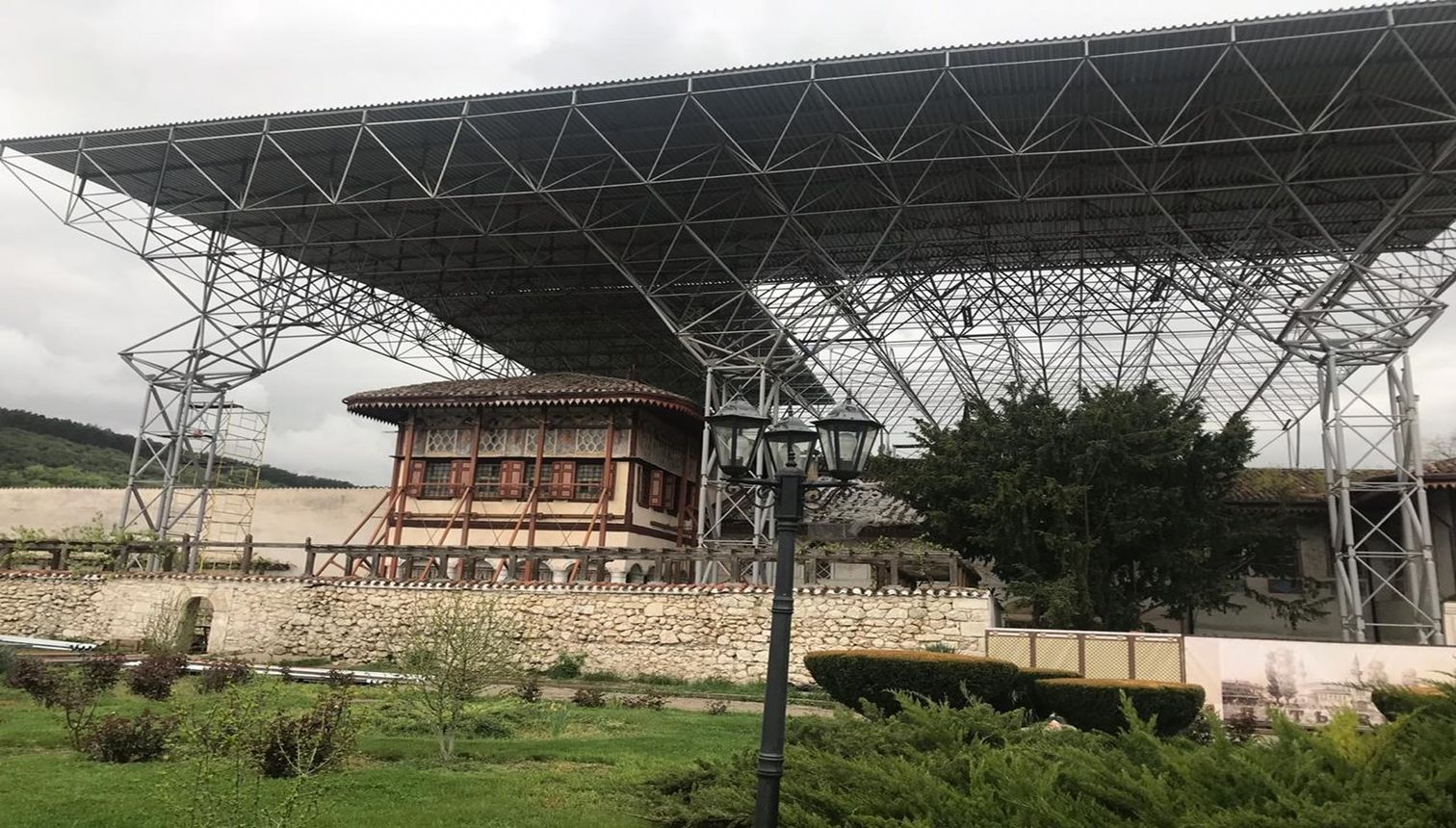
The company “Meandr” (St. Petersburg) is carrying out restoration work on the main building of the Khan's Palace
Regarding the situation around the Big Khan Mosque: is this a story about corruption, negligence, and unprofessional actions, or something else? Monuments at all times have been destroyed and ruined for ideological reasons, in order to obliterate the symbols of a hated past.
After the deportation of 1944, the culture of the Crimean Tatars was destroyed: "toponymic repressions" were carried out on the peninsula, the Soviet authorities destroyed Crimean Tatar monuments, burned manuscripts and books, and opened cinemas and shops in mosques.
After such near-total destruction, the miraculously preserved Bakhchysarai Khan's Palace became for the Crimean Tatars, during the period of their return to their homeland, not only a symbol of the origin and development of statehood in this territory, but also a symbol of revival on their native land.
Therefore, by devaluing (even through reconstruction) the historical significance of the object, which is the main symbol for an entire people, the occupying authorities are implementing a long-term program aimed at destroying historical memory, changing worldviews, and assimilating the Crimean Tatar people.
This is exactly why and exactly now the issue of protecting the cultural heritage remaining in the occupied territory of Crimea requires greater attention; it is necessary to strengthen international legal and institutional control over the preservation of cultural heritage sites and to use all possible institutional and treaty mechanisms for their protection. In response to these challenges, Ukraine must introduce its own long-term programs for the preservation, restoration, and development of Crimean Tatar history and culture.
With the support of the Ukrainian Cultural Foundation