The Last Spring
The neglect of cultural monuments during the reign of the Russian Empire.
Ivan Klepyk. "Krymska Svitlytsa" newspaper, 2019, Issue No. 15–16
We trampled down the Muslim paradise, cut down the forests, took apart the ruins, pillaged and plundered the land. Orphaned stone huts gape; on the slopes, orchards are uprooted. The people left. The springs dried up. No fish in the sea. In the fountains, there is no water.
This excerpt from Maximilian Voloshin's poem "The House of the Poet" has been quoted quite often lately. Usually in the context of the 1783 annexation and its consequences. However, Voloshin did not only note the destructive actions of the Russian Empire: in modern times, the poet's words sound like a prophecy. Though there is nothing surprising about this—only the name of the state has changed, while the policy has remained the same.
Although in some respects Maximilian Voloshin's predictions did come true. In the last line, the poet depicts a kind of apocalyptic picture: a sea without fish and fountains without water—this is what the inhabitants of Crimea have faced in its specific regions. For example, as a result of the active construction of the “Crimean Bridge,” mass migrations of fish have been observed in Kerch. But that is at best. At worst, local fishermen find corpses of dolphins on the shore of the Kerch Strait. As for the fountains, that is a separate story that concerns not only water as such, but also cultural heritage.
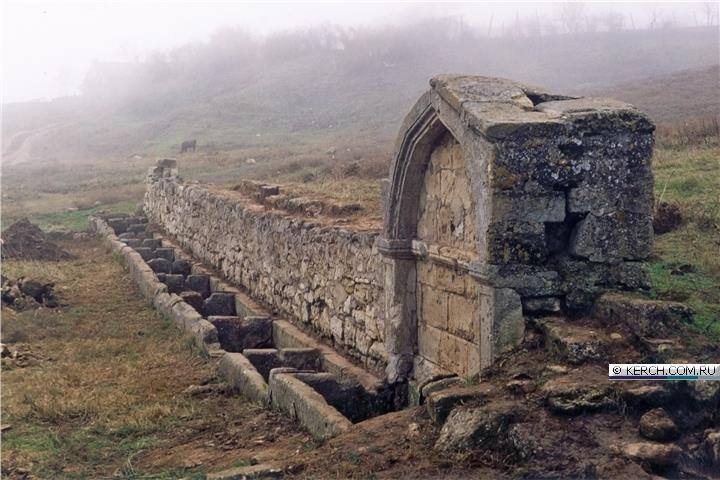
Until recently, this fountain looked like this
The Neglected Cult of Water
When I think of Crimea, especially its steppe zone, my mouth goes dry: already in July, you can find no juicy green grass here. The scorching sun chases you everywhere; you have nowhere to hide. But it was not always like this. Y. Markov, the author of "Sketches of Crimea," first published in 1882, notes that before 1783 the Crimean Peninsula was densely populated, with gardens, vineyards, pastures, and a large number of fountains—for people and livestock—everywhere.
Fountains were of great importance for the culture of the peoples of Crimea, especially the Crimean Tatars. Let us remember, first of all, the “Fountain of Tears” in the Bakhchysarai Palace. However, right now I mean fountains of domestic use for public convenience.
For the Crimean climate, water is not poetry, but a vital necessity. That is why the Crimean Tatars created a true cult of water.
And here is the description of Crimea in the second half of the 19th century that we find in the "Sketches": "The current economic situation of Crimea has become well enough known even to people who have not been there. The steppes, which make up 9/10 of the entire area of the peninsula, are complete deserts; the grass in them is small, degenerate, and in June, right up to late autumn, burns to a yellow color. There is almost no water. Settlements are so rare that you travel from one to another by post-chaise for several good hours. Those that do exist are not settlements, but ruins.
Out of ten huts, two are inhabited; for every one intact, ten lie in heaps of rubbish. Out of ten fountains, eight are probably broken or dried up. Where within the memory of old-timers there were still forested areas—now it is completely barren. You drive along a ravine, along a stream bed—around you are pear trees, garden medlars, poplars, sweet cherries—and not a trace of settlement. And these, meanwhile, are the remains of orchards. Along some rivers, wild orchards with chairy (woodland orchards) stretch for entire versts."
This state of Crimea is connected with the policy of the empire, which distributed the lands of the local population to new "owners" who, in turn, did nothing to preserve the peninsula at least in the state in which it was. Not to mention improvement.
Ruined history
For some reason, spring water on the peninsula is associated only with mountains. Ironically, fountains were also built in mountains and forests. However, there were also fountains in the steppes. For example, on the Kerch Peninsula.
In Kerch, there were several fountains, one of which—the largest—reached 40 meters in length. Outside the city, fountains were also known to exist in Yenikale, Bulhanak, Michuryne, in Kapkany, Marfivka, Fontan, and on Cape Opuk. All of them gradually ceased to function and were dismantled (the last one in the mid-20th century).
Only one fountain has survived to our day in the village of Hlazivka, or Baksy, as it was called until 1945 and is still called today.
The village of Baksy (from the Crimean Tatar word for "spring") is first mentioned in the "Description of the towns that ceded to Russian possession under the peaceful treaty of 1774 with the Ottoman Porte and the lands belonging to them, with some geographical information by Engineer-Lieutenant Colonel Tomilov" as a place where Tatars lived with Circassians, with fifteen households and four wells. It is here that the last fountain on the Kerch Peninsula is located, which is classified as a monument of medieval Crimean Tatar architecture, dating no later than the 18th century.
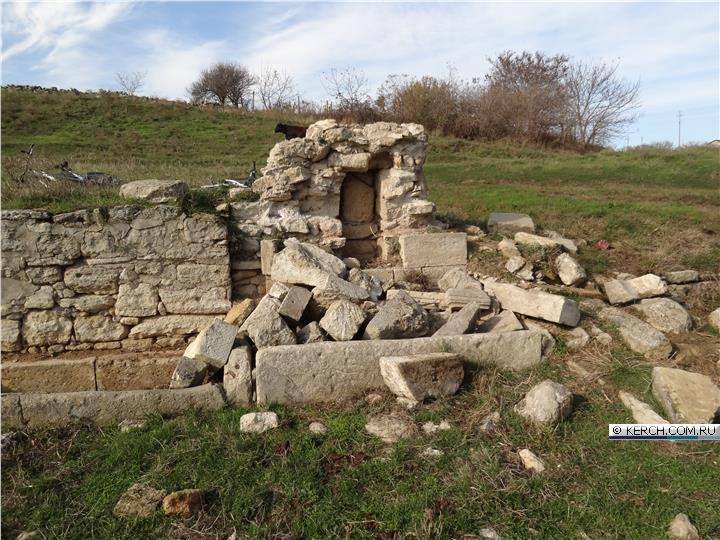
And this is how it was photographed in 2018
These are photographs from a local news portal. Kerch historians are already sounding the alarm, emphasizing the importance of restoring the fountain. Unfortunately, most likely, this last spring will remain only a memory in photographs. Just like many historical and cultural sites of the peninsula, since currently the local authorities cannot settle such everyday issues as the simple absence of water: in February 2019, the water tower collapsed in the village, and local residents found themselves without the most basic necessity.
And this despite the fact that Hlazivka is known to the inhabitants of the Kerch Peninsula as the place where in 1994 they began bottling mineral water from the "Baksy" spring. In fact, the entire Kerch Peninsula is the most promising in terms of mineral water reserves in Crimea. However, that is the irony of this world: no fish in the sea, no water in the fountains…