Who Is He Really?
'Adjutant' Pavlo Makarov, a Bolshevik intelligence agent in the camp of the Armed Forces of South Russia, a participant in the war of intelligence services.
Valeriy Verkhovsky. "Krymska Svitlytsa" newspaper, 2018, Issue No. 47
— Pavel Andreich, are you a spy? — You see, Yura…
“The Adjutant of His Excellency”
The war of intelligence services is an integral component of any war, like a shadow. The bloody turmoil of a century ago, traditionally called the Civil War in Russia, was no exception; for Ukraine, it was an all-out war of everyone against everyone: with the Poles, with the red Russians, white Russians, as well as Petliurists against Hetmanists, with Makhnovists and Red Cossacks.
Without intelligence, an army is blind and deaf, and defeating the blind and deaf is not a problem. The intelligence services of the Whites and the Reds met in a fierce clash that was to decide not only the fate of Russia but also the course of world history. Many people have watched the television film "The Adjutant of His Excellency," but not everyone knows that the real prototype of its main character, Pavel Koltsov, is considered to be Sevastopol resident Pavlo Makarov, a Bolshevik intelligence agent in the camp of the Armed Forces of South Russia.
The Bolsheviks, for their part, created a powerful spy network both in the military leadership of Denikin's "South of Russia" and in Kolchak's headquarters, obtaining information not only about troop movements but also about White agents directly from their counterintelligence. Special services of the newly created Ukrainian State acted against both the Whites and the Reds: for example, in Katerynodar in 1918, Denikin's forces exposed Skoropadsky's agents who had the task of reuniting Kuban with the Ukrainian State.
Perhaps the first to touch upon this topic was a book published in 1927 in Leningrad, "The Adjutant of General Mai-Mayevsky," written by a figure of the Bolshevik underground and partisan movement in Crimea, retired Chekist Pavlo Makarov. Vladimir Mai-Mayevsky was a talented military commander, lieutenant general, who commanded the Volunteer Army in 1919. His unquestionable military talent, however, suffered and was ultimately defeated by alcoholism, which affected both the fate of the Armed Forces of South Russia and the outcome of the Civil War in general.
In 1918, when the White General Mai-Mayevsky commanded only a division, the dubious figure of adjutant Makarov appeared next to him: “One must know how: to turn from a newspaperman into an ensign. To be an organizer of the Red Army, to be captured by the Whites and become a captain and adjutant of Mai-Mayevsky,” Makarov writes in his book.
However, if one reads Makarov's "memoirs" carefully, it remains unclear what his intelligence activities actually consisted of. True, he was a Bolshevik and even an underground fighter. But no one gave him the task of infiltrating the White headquarters; Makarov acted situationally, without coordination with the Intelligence Directorate of the Red Army or the VChK. One wonders, if the situation had changed and the Whites had won, how would Pavlo Makarov have reacted situationally? Would he have continued his career as a staff officer of the new Russia, forgetting his Bolshevik illusions, or not?
His activity was reduced to encouraging General Mai-Mayevsky's alcoholism and reading secret dispatches. Yet he himself admits that: “My efforts to contact the Rostov Bolsheviks were in vain.” And there is not a single story about the conspiratorial transmission of intelligence data to the Red camp. Perhaps he simply did not transmit it?
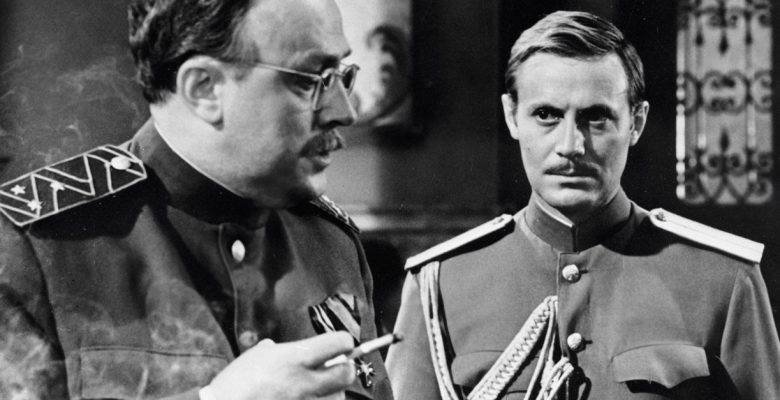
A frame from the TV film "The Adjutant of His Excellency"
Ultimately, Denikin decided to remove Mai-Mayevsky from the command of the Volunteer Army; from December 1919 until the very retreat of the Whites to Crimea, General Pyotr Wrangel would command it. Makarov's intelligence mission practically ended with this—he could no longer find out anything secret or relevant. Along with Mai-Mayevsky, he and two orderlies departed for Sevastopol.
In the film "The Adjutant of His Excellency," the elegant, samurai-like calm, and insightful intelligence officer Koltsov, played by actor Solomin, exposes himself by derailing a train with tanks. As we can see from Makarov's memoirs, there were no trains anywhere near.
Soon, counterintelligence exposed an underground Bolshevik group in Sevastopol led by Volodymyr Makarov, the adjutant's own brother… After that, he himself was arrested.
Here is how Makarov himself describes his escape from custody: “…And I said to the guard: 'Call the chief of the guard to me.' The guard called the corporal, who called the guard commander. 'Who called me and why?' the lieutenant asked dismissively. 'Lieutenant, I have an important matter of state. In some way, it concerns you.' 'Speak, I am listening.' 'How can I speak in front of everyone, especially in the presence of Communists?'—I pointed toward the rebels. 'Lieutenant, let's step into the cell for a minute, I will tell you.' We entered the cell, and I quickly said: 'Lieutenant, just a moment! Wait for me here, I'll bring the manuscript right away.' And without giving the lieutenant time to recover, I slipped out of the cell and closed the door with a cast-iron latch.”
This resembles the adventures of Agent Johnny English from the British film comedy rather than a professional of illegal intelligence.
After the Bolshevik capture of Crimea, Pavlo Makarov went to serve in the Cheka, but later transferred to the Simferopol militia, and in 1926 retired altogether due to health conditions… and sat down to write his memoirs. The publication of the book "The Adjutant of General Mai-Mayevsky" aroused not only the interest of the general reader but also an indignant reaction from veterans of the war against the Whites, including underground fighters. Makarov provides no confirmation of his words: all the Sevastopol underground fighters with whom he maintained contact, including his brother, Volodymyr Makarov, had died. No witnesses remained.
It reached the point where Pavlo Makarov's pension was reduced from a personal one to an ordinary one, he was stripped of privileges and awards, and in 1937, he was arrested. However, he was released two years later, without even being shot.
In 1968, Igor Bolgarin and Georgy Seversky wrote the script for the 5-episode TV film "The Adjutant of His Excellency." Learning about the filming, Pavlo Makarov began demanding a mention of himself in the credits, but the screenwriters objected: the character of Pavel Koltsov was not an embodiment of Pavlo Makarov; it was constructed from the figures of various Bolshevik intelligence agents, including Makarov, but there were plenty of Bolshevik illegal agents in 1917–1920 without him. Having achieved nothing, the Simferopol pensioner Makarov died in 1970 unknown, while the fame of the fictional intelligence agent Koltsov resounded throughout the USSR. His oblivion was well deserved: braggarts and graphomaniacs have no place among undercover intelligence agents.
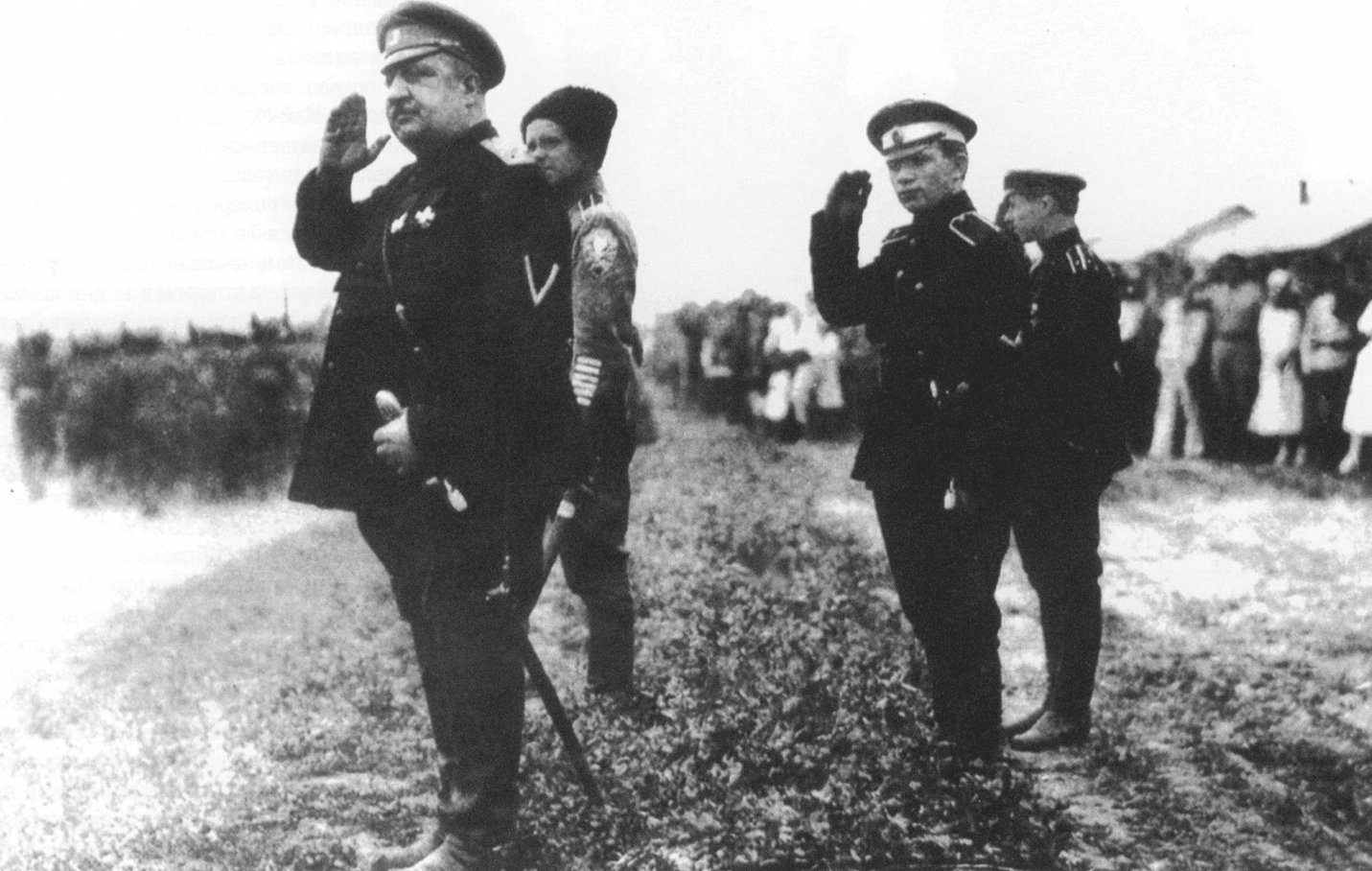
Pavlo Makarov (second in the foreground)
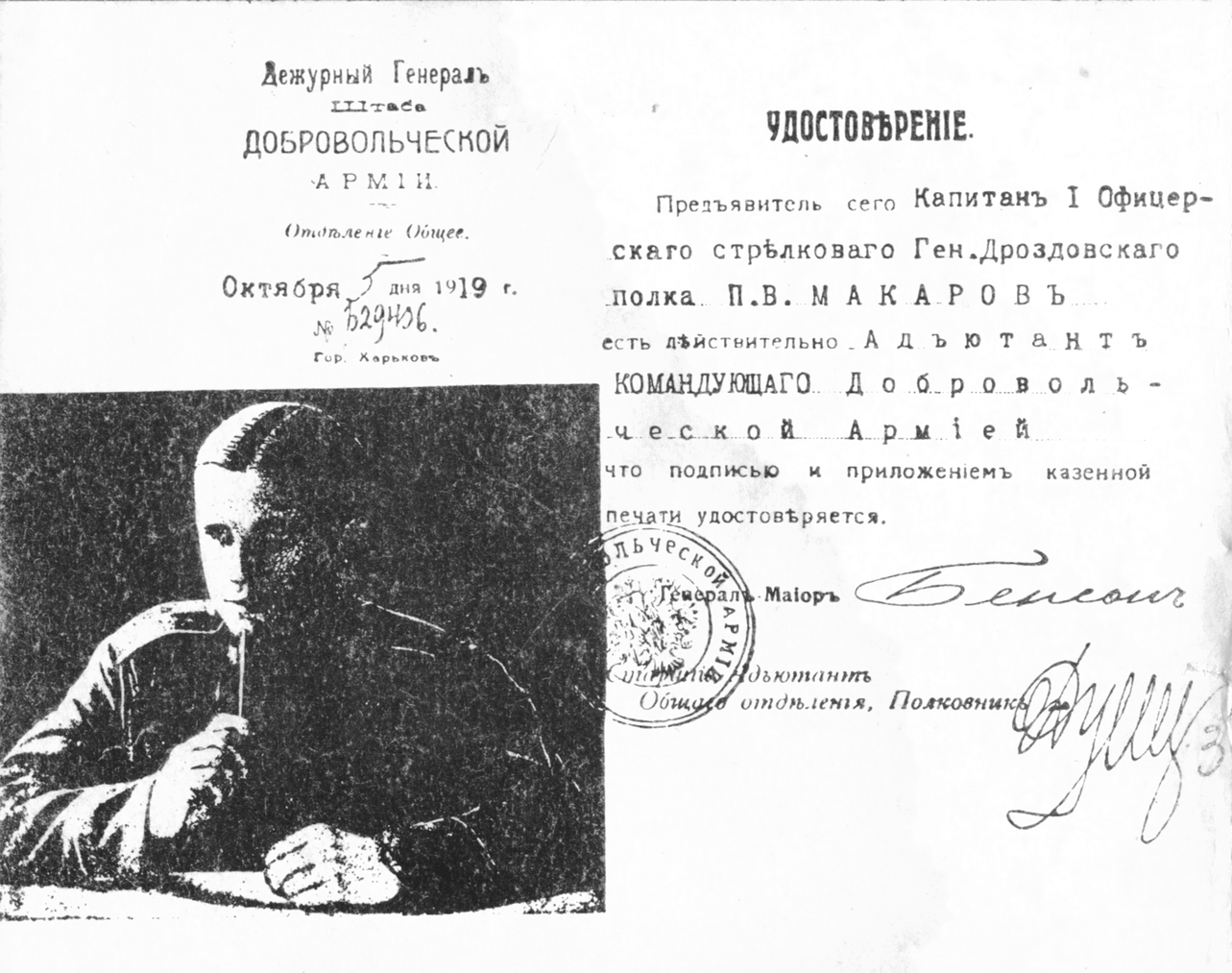
Pavlo Makarov's ID card