Caves of the Desolate Plain
The ornament of the Crimean Peninsula—caves.
Maksym Dubovyaz. "Krymska Svitlytsa" newspaper, 2017, Issue No. 20
Crimea presents the basics of Turkic language right past Perekop: Yany-Kapu—New Gate. Dzhan-koy: Dear village, although some researchers believe that “dzhan” is the steppe pronunciation of “yany.” In that case, Dzhankoy is New Village; but these are not the basics anymore, rather the subtleties. Pronunciation nuances are sometimes debatable. Usually, Crimean toponymy is unambiguous and clear: Kara-Dag—Black Mountain, Kara-Tau—black peak… And the Black Sea around the peninsula is Kara-Deniz. There is very little white, except perhaps Ak-Kaya, White Rock, above the city on the Kara-Su river (Black Water), and that ancient city which once saw Bohdan Khmelnytsky is called Karasubazar, and there is no need to translate what “bazar” means.
In the Turkic world, black water is the name for water flowing from underground, from springs, while white water—ak-su—is that which flows from mountain glaciers. Crimea does not have perpetual snows, so Crimean rivers are not called white waters.
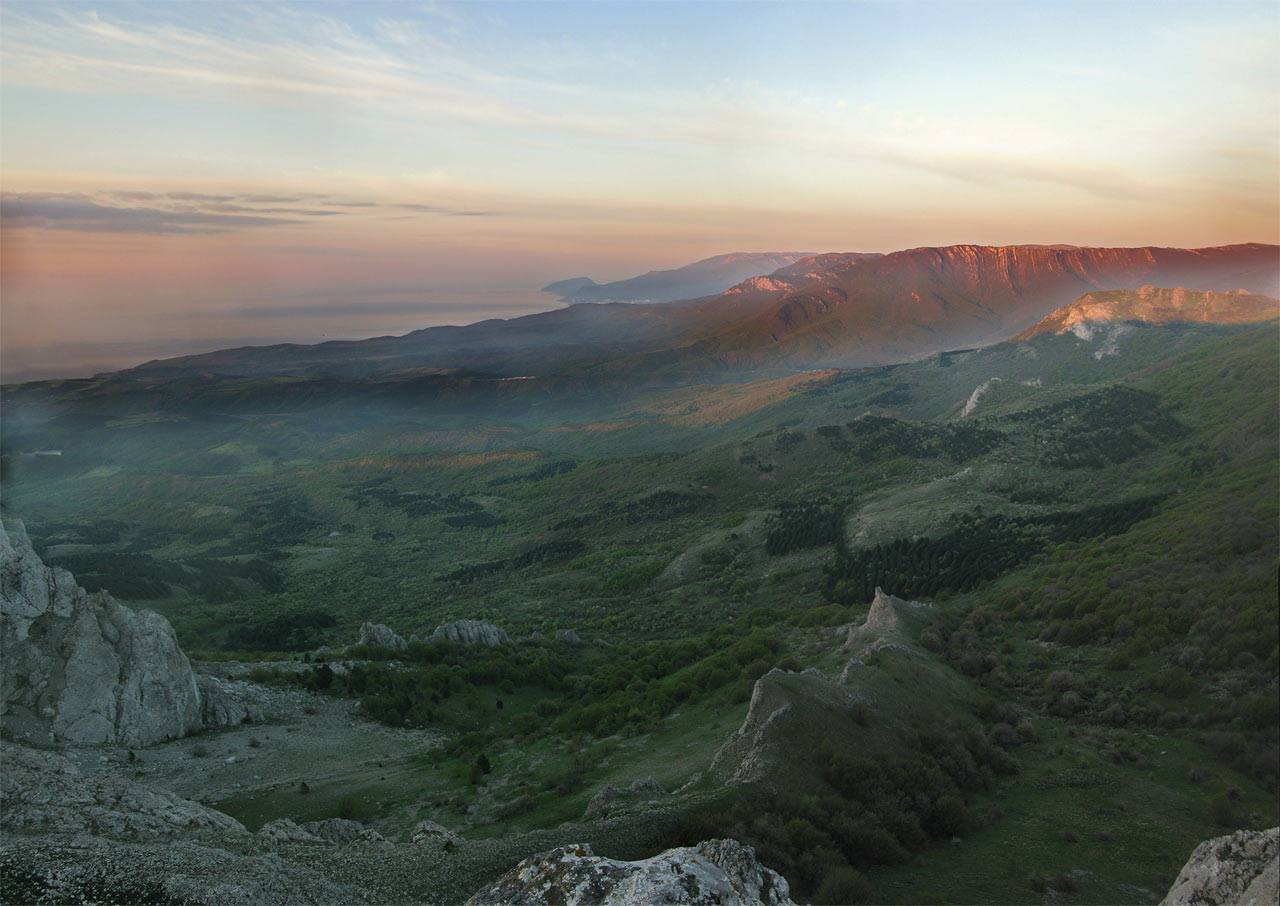
Crimea is colorful. Sary means yellow; the Sary-Su River is a kind of Crimean Yellow Waters. Kok is blue; there is the Kok-Tash rock (Blue Stone), and there is a whole “land of blue hills”—Kok-Tepe-El, Koktebel. Kyzyl is red; there is Kyzyltash near Sudak, and Kyzyltash near Yalta, famous for the world's best wine "White Muscat of Red Stone." And the entire Crimean peninsula is poetically called Yeshil-Ada—Green Island. The aforementioned Kara-Su is fully called Biyuk-Karasu, that is, Great Black Water. Indeed, it is the most abundant of the Crimean rivers.
And it flows from an altitude of almost a kilometer, from the slopes of the massif called Karabi-Yayla. Yayla is the name used in the Turkic world for mountain pastures, tablelands covered with alpine meadows and small forests; a close equivalent is our word play (mountain meadow/pasture). What the word Karabi means is a mystery. Most likely, this name is from the same series as the surrounding untranslatable Tuak, Kanaka, Artap, Kotur—proper names of nomadic clans that claimed corresponding Crimean locations during their ancient wanderings.
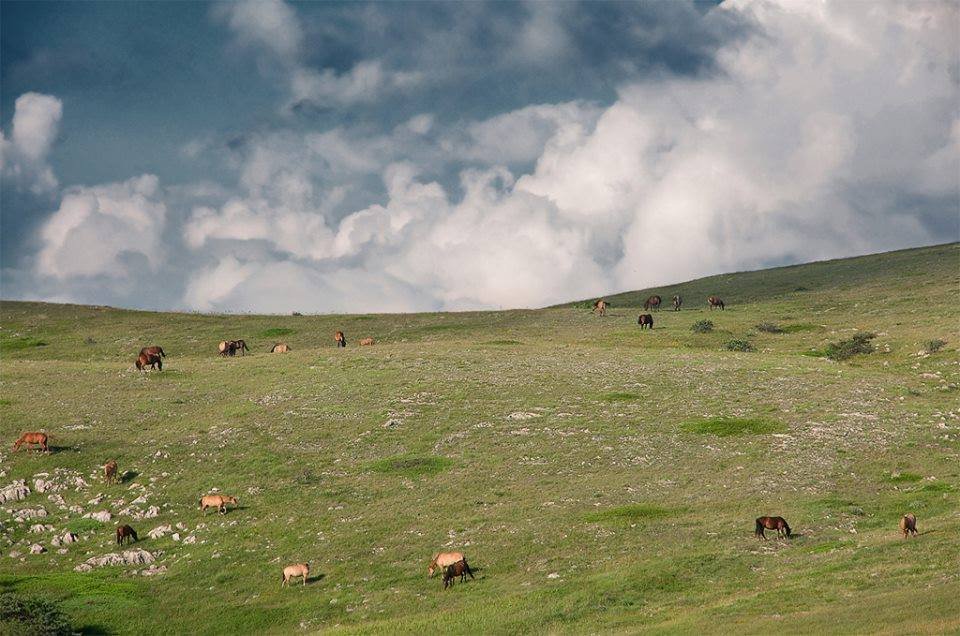
Karabi-Yayla is large; sometimes it is called simply Yayla, without explanation, as the largest of the Crimean plateaus. On its 113 square kilometers, there is only one village, Kurtluk, on the northern edge of the tableland, where pine forests planted in the 1960s adjoin natural oak groves. The name can be translated as Wolfish: kurt is a wolf, but more often in the vicinity of the almost deserted village, one can encounter a fox or a badger. Deer are also not uncommon, and the koumiss farm for which the district was famous throughout Crimea, with its herds, gave rise to a legend about Crimean mustangs that supposedly still grazed among the karst pits of the plateau in the 1990s.
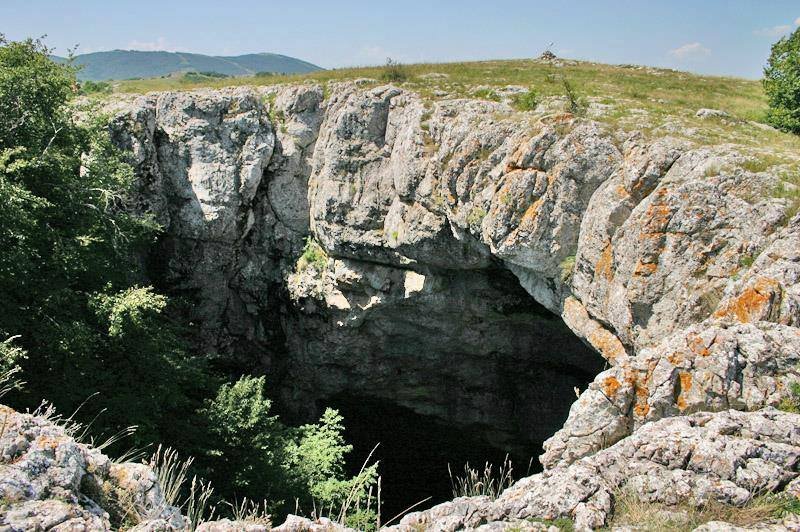
Yes, Karabi is best known precisely for its caves. There are countless of them here; no one can say how many. Several dozen are marked, having a steel plate shot with a dowel into the stone near the entrance, with its state register number stamped on it. Most of these caves also have their own names, mostly modern, such as the deepest, Soldatska (Soldier's), or Studentska (Student's), famous for its rock carvings. The names of others immortalize the names of researchers: Kruber and Newman, Mamin and Dublyansky. There is also Viola, which goes through sloped, tight crevices ("skin-scrapers"), and Kazka (Fairy Tale), a very small one, from whose shaft beginners start their speleological career…
The Buzluk cave has been known since ancient times. Buz means ice; in this cave, which is accessible without special equipment, it has remained since the Ice Age. Once, it was even mined; nowadays, it saves speleologists who have not made a sufficient supply of water, because there are no springs on top.
The Crimean Mountains do not hold perpetual snow, but snow on the Yayla occurs from the beginning of November almost until May. And once it melts, southern nature quickly catches up: in early June, foragers carry fragrant wild strawberries from the mountains, and later, thyme with wild herbs… And where there are flowers, there are bees. Kurtluk was once renamed Bdzholyne (Bee village), and wild bees still live in the vicinity, creating stone hives right in the karst.
In the middle of that plateau is a weather station, which is usually the starting or ending point of speleological expeditions, amateur or student ones from geography universities. More organized speleotourism here is only beginning to emerge. When it will continue depends more on the course of world politics than on the efforts of entertainment industry businessmen.