Relocation of Ukrainians to Crimea in the 1950s
How and under what conditions the relocation of the Ukrainian people to Crimean lands took place.
Petro Volvach, full member of the Shevchenko Scientific Society (NTSh), member of the National Writers' Union of Ukraine (NSPU), Honored Worker of Science and Technology of the AR of Crimea, Crimean resident with 60 years of experience. "Krymska Svitlytsa" newspaper, 2017, Issues No. 3–4
The forced relocation of the Ukrainian population from Ukraine, devastated by World War II, to depopulated Crimea took place on a fairly large scale long before the change in its subordination. With this criminal action, Kremlin leaders pursued several tasks important for the Soviet Empire. First of all, it was necessary to revive the neglected agriculture and save the economy of the peninsula with the hands of the hardworking Ukrainian people, which, after the deportation of Crimean Tatars, Greeks, Bulgarians, Armenians, and Germans, were in a catastrophic state. As already noted, the first wave of settlers from the Russian hinterland failed to cope with this task, and Crimea remained the most backward and problematic region of the RSFSR.
But an equally important task for the Kremlin was to deplete and bleed the population of Ukraine itself, which in the western regions resisted the Bolshevik regime until the late 1950s. The authorities could not carry out the secret 1944 order of Stalin's satraps Lavrentiy Beria and the bloody marshal, staunch Ukrainophobe Konstantin Zhukov, about the mass deportation of Ukrainians from Ukraine due to the scale of the action itself and the possibility of military resistance within the ranks of the Soviet Army itself.
Therefore, the Kremlin decided to carry out the ethnic cleansing of Ukrainians from Ukraine in a less noisy and economically less costly way—through migration policy. Crimea, cleared of Crimean Tatars and other national minorities, turned out to be a very attractive site. Besides Crimea, after the war, Ukrainians were also massively relocated, in a voluntary-forced manner, to the most remote regions of Russia: Sakhalin Region, Khabarovsk Krai, the Jewish Autonomous Region, Primorsky Krai, the Buryat-Mongol ASSR, the Karelo-Finnish SSR, and other regions.
At the same time, the Russian population was massively relocated to Ukraine, not only to industrial regions (Donbas, Luhansk, Zaporizhzhia, Dnipropetrovsk, Mykolaiv, Kherson, Odesa, Poltava, Kharkiv, Sumy, etc.), but also to towns and even villages of Western Ukraine, Bukovina, and Transcarpathia. Thus changed the ethnic, genetic, and linguistic-cultural map of Ukraine. However, that is a topic for another conversation.
We will focus on the forced relocation of the Ukrainian population to Crimea in the first post-war decade, that is, when it was still part of the RSFSR. Fulfilling the Resolution of the Union government of December 5, 1949, No. 5530, the Council of Ministers of the Ukrainian SSR subserviently adopted its Resolution No. 3893 on December 29, 1949, “On relocation to the collective farms of the Crimean Region.” This Resolution planned to relocate 1,000 Ukrainian families to Crimea: 300 from the Drohobych region, 400 from the Transcarpathian region, and 300 from the Chernivtsi region. In total, this was about 5,000 people.
It is completely clear why the local authorities, subservient to Moscow, chose these particular regions for relocation. On the progress of relocation, Kyiv high officials obliged local bodies to provide information twice a month and to submit full reports by the end of the year. Already in early February 1950, the authorities of the Lviv region, formed from occupiers and SMERSH members, reported that they had secured applications from 195 families who “agreed” to relocate to Crimea. This group numbered 833 people, of whom 420 were able-bodied. In order to fulfill the plan of “voluntary” relocatees “handed down from above,” the regional council undertook to “catch” more “volunteers” in two mountainous districts.
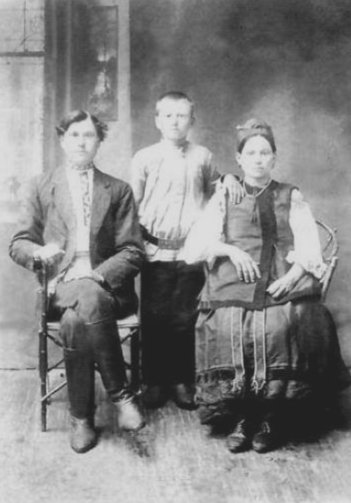
Relocatees to Crimea from the Chernihiv region (town of Pryluky, early 20th century)
In order to overfulfill the plan of relocation of Ukrainians to Crimea determined by Moscow in 1950, republican officials additionally involved several more regions in this action: Kamianets-Podilskyi (now Khmelnytskyi), Vinnytsia, and Kyiv regions. The people of Kamianets-Podilskyi were to relocate 200 families from 15 districts in 1950. The Kyiv region was also to relocate 200 families from 8 districts. But the largest number of peasants (300 families) in the course of 1950 alone was to be relocated to Crimea by the Vinnytsia region. As evidenced by the report of the Directorate for Evacuation Affairs under the Council of Ministers of the Ukrainian SSR as of July 1, 1950, the relocation plan was fulfilled.
Thus, during the first half of 1950, 972 families with a total number of 4,070 people were relocated to Crimea. The local officialdom promised to relocate the remaining 28 families needed for full completion of the plan by the end of August.
Whether the relocation of Ukrainians to Crimea was “voluntary” is quite clearly evidenced by the letter of the secretary of the Sudak district committee of the CPSU(b) of the Crimean Region, M. Osadchykh, to the first secretary of the Central Committee of the CP(b)U, L. Melnikov. He complains to his party boss that of the 169 families who arrived in accordance with the resolutions of the Council of Ministers of the USSR of December 5, 1949, and the Council of Ministers of the RSFSR (it turns out that Ukrainians were relocated to Crimea even without the consent of the subservient Kyiv authorities), 83 families had left Crimea by October 1, 1949. The fact that there were many communists among the escapees also draws attention.
They had, of course, moved to Crimea by order of the party. The escapees did not even deregister from their party accounts and left Crimea arbitrarily. The local-level party ideologue demands that pressure be put on the local Vinnytsia party and executive authorities so that they return the escapees. This fact indicates that the relocatees from Ukraine were in terrible conditions. Often they were not provided with housing and were settled in barns and livestock farms. In most farms, there was neither water nor electricity. Even buildings not adapted for living were not heated in winter.
Starting from 1951, the relocation of the Ukrainian population to Crimea became more massive and took on other forms. During the summer of 1951 alone, several government decrees were issued on the relocation of Ukrainians to Crimea. At the request of the Council of Ministers of the USSR of June 1, 1951, No. 1849, the Council of Ministers of the Ukrainian SSR, by Resolution No. 1406 of June 13, adopted a decree on the relocation of another 1,000 families of Ukrainian collective farmers from Kamianets-Podilskyi, Zhytomyr, Kyiv, Sumy, and Chernihiv regions to Crimea in 1952. Moreover, for the first time in all the years of relocation, the Union authorities set the task of relocating not just individual families, but carrying out relocation mainly by entire collective farms and brigades.
Faced with the problem of relocatees returning to their native lands due to the lack of housing, the authorities, for the first time, began allocating funds for construction work and resettlement in Crimean collective farms (from 16 to 20 thousand rubles per family) and providing interest-free loans for a period of 10 years. Moreover, the state took on 40% of the loan.
Before the relocation to Crimea was carried out, construction brigades were formed from local Ukrainian residents, including relocatees, who were engaged in the construction and arrangement of housing. This helped establish the relocatees in their new places. Furthermore, the authorities began to enforce group (collective farm and brigade) rather than individual (family) responsibility for relocation, state expenses for it, and for the loans received. The decision of the executive committee of the Kyiv Regional Council of July 16, 1951, states that Kahanovychi, Rozvazhiv, and Rzhyshchiv districts are to relocate 200 families to Crimea, mainly by entire collective farms and brigades, which before amalgamation were small collective farms. Eager regional officials, in order to gain favor with Moscow and Kyiv, increased the number of relocated families to 300.
In this decree, for the first time, we find the already determined district and collective farm that are to receive the Ukrainian relocatees.
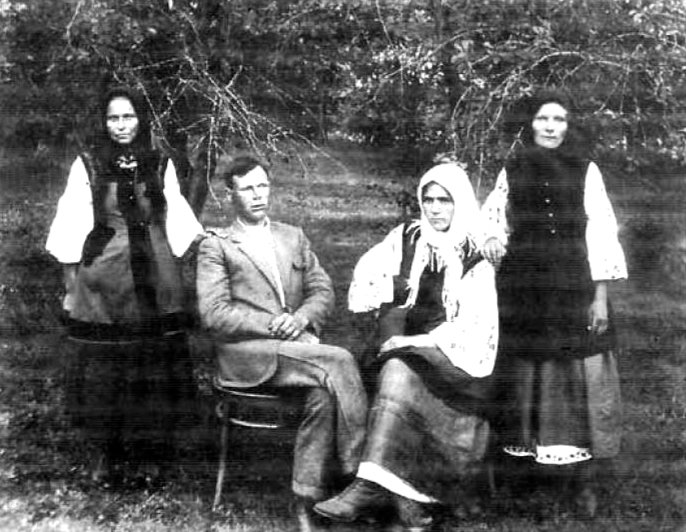
Relocatees to Crimea from the Poltava region. Village of Zuya, 1928
An even more interesting document is the minutes of the general meeting of the Dzerzhinsky Collective Farm in the village of Ryzhiv, Chudniv district, Zhytomyr region. In addition to all the village and district leadership, a representative from the Crimean Kirov Collective Farm (Zuya district) was present at the general meeting, which had a nearly 90 percent turnout. He played the role of an agitator.
The minutes were prepared for reporting to the district, region, and capital, in compliance with clerical and bureaucratic requirements. There was an authoritative presidium consisting of the collective farm chairman and the village council chairman, district officials, local labor veterans, and the emissary-agitator from Crimea.
As is customary according to the established protocol of such organized meetings, the first to speak was a Ryzhiv veteran of the collective farm movement, who had previously been sent to Crimea. He, in particular, reported: “Today the question is on the agenda of the meeting about the relocation of our collective farm to the Crimean Region. …In this collective farm there are 4,574 hectares of land, the collective farm has 60 hectares of orchard, 45 hectares of vegetable garden, 45 hectares of tobacco crops, and 800 hectares of pastures and meadows; the collective farm also sows and plants roses, sage, and other valuable oilseed crops, which give the collective farm large profits; from all sides, collective farmers receive high cash payments for labor days.
There are also 450 beehives in the collective farm, the land in the collective farm yields a great harvest. The collective farmers of this collective farm live culturally and prosperously. This collective farm has great prospects for the future, but due to the lack of a sufficient number of workers, the collective farm is unable to utilize the wealth it has. I urge all collective farmers, one and all, to relocate to the Crimean Region” (quoted in the spelling of the original).
The representative of the Zuya farm was not to be outdone: “…A significant brake on the development of our collective farm is the lack of labor force, and our collective farm to a large extent cannot utilize to full capacity the wealth it possesses. …The regional executive committee and the regional party committee, taking into account the merits of your collective farmers during the Great Patriotic War, recommended that our collective farm receive your small Dzerzhinsky Collective Farm into our family, and today, discussing the question of relocation, I think that one and all will unanimously approve this important decision of the Party and the Government to improve the well-being of the collective farm and collective farmers and, upon arrival at our collective farm, will assist us in utilizing the wealth that has not yet been utilized by our collective farm to this day” (spelling of the original preserved).
The chairman of the local collective farm, the chairman of the village council, and, as is customary, the leading milkmaid joined the approving propaganda action. She had also already visited the Crimean farm. The agitation and party pressure turned out to be so powerful that of the 146 collective farmers present, 96 voted for the relocation, and 50 voted against it.
It is quite telling that none of the collective farmers present at this meeting, which was destructive for them, inquired about either the fate of the village or the fate of the lands they were to leave behind. Apparently, such curiosity was highly dangerous for everyone. After all, representatives of NKVD structures, who were not declared in the minutes, were present at the meeting. The meeting resolved: “To approve the resolution of the Council of Ministers of the USSR on relocation to the Crimean Region and to relocate completely as a collective farm to the Kirov Collective Farm, Zuya district, Crimean Region. To request the executive committee of the Chudniv district council of working people's deputies to approve our decision and to petition the executive committee of the Zhytomyr Regional council of working people's deputies to relocate the Dzerzhinsky Collective Farm to the Crimean Region” (spelling of the original preserved).
The relocatees decided: to allocate a construction brigade from the members of the Dzerzhinsky Collective Farm consisting of 45 people.
In 1951 alone, nearly 4,600 people were sent to the Crimean Region from the Vinnytsia and Sumy regions. In addition, to overfulfill the plan for 1952, another 69 families (275 people) were additionally relocated from the Kyiv region, and 23 families (91 people) from the Zhytomyr region. So how many Ukrainian villages and collective farms had to be destroyed to execute and overfulfill the criminal orders of the Kremlin?
And the instructions and orders from Moscow and Kyiv were indeed criminal. Even the German occupiers did not resort to such anti-human actions. For, on instructions from Moscow, the Kyiv Regional Council on December 5, 1951, adopted an idiotic decision to relocate a brigade of the Petrovsky Collective Farm in the Rozvazhiv district to the “Path of Communism” Collective Farm in the Bilohirsk district. The executive authorities of the Rozvazhiv district were tasked with ensuring organizational and practical management of the dismantling of both residential and outbuildings of the entire brigade and collective farmers, marking structures, transporting them to the railway station, and loading them into cars for further transportation to Crimea.
Party and soviet organs set another unbelievable task for the defenseless, homeless people: “Deliver cattle, young stock, and horses to the loading station by driving them on foot, ensuring feed for the livestock all along the way and care for milking cows.” Even in summer, executing such a task in a short period would be quite difficult. But this was all happening in the midst of a harsh winter, and the brigades with relocated property and livestock were ordered to be delivered no later than December 15. And by December 20, a report on the execution of the task had to be submitted.
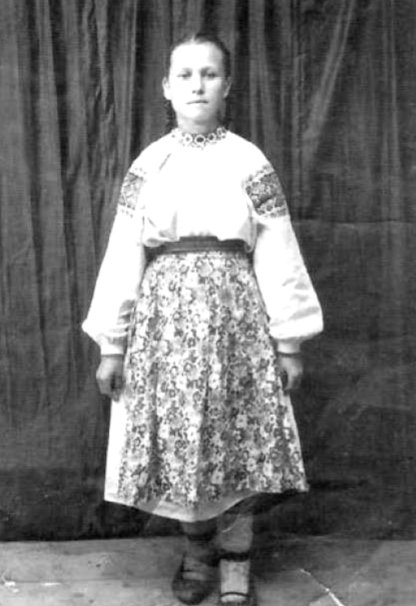
A female relocatee to Crimea from Western Ukraine (village of Stepove, Pervomaiske district, early 20th century)
The large-scale relocation of Ukrainians to Crimea and other regions of the RSFSR during 1949–1951 is evidenced by a report of the Administration of Affairs of the Council of Ministers of the Ukrainian SSR for this period. 13,111 families, or nearly 52,000 people, were relocated from Ukraine. In 1952 alone, as of November 1, almost 780 families from 16 collective farms and brigades were relocated from Zhytomyr, Kamianets-Podilskyi, Kyiv, and Sumy regions.
In 1953, 600 families were relocated to the collective and state farms of the Crimean Region from the Chernihiv region alone, 800 to the collective farms of Primorsky Krai, and 400 to the Sakhalin Region—that is, more than 7,200 people; of these, almost 800 families (over 3,200 people) were sent to Crimea. The pace of Ukrainians' relocation to Crimea grew every year. In 1953, the Crimean cotton trust refused to receive 124 families of relocatees from the Chernihiv region because they had stopped growing cotton on the peninsula.
The emboldened Crimean leadership, observing the avalanche of relocatees from Ukraine, began to dictate its terms. It refused the relocation of 1,400 families from Transcarpathia to Crimea. The chairman of the Crimean Regional Executive Committee, Dmytro Polyansky, noted in his letter to the chairman of the Council of Ministers of the Ukrainian SSR, Demyan Korotchenko, that from 1950 to 1953, relocation to Crimea from Vinnytsia, Kyiv, Kamianets-Podilskyi, and mainly Sumy and Chernihiv regions took place predominantly by entire collective farms and brigades.
Precisely this type of relocation proved to be the most effective, helping establish the relocatees in their new places and reducing their return to former homes. Since the Transcarpathian authorities could not ensure the departure of relocatees by collective farms and brigades, the leadership of the Crimean Region refused to accept individual relocatees. Taking into account the petition of the Crimean Regional Executive Committee, the Council of Ministers of the Ukrainian SSR decided to fulfill the relocation plan at the expense of Vinnytsia (400 families), Chernihiv (500 families), and Sumy regions (500 families).
For 1954, it was planned to relocate about 1,200 families (almost 5,000 people) to Crimea from Sumy and Chernihiv regions. Note that for 10 years (from 1944 to 1954), the colossal costs of Ukrainians during their relocation to Crimea, which was part of the RSFSR, were covered at the expense of Ukraine and the Ukrainian people. This was yet another cunning plan of the imperial Kremlin to destroy the nation's gene pool, bleed it dry, and subjugate the Ukrainian people.