Crimea: First Steps in Ukraine
The Soviet policy pursued in the territory of Crimea after its transfer to Ukraine.
Petro Volvach, full member of the Shevchenko Scientific Society (NTSh), member of the National Writers' Union of Ukraine (NSPU), Honored Worker of Science and Technology of the AR of Crimea, Crimean resident with 60 years of experience. "Krymska Svitlytsa" newspaper, 2017, Issue No. 31
There is no doubt that the study of the Crimean population's reaction to the transfer of the Crimean Region to Ukraine was under the close scrutiny of the Kremlin leadership. Collected information, which was not distributed in the media, reached the Kremlin through special communication channels. This is evidenced by the reaction of the Ukrainian Central Committee to the conclusions in the process of discussing the fears of a part of the Russian population regarding the “inevitable Ukrainization of the peninsula.” Anticipating events, Kremlin ideologists even then were preparing the ground for the Russification of relocatees from Ukraine in Crimea. According to their plan, the peninsula was to be revived and built up by Ukrainian relocatees, but it was, as before, to remain Russian-speaking.
It was no coincidence that this issue arose, supposedly spontaneously, at the 25th Party Conference held on March 10, 1954, virtually two weeks after the adoption of the Resolution of the Supreme Soviet of the USSR on changing the administrative subordination of the Crimean Region.
Obviously, at such a meeting, party and economic representatives should have been concerned with the catastrophic state of the Crimean economy, neglected agriculture, low living standards, acute shortage of water and electricity, the absence of roads, water mains, and sewage systems in most cities of Crimea. However, the leaders of that time were interested in something else entirely. For them, it became important to safeguard Crimea from the spread of the Ukrainian language and culture. The issue also became acute because among the leading cadres there were many who were in the rear during the war, and after its completion fought against the UPA (Ukrainian Insurgent Army).
The study of the personal files of a significant part of the Crimean leadership of that time, which I reviewed in the funds of the former party archive, revealed that many of these individuals were not real front-line soldiers during the war; they held various staff positions, were political workers, served as quartermasters, or worked in army newspapers.
After the deportations of Germans, Crimean Tatars, Greeks, Armenians, Bulgarians, and other ethnic groups from Crimea, the first wave of selecting settlers to populate the southern coast and foothills—as the parts of the peninsula most suited for living—began. Preference was given to village activists, party members, former GULAG guards, SMERSH personnel, and retired military personnel. Therefore, it was natural that these new Crimeans coldly received the government decisions to re-subordinate the Crimean Region to Ukraine. And since this decision had been made by the highest Kremlin leadership, they did not dare object. The only thing they managed was to present to the new Kyiv authorities a different point of view, distinct from the generally accepted one. It was important for them to voice it from the high tribune of the regional party conference.
Significantly, the Crimean press, neither before the transfer nor after Crimea's entry into Ukraine, spoke of any criticism of the Kremlin leaders' decisions. I was also unable to find the speeches of the delegates to the 25th conference. Perhaps they were kept in a special fund.
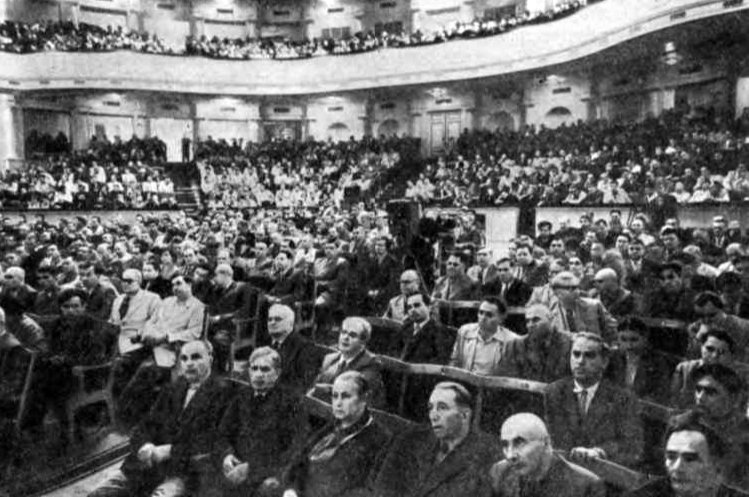
An extract from the speech of CPU Central Committee Secretary Mykola Pidhorny at this conference reveals little-known facts about the positions of a part of the Crimean elite regarding the act of transferring the Crimean Region to Ukraine. This, as is already known (see "Krymska Svitlytsa" newspaper, No. 30, 2017), manifested itself back during the discussion of this issue in labor collectives.
M. Pidhorny then read out one of the notes, of which, in his words, quite a few had been received by the Crimean leaders: “At the present moment, departments of district executive committees have begun to receive documents in the Ukrainian language from the Ministries of the Ukrainian SSR. It is desirable to know what will be the procedure for introducing the Ukrainian language in the Crimean Region, in particular, in soviet institutions, schools, press, radio, etc.” It is clear that the note was skillfully used as a hook; such indicative moments allowed the speakers, so to speak, to legalize and bring to the fore the rough questions.
Consequently, the party leader focused on the planned agenda and replied: “This question, as far as I know, was of concern to the working people of the Crimean Region long before the Decree of the Presidium of the Supreme Soviet of the USSR on the transfer of the Crimean Region to the Ukrainian SSR was announced... I must say that such talks are completely groundless; one must take into account that in Ukraine there are many regions like the Crimean one, or almost like it. These include Voroshilovgrad, Stalino, and a number of other regions where instruction in schools is conducted in Russian, and paperwork is also conducted in Russian. Obviously, the same will be true in Crimea.”
Thus, even before the official transfer of the region, it was decided that Crimea would remain Russian-speaking, and therefore clearly not Ukrainian.
As a great achievement of the Communists, the Kremlin psychologist Mykola Pidhorny demonstrated the presence of Russian schools even in Ukraine. Regarding this, "even in the western regions of Ukraine we have Russian schools, just as in all other regions. But even in these schools, the Ukrainian language is studied as a subject," the Secretary of the CPU Central Committee proudly declared. To what level of national degradation must a republican party leader descend to, almost with an apology, convince the delegates of the Crimean party conference that nothing bad will happen if in Ukraine "in Russian schools, the Ukrainian language will be taught. After all, they teach other languages."
M. Pidhorny then assured: “Paperwork will continue to be conducted in Russian as it has been. There is no need to switch paperwork to the Ukrainian language.” How indeed “can one think that paperwork in institutions could be conducted in the Ukrainian language,” the speaker himself was indignant. “Regarding radio, cinema, correspondence—the same, everything will be as it was.” And, as it turned out, the question was never even raised to put everything “topsy-turvy, to switch everything to Ukrainian” immediately after Crimea joined Ukraine. This “topsy-turvy” exhaustively characterizes the attitude of both the speaker and all Crimean party leaders toward everything Ukrainian.
It is worth noting here that no one even tried to review this humanitarian policy. The situation in this area did not change significantly even during the 25-year period of Ukraine's independence. And the fact that exactly 60 years later we lost Crimea, rebuilt by the hands of our people, is to a large extent the result of the well-thought-out course of the Kremlin leaders, mapped out for the Crimean Region back in the distant year of 1954.