The First Signs of Ukrainization of Crimea
The introduction of Ukrainization in the cultural world of Crimea.
Petro Volvach, full member of the Shevchenko Scientific Society (NTSh), member of the National Writers' Union of Ukraine (NSPU), Honored Worker of Science and Technology of the AR of Crimea, Crimean resident with 60 years of experience. "Krymska Svitlytsa" newspaper, 2017, Issue No. 36
It is completely clear that neither the Crimean Regional Committee of the CPU nor the Regional Executive Committee, with their staff inherited from the RSFSR, could generate significant changes in humanitarian policy, directing it toward Ukrainocentrism. There is no doubt that key principles in the humanitarian sphere, certainly within the limits meted out by the Kremlin, were developed in Kyiv. Dmytro Polyansky, as a direct Kremlin protege, although in his heart did not agree with the new course of the Kyiv leaders, was forced to implement it. However, both he himself and the apparatus of the Crimean Regional Committee were in no hurry to bring the most important decisions to life.
So it is not surprising that the leadership of the region declared certain changes in humanitarian policy only at the end of the year, although this should have been done in the very first months after the re-subordination of the region to Ukraine.
If we analyze the decisions made by the Crimean authorities in the last months of 1954, we can conclude that they all fall under the secretaryship of Dmytro Polyansky, and most proposals were sent to Kyiv under his signature. This applies to many documents that reached Kyiv from Crimea or were initiated by the Central Committee of the CPU and its apparatus.
An attention-grabbing note from the head of the propaganda and agitation department, V. Pashko, to the CPU Central Committee proposed publishing part of the run of the “Agitator's Notepad” in the Ukrainian language ("Crimea in the conditions of socio-political transformations (1940-2015)". Kyiv, 2016, "Clio Publishing". – Doc. No. 61, dated September 3, 1954). This shows that it was not Crimean party functionaries, but the apparatus of the republican CPU Central Committee and its secretaries who, already in the first year after the transfer of Crimea to Ukraine, tried to make certain corrections to the established Russian-speaking information space.
The note stated "that the 'Agitator's Notepad,' as an ideological publication in Crimea, is published only in Russian. Meanwhile, the vast majority of relocatees, especially in rural areas, arrived on the peninsula from Ukraine. Therefore, it is better for agitators to conduct propaganda work in the Ukrainian language, using a Ukrainian-language duplicate of the publication." The department of propaganda and agitation rightly suggested that the Crimean ideological party bureaucrats provide a certain part of the circulation in a Ukrainian-language duplicate.
The Crimean regional committee of the party, certainly not without the intervention of the Kyiv leadership, adopted another important resolution “On duplicating the newspaper 'Krymsky Komsomolets' in the Ukrainian language.”
The resolution noted that the entry of Crimea into Ukraine posed to the youth organization the necessity of duplicating it in the Ukrainian language. The existing three issues of the newspaper per week and small circulation (10,000 copies) did not satisfy the demands of 90,000 Komsomol members. At the end of 1954, the regional party committee under the signature of Dmytro Polyansky requested the CPU Central Committee to allow, starting from January 1, 1955, an increase in the frequency of publication of “Krymsky Komsomolets” to 5 issues per week, with a circulation of 20,000 copies, anticipating the printing of 5,000 copies in the Ukrainian language from July 1, 1955 (Doc. No. 75 of October 8, 1954, ibid.).
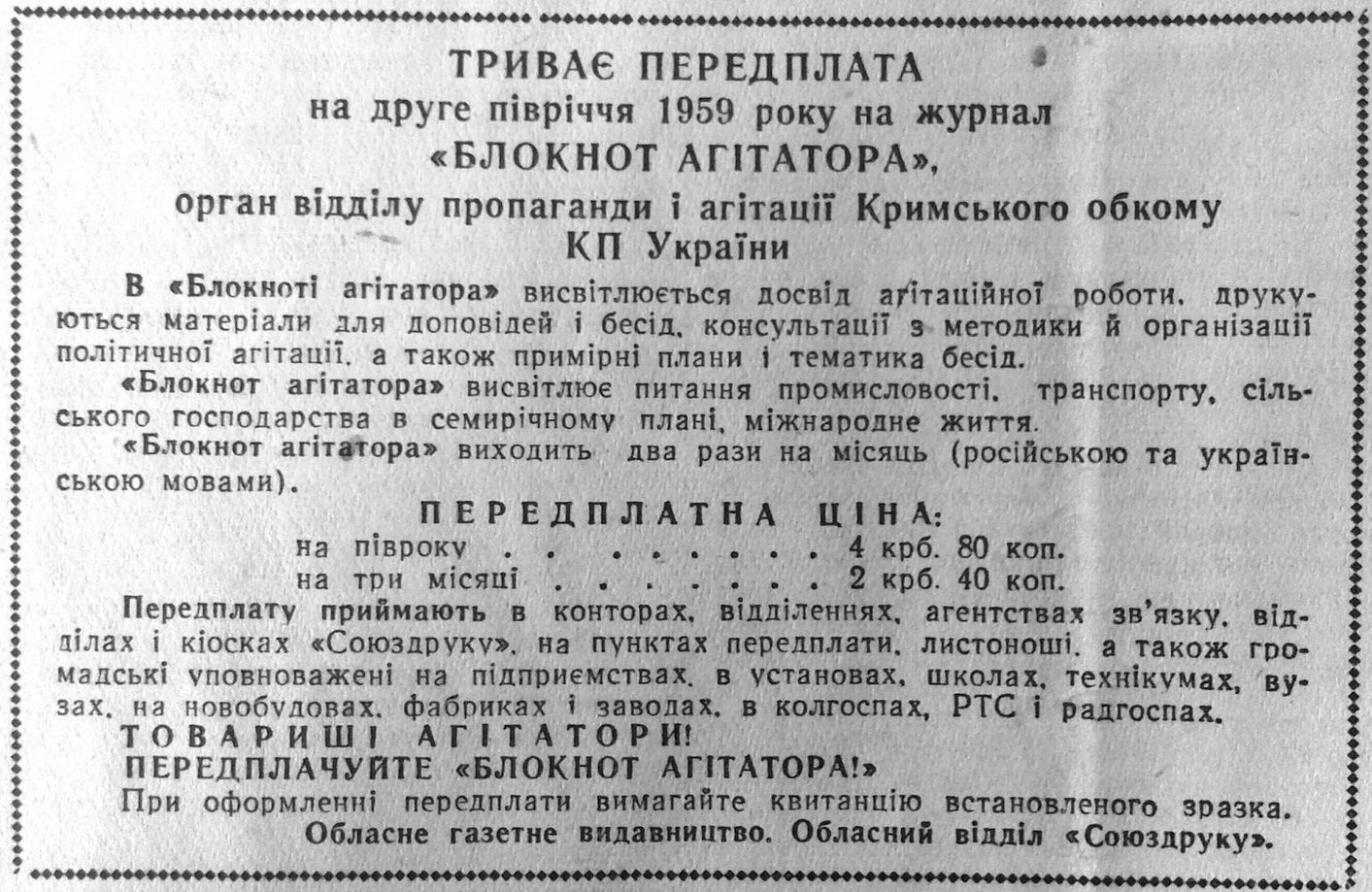
Subscription to the “Agitator's Notepad” on the pages of the newspaper “Radianskyi Krym”
At the end of September 1954, the Presidium of the CPU Central Committee adopted a decision “On the publication of the regional newspaper 'Radianskyi Krym'” (Doc. No. 69 of September 20, 1954, ibid.). The daily circulation of the newspaper was 20,000 copies. The funding of the newspaper was provided from the state budget. The editorial office was also provided with a "Pobeda" car, and the government obliged the Ministry of Culture of the Ukrainian SSR to allocate 100,000 rubles from capital investments for equipping the editorial office. The State Planning Committee of the Ukrainian SSR provided another 30,000 rubles for purchasing furniture for the editorial office.
The department of propaganda and agitation of the CPU Central Committee was tasked with assisting local bodies in selecting managers and creative workers for the editorial office of the Ukrainian-language newspaper “Radianskyi Krym.” Such an attitude of the authorities of that time toward creating a Ukrainian information space, first of all, a regional newspaper, should be educational for all leaders of independent Ukraine. After all, the only Ukrainian-language newspaper in Crimea, “Krymska Svitlytsa,” which celebrates its 25th anniversary this year, has been deprived of state attention all these years. And after the occupation of Crimea by Russia and the relocation of the editorial office to Kyiv, the unpatriotic leaders of the Ministry of Culture completely destroy “Krymska Svitlytsa” and brutally strip it of funding.
The path to implementing the resolution of the Presidium of the CPU Central Committee on creating the Ukrainian-language newspaper “Radianskyi Krym” in Crimea stretched for nearly a year. The newspaper was to be published on November 1, 1955. Since the process of creating a Ukrainian-language printed party organ was delayed, or rather sabotaged, Mykola Pidhorny, as the second secretary of the CPU Central Committee, was forced to address the CPSU Central Committee in August 1955 with a letter justifying the feasibility of creating such a party printed organ in Crimea (Doc. No. 108, August 2, 1955, ibid.):
“After the annexation of the Crimean Region to the Ukrainian SSR, an immense interest arose among the working people of the region in the economic, political, and cultural life of the republic. The demand for Ukrainian literature and periodicals in the Ukrainian language is growing. At the present time, over 200 thousand Ukrainians live in the Crimean Region, which is about 25 percent of the total population of the region. In the northern agricultural districts, the Ukrainian population accounts for 35 percent.
To strengthen political-educational work among the population, the need has arisen to create an independent press organ in the Ukrainian language in the Crimean Region.
CC of the CP of Ukraine requests permission to publish the regional newspaper 'Radianskyi Krym'—the organ of the Crimean regional committee of the CP of Ukraine and the regional Council of working people's deputies, setting for it a size of 4 pages of full-format 'Pravda,' frequency—5 issues per week, single circulation—20 thousand copies.
The expenses for publishing the newspaper in the amount of 2,586 thousand rubles will be covered by income from the sale of the newspaper and printing of advertisements, and the remaining 1,443 thousand rubles by a subsidy from the republican budget at the expense of allocations for the press.
Newsprint necessary for publishing the newspaper in the amount of 15 tons per year will be allocated from republican funds.” Secretary of the CC CPU N. Podhorny
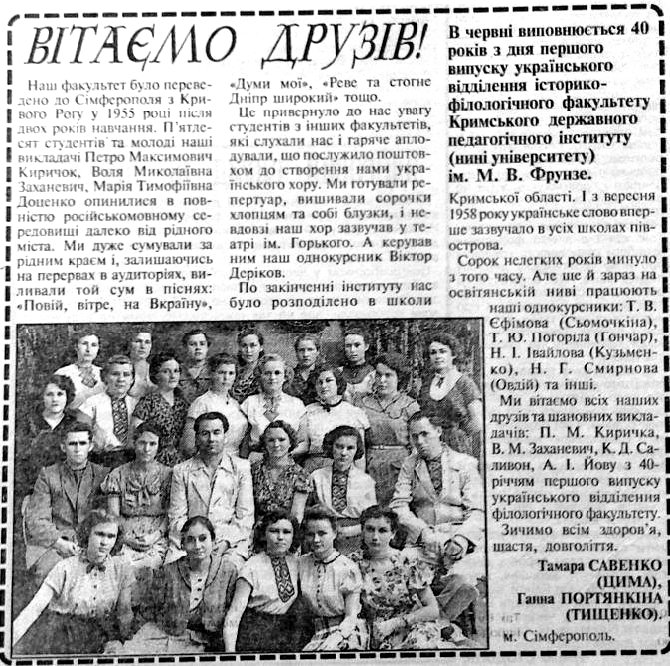
A group of 3rd-year students of the newly created Ukrainian department near the Simferopol cinema, 1955
It was only in early September 1955 that permission for publishing a newspaper in the Ukrainian language, “Radianskyi Krym,” was received from Moscow. On September 30, 1955, the Crimean Regional Committee of the CPU adopted a resolution “On the publication of the regional newspaper in the Ukrainian language 'Radianskyi Krym'.”
Responsible workers of the Crimean Regional Committee (Polyansky, Klyaznytsya, Rychykov, and Katkov) and the chairman of the regional council Kuzmenko were tasked with studying the proposals of workers dispatched by the CPU Central Committee to Crimea to work in the editorial office of the newspaper “Radianskyi Krym.” The department of propaganda and agitation (Karpenko) was to submit the composition of managers and creative workers of the newspaper for consideration of the bureau by October 10, 1955.
In order to ensure the guaranteed distribution of the newspaper in Crimea, the regional party committee established a limit on subscriptions to the publication for all cities and districts of the region, including Sevastopol. Depending on the population in each settlement, it ranged from 450 to 1,700 copies.
The government decision to organize a department of the Ukrainian language and literature in the Crimean Pedagogical Institute was also of great importance for the establishment of Ukrainian culture and education in Crimea.
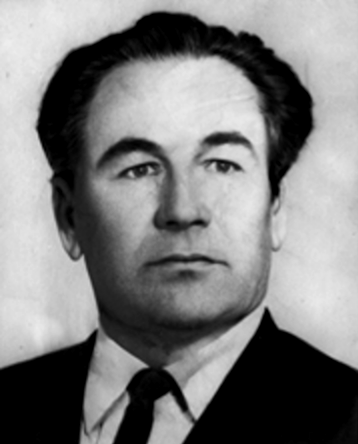
Petro Maksymovych Kyrychok
At the end of September 1954, the school department prepared an official memorandum for the CPU Central Committee on the organization of a department of the Ukrainian language and literature at the Crimean Pedagogical Institute (Doc. No. 70, September 29, 1954, ibid.). The document states that the Crimean Regional Committee of the CPU and the Ministry of Culture submit a proposal for the organization of a department of the Ukrainian language and literature at the historical-philological faculty of the CPI in the 1954–1955 academic year. It was planned to create one academic group of 25 students from among the already admitted students. And for the next 1955–1956 academic year, it was planned to admit the first year of the Ukrainian department consisting of two academic groups (50 students).
The Ministry of Education of the Ukrainian SSR decided to transfer the department of Russian language and literature of the CPI to the curriculum and programs of these departments of pedagogical institutes of the Ukrainian SSR. They provided for the study of the Ukrainian language in the 2nd, 3rd, and 4th years (190 hours) and Ukrainian literature in the 3rd and 4th years (140 hours).
Among those who moved to Crimea to organize the educational process at the newly created Ukrainian department were candidates of philological sciences, associate professors P. M. Kyrychok and H. Y. Nedilko, and several teachers who did not hold a scientific degree. In 1955, the first Ukrainian studies department was created at the M. V. Frunze Crimean Pedagogical Institute—the department of the Ukrainian language and literature, headed by P. M. Kyrychok.
It must be noted that the leading Kyiv party bodies treated the proposals worked out by specialists quite responsibly. The implementation of all Ukrainocentric decisions and resolutions was under constant, strict control of Kyiv. However, the Crimean Regional Committee of the party, led by Dmytro Polyansky, quite often delayed the implementation of adopted decisions, which caused dissatisfaction of the Kyiv party and soviet leadership with his activity. This led to the replacement of Dmytro Polyansky.
At the end of 1955, he was stripped of the post of first secretary of the Crimean Regional Committee and appointed first secretary of the low-prestige Orenburg regional committee in the Russian Federation. Undoubtedly, this was a significant demotion, equivalent to exile. But his replacement by Vasyl Komyakhov played a huge role in the further Ukrainization of the peninsula.