A Stolen Name: How Kishka Was “Koshka”
The dilemma of the surname of the hero of the Sevastopol defense of 1854–1855, Petro Kishka.
Serhiy Konashevych. "Krymska Svitlytsa" newspaper, 2017, Issue No. 38
At the beginning of 2017 (Krymska Svitlytsa, No. 3, dated 20.01.2017), an opportunity arose to ponder what the surname of one of the prominent Ukrainian artists, a significant part of whose life was connected with Crimea, actually looked like—"Samokysh" or still "Samokysha" (a dialectal name for sour milk in the Sivershchyna region; this is exactly how the master signed his letters).
And just recently, during archival work, I had to recall the title of Yevhen Nakonechny's work "A Stolen Name (Why Rusyns Became Ukrainians)." Among the old newspapers, a copy of the publication "Radianskyi Krym" dated May 28, 1956, was found. On the front page, it reports the opening on May 26 in a new Sevastopol square on Malakhov Avenue of a monument to the legendary sailor Petro Kishka, a participant in the defense of the city during the Crimean War of 1854–1855. The solemn meeting, which began with the anthem of the USSR and ended with the anthem of the Ukrainian SSR, was attended by the authors of the monument's project V.
P. Petropavlovsky and senior sailors Vasyl and Yosyp Keiduk, the chairman of the executive committee of the Sevastopol City Council Sosnytsky, the secretary of the city party committee Pashkov, as well as the sailor's compatriots from the Vinnytsia region—the chairman of the Yatsenko Collective Farm of the Sytkivtsi district Kryvotey and the head of the delegation Hnenny, who said that the youth of Ometyntsi—Kishka's native village—often hear about his combat feats. At the end of the meeting, during which speeches were made about the “thrilling feats of Russian soldiers and sailors,” the monument was covered with bouquets of fresh flowers.
And here is how the observer of “Radianskyi Krym” describes the monument: “The bust of the brave intelligence agent is installed on a three-meter pink granite pedestal. On the front side of the monument at the top is the inscription: 'Sailor Koshka Petr Markovich, Hero of the Defense of Sevastopol.' Below is a bronze cartouche depicting, against the background of banners and cannons, a medal for participation in the first defense of Sevastopol.”
It would seem unsurprising that in the Russian-language inscription on the monument, the surname of the prominent Ukrainian soldier is written as “Koshka”—this is precisely what the word “cat” (кішка) looks like in Russian. One could agree that writing it as “Kyshka” (meaning bowel/gut in Ukrainian) would look ambiguous and raise questions about the stress accent. But this surname is presented this way throughout the text of the reportage, which was written in the Ukrainian language, and was even placed under the headline “A Monument to Petro Koshka.”
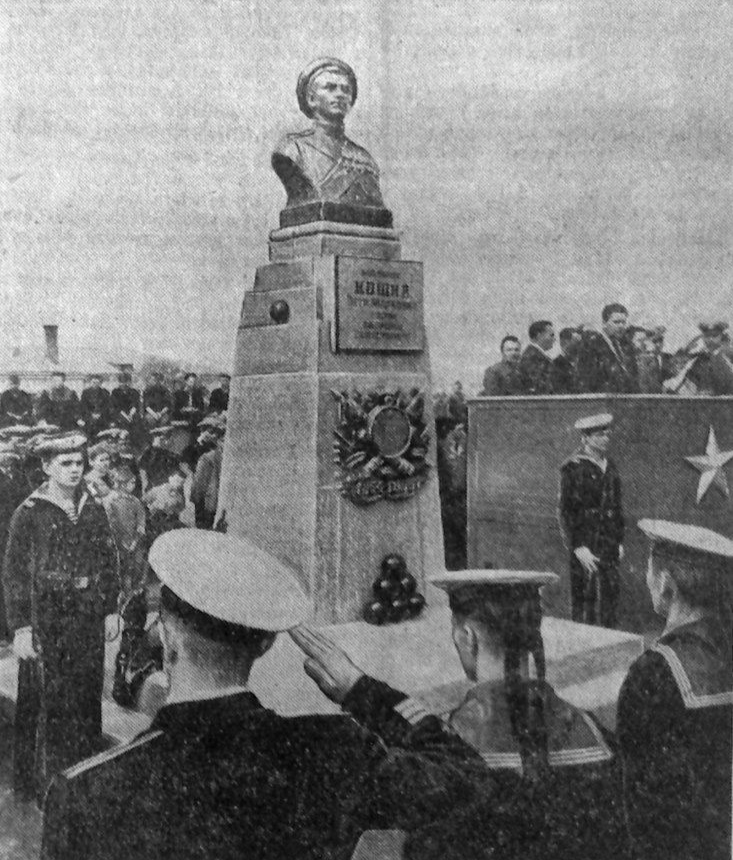
Photo from the newspaper “Radianskyi Krym” dated May 28, 1956
In general, this dilemma itself—"Kishka" or "Koshka"—recalled an excerpt from the work "The White Guard" by the Russian writer Mikhail Bulgakov, who lived more than half of his short life in Ukraine, but, to put it mildly, had no love for either it or Ukrainians:
– “He's a scoundrel,” Turbin continued with hatred, “why, he doesn't even speak this language himself! Eh? The day before yesterday, I asked that rascal, Doctor Kurytsky—he, if you please, has forgotten how to speak Russian since November of last year. He was Kurytsky, and became Kuryts’kyi… So I ask him: what is 'cat' in Ukrainian? He says: 'kit.' I ask: 'And what is a whale?' And he stopped, stared at me, and said nothing. And now he doesn't bow.”
Nikolka laughed loudly and said:
– “They cannot have the word 'kit' (whale), because there are no whales in Ukraine, whereas in Russia there is plenty of everything.”
Just as in the Russian Empire “there were no whales” in Ukraine, so in the Soviet Union a native of the Ukrainian village, Kishka, could only be a “Russian warrior Koshka.” Even if the exposition in the Museum of the Sevastopol Panorama once began with his embroidery-trimmed shirt (vyshyvanka).
It is not excluded that Petro Kishka was recorded in the registers as “Koshka.” For instance, even during the First World War, soldiers mobilized from Ukrainian lands, even with distinctly Ukrainian surnames, were labeled as “Russian” in their personal files—this was facilitated by another term, synonymous at the time with the first: “Orthodox.” However, in 1956, there was no longer a tsarist regime, nor religion as a marker of identity. Moreover, the first years of the “Khrushchev Thaw” were marked by the “gentle Ukrainization” of the Crimean Peninsula after its transfer to Ukraine. Therefore, for creating texts in the Ukrainian language, they could have studied the spelling at least for appearance's sake.
“If only you had studied properly…” In the mid-1950s, Crimea suffered from a shortage of cadres in the field of Ukrainian linguistics—hence “Radianskyi Krym” (and other few publications in the Ukrainian language) was filled with literal translations from Russian, such as “Dobro pozhaluvaty” (Welcome), “Palace of Molodozhoniv” (Palace of newlyweds), etc. Any attempts to return the language its true face could lead to accusations of “bourgeois nationalism”—of which the very same “Radianskyi Krym” could be accused, whose Ukrainian version was published for as long as 4 years.
The researcher of Soviet occupation Pavlo Shtepa recalls that in Ukrainian-Russian dictionaries of the Stalin era, which linguists themselves called “Russian-Russian,” there were such “specifically Ukrainian” words as “bechivka” (string/rope), “derzky” (daring), “rezyna” (rubber), “lyshny” (extra), “lopnuty” (to burst), “svekla” (beetroot), etc. Previous, and especially pre-revolutionary, dictionaries were declared “nationalistic,” “built on false methodological principles,” and designed “to distance the Ukrainian language from Russian as much as possible.” Thus, under the instructions of “Comrade” Stalin, they had to “reflect the connection of the Ukrainian and Russian peoples,” and even compile dictionaries of forbidden Ukrainian words.
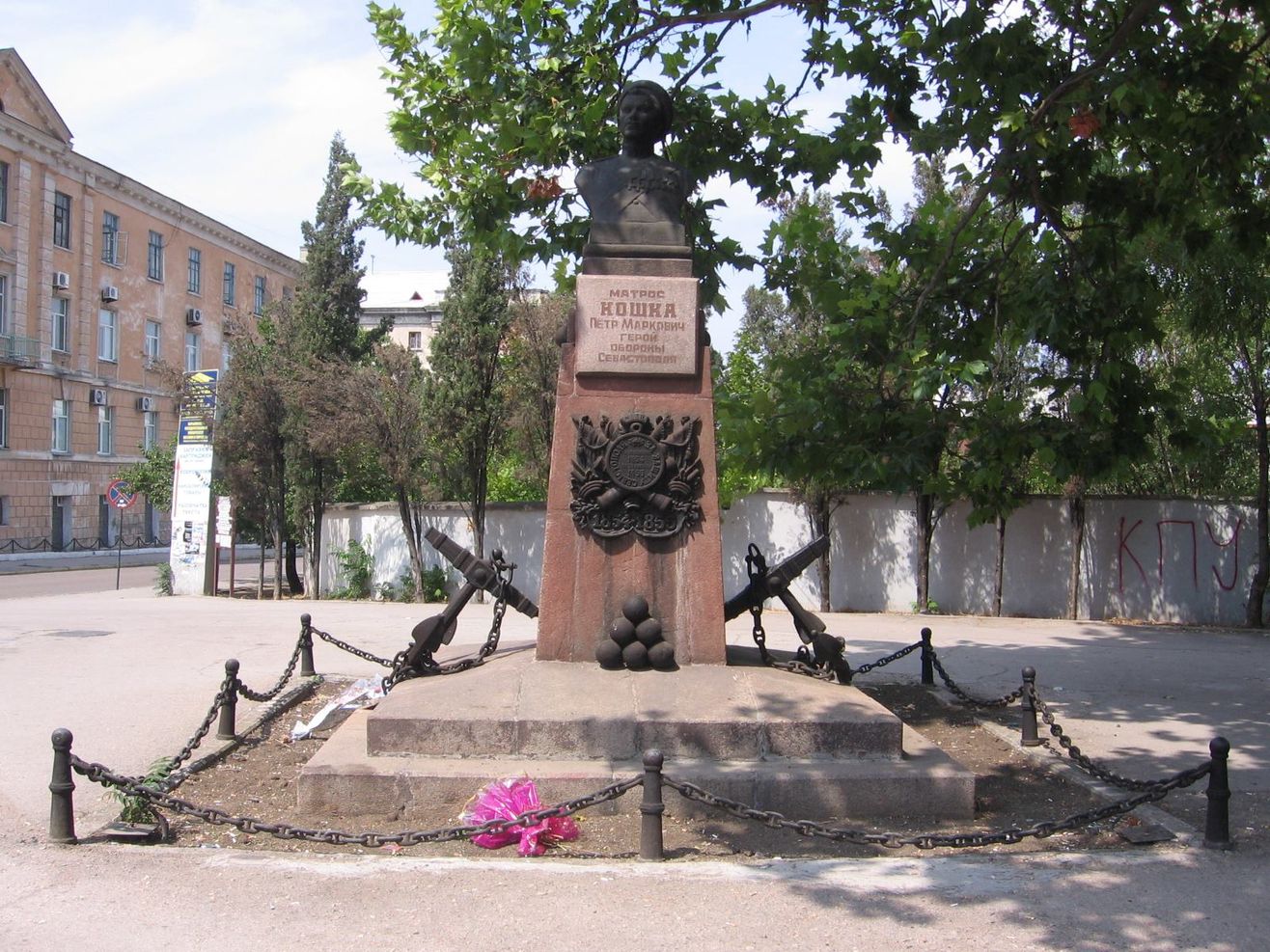
Monument to Petro Kishka in Sevastopol
So there is no need to be surprised that our history is practically unknown to us—especially the pages of our people's existence in Crimea, which in their time were cleaned up and ripped out much more thoroughly than our language. Therefore, it is worth restoring historical justice at least now.