A Peninsula Between Two Seas… and Without Fish
Marine fishing in post-war Crimea.
Petro Volvach, full member of the Shevchenko Scientific Society (NTSh), member of the National Writers' Union of Ukraine (NSPU), Honored Worker of Science and Technology of the AR of Crimea, Crimean resident with 60 years of experience. "Krymska Svitlytsa" newspaper, 2017, Issue No. 23
Marine fishing has always been a fairly important and integral component of the Crimean economy. The presence of two warm seas (the Black and Azov seas), rich in nutritious bioplankton, and the absence of industries harmful to the environment and water areas (metallurgical, mining, and chemical) created almost ideal conditions for the formation of unique natural bioresources in them.
The almost freshwater Sea of Azov was distinguished by its particular richness and species diversity. Seventy-nine species of Mediterranean and 26 species of freshwater fish had commercial importance in it. Kilka, anchovy, gobies, pike-perch, bream, carp, sturgeon, stellate sturgeon, beluga, roach, flounder, herring, etc., were in huge demand among the local population and the fish processing industry. In terms of its productivity (80 kg of fish per 1 km2 of water surface), the Sea of Azov was the richest of all seas of the former Union.
The Black Sea coast of the peninsula was almost not inferior to the Sea of Azov in terms of fish wealth and species diversity of marine fauna. Gobies, anchovy, sprats, herring, beluga, salmon, mackerel, horse mackerel, sardines, mullet, and other fish species have always had commercial importance in the Black Sea. At the peak of its development—in the 1960s and 1970s—the Black Sea basin provided an annual catch of over 1 million tons of various fish species. It was thanks to individual and state fishing that the population of the coastal regions of the Crimean Black Sea survived even in the hungriest years. Old-timers claimed that the inhabitants of coastal areas suffered the least from hunger during the destructive Crimean wars, famines, and natural disasters.
According to statistical data, before the war, Crimea's fishing industry had 9 fish processing plants, 2 canning factories, a shipyard, 5 motor-fishing stations, 27 fishing collective farms, a state fish catch base, and other enterprises. The fishing sector also had 220 motor vessels and 310 rowing boats. 2,500 fishermen worked in the fishing industry. The fish catch in 1940 amounted to 620,000 centners (Central State Archives of Ukraine. – F. 1. – Op. 24. – D. 3672. – L. 5-29).
Unfortunately, the fishing industry, like all other sectors of the Crimean economy, suffered huge losses and material damage during World War II. The low-capacity fishing fleet of fishing collective farms and artels was almost completely destroyed, and small, scattered fish processing plants and facilities ceased their activities due to lack of raw materials. The post-war revival of the fishing sector in Crimea took place quite slowly and painfully. In the fishing collective farms and artels, there was a shortage of vessels, boats, and technical equipment. Many pre-war fishermen of working age either did not return from the war or were deported from Crimea. All these circumstances negatively affected the results of the fishing industry's activities in the first post-war years.
The development of the fishing industry in the Crimean Region was supervised mainly by the Union and republican ministries of the fishing industry and the created Krymderzhrybflot.
As archival documents show (Report of the Party Organs Department of the Crimean Regional Committee of the CPU to the Central Committee of the CPU on the economic potential of the Crimean Region for August 1954), by the end of 1953, a corresponding fishing industry sector already existed. It was represented by a fishing fleet, 10 fish processing plants, 1 fish combine, and 5 inter-district unions of fishermen, which united 30 fishing collective farms. However, they failed to meet planned fish catch targets annually. Thus, in the last year of the Crimean Region's subordination to the Russian Federation (RSFSR), the plan envisaged catching 716,000 centners of fish. The actual catch in 1953 was 450,000 centners (the plan was fulfilled by 63%). The indicators were even worse in all previous years.
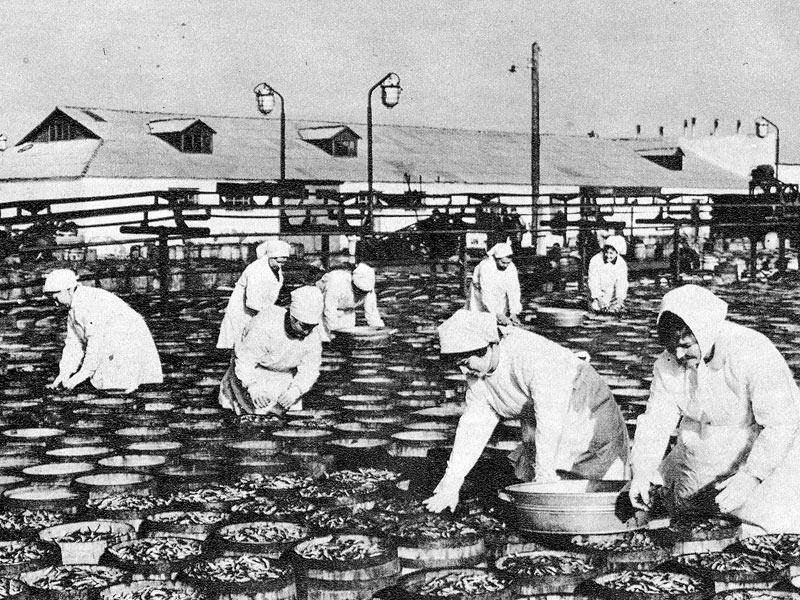
Fishing industry in Kerch, early 1950s
The catastrophic state in the fishing industry prompted the government of the Ukrainian SSR, already in the first year after the transfer of the Crimean Region to Ukraine, to start painstaking work to revive the fishing industry on the peninsula.
On January 19, 1955, the Council of Ministers of the Ukrainian SSR, under the leadership of the relevant deputy chairman, H. Onyshchenko, held a special meeting dedicated to the development of the fishing industry in the Crimean Region. An official representative authorized by the Council of Ministers, Oleksiy Yashchenko from Kyiv, noted in his speech at the meeting that the activities of the Crimean State Fish Trust and the Directorate of Motor-Fishing Farms were extremely unsatisfactory and the situation required radical changes. Simulating hyperactive work, local fishing officials focused their attention mainly on catching low-value fish species (anchovy, kilka, gobies).
But the plans for catching them were not fulfilled year after year. Due to the overfishing of these species, their productivity in the water area of the Sea of Azov sharply declined. Due to the depletion of the fish resource, even of low-value fish species, the Ukrainian government raised the issue with the State Planning Committee for a temporary ban on their catch in the water area of the Sea of Azov.
The report to the draft resolution of the Council of Ministers of the USSR of April 7, 1954, “On measures for the further development of agriculture, cities, and resorts of the Crimean Region of the Ukrainian SSR” stated: “After the war, the state provided fishermen with new, more powerful fishing gear. Currently, there are 300 motor vessels and 1,200 rowing boats in the region.” The number of workers in the fishing sector almost reached the pre-war level—2,200 people, although the fish catch significantly decreased (620,000 centners in 1940 and almost 500,000 centners in 1953).
The meeting decided to carry out the consolidation of fishing enterprises, the reorganization of existing fish factories, and to review the system of labor remuneration in the state association "Rybovylov." The issue of scientific support for the fishing sector, prospects for predicting fish catches, and organizing mullet farms in Syvash, as well as surveying Syvash and the Molochnyi Estuary to optimize their fishing economy and constructing a mussel processing factory in Crimea was raised before scientific institutions of the fishing industry and corresponding ministerial structures. The solution to all these important and rather complex scientific and production problems was entrusted to Ukraine.