Strongly! Beautifully! Carefully! Swiftly!
From the history of the Plast movement in the Autonomous Republic of Crimea.
Maksym Dubovyaz. "Krymska Svitlytsa" newspaper, 2018, Issue No. 16
In the Ukrainian rural tradition, since ancient times, children and adolescents formed semi-rowdy groups where, under the close supervision of the older community, they hardened themselves before the start of Cossack training. In the cities of Ukraine, researchers track the emergence of youth target structures virtually from the beginning of the Modern Era. Thus, according to one source, “the organized life of Ukrainian youth began as early as the 15th–16th centuries and is associated with the activities of brotherhoods—public associations created to protect the rights of certain groups of the population, with religious, charitable, or cultural-educational purposes. Often, separate 'youth' or 'infant' brotherhoods for young people functioned under the brotherhoods.”
Later, with the development of social life in Europe, new forms arose; from the mid-19th century, a certain canon of educational activity took shape, combining elements of spiritual and civic growth with physical training, with various national characteristics. At the beginning of the 20th century, as a result of such developments, the scout movement emerged in Britain and rapidly gained international spread. In Ukraine, this movement took organizational shape on April 12, 1912, as "Plast."
The severe social cataclysms of the subsequent decades gradually removed scouting and "Plast" from the realities of our country; the Soviet youth were forced to accept the sole alternatives of the Pioneers and the Komsomol. However, "Plast" did not die out; it operated in the Ukrainian diaspora, spread across the world, and is active today in all countries with a significant Ukrainian diaspora.
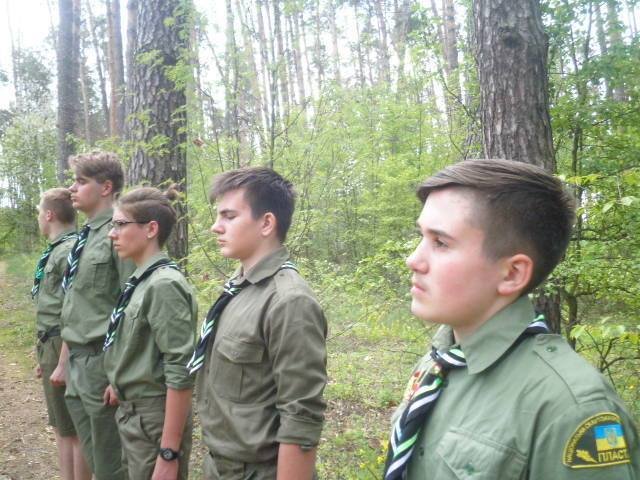
Crimean Plast member Volodymyr Shchekun (far right)
With the rise of national activity, "Plast" began to revive in Ukraine. In December 1989, this process took organizational form, and on August 30, 1990, the first detachment of the revived "Plast" took its oath. With the acquisition of independence, the Plast movement spread across Ukraine from west to east. According to data, by 2012, the total number of Plast members reached up to 5,000 people.
In the Autonomous Republic of Crimea, the first Plast units also appeared in the mid-1990s. But, as some sources testify, “while in the first years of independence there were several Plast organizations here: Simferopol, Sevastopol, Yevpatoriya, Yalta, and Kerch, since 2005 only one has barely survived—in Sevastopol.”
On March 3, 1997, the first General Assembly of the Sevastopol branch (stanytsia) took place. This first step in the formation and development of the National Scout Organization of Ukraine (NSOU) Plast in Sevastopol is the date of the official founding of the organization. Individual Sevastopol Plast members attended the first camps in the Carpathians back in 1995–1996. They made a name for themselves for the first time at the Orlykiada in Rivne in the autumn of 1996, winning third place in the competition.
The first patrol (hurtok) was named "Chayky" (Seagulls). It consisted of four girls—Mariya Protsak, Zina Belanyuk, Iryna Topilina, and Yulya Yermoshkina. Over the time of the Sevastopol branch's existence, the Plast members went through many camps.
It should be noted that Crimean Plast members constantly participated in training courses, competitions, and camps “on the mainland,” and hosted guests from Greater Ukraine in Crimean summer Plast camps. The last of these took place in the summer of 2013. This is how the "Plast Portal" wrote about it—the district local history and educational camp of the Crimean District “Principality of Theodoro”: “The first stage of the camp took place near the cave city of Eski-Kermen, where long ago the inhabitants of the medieval state of Theodoro lived. On the first day of the camp, active camp set-up and introduction between the participants began.
Everyone received their camp nickname, and from then on, everyone addressed each other only by nicknames. A specific nomenclature system operated at the camp, in accordance with the camp's legend: the commandant was the prince, the sergeant-at-arms (bunchuzhnyi) was the executioner, the scribe was the philosopher, the quartermaster was the merchant, and the doctor was the druid.
Already in the first days, the campers had the opportunity to feel like real medieval warriors and practice archery, throwing knives, and shurikens. On the beautiful holiday of the Holy Trinity, guests visited the camp—friends of "Plast," in particular, the chaplain of the Crimea District, Archbishop of the UOC-KP Fr. Klyment, who held a prayer service for the campers, and the head of the Crimean Center for Business and Cultural Cooperation “Ukrainian House,” Andriy Shchekun.”
Five years have passed. Crimea is occupied. Of course, its activity on the peninsula is no longer possible at all, but, as a hundred years ago, Plast members act in exile, maintaining the continuity of tradition and educating a new generation for a new revival. As Andriy Shchekun recalls: “'Plast' for Ukrainians, for the national idea, is a heritage from our older generation that must be revived. If we speak, for example, of Bakhchysarai, there were no conditions, no organizational structure, to create a 'Plast' branch in this small town. First, we had to create a base: those children who could and would want to join 'Plast.'
And we started with opening a group in a kindergarten, then classes, and later a school with Ukrainian as the language of instruction. Then—active participation: mine and other public activists', invitations to active Plast members from Sevastopol and other regions of Ukraine to demonstrate and explain to people.
Of course, once we had created the ground, I then communicated with "Plast" in Sevastopol and Simferopol regarding the need to open a troop (kurin) or patrol in Bakhchysarai. My oldest son, Oleksiy, initially traveled to Simferopol for all events. Then my middle son, Volodymyr, grew up and also joined "Plast," and today he is actively involved in it. I will say frankly that "Plast" made a huge impression on both of my sons; that is, it fully justified my expectations as a father! The children changed, they grew up, they became leaders. And that small "Plast" in Bakhchysarai—even this patrol that formed around my sons—was not in vain. Because "Plast" is a union of free people!”
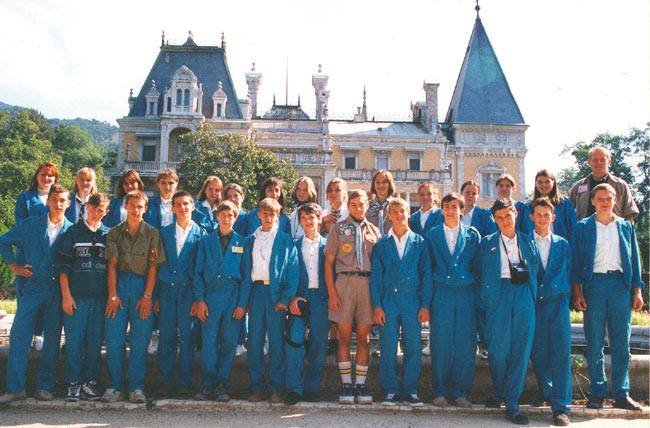
Meeting of leaders of youth organizations of Ukraine, August–September 1997, Artek ICC
Confirmation of the strength of the influence of Plast training on the young is the fact that currently, Crimean Plast member Volodymyr Shchekun, through persistent efforts, relying on his own experience and cooperation with Plast friends, has created a Plast branch “in exile”: in the village of Shchaslyve in the Boryspil district. The patrol is named exactly that: “Shchaslyvi Levy” (Happy Lions). Of course, they are still “cubs”! But children grow up.
Photos from the archive of the Shchekun family and http://plast.ukrlife.org