A Journey to Crimea in 1920 (Abridged)
An abridged version of Levko Chikalenko's memoirs about Crimea, its political and social life.
Levko Chikalenko. Newspaper "Krymska Svitlytsia", 2020, issues No. 3-9
In the autumn of 1920, when our front, which ran south of Lviv all the way to the Romanian border, stood in one place for some time and nothing yet portended such a sad end as late autumn already showed us, Colonel Noha arrived at the headquarters of our command from Crimea from Wrangel, with credentials signed, as is proper, by the command of Wrangel's army.
I no longer remember who signed them, on behalf of which specific person or on whose initiative he came to us, but the fact remains that he was received as an official representative. He came to us in order, on the initiative of the "Command of the Armed Forces of South Russia", to invalidate the hostile attitudes that had prevailed between the two armies after the sad memory of the autumn of 1919, when the White Moscow troops so disgracefully threw us out of Kyiv, dividing us from the Galicians and, finally, already faltering themselves, drove us into the triangle of death near Liubar.
This colonel hung around for a long time both at the commander's headquarters and at the Chief Otaman's headquarters in Khryplyn, until, whether circumstances demanded it or perhaps he himself had somehow influenced it, our government decided to send its delegation to Crimea in response to their courtesy.
Our government, mainly the military, really wanted to finally reach some understanding with Wrangel, because, firstly, this was required by strategy when fighting a war against a common enemy – Red Moscow, and secondly, too many "charming" letters and rumors were coming about the sympathy of Wrangel's entourage towards Ukrainians, about the "Ukrainization" of the army, and about our people in high positions there. Probably, Colonel Noha himself did quite a lot in this direction so that both in the words and actions of our military command, hints favorable to an understanding could be heard.
Our civil government, giving its consent to the military to send a delegation to Crimea, demanded that a person who was at least somewhat oriented in public and political affairs be included in its composition, and that somehow, if possible, more reliable information be brought from Crimea about what was happening there. The choice fell on me. Premier Prokopovych informed me of this, and from Tarnów, without delaying long, I arrived in Khryplyn, where the headquarters of the Chief Otaman was then located.
So, when the Directorate government, or rather the high command, in August 1920 faced the need to send a delegation to the "Command of the AFSR", which was then already headed by Gen. Wrangel instead of Gen. Denikin, I was also assigned to this delegation as a person more or less competent in Cossack affairs and the issue of the Volunteer Army. Having discussed the matter with the Premier and the Chief Otaman and having received certain advice regarding my behavior and the purpose of the trip itself, I still had to go to the army headquarters to obtain the same credentials from the army as had already been received by our delegation members who had left for Crimea via Romania, where they had to stay for several days and wait for me.
Having obtained credentials in the name of an artillery captain (sotnyk), I returned to Khryplyn, got a brand new military uniform from the chief of the otaman's guard, bought what was needed in Stanyslaviv, and, finally, fully secured with various "passes" and money from the Ministry of Finance, went through Chernivtsi to Bucharest. There, an unpleasant runaround through various "siguranzas" detained me for a few days, and with a week's delay I finally reached Galati, where our delegation, headed by Lytvynenko and consisting of Col. Krat, Lieutenant (khorunzhiy) Romensky, and Ivan Bludymko, was waiting for me and for the large steamship "Saratov", which was to take us from Reni to Sevastopol. I successfully met up with ours at the hotel at a time when Col. Noha, who was traveling with them, was not there. When Col. Noha appeared, we had already got to know each other well and quickly agreed on the specific matter that both they and I had outlined earlier, entirely independently, without consulting each other.
It is interesting that neither Sevastopol nor Yalta, although there is so much Eastern element in their population and architecture, never evoked in me a comparison with either Odesa or the small and large towns of Romania.
The steamship carrying us was an ordinary tugboat, which, taking us aboard, began its voyage along the wide and mighty river, connecting with thick ropes to huge barges (berlyny) full of Wrangel's future soldiers. The fact is that during the defeat of the Volunteer Army by the Reds in the late autumn of 1919, quite large parts of it ended up on Polish and Romanian territory, and now, by order of the Entente, they were being directed to Galati, and from there by water, with a transfer in Reni to large ocean steamships, they were transported to Crimea under Wrangel's command. These were mainly the remnants of Bredov's units, which had fought against us, and which we later met everywhere as internees at the stations of Galicia, and most of all in Stanyslaviv, where they stood for days and weeks, moving slowly in cargo trains from internment camps in western and southern Poland to Romania.
On all these barges attached to our vessel in Galati and along the way, where they stood tied to the shore, there were many men, women, and children. Whether by their own request or by the grace of the steamship command, very quickly several dozen officers' ladies with young children gathered on the deck and in some cabins of the steamship. It was pitiful to look at these ragged, shabby ladies and young ladies, mostly wives, sisters, and daughters of once brilliant guards officers, who settled with unconcealed joy and pleasure – after dirty camps, trains, and barges – on the clean steamship. Among the officers, there were several acquaintances of our Colonel Krat, who, on the occasion of the meeting, or rather, perhaps, on the occasion of a protective cabin on the steamship, organized quite solid "libations".
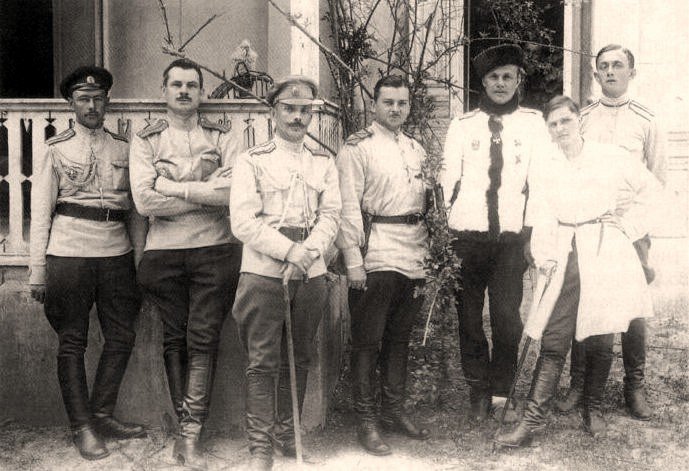
Commander of the Crimean Corps Lieutenant General Ya. O. Slashchov (third from right) with members of his staff. Crimea, April-May 1920
So we finally reached Reni. Here we did not go ashore, but simply transferred from our steamship via a rope ladder to the large steamship "Saratov". Our steamship headed straight for Yalta, where it was to land all the "Bredovites". We had to get off there as well.
While Col. Noha was looking for means to get us to Sevastopol, we, not without his help, found some of the Ukrainians whom some of us knew were staying somewhere in Yalta. I had instructions from Prokopovych, in case of staying in Yalta, to find the well-known Ukrainian educator in Yalta, Horyansky*, a former student of the Kyiv Theological Academy related to the Durdukivsky family, and also to find Prokopovych's student from the Zhekulina gymnasium in Kyiv, Miss Poltoratska, who, suffering from tuberculosis, had been living in the Yalta sanatorium for a long time. We spent a whole day in Yalta, and during this time I managed to find both.
From Horyansky, we learned about the mood of the Ukrainian community in Crimea, about its fears and hopes, as well as about who among the leading figures held which orientation, which, of course, was useful to us in preparation for Sevastopol. From him we also received advice, if we had enough time, to visit the eternal resting place of Stepan Rudansky. I also managed to visit Poltoratska, which brought her great joy, perhaps, indeed, the last one... A heavy impression remained with me from this meeting.
I went to the cemetery, to our glorious Deceased. The rest of ours and Horyansky were also there. We sat in silence, then expressed envy of the deceased, who found his eternal resting place amidst such beauty on a high hill, with a wide horizon of the sea, under cypresses. From the cemetery we went to Horyansky's place to lie down earlier and get up earlier the next day so as not to miss the small cutter that was to take us to Sevastopol. The weather turned out to be windy, the small vessel kept close to the shore, and it did not toss on the waves so much as it jerked unpleasantly. Sickness from such jerking, it seems, does not happen, but it was unpleasant, and very much so.
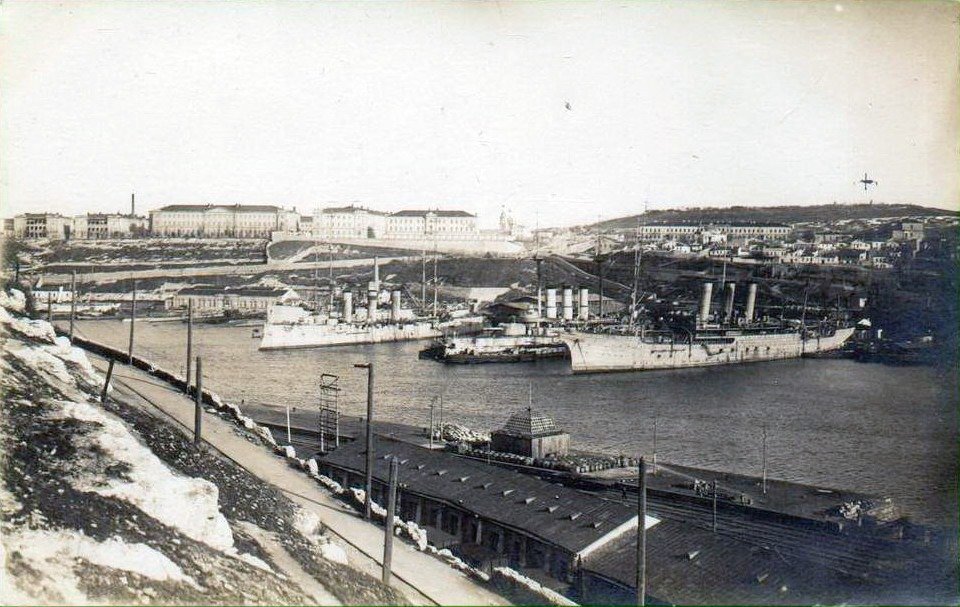
I stood on the starboard side all the time and recognized or tried to recognize those places that I had walked through as a youth, traveling on foot from Sevastopol to Gurzuf and back. From Balaklava the places were unfamiliar and uninteresting to me. This part of Crimea is not mountainous, although it is a rather high plateau. Only when entering the Sevastopol Bay was my curiosity aroused again, because on the right was old Chersonesus, excavated in places, where some remnants of ruins could be seen from the ground, and straight ahead and to the left, both far and near the shore, with cliffs or sand dunes everywhere, wherever you looked – buoys and lanterns on them, showing the way to vessels at night.
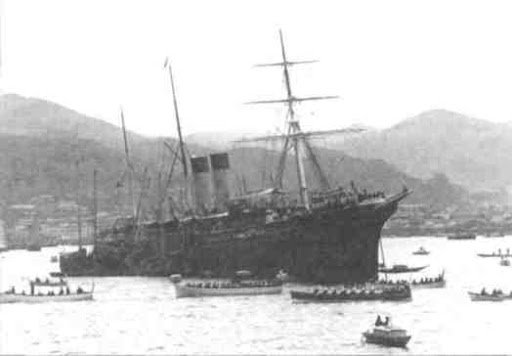
Steamship-cruiser "Saratov"
Col. Noha, as it was seen, communicated by telephone with Sevastopol, but said nothing to us about it, and we, of course, did not ask him. When the cutter docked and all passengers went ashore, we went out too. And here it turned out that not everything was going as Col. Noha had expected. He was already worried that no one came out to meet us.
He ran off somewhere frequently, probably to the telephone, and finally asked us not to worry and wait a little, because he had to talk about our accommodation. Finally he appeared and took us in three carriages to a hotel, where he settled the seniors – the three of us – showing some papers, and led the two lieutenants to a requisitioned accommodation in the house of some doctor. After this, he came back to us and, starting from very far, explained many things to us that we had not even suspected.
It turned out that during his absence, important changes had taken place in the constellation of political influences in Wrangel's entourage. It turned out that his trip to us had occurred under the influence of Gen. Slashchov. It was his assessment of the political and strategic position of the "Command of the AFSR" that caused Col. Noha's trip to our army. It seems that among the forces that made up Slashchov's entourage, Noha played not the least role. Now, as it turned out, Slashchov was not only "out of work" but also "in disgrace"**. It was clear that all this was very unpleasant for Col. Noha, and we felt awkward.
Assessing the situation in a simple way, namely, that Col. Noha was more uncomfortable than we were, I began to reassure him that, well, things would work out somehow, and that obviously these are such times and such circumstances now that people often do things they repent of a minute later.
This put Noha in an optimistic mood as well, and we began to guess together, as one side, what would happen next and how. Noha was sure that his trip was not such an ill-considered step on the part of the ruling spheres, and that even if Slashchov was "out of work", the matter could not change much because of this. So we decided not to worry, but to wait patiently for what would happen next. We rested, and then, taking our lieutenants, walked a little around the city, sat on benches in some miserable public garden or park, and later, having had dinner, went to our quarters with the thought "what was, we saw, and what will be – we shall see".
- Pavlo Horyansky (1878-1935) – head of the Yalta Ukrainian community (1917). At the beginning of 1918, under the conditions of Bolshevik terror, he organized the elections to the Constituent Assembly of Ukraine on the territory of Crimea. During the Denikin occupation of the peninsula, he headed the Small Council (executive committee) of the Regional Ukrainian Council in Crimea. After the congress of Ukrainian public organizations of Crimea in August 1919 in Sevastopol, he was commissioned to take upon himself the defense of Crimean Ukrainians with the rights of a consul of the UNR on the peninsula.
** Lieutenant General Yakov Slashchov (Krymsky) in 1920 was the commander of the Crimean Corps of the "AFSR". In December 1920, he evacuated to Istanbul (Turkey), where he published his memoirs "I Demand Judgment of the Public and Transparency. Defense and Surrender of Crimea" criticizing the Wrangel movement. At the end of 1921, at the invitation of the All-Russian Central Executive Committee of the RSFSR, he left for Moscow via Sevastopol along with other participants of the "White movement", calling on the soldiers of the "Russian Army" to go to Soviet Russia. He joined the Red Army, taught at rifle-tactical courses at the school for command staff. He published articles on tactical issues. In January 1929, he was shot in his apartment in Moscow.
In his memoirs, Slashchov recalled the episode mentioned in Chikalenko's memoirs as follows: "Even during my stay in the Caucasus, seeing the failures of the Volunteer Army, Wrangel became interested in Crimea. At his insistence and under the patronage of the head of the counterintelligence of the Headquarters, Seminsky, his officer, Colonel Noha, was sent to Crimea as an informant with instructions to watch me. Colonel Noha, without any obstacles from my side, went about his business, but, to the great regret of the Headquarters and Wrangel in particular, found no confirmation of the rumors spread about me.
Despite his counterintelligence activities, he turned out to be an honest man and sent Seminsky a detailed report, which later fell into my hands. Noha, in his report, highlights my energy and efficiency in defending Crimea and concludes with a brief summary: 'Slashchov holds the front and the rear, the front will hold as long as he solely heads the army,' etc. This report, of course, was not liked at the top. Surveillance over me was entrusted to the official Sharov, the head of the corps counterintelligence, which was not subordinate to me. During Wrangel's command, Noha was dismissed from service."
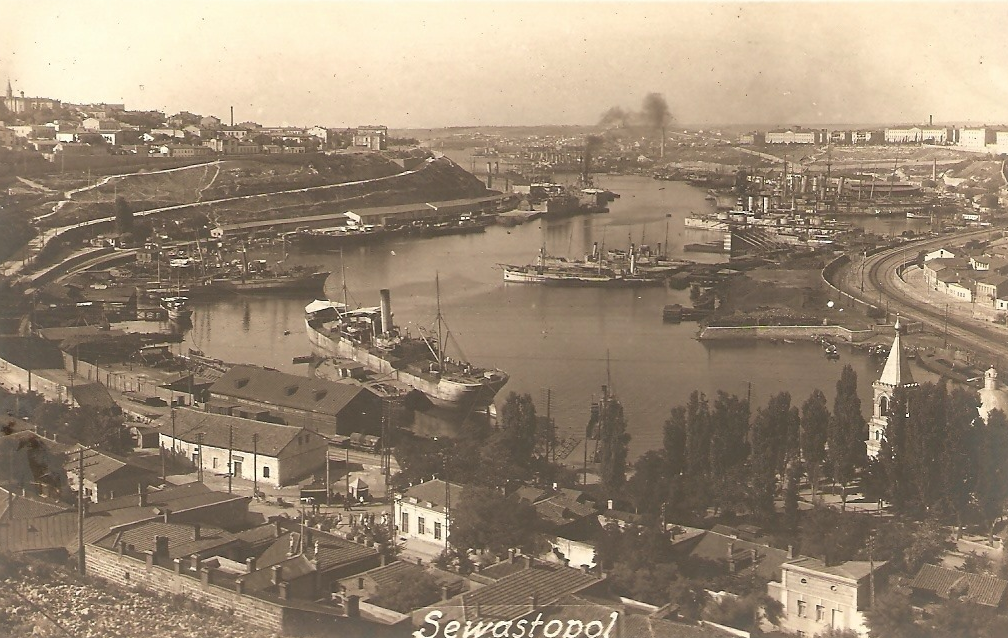
Sevastopol, 1920
On the next day, somewhere before noon, we went to the headquarters to present ourselves to Gen. Kiriy – the quartermaster general – a person very influential in Sevastopol at that time. Our colonels knew General Kiriy. He, as they recounted, had been in our army since the beginning of the revolution. He was even, for some time, the chief of staff of, if I am not mistaken, the Slobidska Kish, which, under the leadership of S. Petliura, defended the approach to Kyiv on the Left Bank in the Kharkiv direction. Then he disappeared somewhere, but where and how – they either did not recall or simply did not know.
One of the colonels only recalled the rumors that circulated in connection with his departure. It was said that he did not want to serve in our army because "the Central Rada took away his ancestral land". He was from the Chernihiv region, somewhere near Nizhyn, a Cossack, and had 50-60 desiatinas of land, with the loss of which he could not reconcile himself. What happened to him after that, no one knew, nor did any of them know when he got involved with the Volunteer Army*.
On the way to the headquarters, as on the previous day when we walked around the city, I felt awkward all the time. The local population looked at us with such active surprise that I, unused to being a spectacle, kept inspecting myself and my companions, not understanding the reason. It always seemed to me that something was wrong with our appearance. Most of all, of course, I was afraid for myself, thinking that everyone could see that I was not a soldier but a disguised "civilian". I kept close to Col. Krat so that he could tell me how to behave with senior military ranks, because for some reason these "distinctions" did not stay in my head. I could easily tell soldiers from officers, but it was very difficult for me to understand officer ranks. Krat reassured me, advising me to be attentive and react only to the generals we met, and to pay no attention to colonels. And indeed, most of the officers were colonels, and if one were to react to all of them, one would have to salute incessantly in all directions. And we did not meet that many generals.
But, of course, the reason lay not in any flaws in our uniforms, but in the uniform itself. The residents of Sevastopol had seen various uniforms, but not the Ukrainian one. In my opinion, our uniform was not something bizarre. I would say it was quite nice, and most importantly, we all had new, clean, khaki-colored uniforms, which could not be said about the Volunteer Army. Perhaps the passersby were surprised by the colored patches on the collar, the tryzubs (tridents) on the sleeves and caps, specific to each branch of service. The infantrymen had blue, the cavalrymen – yellow, and I, as an artilleryman, – red.
Only Colonel Krat had a completely individual outfit: dark blue, almost black trousers with thin silver stripes (lampases), a less colorful tunic, and a sheepskin hat with a silver cross on a small shlyk, and he wore a Caucasian saber at his side. All the others wore short flat bayonets on their belts. Finally, I got used to the curiosity of the passersby, calmed down, and took it for granted. Colonel Noha also seemed to have calmed down. Before our visit, he had probably been somewhere and received reassuring information.
Gen. Kiriy received us very favorably, but did not ask us to sit down. Instead, he led us to a far corner of a huge room, where several officers were examining something on a large map spread out on a large table in the middle of the room. He apologized because he was very busy, asked if we liked our quarters, whether it was clean and quiet, and advised us not to worry but to live quietly and look around the city, for we would surely find more than one family of acquaintances here.
He advised us to eat in the dining room run by the well-known Kotliarevsky family from Kharkiv-Poltava; the dining room was open all day until late, so we would find everything we needed there, as he had already asked the ladies to take care of us, and he asked Col. Noha to take us there and introduce us to the ladies. He told us that Col. Noha would continue to take care of us and inform us of everything we needed. With that, our visit ended...
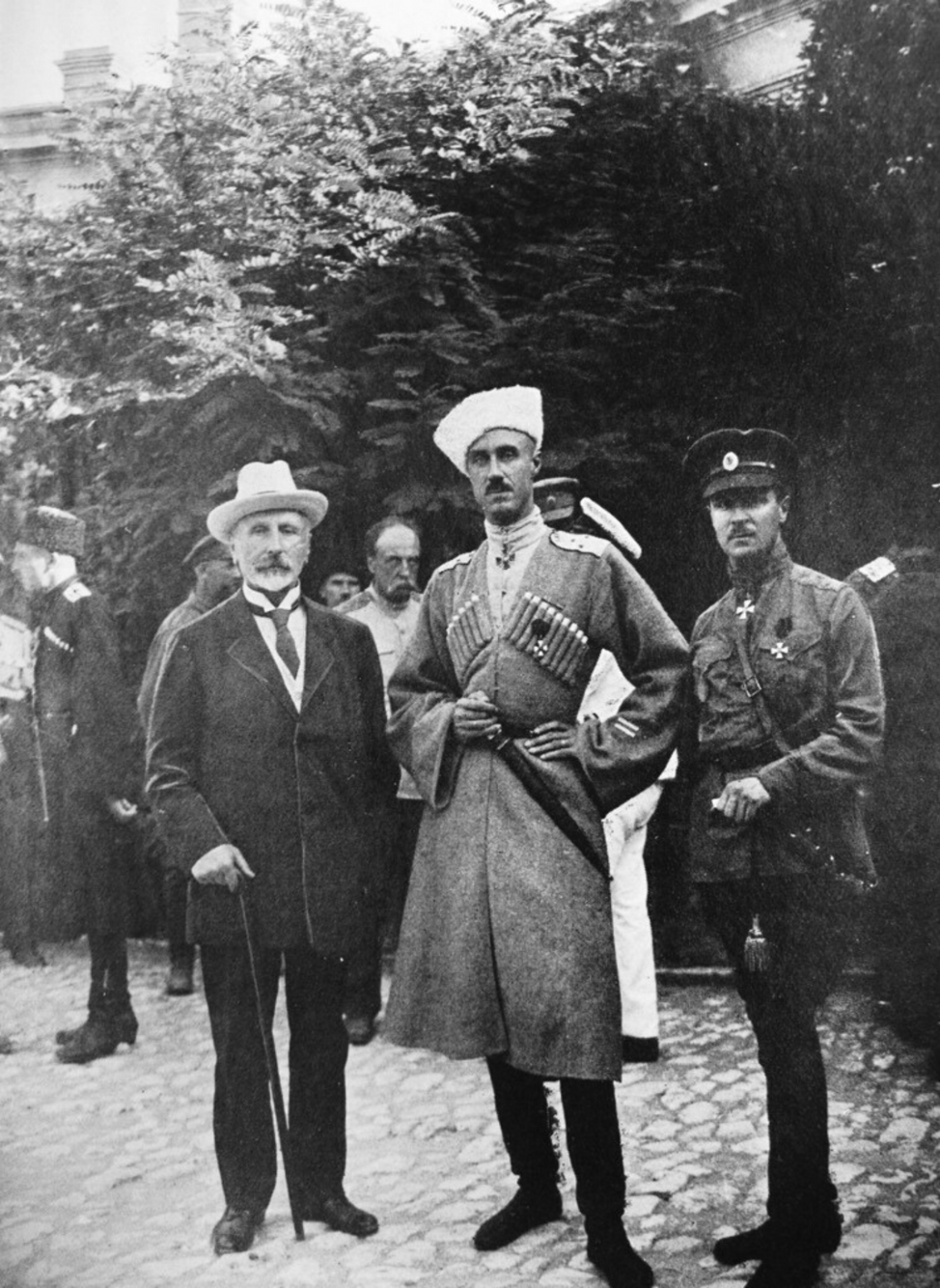
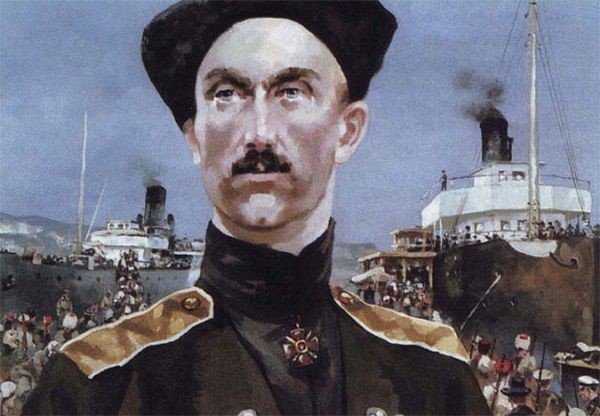
Head of the Government of South Russia Aleksandr Krivoshein, Lieutenant General Pyotr Wrangel, and his Chief of Staff Pavel Shatilov. Sevastopol, 1920
Gen. Kiriy was right about acquaintances. In the dining room we were received as dear guests. The staff consisted of two young ladies and their mother, an older lady who sat at the cash register. We got acquainted, sat down at the table, and the eldest of the young ladies, serving us, kept asking us about everything and telling us stories. I think that to some extent it was their duty here to inform someone about the people who ate there. It turned out that this lady's brother was a secretary to Krivoshein, who was Wrangel's prime minister at the time. Their family was related to many noble families of the Poltava and Kharkiv regions, and if not related, then well acquainted.
They were obviously aware of all the affairs of these once noble, probably Cossack, families. We had common acquaintances, as it turned out – the Leontovyches, Ustymovyches, she also used to know the Starytskys; in a word, there were plenty of topics on which she spoke very willingly and at great length. Whether because of common acquaintances, or the fact that I knew the Poltava region well, or perhaps some special instructions from above, she showed marked attention to me. Very quickly I learned that she liked my uniform, that I resembled Enver Pasha, and finally, a few days later, in her free hours, she undertook to show me Sevastopol, the sea, and a few days after that we were already boating and swimming in the sea.
I not follow the local newspapers, unfortunately, but in one of them, or perhaps there were not many of them in general, a note was published about our arrival. I learned about this because I received two letters from Simferopol, one from Acad. Vernadsky, and the other from a colleague from Khv. Vovk's anthropological seminar in St. Petersburg, A. Z. Nosov**. In the letters, both asked me, if possible, to visit them in Simferopol, where they were undergoing treatment or resting.
- Vasyl Kyrei (Kyrii, Kiriy) was born in Baturyn in 1879. He was a general-khorunzhiy of the UNR Army. Not recognizing the authority of the UNR Directorate, he joined the army of General Anton Denikin, where he was appointed chief of artillery supply. In the Volunteer Army, he was the chief of the Military Technical Directorate, referee of General Pyotr Wrangel on Ukrainian affairs (he was responsible for diplomatic relations with Ukrainian political and armed forces). He headed the mission in negotiations with the delegations of Symon Petliura and Ukrainian insurgents regarding joint actions against Bolshevik Russia. In 1920, with the remnants of Wrangel's army, he left for Turkey. From 1924, he resided in Czechoslovakia. He died in Prague in 1942.
** Anatoliy (Anatol) Zinoviyovych Nosov (Nosiv) – anthropologist, ethnologist, and archaeologist. He worked as an assistant to the Ukrainian scientist Fedir (Khvedir) Vovk (Volkov). He was Levko Chikalenko's teacher. In 1919, due to consumption, he left for Crimea, where he lived until 1921. In 1929, he was arrested in the case of the "Union for the Liberation of Ukraine", in 1933 – in the case of the "Ukrainian Military Organization"; he was sentenced to 5 years in corrective labor camps. After exile, he worked in the local history museum of Yalta.
The date of death is indicated as 1941. According to the memoirs of Yuriy Shevelov, "when the evacuation of Crimea began during the German offensive, along with other 'unreliable' people, Tolya and his family were loaded onto a special steamship. This steamship never delivered its human cargo anywhere." Such an assertion makes it possible to assume that Nosov was one of the passengers of the motor ship "Armenia", sunk on November 7, 1941, by German aviation near the coast of Crimea.
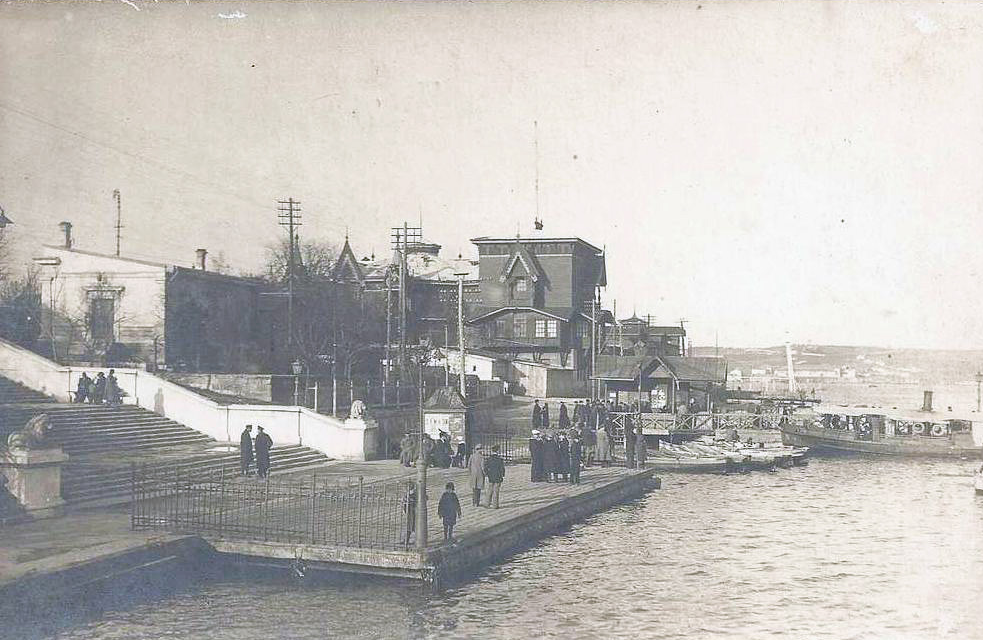
The first to find us in Sevastopol was Viacheslav Lashchenko, whom I knew slightly from Kyiv. Viacheslav lived in Crimea and since the beginning of the revolution had been conducting some national work here. I was pleased to learn that he had preserved several issues of the first Ukrainian newspaper in St. Petersburg, "Nashe Zhyttia" (Our Life), which Mr. P. Fedenko and I had published from the very first days of the revolution. They had even published here, as separate leaflets, two of our (mine and Fedenko's) popular articles on federation and autonomy.
Later, I got acquainted with Chernysh – one of the most active Ukrainian socio-political figures here. He himself was from Kyiv, and how and why he got here I did not ask out of delicacy, but from the way he treated the UNR, it was clear that in his person we had a sincere and active friend. From him I learned a lot about the state of the Ukrainian cause here, about the number of our supporters, and about their work in the direction of settling Ukrainian-Russian relations, which had been fundamentally ruined and inflamed during Denikin's times. Through him, I got acquainted with Ivan Mykolaiovych Leontovych and with many of our more and less influential public figures of Ukrainian origin.
Several of my classmates from the Kyiv gymnasium also found me, whom the turbulent waves of the civil war had washed ashore in this distant land. Kozachevsky found me – a Russian Social Democrat in gymnasium times, who later moved more and more to the right. Kryzhanivsky also found me – a man without any national or political sympathies, but a man who knew everyone. Korobchenko, completely inconspicuous in our class and seemingly without any aspirations beyond a personal career, the son of a Kyiv confectioner, and now a quite well-off local dentist, also found me.
From them I learned many different details about former gymnasium classmates, whom I had never met after completing secondary education. The same went for the teachers, some of whom had enjoyed our student sympathies in their time.
My former classmates were prompted to meet with me, and they all asked me about the possibility of obtaining a Ukrainian passport to leave Crimea for abroad. Kozachevsky, in particular, asked about such possibilities in great detail; he eventually succeeded in leaving, as I met him once in Paris while staying there in 1926-1928. Equally a surprise to me were the visits of my old friend since childhood, Sashko Voloshyn, the son of the well-known Ukrainian public figure Oleksandr Fedorovych, who worked in the Ananiv zemstvo and was widely known as a musical ethnographer and compiler of several collections of songs.
I met him later occasionally in various cities of Ukraine or only heard some things about him. He had chosen the career of an actor in the Russian theater. He was a fairly popular entertainer (conférencier) and declaimer.
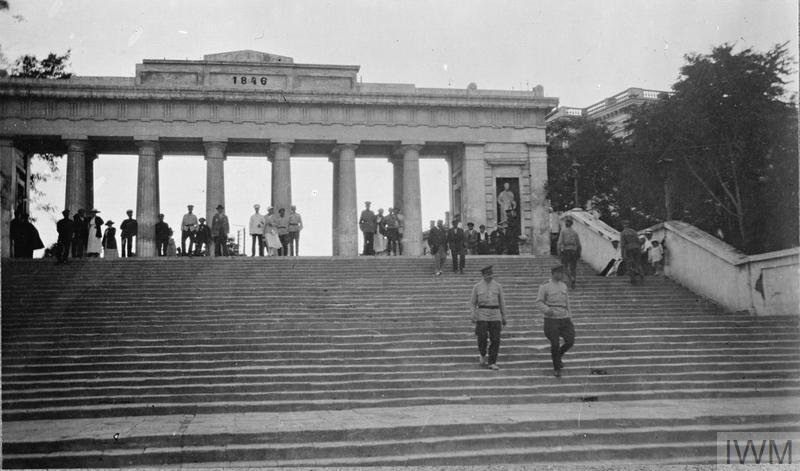
So, some days into our stay in Sevastopol, when our life had already entered a routine and we walked together after breakfast or dinner to some small garden for a walk, Sashko Voloshyn approached me. After the usual inquiries about minor things, he asked me if I would agree to visit the famous Russian writer Arkady Averchenko*, who lived here, confined to bed by illness, and who would like to meet me and ask me about some things. I agreed and immediately arranged a meeting place with Sashko to visit Averchenko together.
The acquaintance with Averchenko has remained in my memory to this day as one of the intriguing events. In the room, a man of some strange anthropological facial structure lay on the bed. Having greeted him and sat down by the bed, I immediately asked what exactly caused his desire to see me, and how exactly I could serve him. I still do not understand the reason for Averchenko's interest in the Ukrainian cause, which he showed by asking me question after question. Thus, I had to tell him briefly the history of our national movement in recent times, from somewhere before the revolution of 1905 to the last days.
When I reached the events of the Directorate's struggle against three enemies at once, in northern Podillia – with the White and Red Russians, and with the Poles, and moreover in the face of a possible armed conflict with the Romanians, Averchenko's face became the face of a sufferer, a martyr, and tears came to his eyes... Maybe he just felt bad at that moment, maybe the illness just made itself felt more clearly at that moment, but for some reason I attributed this to interest in my words. Or perhaps, somewhere in the depths of his soul, something began to ache, something began to burn that he had not felt before. After all, many Little Russians like him became Ukrainians when something burned inside them, and when all their life up to that point suddenly seemed to have been lived not as it should have been.
I also had an interesting conversation in those days, this time with a larger group of people. In the same garden, an unfamiliar young man approached me. Asking if I was Chikalenko, he handed me a note. It was written by Halya Rudenko, the sister of my St. Petersburg classmate, Serhiy Ivanovych Rudenko, a senior student of Fedir Kindratovych Vovk. And here was an unexpected request – to come to her place in the evening for a cup of tea. I went. In a large room I found Halya surrounded by five or six young guys who were apparently eager to look at an exotic bird – a Ukrainian. What a different picture from the one in Averchenko's room. Here everyone, and most of all Halya, was simply boiling with rage towards everything Ukrainian, and most of all because the development of events had brought them together with me here.
To this day, though in a different way, I wonder why invite a person to your place towards whom, perhaps not personally but spiritually, you feel nothing but anger?.. And here was an interesting conversation. Halya was practically hissing, while the others, perhaps because they were not well acquainted, calmly asked about my view on the course of events throughout the revolution and on the change in the policy of the "Command of the AFSR". This group was somehow connected with the theatrical world, but I did not figure out whether they were connected with Ukraine or if the events had simply brought them here from all ends of the Russian Empire. I stayed at Halya's for quite a long time, drinking tea and bickering with her.
It was already past midnight when I returned to my hotel through the empty streets. On the way, a group of soldiers – some sort of security patrol – stopped me. Of course, for form's sake, they asked for a document, although they could see well enough by the uniform who I was, and, returning it to me, remarked that walking in the streets at night had long been banned in the city. Having expressed regret that no one had told me this so far, I finally reached my hotel, not without difficulty.
- Arkady Averchenko was a satirist writer, theater critic, and playwright. He was born in Sevastopol. In 1918, he took a negative attitude towards the Soviet regime. He returned to his native city. From July 1919, he worked in the newspaper "Yug" (later "Yug Rossii"), campaigning for help to the Volunteer Army. In early December 1920, he evacuated from Sevastopol to Istanbul, later moved to Prague via Sofia and Belgrade, where he died in 1925.
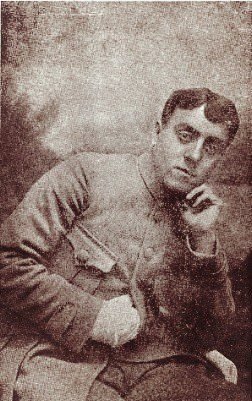
Oles Kozyr-Zirka
One of our local acquaintances brought us together one day with two insurgents from Ukraine who, in the maelstrom of military events, found themselves here in Crimea and were probably connected with the relevant agencies of the military government.
One of them was an extremely interesting person. He told us that he was originally from the city of Scutari on the lake of the same name in Macedonia. The son of wealthy parents, as a youth, having finished secondary school, he managed to get to Switzerland and enter the medical faculty of the university in Geneva. There he met our Ukrainian woman from Bohuslav in the Kyiv region and married her. Upon completing his studies, he went with his wife to her home.
He from the stories of his family knew that his grandfather, or rather great-grandfather, was originally from Ukraine and got beyond the Danube during the destruction of the Sich by Catherine II, where he settled in Dobruja. When some of the Zaporozhians returned to Ukraine at the persuasion of the Russian government, his ancestor, along with others who remained in Dobruja, was resettled by order of the Turkish government to Macedonia, where they settled on the lake, while some communities were scattered to other places in Turkey and even as far as Asia Minor.
So having arrived with his wife in Bohuslav, he validated his doctor's diploma and began practicing medicine in that area. Thus he lived peacefully and quietly until the arrival of the Bolshevik power in the Bohuslav region, during the retreat of the Directorate. But when the Denikin offensive began, circumstances turned out in such a way that the Reds wanted to liquidate him. There was an attack on his estate, but he managed to hide somehow, but his family was captured by the Reds and destroyed in an inhuman way. Then he joined the insurgents and took revenge on the Reds as best he could, and later was forced to join one of the Denikin units and thus finally ended up in Crimea. His surname was Heliev*.
With him was a man younger than Dr. Heliev, also from the Bohuslav region, who gave his surname as Kozyr-Zirka**. We saw him about three times, but neither of them asked us about the possibilities of reaching our front. Apparently, they were in Crimea under account and considered their fate connected with the local authorities.
Thus day after day passed, and in the matter for which we had come, nothing seemed to be done. That is, of course, how it looked from the outside, but, as our Ukrainian acquaintances, especially Chernysh, told us, disputes were going on at the top all the time. As I have already mentioned, the initiative in the negotiations with us was shown by Gen. Slashchov, who was now for some reason isolated and almost under some kind of arrest. Why Slashchov?.. It seems that some circles of people originally from Ukraine, who found themselves in the volatile course of events on the Don, were connected with him. Under Denikin, they kept quiet because their social interests were connected with the monarchy, and they expected salvation from the Volunteer Army from the Don and Kuban.
But later, whether because of information about the Ukrainian struggle, or perhaps despair in the restoration of the monarchy forced them to recall that they were Ukrainians. How exactly their grouping began and in what forms it took place, it is difficult for me to say. Apparently, the failure of Denikin's policy played the largest role in their mentality. That was not a restoration of the old regime, but real banditry, which was covered up with some "Black Hundred" ideology, and the "army of offended officers", as our prominent military figure Gen. Yunakov, a professor of military history at the Russian Academy of the General Staff before the war, called the Denikinites, no longer impressed any of the intelligent people.
And quite a lot of them gathered, by will or by force, and mostly from Ukraine. While in the army itself there were quite a few front-line soldiers originally from Muscovy, the youth was supplied from various cadet schools and cadet corps all from Ukraine. This was an Ukrainian element from landowners' and officials' families. The revolutionary mass, hated by them, threatened because it was Ukrainian; the Ukrainian village drove them out of various estates, dividing their land.
For these people, the revolution was primarily a rebellion of those "their own", "local", semi-intelligent village teachers, accountants, paramedics, telegraph operators, whom they, in long and good times for them, if not despised, then in any case would never have seated at their table... That such a thing was happening throughout the giant empire did not reach their consciousness – they saw, heard, and lived on the hopes of the nearest outskirts, and therefore, under the Hetman, burning with revenge, they joined punitive detachments, and under Denikin – the police, to take revenge, to still have time to take back something, to realize something for an even darker hour.
Well, and now the end of everything was already visible. The policy of Denikin and his entourage failed, and he and his ideological friends were already somewhere abroad. I never once heard a mention of Shulgin, or Savenko, or Gen. Dragomirov, the son of the famous, prominent father. They had all left. And so the Ukrainian element raised its head. The Leontovyches, Chernyshes, Kotliarevskys, Barbovyches, Kiriys appeared; they began to think about saving at least what could be saved. "Ukrainization" began, but sluggishly***, with friction and creaking.
Chernysh kept running in and told us not to worry and wait a little longer, because we were already getting bored and thinking seriously about returning home, especially since well-meaning people warned us that matters on the front were not very certain...
In the first days of our arrival, officials from the French and North American military representations sought us out. They must have learned about it from the Polish representation, which we visited immediately as advised in Poland. A civilian who spoke Ukrainian perfectly came to us from the French, simply asking us to visit and satisfy the curiosity of his highest chief. But on that same day, a sailor from the US ran in and also asked us to visit the chief of the military mission, Captain MacKelly.
We all three (seniors) visited the French, but only I was sent to the Americans, because we were not sure if we could find a language common to all with the Americans. The Frenchman, a middle-ranking officer, not old yet, thanked us very much for the visit and asked about everything he could. It was clear that through his employee who spoke Ukrainian, he was quite well aware of the events of recent years.
- First name unknown, in all sources mentioned as "Doctor Heliev" and as a Serb or Macedonian by nationality, although the surname points to a Bulgarian origin. He was an organizer of the armed Ukrainian underground in the Katerynoslav, Kherson, and Northern Tavria regions. He cooperated with S. Petliura and P. Wrangel. He died in 1921 in a battle with the Bolsheviks.
** Oles (Oleksiy) Kozyr-Zirka – colonel of the UNR Army, later an insurgent otaman. In late 1918 – early 1919, Kozyr-Zirka's regiment "distinguished itself" with numerous Jewish pogroms in the Zhytomyr and Kyiv regions. Kozyr-Zirka himself was court-martialed, but escaped execution. Until the summer of 1919, with a small detachment, he ravaged the rear of the Ukrainian army. Later he went over to the Bolsheviks. According to unverified data, in the 1920s he worked in the Cheka. His subsequent fate is unknown.
In his memoirs, Levko Chikalenko blames Oles Kozyr-Zirka for the death of Heliev, believing that he betrayed or gave away the Petliurite emissary. However, according to other sources, Heliev, like dozens of other Ukrainian insurgents, died due to the betrayal of the Kholodnyi Yar otaman Andriy Rybalka (Rybalko), who also used the pseudonym "Zirka" and cooperated with the Cheka. *** Slowly
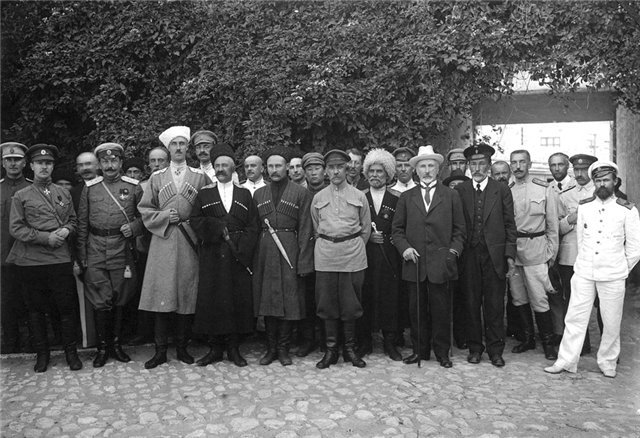
Wrangel and the public of Sevastopol in front of the Marine Assembly, June 1920
With the American it turned out a bit differently. When I arrived at the designated place at the agreed time, which was at some small pier, I found a boat with the sailor I already knew waiting there and went by that boat to a fairly large warship. When I was ushered into the cabin of Captain MacKelly, I found him there with a Russian female secretary, who was to act as translator.
Having listened to my words of greeting, she, to my great surprise, began to translate for the captain into French. I could not stand it and immediately began to speak to MacKelly in French myself, which put him in a very cheerful mood. He immediately proposed that the secretary organize some coffee and cakes for us and sent her out of the cabin into the adjacent room. He was a man above average height, dark-haired, not more than 35 years old, vigorous, cheerful, and kind. From his inquiries, I got the impression that he knew very little about Ukraine, so I may have abused his patience and told him quite a lot. When the coffee was ready, we got down to it, but he sent the secretary out of his office again.
When the conversation, or rather my exposition, ended and the coffee was drunk, I began to say goodbye. It was then that he told me in a low voice that, according to his information, Wrangel's affairs on the front were not wise and that the landing that the Russians had made on Taman had failed. He advised us not to linger in Sevastopol, offering to take our delegation to Constanța, with which he was in constant contact. I thanked him heartily and said that we would gladly use his offer, but that we had not yet finished our business, in fact, for some reason we had not even started it, and because of this we had to stay here for some time yet.
Unless there was an urgent need to leave, in which case we would turn to him. MacKelly replied to this that for his part he would inform us when, in his opinion, such a need arose. With that we parted, and by the same path I returned home, where I told my companions about my impressions and about MacKelly's warning about the danger in case of dragging out our visit here...
Whether due to alarming rumors or some other reasons, fortunately for us, the course of events finally accelerated. It seems that the day after my visit to MacKelly, Col. Noha informed us in the morning that Premier Krivoshein wanted to see us and that he was to take us to him right away. We quickly got ready and went in several carriages. Krivoshein received all of us, of course without Col. Noha, in his office. I wouldn't say I liked him, and it was clear that he didn't like us very much either. But, apparently, circumstances or orders from above dictated to him a behavior that he might not have wished at all. He received us officially, sat at his desk, and we sat around him so that Col. Lytvynenko sat in front of him across the table. The conversation was of an informative nature. He was interested in our army, its organization, branches of service, armaments, etc. On the pedagogical side, Krivoshein received a good lesson: he had the opportunity to make sure that the Russian language and the Ukrainian language are indeed not the same. In essence, our visit was organized only so that Krivoshein could make sure that we were not some Makhnovists or something of the sort, and that it was not embarrassing to show us to their ministers and to Wrangel himself. Apparently, a few words added to Krivoshein's dialogue with Lytvynenko by Krat and me created the impression that it would not be a great compromise for the government of the "AFSR" to negotiate with us officially.
The preparation of the relevant circles from their entourage regarding us and our visit did not come into conflict. Thus Krivoshein said that he was sorry to keep us for so long, but many things had contributed to this. Being busy with current and urgent matters was the main thing, and the second was that our visit was also to some extent a surprise for them. This was an unambiguous hint that, well, someone else had initiated our arrival, which they, the current influential persons around Wrangel, did not wish for very much.
I could not resist and remarked, perhaps not quite diplomatically, that in our circumstances, as in others, perhaps not everything was clearly thought out, and that, of course, all kinds of mistakes can happen, and if so, we would accept it according to our proverb: "If ours is out of place, we will take ours and go back." These words stung Krivoshein, and he very hastily began to apologize and smooth over his tactlessness. Finally, he declared to us that everything was fully cleared up, and that in the coming days we would be received by Wrangel and his inner circle.
When we returned home, Chernysh ran in and informed us that he, that is, the group of more influential Ukrainians, invited us tomorrow evening to a dinner, which would also be attended by some of Wrangel's ministers who had a better understanding of the Ukrainian issue; there would also be a few people from Russian influential circles who looked favorably on the initiative shown at one time from Wrangel's circles, which had brought us to Sevastopol. And indeed, on the appointed evening, we found ourselves in a large hall where there were several dozen people, mostly elderly gentlemen, often of aristocratic appearance.
One could hear "count", "prince" there. After introductions, the hosts seated the company at a very long table, with all of us delegates seated next to each other in the middle of the table on one side, and opposite us sat several ministers, among whom my attention was immediately drawn to the minister of land affairs and, it seems, land reform – Glinka. Near him sat another elderly gentleman who also attracted attention – Prince Volkonsky...
This dinner, apparently, was the result of the latest decision of the Wrangel government to treat us with the utmost seriousness. So, before the official solemn reception, they decided somewhere at the top that the local supporters should invite us to introduce us in unofficial social conditions to those who were to speak with us officially later. At first, as is customary, having sat down, the attendees spoke with each other next to them or across the table.
Topics chosen were some trifles, such as the differences in our uniforms, or how our journey went, or how things were on our front... Only later, when it came to drinking, some of the hosts would stand up and express joy that now, at last, not only had military actions between us stopped, but, thank God, it had come to mutual hospitality. They touched upon, complaining about Denikin, the tensions that arose between us, etc. Interesting was the long but very confused speech of the Minister of Land Affairs, Glinka, who in general terms boasted about the project of his land reform, which, in his opinion, would be able to satisfy the peasants and win their sympathy for their liberation action.
It was difficult for me to distinguish where the current ruling circles had a genuinely sincere desire, and where it was only pretense and an attempt to deceive our peasant with promises. The impression was that they had burned their fingers, but had not yet thought through how exactly to repair the damage done during the times of Denikin, Dragomirov, Shulgin, and others. Nothing important of that evening remained in my memory, although, obviously, there was something, because in my official written report to the Minister of Foreign Affairs, A. V. Nikovsky, I had gathered quite a lot of material, including some things heard that evening.
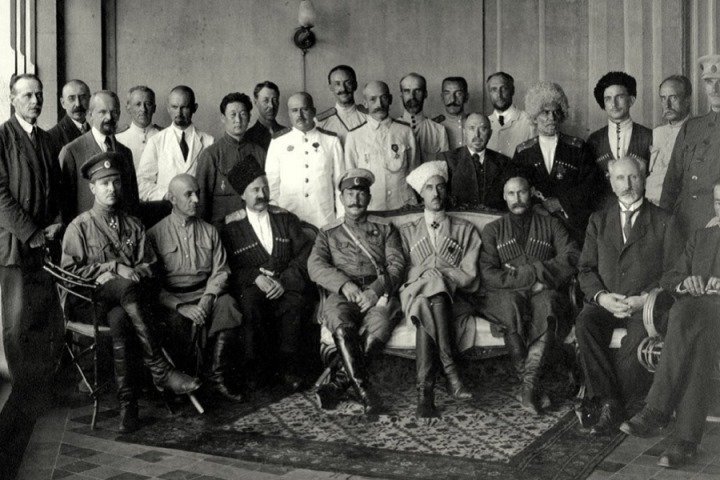
Government of South Russia. Crimea, Sevastopol, July 1920
When finally, two days later it seems, we were summoned to Wrangel, our leader Lytvynenko was already prepared with a speech that Chernysh and I had drafted based on his project. The speech was in moderate tones, which in general welcomed the initiative of the "Command of the AFSR" regarding an understanding with us and expressed the idea that any understanding would be an important matter in the history of our peoples, when by joint forces both Ukrainians and Russians would throw off the yoke of communism.
When we were driving to Wrangel's apartment in the phaetons sent for us, one of the soldiers who was driving Krat turned to him with a smile, saying: "Well, so I have to drive my commander once again." Krat looked at him in surprise and could not recognize where and when exactly he had driven him before. From the conversation it turned out that the soldier had once been in our army under Krat's command and that some illness or wounds had forced him to return home to the Poltava region, where the Denikinites later mobilized him.
When we were ushered into the hall, or rather the office of Gen. Wrangel, there were already quite a lot of people there. Wrangel himself was sitting at the desk talking to someone across it. Others stood in groups in various parts of the hall, smoking cigarettes and talking. Wrangel rose from his place and, in the order we walked in, greeted us one by one, while Gen. Kiriy said our surnames to him. Having greeted us individually, he then addressed us with an official greeting. He briefly expressed satisfaction to see us at his place, for in this he saw a sign of a new period in our common struggle.
Glad, so to say, to note that the brotherly blood shed would not become an impassable river between us. Although his aspiration was to liberate the homeland from the Bolsheviks, he understood well that this would not happen in such forms as his predecessors had imagined until recently, and not by the paths they had followed. He had changed everything cardinally, and he turned to us so that the work of rebuilding our common homeland would take place in a way that we all would agree to.
He does not demand anything now, does not even raise questions about the future structure of Russia, he only desires that trust be established among all those nations fighting against the oppressors. He had already agreed on this with the Kuban Cossacks and with the mountain peoples of the Caucasus. Likewise, he would like the Ukrainian armed forces to enter into an understanding with him for a joint armed action. He was sure that the representatives appointed by the Ukrainian army would agree with his representation in Romania, headed by Gen. Gerua, on the affairs of the present day, and the business of the further future would be to arrange our mutual relations in brotherly understanding. To this, Lytvynenko replied with a speech learned by heart. There was not much concrete said in it either, it also expressed joy that the hostile clashes between us had gone into the past, that, finally, thanks to the noble initiative of the "command of the AFSR", the opportunity arose to speak voluntarily, without coercion, about a common act, and he believed that this act would be achieved...
After shaking hands with all of us, Wrangel sat down, and after him some of those present sat down, while some of the hosts and of ours stepped away from the table, and unfamiliar persons approached each of us to exchange a few optimistic forecasts in a conversation on the topic of our arrival and its significance. A gentleman from the outer circle, of young age, approached me and, having greeted me, gave his surname, asking me if I remembered him. I did not recognize him at first, but hearing the surname, I immediately recalled.
This was Pyotr Savitsky, the son of a Chernihiv landowner and member of the "State Council". Now, as it turned out, he was the personal secretary of the Minister of Foreign Affairs in Krivoshein's cabinet – Pyotr Bernhardovich Struve. I expressed a desire to speak with the minister, especially since in our government there were several of Pyotr Bernhardovich's students, namely Valentyn Sadovsky and Oleksander Kovalevsky, who knew that Struve was here and who would be pleased to hear something about him. Savitsky promised to do this, and the next day I had a brief audience with P. B. Struve.
After the reception at Wrangel's, we felt completely free to leave, but no one spoke to us about the method of our departure. The compatriots all wanted us to stay with them longer, but we were already getting bored. And to make matters worse, I fell slightly ill with a stomach ailment; either I ate something bad, or perhaps I caught a cold. Nevertheless, the next day I overcame the illness to visit Struve.
The impression of him remained pleasant on the whole. It is pleasant to see a smart, cultured person who by the course of his life did not very well fit into Wrangel's entourage. But Russian patriotism led him to minister in Krivoshein's cabinet. I started with compliments to the effect that it was difficult for me, knowing him for a long time from his writings, which were always read with interest, not to meet him. Especially since several of my friends and acquaintances were his students, and they would surely be pleased to hear something about him. As he inquired about Sadovsky and Kovalevsky, it was clear that he remembered them well and had paid attention to them at the time.
After such, so to say, words of politeness, completely neutral, before saying goodbye, I nevertheless asked him how he looked at our, possibly close, understanding. He said rather reservedly, without any enthusiasm, that it was difficult in the current international circumstances to predict anything and everything would depend on the balance of power. This was in the full sense a "realist politician", but surely he, perhaps more than anyone else, saw the need for our understanding and, probably, impressed the local Russian bureaucrats-politicians with his presence in Crimea; even more his person meant, probably, for the "allies", although in general they were not very liked or respected here.
The compatriots wanted to talk with us once more in a close Ukrainian circle. So they arranged a farewell dinner. Nothing interesting happened there. Except only that we managed to see and hear representatives of those Ukrainian communities that stood very far from us on the issue of our independent state.
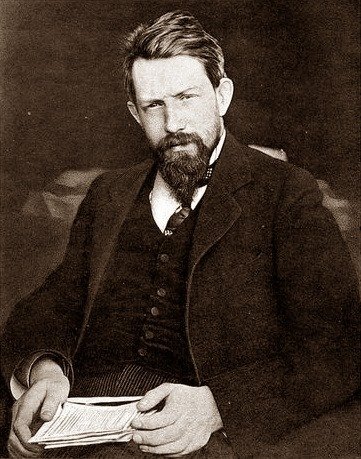
Pyotr Bernhardovich Struve, Russian philosopher, historian, economist, politician, and publicist
We stayed in Sevastopol for another two days or so. If it were not for my illness, I would have gone to Simferopol, where Acad. V. Vernadsky and A. Nosov invited me.
Although Gen. A. Kiriy urged me to go, I did not feel well, and I took to bed for a few days. One evening, when I was alone in my room, a messenger came from MacKelly with the news that the captain advised us to take the opportunity of their destroyer departing for Constanța tomorrow morning and leave, because, they said, a time was approaching when it was better not to be here. This was delivered by the messenger in a rather categorical form. When he added that Baroness Wrangel was also traveling on this destroyer, I realized that we also had to leave, even without saying goodbye to all those with whom we had made acquaintances here. Probably they would soon have no time for us...
When ours gathered in the evening, I told them about the messenger, and we did everything to be at the pier in the designated place tomorrow at the appointed hour... The next day, when we were already on the shore, a boat was waiting for us. Having left Sevastopol, we stood for quite a long time on the deck (paluba)* of the destroyer, marveling at its speed and all this structure, which looked like a perfect huge machine. It was only strange that we saw very few people. Everything shone with some emptiness. We were shown a cabin where we could sit or lie down if anyone wanted to. In that cabin, in the corner behind various packages separated from the middle, I saw a thin lady who was, it seemed, Baroness Wrangel.
The liquidation of our front against Red Moscow occurred much later than the liquidation of the front between the White and Red Russians in Crimea. In those days, news of events of even primary importance arrived with a great delay. In the capital of our emigration, in the city of Tarnów (Western Galicia), I had already begun to forget about the journey to Crimea.
- Deck
(Presented according to the edition: Chikalenko Yevhen. Diary (1918-1919). – K.: Tempora, 2011. – 424 p. – P. 389-407)
Prepared by Serhiy Konashevych