Ten Years Without Own Food Supply
Development of the food industry on the Crimean Peninsula.
Petro Volvach, full member of the Shevchenko Scientific Society (NTSh), member of the National Writers' Union of Ukraine (NSPU), Honored Worker of Science and Technology of the AR of Crimea, Crimean resident with 60 years of experience. Newspaper "Krymska Svitlytsia", 2017, issue No. 21
Traditionally, in pre-war Crimea, meat and dairy farming and sheep breeding were practiced mainly by Crimean Tatars and Ukrainians. Meanwhile, vegetable gardening developed quite successfully in the settlements of Bulgarians, Greeks, and Germans. After their forced deportation, the first colonizers brought in from the Russian heartland proved unable for a long time to adapt to the extremely difficult and capricious natural and climatic conditions of waterless, hot Crimea. Thus, this first wave of settlers in the post-war years could not ensure the revival of the agricultural sector. In almost all categories, the region by 1954 had not reached the indicators of 1940.
The lack of a reliable feed base, primarily fodder grain, succulent feed, hay, and the shortage of even straw negatively affected the development of animal husbandry, depriving it of prospects. Therefore, during the entire post-war decade in Crimea, unlike even the neighboring southern, southeastern, and central regions of Ukraine, the authorities failed to resolve the issue of providing the population and vacationers with the main food products: meat, milk, potatoes, and vegetables of own production.
If one looks through the materials of the Ukrainian state archives and Crimean newspapers after 1954, the vast majority of government and party decrees, as well as decisions of union and republican ministries, concerned mainly the problems of agricultural development, resort construction, water supply, and the construction of housing, industrial facilities, roads, and cultural institutions. During the first two years alone (1954-1955), dozens of such decrees and decisions were adopted. It is these documents that allow for an objective cross-section of the state of a particular sector and make it possible to understand the real motivation behind the gift of the "elder brother".
The Report prepared by the Crimean regional party committee for the Central Committee of the CPU, without unnecessary statistical manipulations for the public and the press, presents the true picture of the state of the agricultural sector. Compared to the pre-war period, the yield of vegetable crops decreased almost threefold and amounted to 51-54 centners/hectare. The yield of potatoes was equally low – 29.2 centners/hectare in 1952 and 30 centners/hectare in 1953. Because of this, the state plans for the procurement of vegetables and potatoes were not fulfilled year after year.
Compared to 1940, the state procurement of vegetables in 1950-1953 varied within the range of 34-41 thousand tons. Meanwhile, in 1940, the procurement of vegetables amounted to over 60 thousand tons. For potatoes, this figure was even lower. In 1940, almost 17 thousand tons of potatoes were procured in Crimea, and in 1950-1953, the volumes of state procurements of potatoes fluctuated from 4.7 to 6.1 thousand tons. Only in 1952 – the most favorable year in the region in terms of weather conditions – did they procure 9.1 thousand tons of potatoes. Huge volumes of potatoes were brought to Crimea from Ukraine annually. The delivery of fresh vegetables along poor roads to the southern coast of Crimea was also quite problematic.
Thus, during the first post-war decade, the Crimean region, even with a significantly smaller population (over 1 million people), could not provide itself with basic food products. At the same time, with a much larger population in 1940, the Crimean ASSR was self-sufficient in most categories.
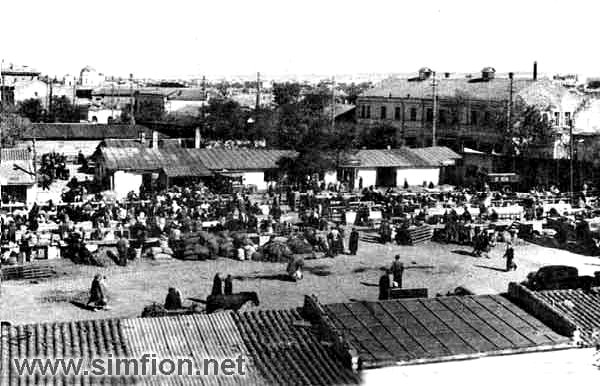
Simferopol. The market on the site of the current Trenyov Park existed until 1957.
A rather difficult situation with providing the population of the Crimean region also arose regarding meat, milk, and their state procurements. While for milk, compared to the pre-war period, a noticeable increase in procurement volumes was observed (90.4 thousand tons in 1940, 44.2 thousand tons in 1952, and 61.4 thousand tons in 1953), for meat the situation was much worse. Note that the increase in the volumes of milk procurement in the post-war years was primarily associated with a significant increase in the areas of haymaking pasture lands and commons.
Indeed, the lands of hundreds of thousands of deportees remained uncultivated and turned into pastures. Moreover, settlers from Ukraine and Russia arrived on the peninsula with their own livestock and poultry. If entire villages and collective farms resettled, livestock – cows, oxen, horses – was also transported to Crimea by rail.
It was precisely because of this that in the Crimean region in the post-war years, especially in the last years before the transfer of the region to Ukraine, the number of cattle increased (104.8 thousand heads in 1940 and almost 150 thousand heads in 1953), and the number of cows almost doubled (26.4 thousand heads in 1940, 45.9 thousand heads in 1953, and 57 thousand heads in 1954). A similar trend was observed in the pig population. Before the war, the pig population in all categories of farms was 39.4 thousand heads, and in 1953-1954 it reached 73 thousand heads. Such an increase in the pig population in Crimea in the post-war period was associated with a change in the ethnic composition of the population caused by the deportation. The settlers, like the deported Crimean Tatars, continued to practice sheep breeding.
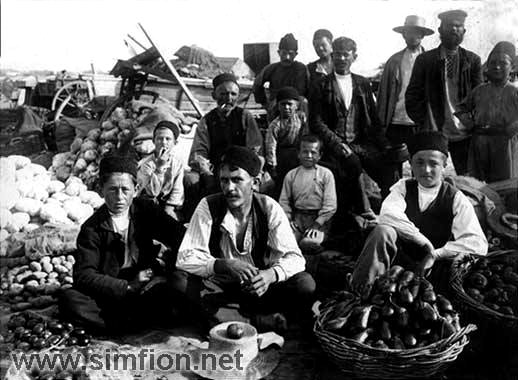
Merchants at the market before the war
Due to the war and the expulsion of the Crimean Tatars, the horse population in Crimea fell sharply (81 thousand heads in 1940 and 46.4 thousand in 1954). Poultry farming was probably the only sector in which noticeable progress was observed compared to 1940. While in 1940 there were 338 thousand head of poultry (mainly chickens) in various categories of farms in Crimea, in 1953 their population grew to 1,554 thousand heads. In 1954, it was planned to bring the poultry population to 1,200 thousand.
An acute shortage of meat in Crimea was felt for almost 10-12 post-war years. In the first years after the transfer of the region, Ukraine could not overcome it either, although this task was one of the most important and high-priority ones. The authorities tried to solve the meat shortage, as in previous years, by bringing it in from other regions of Ukraine. Transporting meat across the Kerch ferry was unprofitable, and during strong storms, it was also quite dangerous.
A real disaster for Crimea in the post-war years was the almost complete degradation of low-capacity, poorly equipped meat processing plants. Furthermore, the network of meat shops in the region was rather undeveloped. Meat, even in Simferopol, was sold mainly at the collective farm market located in the center of the city (now Trenyov Park), the material and technical base of which was extremely unsatisfactory, and the sanitary and epidemiological condition was simply terrible. Therefore, outbreaks of acute infectious diseases both in the city itself and on the Southern Coast were a fairly common occurrence.
It should be noted that the first decent meat shops in the center of Simferopol, as in most regional towns, were opened only after the transfer of Crimea to Ukraine. At the same time, the famous shops "Ukrainska Kovbasa" (Ukrainian Sausage), "Ukrainska Palianytsia" (Ukrainian Bread), and a rich shop of Crimean vintage wines and Crimean fruit were opened on Karl Marx Street in the very center. It was during Ukraine's time that from sterile clean trays, salespeople in snow-white coats, to the surprise of even Muscovites and Leningraders, began to mass-sell chilled poultry and rabbits to the population in the streets of Crimean cities.
During the next post-war decade, Ukraine and the Ukrainian people successfully solved almost all of the most acute Crimean problems that the Russian Federation was unable to solve during the first post-war decade.