A Wasted Decade: The State of Crimean Industry and Construction Sector in the First Post-War Decade
The state of the Crimean industry and construction sector in the first post-war decade.
Petro Volvach, full member of the Shevchenko Scientific Society (NTSh), member of the National Writers' Union of Ukraine (NSPU), Honored Worker of Science and Technology of the AR of Crimea, Crimean resident with 60 years of experience. Newspaper "Krymska Svitlytsia", 2017, issues No. 11 – 12
The editorial board and the authorial collective of the pompous 26-volume edition "History of Cities and Villages of the Ukrainian SSR" (Kyiv, 1974), in the volume dedicated to the Crimean region, tried to convince readers and the international community of the huge successes of the communist party leadership of the peninsula in the first post-war decade. The figures and indicators presented were shamelessly falsified. According to the edition: "During 1944-1947, 1037 million rubles were spent on capital construction in the region. By the beginning of 1948, 459 enterprises were rebuilt and put into operation here... Party and Soviet bodies of the region paid primary attention to the reconstruction of heavy industry. On the basis of the Kerch iron ore deposit, the Kamysh-Burun iron ore plant was recreated. Several sections of the concentration plant began producing output".
The only reliable fact in this victorious report is the construction of several low-capacity power plants in Sevastopol and Kerch. But their main purpose was to provide electricity only to industrial facilities and the Black Sea Fleet, and they in no way solved the problem of energy supply for the entire peninsula. It was resolved only after the reconstruction of the Dnipro Hydroelectric Station in 1947 and the construction of the Kakhovka Hydroelectric Power Plant. Thus, for the reconstruction of Crimea, electricity coming from Ukraine was used to a significant extent. It was thanks to this that Crimea was able to increase the output of the metalworking and machine-building industries and establish the production of building materials.
The real state of industry and the construction sector in post-war Crimea, which was part of the RSFSR, was until recently hidden from the general public in special archives. Objective data on the state of the Crimean economy in the first post-war decade began to reach the press only in the 1970s and 1980s.
Thus, in the dissertation of Ivan Yatsenko, a graduate of the Higher Party School of the Central Committee of the CPU, defended in the early 1980s, which became an integral part of the book "The Crimean Party Organization in the Struggle for the Revival and Further Development of Industry (1944-1950)", it is noted that even five years after the end of the war, the volume of industrial production in Crimea was only 56.9% of the pre-war level. In three basic sectors for Crimea – canning, tobacco, winemaking, etc. – this figure did not exceed 30-35% of the pre-war level.
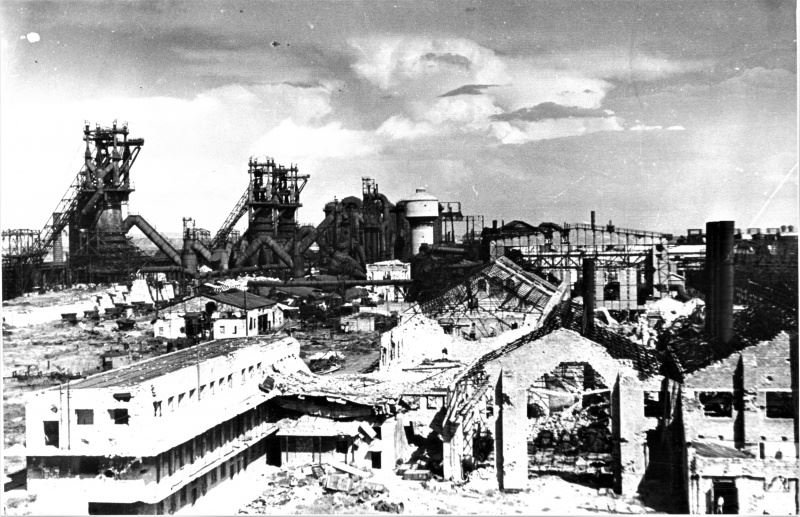
Ruins of the destroyed Voikov plant (Kerch Metallurgical Plant) in Kerch, 1945
The already cited encyclopedic edition boasted of huge successes in the reconstruction of the Kerch Metallurgical Plant. But in a letter closed to the general public to the Secretary of the Central Committee of the CPSU G. Malenkov, the First Secretary of the Crimean regional committee P. Titov on February 27, 1953, i.e., a year before the transfer of Crimea to Ukraine, complained that "The Ministry of Ferrous Metallurgy and Construction of Heavy Industry Enterprises does not pay proper attention to the reconstruction of the Kerch metallurgical base, has not ensured the timely preparation of design assignments and technical documentation for any facility, and has not fulfilled government decrees.
The "Krymmetallurgstroy" trust is not prepared for the execution of the increased plan of 1953, and the commissioning of the first blast furnace at the Voikov plant with the necessary complex of enterprises in 1954 is under threat of disruption. The newly created in 1946 trust "Kerchmetallurgstroy" did not have its own production base until 1953. The existing quarries of crushed stone and rubble stone, raw materials so necessary for construction, are not equipped with the necessary mechanisms, and the technologies for manufacturing these materials are obsolete and primitive".
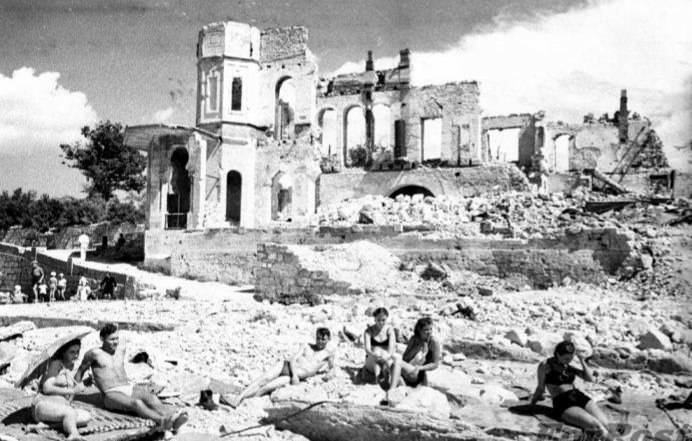
Post-war Sevastopol
An even more disappointing picture of the state of the construction sector in Crimea in the first year of Crimea's accession to Ukraine was painted by the First Secretary of the Feodosia city party committee, Moiseiev: "Ten years have passed since the end of the war," said Moiseiev, "and the working people present legitimate demands – when will the city be rebuilt and minimal living conditions created? There is no water in the city, no sufficient amount of electricity, no bath and laundry complex. During the war, up to 40 percent of the housing stock was destroyed, and only one building with 8 apartments was rebuilt by the forces of the city executive committee. The city has almost no amenities; only one street has an improved surface.
Many of these issues were repeatedly raised before higher organizations – the Council of Ministers of the RSFSR and the ministries. In 1953, a decision of the republican government was made regarding measures to help Feodosia. But the Ministry of Communal Services of the RSFSR apparently holds this decision in poor regard and did not implement it in a timely manner" (TsDAGO U: F. 1. – Op. 52. – File 4990. – Sheet 125).
This party functionary at the plenum of the Crimean regional party committee, dedicated to the region's entry into Ukraine, applauding the Decree of the Presidium of the Verkhovna Rada of Ukraine, declared: "The adopted Decree is a major event in the life of our region. It corresponds to the vital interests of the working people of Crimea, which is closely connected economically with the Ukrainian SSR".
The First Secretary of the Kerch city party committee, Smorodin, spoke even more frankly about the inactivity of the Kremlin and Crimean leadership in the post-war decade. He addressed a rhetorical question to the Crimean regional party conference: "Who will rebuild the Kirov district of Kerch?" The city party leader himself answered it: "No one. There is no such construction trust. We have the Directorate of the Simferopol trust 'Krymzhylstroy'. Its program in Kerch is 2.5 million rubles a year, but it does not fulfill it. At this rate, we will not rebuild the city even in a hundred years...".
Under pressure from the party conference, the Council of Ministers of the RSFSR adopted a belated decision on February 26, 1953: "Oblige the Ministry of Housing and Communal Construction of the RSFSR to consider the issue of organizing the 'Kerchzhylstroy' trust". However, such a trust was not created back then.
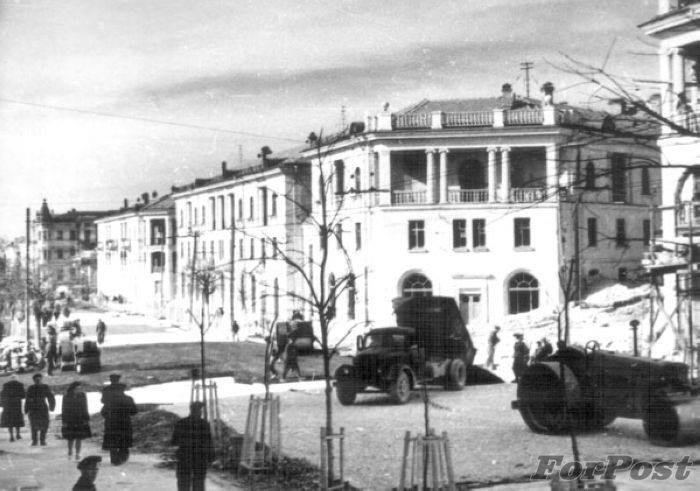
Post-war Sevastopol
Back in April 1952, the Council of Ministers of the RSFSR adopted a decision "On measures to help the municipal economy of Kerch". By this decision, the Ministry of the Merchant Marine was instructed during 1952 to prepare project and estimate documentation for the construction of a sea terminal. They got down to the construction of this important transport facility only after the transfer of Crimea to Ukraine. Back in 1945, Moscow officials intended to build a dairy plant in Kerch. According to another government decree, it should have been built in 1953. But before the transfer of Crimea to Ukraine, this important facility for the city was never built. The local authorities intended to open a confectionery shop back in 1952, but even this was not done before the transfer of Crimea to Ukraine.
Of the 552 industrial enterprises available in the region, in 1953, the plan for the output of gross production was barely fulfilled by only 427. Among them, a high share (44%) consisted of food industry enterprises.
The Kerch Metallurgical Plant, which had 3 blast furnaces before the war, was never revived by the beginning of 1954. Only the foundry shop operated on it, but it too produced mainly secondary products. At the time of Crimea's transfer to Ukraine, the Kirov Coke and Chemical Plant in the city was also not rebuilt. Only the Kamysh-Burun iron ore plant operated in Kerch.
Confirmation of the catastrophic decline in housing construction even in resort towns is the admission of the first secretary of the Yevpatoria regional party committee, Kruhliak: "Not a single square meter of housing was built in the city after the war, although this was promised to us all the time".
A sharp outbreak of dysentery among Crimeans and vacationers in the summer of 1954 forced the Ukrainian authorities to take up the study of the sanitary state of the Southern Coast in the zone of Crimean resorts. In a report of the Crimean regional committee of the CPU, sent to the Central Committee of the CPU in August 1954, it was noted: "Although resort towns and settlements have sewerage systems, they lack treatment facilities everywhere. Because of this, wastewater is discharged into the sea without treatment near the shore, and in the city of Feodosia – right on the city beach. In Yevpatoria, sewerage is completely absent, and sewage is discharged into the upper layer of soil, which contaminates artesian waters".
The authors of the report state "that the pollution of the sea in the resort zone is occurring quite intensively. According to the sanitary and epidemiological service, the seawater contains a huge number of gastrointestinal pathogens and exceeds permissible indicators by thousands of times".
"Funds allocated by the government for the construction of water pipelines and sewerage systems in cities and resorts were not utilized year after year or were used for other purposes." Thus, in 1953, of the 2999 thousand rubles allocated for sewerage installation, only 254 thousand rubles were utilized. Funds intended for the revival of important industrial facilities were also not utilized year after year. This happened mainly due to an acute shortage of labor and a deficit of technical equipment. It is not excluded that a significant portion of the resources was embezzled.
While some housing construction was still carried out in large Crimean cities in the first post-war decade, the construction of housing and cultural-social facilities in villages was carried out solely by the forces of farms and communities. The fundamental reconstruction of Crimean villages and settlements began only after the region became part of Ukraine.
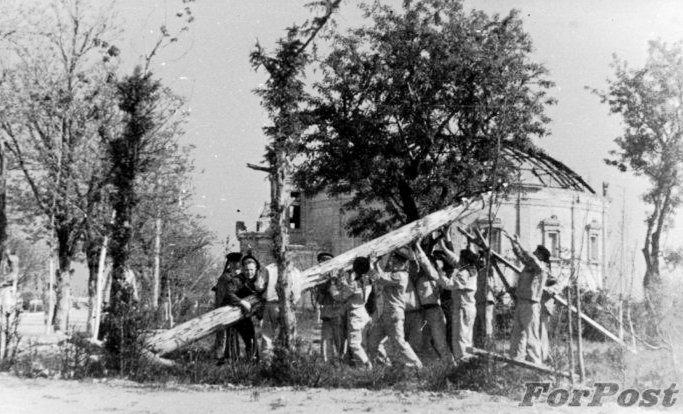
Restoration of the Historical Boulevard
Sevastopol, as the main naval base of the Black Sea Fleet, was rebuilt more intensively. But it too was restored mainly by Ukraine and the Ukrainian people. Therefore, Sevastopol, not only due to military events but also due to the contribution to the post-war reconstruction of the city, can be called with full right a city of Ukrainian military and labor glory. A lot of funds were allocated for the reconstruction of the city and the revival of the Black Sea Fleet not only from the Union (Russian) but also from the budget of Ukraine. And forced and voluntary settlers from Ukraine became the most effective and qualified workforce.
But even despite the immense attention of the Kremlin government, the reconstruction of Sevastopol and the revival of the Black Sea Fleet proceeded rather slowly. And this was despite the fact that this problem was personally supervised by the leader Joseph Stalin himself. It is known that in 1948 he inspected not only the Black Sea Fleet but also took an interest in the revival of Sevastopol. This was precisely what prompted the union government to adopt a decree in October 1948 "On measures to accelerate the reconstruction of Sevastopol".
To implement this decree, the subservient Kremlin and local Crimean officials directed almost all material, technical, and financial resources intended to be spent on the revival of the entire Crimea. Undoubtedly, the "Kremlin sages" shifted a significant share of the expenses onto the shoulders of Ukraine and the Ukrainian people. Its economy, metallurgy, machine-building, and construction industries, as well as human resources, were largely involved in the post-war reconstruction of Sevastopol and the Black Sea Fleet. No money was spared for this.
But even the close attention of the leader himself and his inner circle did not fully solve the rather complex problem of reviving Sevastopol as the main naval base of the Black Sea Fleet. In a letter to the Chairman of the Council of Ministers of the USSR G. Malenkov dated April 9, 1953, the First Secretary of the Crimean regional committee of the party P. Titov and the Commander of the Black Sea Fleet S. Gorshkov noted with concern: "Of the 1176 million rubles allocated to Sevastopol for the reconstruction of the city, only 870 million have been utilized in four years.
The most backward sector, due to the unsatisfactory work of 'Rossevastopolstroy' and insufficient assistance from the Council of Ministers of the RSFSR, was the construction of residential buildings of the city executive committee, healthcare facilities, and cultural and educational institutions. For the city executive committee, 35 thousand m2 of living space has not yet been put into operation, and 226 beds, schools for 630 places, two cinemas, and other facilities have not been commissioned".
The situation in other cities and regional centers of Crimea was even more terrible. Thus, the grandiose plans and loud promises of the leaders of the RSFSR regarding the rapid post-war revival of the peninsula turned out to be failures. It was precisely because of the hopeless neglect of the Crimean region that the Russian Federation initiated its transfer to Ukraine. Thus, the Kremlin leaders quite skillfully and insidiously shifted the entire burden of post-war reconstruction of Crimea onto the shoulders of Ukraine and the Ukrainian people. And, ignoring all interstate and international treaties, Russia also basely and insidiously stole the already rebuilt and organized Crimea from Ukraine in February 2014.