The Price of Crimean Prosperity
The Kakhovka Reservoir and the North Crimean Canal are the largest irrigation structures of the 20th century.
Petro Volvach, Full Member of the Shevchenko Scientific Society (NTSh), member of the National Writers' Union of Ukraine (NSPU), Honored Worker of Science and Technology of the AR of Crimea, Crimean resident with 60 years of experience. "Krymska Svitlytsa" newspaper, 2018, Issue No. 3
Even today, experts consider the Kakhovka Reservoir and the North Crimean Canal to be the largest irrigation structures of the 20th century. After all, the parameters and volumes of work performed during their construction are astonishing. Undoubtedly, in terms of their functionality — solving the most acute problem of southern Ukraine and Crimea: water supply and ensuring the irrigation of tens of thousands of hectares of agricultural land — and the time of their construction, they coincide chronologically and are quite close in the volume of work performed.
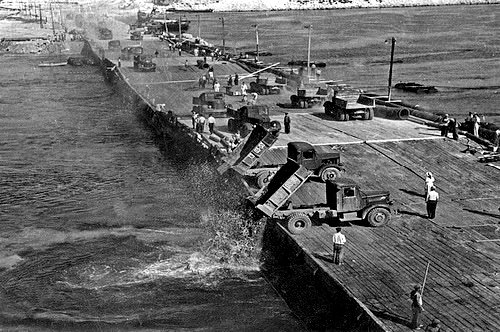
Construction of the Kakhovka HPP
Just the length of the man-made Kakhovka Sea is 230 km. The area of the reservoir is 2155 km2. Several canals originate from the Kakhovka Reservoir: the Kakhovka, North Crimean, and Dnipro-Kryvyi Rih canals. Speaking of the economic expediency of constructing this grandiose reservoir to supporters of "Russian Crimea" and those who even today hysterically chant: "Crimea is ours!", it is worth remembering that to ensure water supply and organize irrigation on the Crimean Peninsula, a huge territory (several million hectares) of the best, most fertile Dnipro lands had to be flooded in the Zaporizhzhia, Dnipropetrovsk, and Kherson regions, and the unique Dnipro floodplains had to be destroyed.
Even today, the best economists in the world are unable to calculate the losses from this huge "construction site of communism." After all, the Dnipro floodplains historically performed the function of a natural filter for the Dnipro water that flowed into the Black Sea, enriching it with plankton, and were a kind of lungs and kidneys of both the Eternal River itself and the Black Sea. The Dnipro floodplains, flood meadows, meadows, and numerous lakes with ancient forests, even in hot years and droughts, swarmed with fish and animals. After these lands were flooded, all this wealth disappeared. As eyewitnesses say, escaping from the water, animals tried to reach the shore, and birds that returned to the floodplains in spring for nesting continued to circle over this new sea for several years.
However, Ukraine and the Ukrainian people suffered the greatest damage, which cannot be measured materially, from the flooding of a huge historical heritage. At the bottom of the reservoir lay the Cossack Great Meadow (Velykyi Luh), celebrated in Ukrainian songs, and many other shrines. There were many such historical sites of national memory and cultural landmarks in the flooded or relocated villages. At that time, Ukraine simultaneously lost about a hundred ancient Cossack villages, winter quarters, and hamlets. It is known that after the reservoir was flooded, only the grave of the famous Otaman of the Zaporozhian Host, Ivan Sirko, was saved from destruction. He was reburied in the village of Kapulivka near Nikopol.
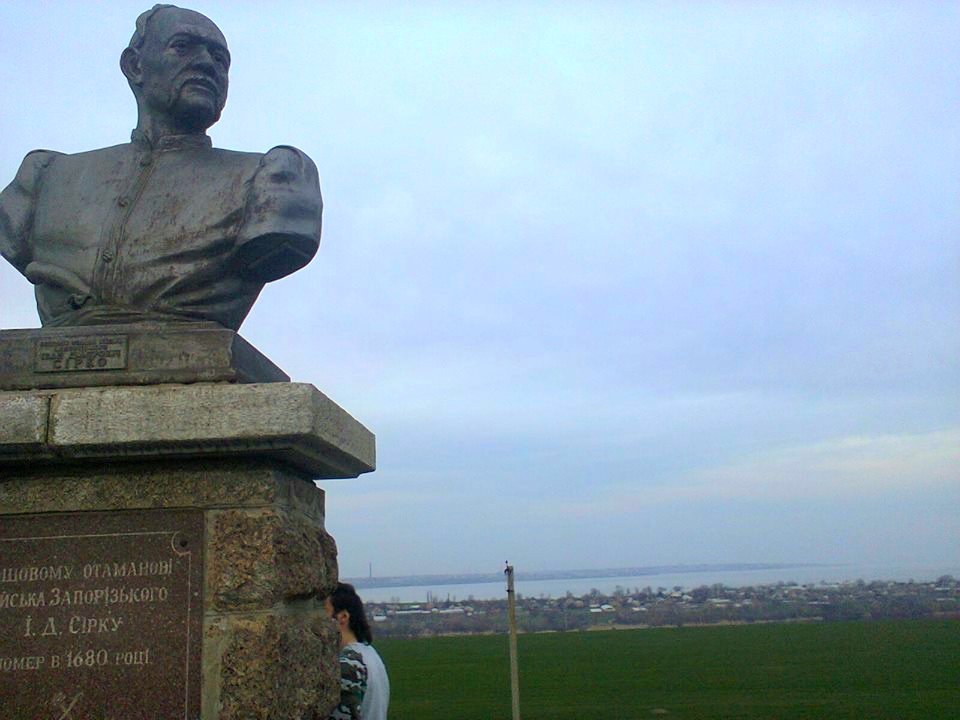
Ivan Sirko's Grave
An undeniable consequence of the negative impact of the Kakhovka Reservoir is, first of all, the flooding of significant territories of agricultural land, settlements, and industrial facilities, in particular, mines in the Dnipropetrovsk region. The unreinforced shores of the reservoir in many places along its perimeter are being destroyed, swallowing several meters of the shoreline annually. The destruction of the Dnipro floodplains dealt a devastating blow to the ecology of the Dnipro and Konka rivers and the entire Lower Dnipro region, which led to their pollution and deterioration of the quality of Dnipro water.
The annual uncontrolled development of blue-green algae in the reservoir, especially in shallow water, causes huge damage to the environment, negatively affects public health, the development of commercial fish species, and creates uncomfortable conditions for residents of many settlements due to the strong stench.
Perhaps if the designers of this man-made sea had listened to the voice of the public and scientists, a more optimal option for irrigating arid Crimea would have been found. After all, the watering of lands in several southern regions of Ukraine could have been solved in a less expensive, environmentally friendly, and non-barbaric way. A caring and responsible master of his land would not have acted in such an alien way. Unfortunately, even today in Ukrainian society there is no awareness of the harmfulness and future dangers for Ukraine from this man-made sea.
What was the chronology of government decisions regarding the construction of the Kakhovka Reservoir, the Kakhovka HPP, the South Ukrainian, and the North Crimean canals? Undoubtedly, this idea arose in offices in the first post-war years. For several years it was discussed by the highest party and state leadership, and several more years were spent on coordination with scientific institutions and construction ministries.
At the end of September 1950, the Resolution of the Central Committee of the CPSU(b) and the Council of Ministers of the USSR "On the construction of the Kakhovka HPP on the Dnipro River, the South Ukrainian, and the North Crimean canals" was issued. Considering this, it was expected that the union authorities and ministries would take care of the declared "construction of communism." But this did not happen. And the Kremlin leaders shifted the task of building the irrigation system entirely onto the shoulders of Ukraine.
While the Kakhovka HPP and the South Ukrainian Canal had a direct administrative relationship to Ukraine, logically the Russian Federation should have built the North Crimean Canal, since the Crimean Oblast was still under its jurisdiction at that time. This is yet another testimony to the puppet nature of the union republics and other local leaders. The real masters and managers of resources sat in Moscow.
It is significant that the aforementioned Resolution did not provide for concrete measures, the execution of which would be assigned to the union ministries and the Russian Federation, for whose administrative unit this construction was initiated.