Wizards
A biography of the Krymchak animation director Ralph Bakshi.
Valeriy Verkhovskyi. "Krymska Svitlytsa" newspaper, 2017, Issue No. 20
His roots are from Crimea, but few in Crimea recall this. His works are better known in the world than his name. He is a representative of a small ethnic group, but this people is one of the few that are truly indigenous to the peninsula.
So, Ralph Bakshi is an ethnic Krymchak. Fate scattered his family across the world, and Ralph was born in Haifa (at that time the British Mandate for Palestine) on October 29, 1938. Perhaps these distant wanderings saved the future genius from the bitter fate of his fellow tribesmen — the Krymchaks of Crimea were almost completely exterminated by the Nazis in 1941.
Soon after, Ralph Bakshi's parents went to the United States. The family lived first in New York, then in the Washington suburb of Foggy Bottom, inhabited mainly by African Americans. Ralph recalled that all his childhood friends were Black, and he even went to the same school as them, being the only "white" student there, which did not bother him at all, especially since the nearest school for white children was several miles away. His Black schoolmates did not object either. However, a teacher was concerned, and Ralph was expelled from school, with the police being called.
However, his parents soon returned to New York. Ralph Bakshi started working at an animation film studio. He studied at the School of Art. In particular, he directed cartoon series about Spider-Man and Mighty Mouse. In 1968, Bakshi founded his own film studio, Bakshi Productions, to realize creative ideas and technical solutions that became revolutionary in world animation. The animated film "Fritz the Cat", based on the comic strip of the same name, brought in profits more than a hundred times greater than the cost of its creation — 90 million dollars (from a budget of 850 thousand). The film's entirely non-childish content contributed not only to its success with early 1970s audiences, but also to censorship restrictions. One of the characters — a police pig — was voiced by Bakshi himself.
In 1977, the feature-length animated film "Wizards" was also a quite strong box office success. Turning to the fantasy genre, Bakshi resorted to rotoscoping technology.
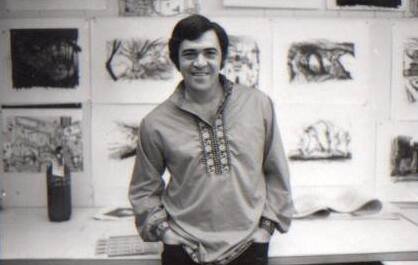
Ralph Bakshi
Rotoscoping animation (the term "rotomation" even arose) is a technology that uses the images of real actors, from which animated characters are then drawn. This technology is not new; it was invented a hundred years ago and was generally used, though in a limited way. And Ralph Bakshi went down in the history of the genre precisely because he actively implemented these tools. Modern technologies give animation creators computer graphics. At that time, everything had to be drawn by hand using a special device.
However, it is the experience of rotoscoping that now forms the basis of modern computer technologies used today in many science fiction films (recall, for example, the films "The Congress" with Robin Wright or "A Scanner Darkly" with Keanu Reeves). And not only science fiction ones.
A landmark work for Bakshi was the first film adaptation of J.R.R. Tolkien's "The Lord of the Rings". Producer Saul Zaentz wanted to adapt Tolkien specifically in an animated version using rotoscoping. And he was lucky to find a like-minded person.
Zaentz, one of the most famous American screenwriters and film producers (Zaentz or Zając — this was likely the surname of his ancestors), a passionate fan of Tolkien's work, was also harboring plans to adapt the trilogy. Zaentz founded Tolkien Enterprises, which owns the film rights to most of J.R.R. Tolkien's works, and wrote the screenplay for the feature film "The Lord of the Rings" back in the early 1970s. Although he was unable to realize the project at that time, he later became the producer of Bakshi's animated film.
The first, animated, adaptation of Tolkien's saga covered only two of the three novels of the trilogy ("The Fellowship of the Ring" and "The Two Towers"), and in the end, Ralph Bakshi was unable to adapt even these two books completely due to a lack of funding, cutting everything possible. The screenwriters made some changes to the plot, adding some scenes and cutting some storylines (for example, Tom Bombadil did not "fit" into the film).
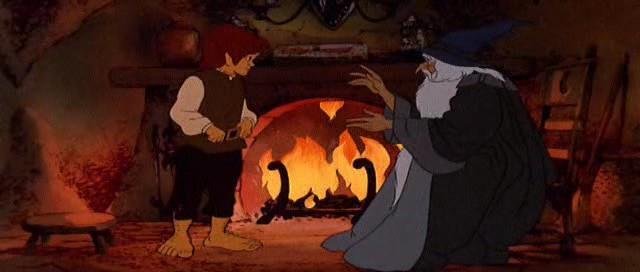
A scene from the animated film "The Lord of the Rings"
The influence of Bakshi's animated film can be traced in Peter Jackson's film. In his film trilogy "The Lord of the Rings", Bombadil is also absent, and Jackson took the directorial decisions of some scenes from the animated movie.
Some films returned only half of the money spent on production. For instance, "Fire and Ice" (1983) made the list of the best animated films of all time, despite not recouping its costs at the box office. The "rotomated" film "Cool World" (1992) was also not a box office success, although it starred Brad Pitt and Kim Basinger; two years later, the director made his only fully live-action film, "Cool and the Crazy".
Today the 88-year-old master lives in New York and does not sit idle. The animated film "Last Days of Coney Island" was filmed with his participation in 2014–2015.
What determines the success of a film: coincidence, the whim of the crowd, the talent of the artist, precise calculation, skill, and painstaking work? Probably all of them together. But in any case, we want to see on screen what we are looking for in life, don't we?
And we enthusiastically watch movies about elves and hobbits or about Jedis and Fremen, empathize, compare the characters with ourselves or ourselves with them... From the screen, they tell us about what Good and Evil are, and every generation in ancient times or in the distant interstellar future has to defend Good. And for at least two hours of screen time, we will have confidence that Good will triumph. It cannot fail to triumph. Therefore, it is too early to give up.