Energy of Two Seas Part 1. Treasures of the Shelf
Oil and natural gas are determining factors of geopolitics in the modern world.
Valeriy Verkhovskyi. "Krymska Svitlytsa" newspaper, 2018, Issue No. 20
Hydrocarbon raw materials have turned Middle Eastern deserts into blooming gardens and resurrected the Kremlin's imperial ambitions from oblivion. The price per barrel fluctuated, bringing the economies of entire countries to ruin with its fall, and then soared, generating large-scale projects. Oil and natural gas are not just energy resources, but also a key factor in geopolitics.
Politics
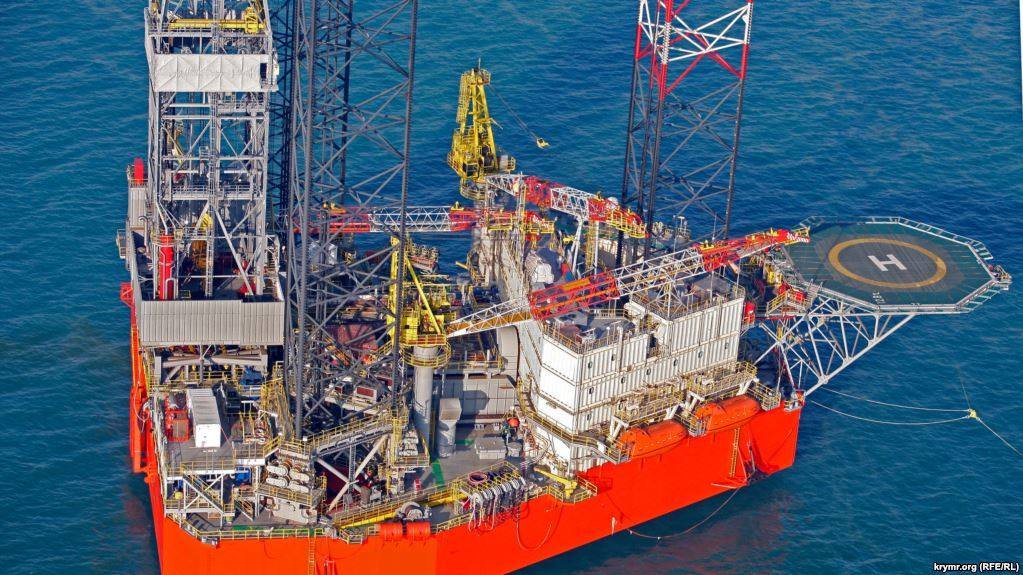
The reserves of deposits discovered on land are gradually running out, so oil and gas workers are moving into the domain of the marine element. For example, the North Sea shelf deposits discovered in the 1960s are now the basis of economic prosperity for the countries of the adjacent region of Europe. But the fabulously attractive deposits of the shelf require hundreds of billions of capital investments, and although the investments pay off quite generously, they do so very slowly. During the period of peak price rises, the Black Sea shelf interests potential developers; during periods of price drops, loud projects are frozen.
The current low price of oil and, accordingly, natural gas does not favor the development of deposits on the shelf adjacent to the Crimean Peninsula. We observed the same thing in the second half of the 1990s, when the drop in oil prices first put an end to the plans of "President" Meshkov and his government to invite British Petroleum to Crimea, then prompted the Russian Federation to adopt a more friendly tone in relations with us, divide the Black Sea Fleet, sign friendship treaties, and after August 1998, this drop drove the Russian economy to the brink of the abyss known in history as the "default."
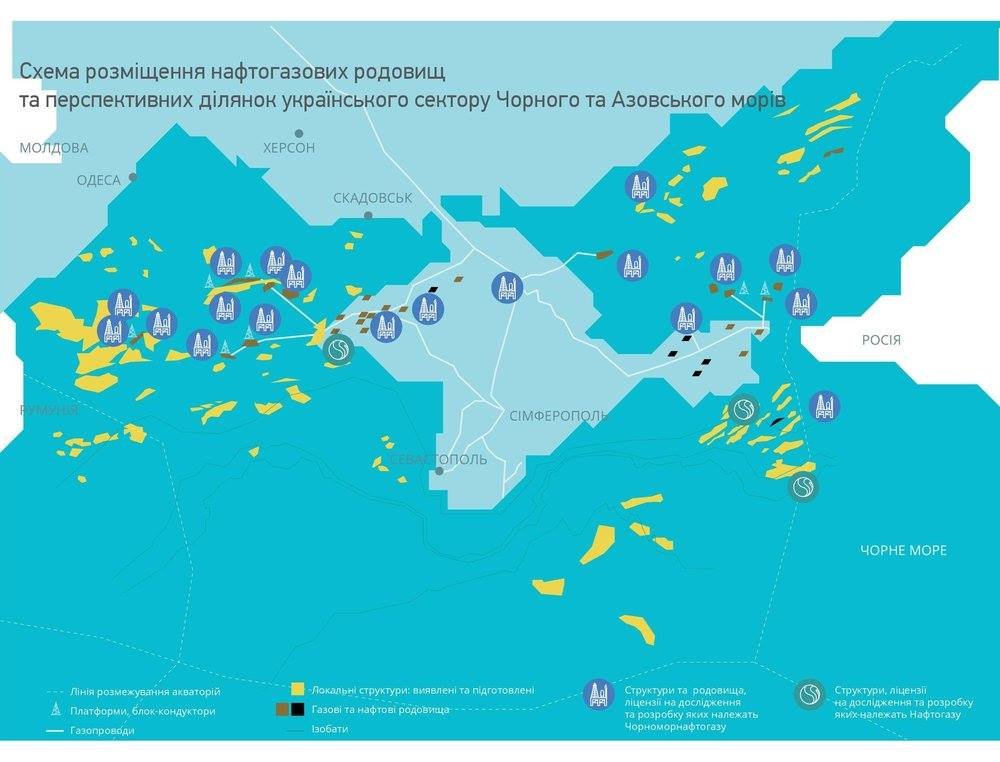
For instance, Ukraine invested 12 billion hryvnias in Chornomornaftogaz, which is currently seized along with Crimea. On the shelf, the occupiers extract approximately two billion cubic meters of gas annually, and that is in the areas that are "Odesa" ones and have nothing to do with the Crimean Peninsula; thus, even if Ukraine gave up Crimea, this gas would still remain stolen.
By fully developing the natural resources of both Ukrainian seas, our country could completely meet domestic needs, giving up not only Donbas coal and deadly nuclear energy, but even exporting gas to neighboring countries.
The market of neighboring Poland, for example, feels an acute need for natural gas: while last year this country imported 10 billion cubic meters of "blue fuel," in 2020 the demand for imports is predicted to grow to 12 billion cubic meters.
Competition
Russia's oligarchic regime is ready to commit any crimes when it loses superprofits. And the state of affairs in the industry is not in favor of their "Gazprom." For example, the Shtokman natural gas field on the Barents Sea shelf, which has already swallowed tens of billions of rubles in investment since the 1980s and could bring in six to seven billion dollars annually, turned out to be redundant on the world market due to the beginning of shale gas development in the world. And during 2014 alone, the net profit of "Gazprom" decreased 3.3 times!
Oil and gas in our time are big politics. Creating competition for Russian companies means raising Ukraine's status as a geopolitical player; accordingly, we must realize the relevance of the words: "Along the bloody road we must go into the world." It is enough to look at the map to understand what guided the Kremlin four years ago: the first blows fell on Crimea (the lion's share of the Ukrainian shelf), Sloviansk (where there are promising shale gas deposits), and Mariupol (more on the significance of the Azov Sea later).
Currently, Russia can rejoice that it made the energy independence of our country impossible by occupying Crimea and seizing the shelf development infrastructure created by Ukraine, as well as surrounding the Azov Sea from three sides (they only failed to capture the northern coast). Not to develop it, but to prevent Ukraine from developing these resources.
Hydrates
Gas hydrates are a compound of gas and water, and in this case, we are talking about natural gas hydrates (mainly methane). They were first found in the ocean depths in the 1970s.
Countries deprived of large oil deposits, by a trick of nature, have large deposits of hydrates at the bottom or at shallow depths in the shelf of adjacent seas.
Research aimed at developing gas hydrates is being conducted by India, South Korea, Chile, and Japan. Ukraine (with Crimea) has the largest deposits of natural gas hydrates in Europe, estimated at 60-70 trillion m3. It cannot be said that we did nothing in this direction. One cubic meter of hydrate yields 164 cubic meters of gas. However, the complexity of extraction lies in the fact that such a compound of methane and water exists only at low temperatures and under certain pressure; when heated, the hydrate decomposes into water and gas. It must be raised from the seabed carefully. This problem is being solved by leading technologically advanced countries.
For example, Japan has gas hydrate reserves on its shelf sufficient for 130 years of consumption. It is not surprising that the Japanese were in the front ranks of enthusiasts developing gas hydrate reserves. According to specialists from the Odesa Academy of Cold (the leading institution developing the topic of Black Sea hydrates since the late 1980s), the full development of Ukrainian hydrate deposits requires an investment of 480 billion dollars; is this much compared to several billion in profits annually?
The innovative project, appropriately named "Methane from Gas Hydrates of the Black Sea," plans to produce 1,680 tons of liquid methane daily from the first extraction complex. It requires an investment of 150 million dollars, which will pay off in just two years. Since 2010, joint German-Ukrainian expeditions have been conducted to prospect for promising hydrate deposits on the Ukrainian shelf. The Sevastopol Institute of Southern Seas took an active part in research on this topic. Currently, all this has been brought to naught by the occupation of the Crimean Peninsula.
By seizing Crimea, Russia made the development of methane hydrates impossible in a huge area of the Black Sea shelf. This project is possible only through international cooperation. The Russians do not have the appropriate technology, and "Gazprom" is generally not interested in developing this resource.
Ideal Fuel
Hydrogen sulfide — it is this gas that gives the Black Sea its dark color, rising to the surface during storms. Due to the fact that hydrogen sulfide kills all life at the bottom of the Black Sea, it has preserved relics of the past for descendants for thousands of years.
And most importantly, it is a resource renewed by nature: every year between four and nine million tons of hydrogen sulfide are generated in the depths of the Black Sea. Hydrogen sulfide can be burned, or it can be split into its components and the sulfur and hydrogen used separately.
According to scientists' estimates, there are 30 billion tons of hydrogen sulfide in the Black Sea, which translates into 28 billion tons of sulfur and 2 billion tons of hydrogen. Sulfur is a chemical raw material, without which the production of sulfuric acid and oleum is impossible. The global sulfur market is 70 million tons and is estimated at 9-10 billion dollars. Hydrogen is an ideal fuel, having the highest specific heat of combustion (two to three times higher than oil or gas), the highest combustion temperature (2800 degrees), and producing a "clean exhaust" in the form of water vapor.
The problem of extracting hydrogen sulfide raw materials and subsequent separation into components — sulfur and hydrogen — is technologically solvable at the modern level. With hydrogen, other problems arise: it is highly flammable, requires large fuel tanks, and its high combustion temperature requires completely new engines and turbines. In addition, the release of water vapor into the atmosphere is not such a safe thing: its greenhouse effect is an order of magnitude more powerful than that of carbon dioxide. However, the use of hydrogen fuel by stationary facilities (CHPs) is a very promising matter.
Another possibility is using hydrogen in fuel cells, where the electrochemical reaction of hydrogen and oxygen occurs without the release of combustion products, in this case vapor, and thermal energy, but with the direct generation of electric current. This option is most acceptable for cars.
In the first part, we examined the possibilities of the Black Sea shelf resources, which are significant but not unlimited. But there is another marine source of energy, and a renewable one at that, which will be discussed in the next issue of "Krymska Svitlytsa."