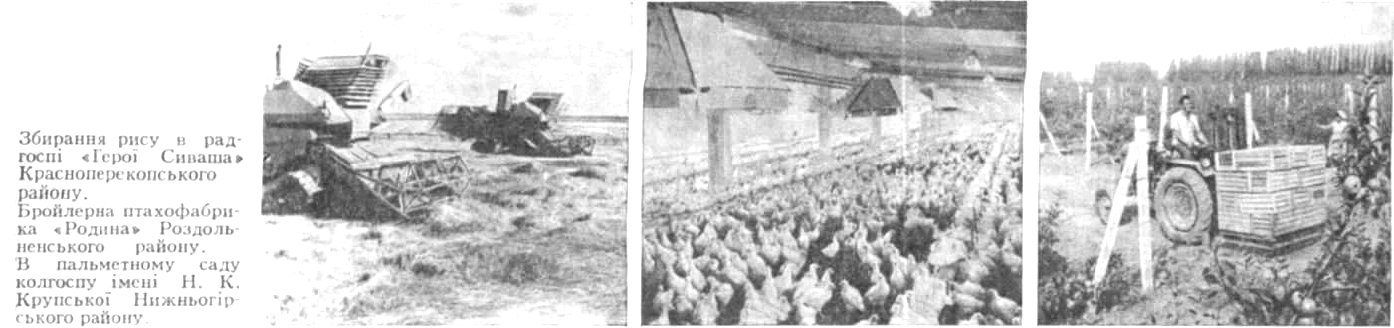
Decisive Steps to Revitalize the Sectors. Ukraine is Revitalizing Crimean Horticulture and Viticulture
Ukraine is revitalizing Crimean horticulture and viticulture.
Petro Volvach, Full Member of the Shevchenko Scientific Society (NTSh), member of the National Writers' Union of Ukraine (NSPU), Honored Worker of Science and Technology of the AR of Crimea, Crimean resident with 60 years of experience. "Krymska Svitlytsa" newspaper, 2017, Issue No. 50
The attention of republican, both economic and party, bodies to the revival and development of Crimean horticulture and viticulture on the peninsula after its incorporation into Ukraine was constant and systematic. Already after the April announcement of revolutionary plans for the further development of these sectors in the Crimean Oblast (August 26, 1954), the Council of Ministers of the Ukrainian SSR and the Central Committee of the CPU adopted a resolution "On measures for the further development of agriculture, cities, and resorts of the Crimean Oblast."
This Resolution became a kind of strategic program for the development of Crimean horticulture and viticulture. First of all, it approved carefully developed plans for planting orchards and vineyards for 1955-1958. During a relatively short period, in the collective farms (kolkhozes) and state farms (sovkhozes) of the Crimean Oblast, Ukrainian settlers had to plant 10.9 thousand hectares of commercial orchards, almost 9.35 thousand hectares of vineyards, and 890 hectares of berry fields. A huge volume of work also had to be performed to revive and reconstruct 1.690 thousand hectares of neglected orchards and reconstruct vineyards on nearly the same area.
A significantly larger volume of work had to be performed by the collective and state farms of the region to put in order the existing orchards (on an area of almost 5.0 thousand hectares and on 7.5 thousand hectares of grape plantations). These sectors had not known such a scale of progress in the entire history of Crimean horticulture and viticulture.
The plan for the revival and development of horticulture and viticulture developed in Kyiv was so well-balanced and solid that it even provided for one of the contractors — the machine and tractor stations (MTS) in mountainous districts — to be allocated explosives for pre-planting soil preparation.
It was at this time that the creation of a powerful specialized horticultural and viticultural association, Krymvyntrest, began. By a government decree from the Ministry of Food Industry of the Ukrainian SSR in July 1954, lands of several state farms in the Simferopol and Staryi Krym districts were transferred to Krymvyntrest. The task was set to create powerful viticultural enterprises on their basis within 4-5 years, with the area of commercial vineyards reaching up to 1,500 hectares. Thus arose the famous viticultural and winemaking giants: the "Vynohradnyi" state farm near Simferopol and "Zolote Pole" near Staryi Krym.
At the same time, the Feodosia grain state farm was repurposed. In accordance with the government decree, a specialized viticultural enterprise began to be created in this farm on an area of 1,100 hectares starting in 1954. Its main task was the cultivation of valuable table and wine grape varieties. Therefore, the foundations of the future powerful industrial viticulture and winemaking in Feodosia were laid in the very first years of the Crimean Oblast's inclusion in Ukraine.
A change in the concept of the development of horticulture and viticulture attracts attention. While the Russian Federation created commercial orchards and vineyards mainly on the Southern Coast, in mountainous Crimea, and in the Foothills, after 1954, the range of horticultural and viticultural zones expanded to the steppe zone, Eastern, Western Crimea, and the Kerch Peninsula. During 1955-1958, Ukraine planned to create several hundred hectares of orchards in the following steppe districts: Azov (370 ha), Dzhankoi (690 ha), Krasnoperekopsk (510 ha), Krasnohvardiiske (390 ha), Lenine (260 ha), Nyzhniohirskyi (430 ha), Saky (410 ha), etc.
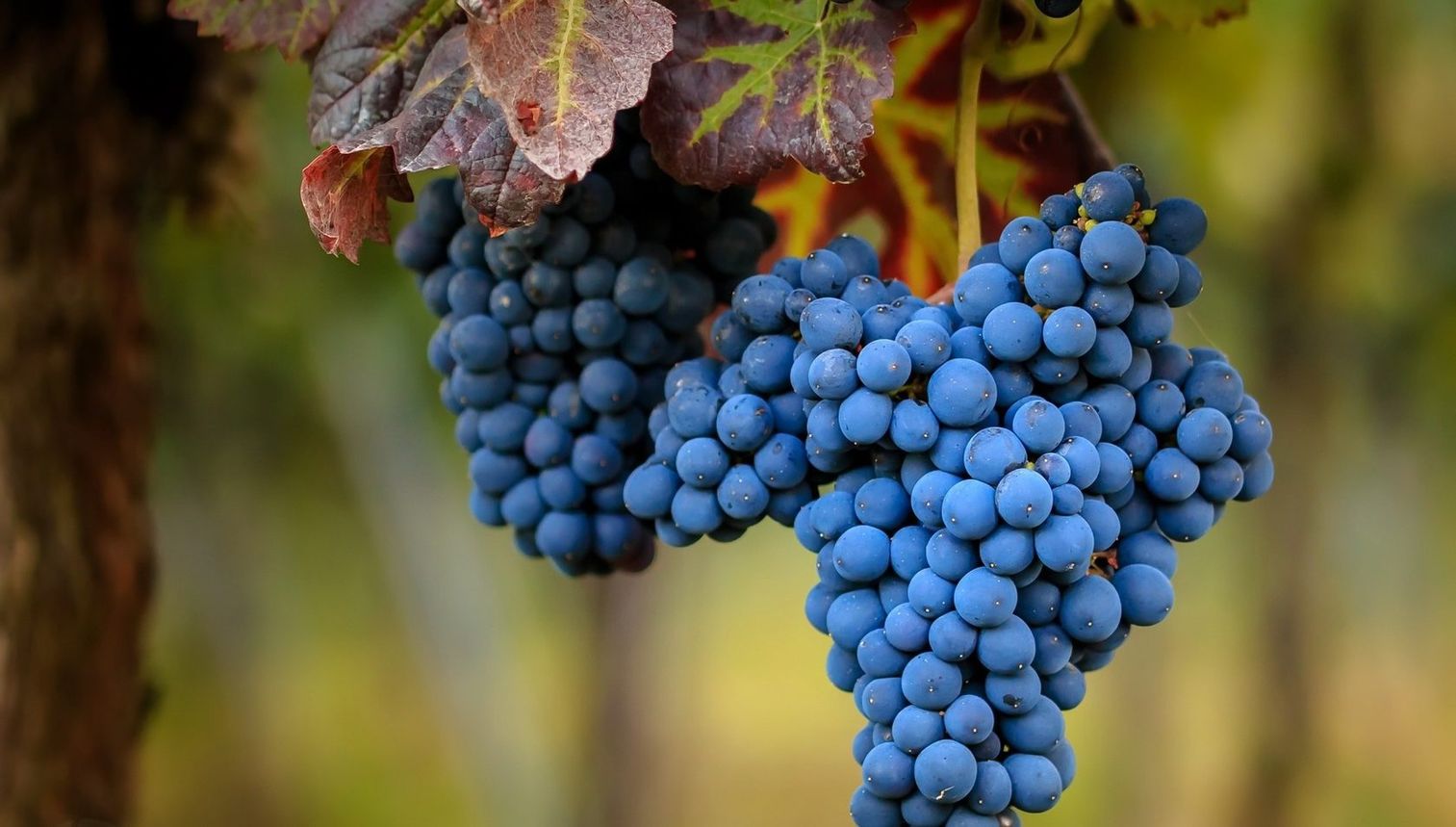
As for vineyards, there was not a single district where the creation of commercial plantings was not planned. The largest areas of grape plantations were planned to be established during 1955-1958 in steppe districts new to this industry: Azov (605 ha), Dzhankoi (803 ha), Krasnohvardiiske (870 ha), Krasnoperekopsk (680 ha), and Rozdolne (410 ha). In total, over four years, the area of orchards in the region was to increase by 8,500 hectares, and vineyards by 9,250 hectares. The peninsula had not yet known such rates of development for the leading sectors of horticulture and viticulture.
The problem of the revival and further development of horticulture and viticulture in Crimea was under the tight control of Ukrainian government officials. Kyiv repeatedly warned the sluggish and ambitious Crimean leadership about the failure to fulfill annual tasks for the creation of new orchards and vineyards and the unsatisfactory rate of reconstruction and repair of already existing plantings. In addition, the Crimean regional party committee (obkom) and the regional executive committee worked quite inefficiently on providing housing for settlers and their settlement on the peninsula. These failures of the local authorities forced Kyiv to radically change the leadership of the Crimean Oblast.
Vasyl Komyakov, a good specialist in agricultural production and an experienced organizer who replaced Dmytro Polyansky as Secretary of the Crimean Obkom in 1955, viewed the revival of horticulture and viticulture in the region as a priority task. It was on his initiative during 1956-1958 that a number of extremely important, fateful events for Crimean horticulture and viticulture were held in Crimea and Kyiv.
At one of these events, Vasyl Komyakov, whom even his opponents rightly consider the father of revived Crimean horticulture and viticulture, reported for the first time on a grandiose ten-year plan for the development of these sectors in Crimea. And they were striking in their scale. During 1956-1960 alone, it was planned to plant 20 thousand hectares of orchards in the region, and over the next 10 years — another 40 thousand hectares. This is almost 5-6 times more compared to the pre-war period.
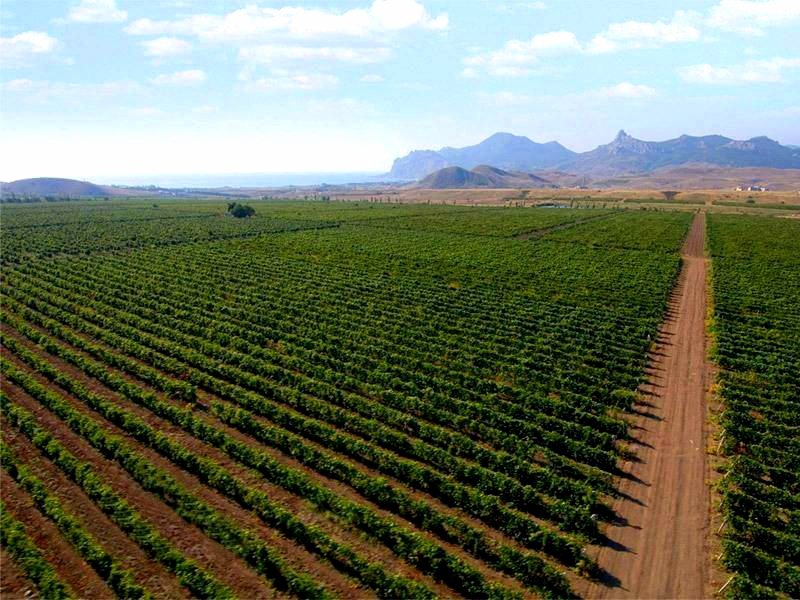
Even more grandiose plans were made for the development of Crimean viticulture: during the five-year plan, 40 thousand hectares of new vineyards were to be planted in the region, and in ten years — 92 thousand hectares. Although such indicators seemed unrealistic to many, as life showed, they were nevertheless achieved. It was at this time that 6,400 hectares of orchards and vineyards were created in the Krasnohvardiiske district, 4,440 hectares each in Simferopol, Dzhankoi, and Saky districts, 3,900 in Azov, 3,500 in Oktiabrske, and 3,100 hectares in Pervomaiske district.
During this period, several giant viticultural state farms were created: "Zolote Pole" in the Kirovske district (1,700 ha), "Zolota Balka" near Sevastopol (over 1,500 ha), the "Vynohradnyi" state farm near Simferopol (1,450 ha), and the "Novo-Dzhankoiskyi" state farm near Dzhankoi (1,350 ha). Over 1,000 hectares of orchards and vineyards were planted on the "Ukraina" collective farm in the Kirovske district and the "Druzhba Narodiv" collective farm in the Krasnohvardiiske district.
Thus, there is every reason to assert that Ukraine, already in the first five-year period of the Crimean Oblast's presence in its composition, radically changed not only the ideology of these sectors but also significantly expanded the range of commercial horticulture and viticulture on the peninsula.