Rus People of Crimea
Stories of the small town of Chornomorske, located in western Crimea.
Olha Puhach, Kyiv City Organization \"Prosvita\" named after T. Shevchenko. \"Krymska Svitlytsa\" newspaper, 2016, Issue No. 33
It was in the first years of the restoration of Ukrainian independence. In search of sun and sea, we found ourselves in western Crimea, more precisely, in the small town of Chornomorske. Stepping off the bus, we were glad to see an elderly woman at the bus stop selling sunflower seeds and plums in paper cones made of newspaper. We were hungry after the journey, so both the plums — sweet Crimean plums — and the fragrant roasted sunflower seeds were very welcome. She, the seller of delicacies, pointed us — in good Ukrainian — in the direction we should head to find accommodation quickly.
\"There are practically no Ukrainians in Crimea...\"
The refined Ukrainian language in Crimea interested us, and we wanted to get to know her better, but this time there was no time for conversation, as we had to settle in. It so happened that on the very next day, we saw our new acquaintance again — she turned out to be our neighbor. Often visiting our hosts, friendly and smiling, she never came empty-handed, always bringing treats — the same sunflower seeds and plums, or something else from the yard and garden. But what especially drew our attention was that she spoke Ukrainian with her Russian-speaking neighbors, practically without any surzhyk or Russianisms.
Long summer evenings were often spent in conversations with locals, including the hosts of the apartment we rented. It was from them that we heard then that \"there are practically no Ukrainians in Crimea. Nobody knows the language, and we can't understand what they are talking about in the parliament in Kyiv. We only understand that deputy Ivan Zayets is for the people. But we can't understand anything else.\" Well, understanding or not is one thing. But as for Ukrainians in Crimea, I decided to object and remind them of their Ukrainian-speaking neighbor. \"She is Russian, and as for her speaking Ukrainian, she probably lived among Ukrainians for a long time,\" the hostess of the household replied with confidence.
Our hosts were nice people, friendly and hospitable. The hostess cooked dinners outside on a kerosene stove and always invited us to taste them. As you taste, you praise, and she immediately shares the secrets of preparation. And the dishes are ours — borscht (definitely!), cabbage rolls, varenyky: \"To make the borscht tasty, throw one potato in whole and mash it at the end. Let it boil once and it's done!\" — a note for homemakers! I cook borscht like that now. \"Where did you learn to cook such dishes?\" — \"My mother cooked them, so we learned too.\" — \"And where did you come from to Crimea?\" — \"We are from near Voronezh.\" — \"So you are Ukrainians?\" — \"No. I am Russian, and my sister is Ukrainian. As we wanted, so we were recorded. I wanted to be Russian.\"
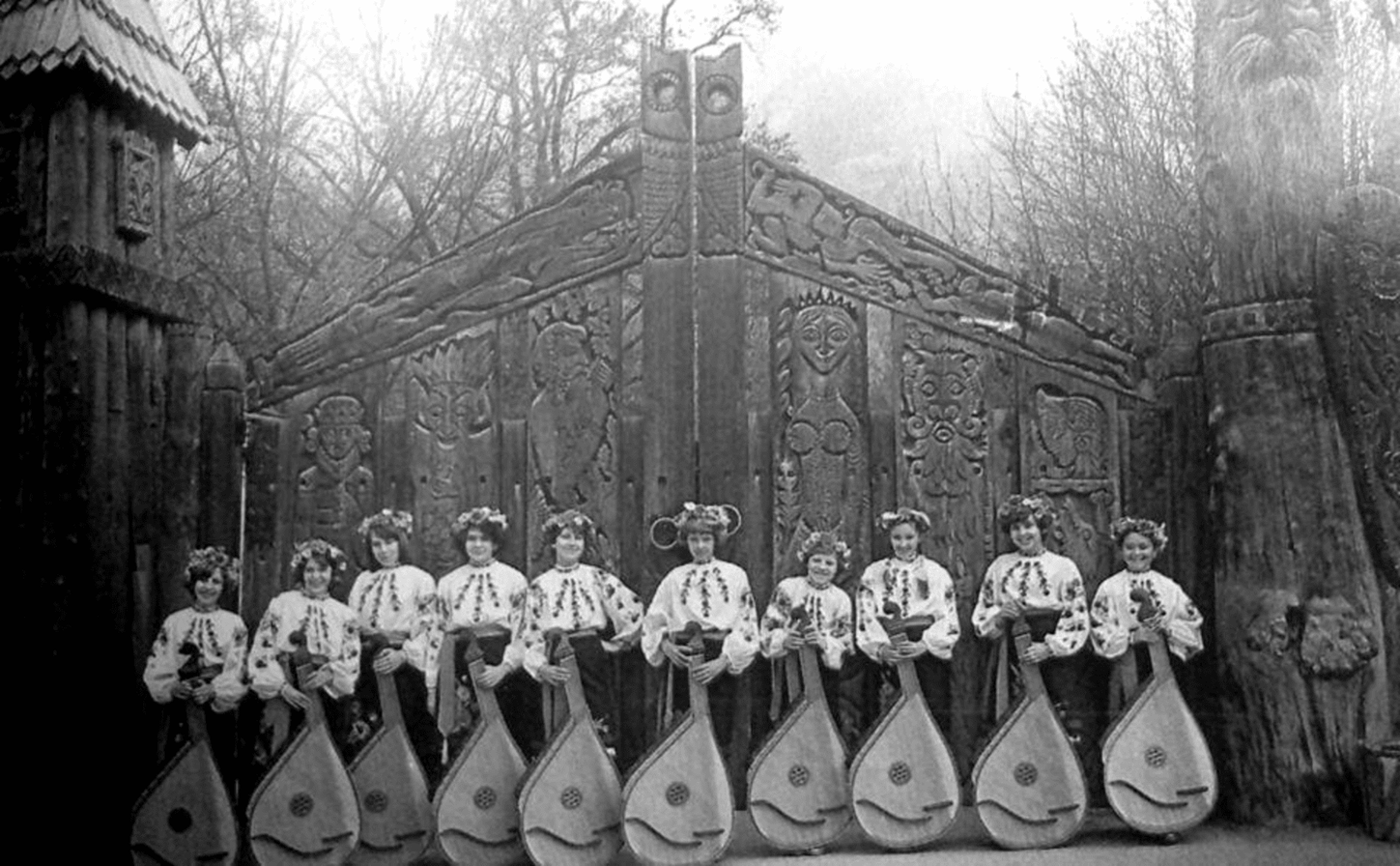
Yalta Bandura Capella at the entrance to the \"Glade of Fairy Tales\".
\"We are Rus people...\"
The conversation with the hostess's husband turned out to be even more interesting. Speaking to us in Ukrainian, he said, almost with emotion, that he had not spoken this language for about eighty years. It was clear how difficult it was for him. He said that he was from a large village on the Volga, somewhere near Astrakhan. A long village, about five kilometers. All Ukrainians. But when his father was hired as a railway driver, on his very first day, coming home, he told the children that from today I am not \"tato\" to you, but \"tyatya\".
His work was considered government service, and the civil servant transferred his family to the state language in one day \"by decree,\" \"since then I haven't spoken this language.\" These sentiments, however, did not prevent our compatriot from the Volga from concluding at the end of our vacation, either angrily or offensively: \"Your language irritates me! All this is useless!\"
But we were still most curious about the elderly woman who sold us sunflower seeds at the station. Since we were told that she was Russian, we wanted to hear from her how it happened that she, a Russian, learned the language so well and spoke it, even though Russian speech was heard everywhere. Agree, this is an unusual case.
\"Where did you come to Crimea from?\" I ask her. — \"From nowhere. I was born here.\" — \"Well, where did your father come from?\" — \"My father was born here, and my grandfather, but I don't know where my grandfather's grandfather was from. But I know that our family got here back during the reign of Empress Catherine. We are Rus people, subjects of Her Majesty the Empress.\" — \"Well, how are you Rus? Do Russians speak like that?\" — and I switch to the Kyiv dialect of Russian. — \"Well, that's the cultured way, and we are simple people, so we speak simply, so it turns out to be uncultured or something...\" — and she smiled, embarrassed. — \"So why do you think you are Rus? Maybe you are not Rus after all?\" — \"Who else are we? Not Tatars...\" — \"And are there many of you here, such Rus people?\" — \"This whole street. And there were no other streets here. And out there in the steppe,\" she points with her hand, \"Tatars lived. But we are indeed Rus people. We lived well here once, had good gardens, kept sheep. And now there is no life. A lot of people arrived, built houses and buildings like those! There is nowhere to graze sheep anymore. It's bad here now. But we used to live well here.\" — \"And do Ukrainians live here?\" — \"They do. Those new houses on that street are theirs. There are many of them there. After Khrushchev gave Crimea away, many of them arrived. And before that, only Rus people lived here, because the Tatars were deported...\"
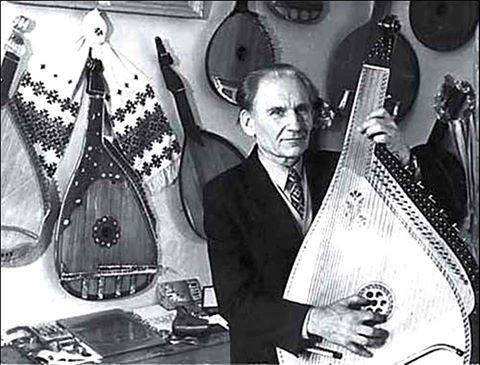
Oleksiy Fedorovych Nyrko — promoter of bandura playing in Crimea and Kuban, bandurist, historian of bandura playing, head of Yalta \"Prosvita\" (1988–1991), director of the S. Rudanskyi Bandura Capella in Yalta.
From the History of Chornomorske
That was the conversation. So it was quite natural that we decided to look into the history of the settlement of western Crimea. The local history museum of the town came in handy.
Documents show that in the 4th century BC, on the lands of modern Chornomorske, the Greeks founded the city of Kalos Limen. In those days, the Ionian dialect of Greek and the language of people from the local ethnic environment — the agricultural population of the lower Bug region — dominated those lands. In Russian, Kalos Limen is translated as \"Prekrasnaya Gavan,\" and in Ukrainian, it is understandable without translation — \"kolosalnyi lyman\" or \"prekrasnyi lyman\", because a liman is a liman. In the 3rd century BC, these lands were part of the Chersonesos state. Interestingly, the citizens of Chersonesos took an oath of allegiance to the State.
Here are some points from the oath: \"...I will not give or receive gifts to the detriment of the State or citizens.\" \"The grain exported from the plain I will neither sell nor export from the plain to any other place, but only to Chersonesos\" — an agricultural civilization! Later, Scythians came to the peninsula, followed by the Huns. By the 4th century AD, the last centers of ancient civilization disappeared in these lands. The Khazar Khaganate was succeeded by Byzantine rule; the troops of the Kyiv Prince Volodymyr also participated in military actions against Byzantium. Next came the Polovtsians. For 340 years, 1443-1783, the Crimean Khanate ruled.
As a result of the military actions of the Russian army, in 1783 Turkish troops left Crimea, and Russian colonization of Crimea began. According to documents from 1864, there were already 1,046 settler households in the Yevpatoriya district (western Crimea). Among the first settlers in Ak-Mechet (the last name of the town before Chornomorske), the museum documents note, were Ivan Hryhorovych Sharylo and the Peretiatko family. The museum has a photograph of one of the first houses of the settlers — a white clay house (mazanka) of the Ikhno family.
Already in the 18th-19th centuries, landlord landownership developed in Crimea. The estates of V. S. Popov and Count M. S. Vorontsov supplied up to ten thousand Astrakhan lambskins (smushka) to the market, worth 2.5-3 silver rubles each. When it is written that \"the estate supplied to the market,\" we read \"serfs, including settlers, put their labor into this.\" It was not the serene prince who dressed those skins. The Vorontsov Palace in Alupka, the ornament of the southern coast of Crimea, was built, among other things, with money from lambskins from landlord estates.
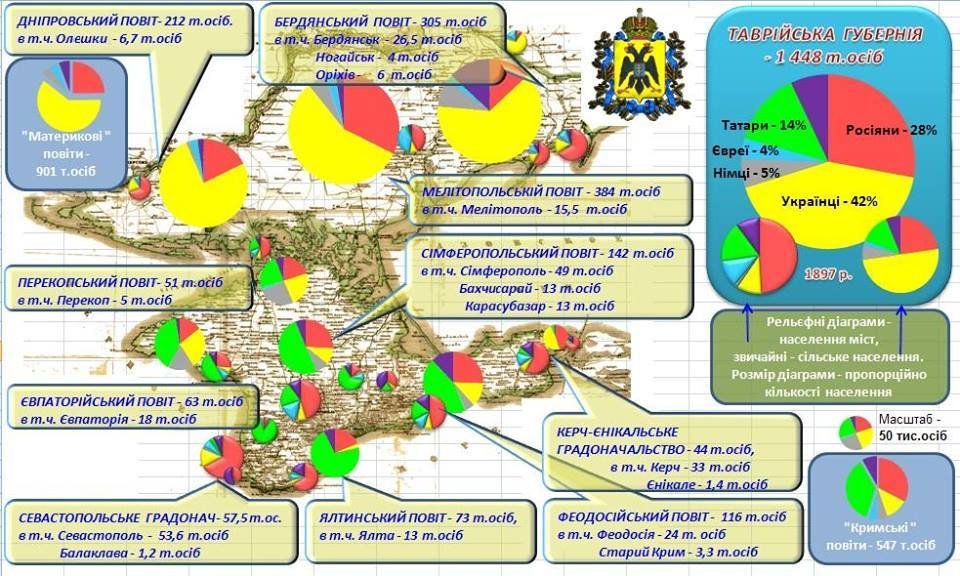
It Seems There Were Some Ukrainians After All...
Soviet power brought a new form of management to Crimean lands — collective farms (kolkhozes). Among the museum exhibits, there is a record of grain delivery to the state by the peasants of Chornomorske from the collective farm named after the October Revolution, dated 1940, that is, before the transfer of Crimea to Ukraine: Overchuk, Myronchuk, Tykhovod, Voronka, Milkevych, Kovalenko, Romaniuta, Lupynos, Aleshchenko, Poroda, Obolentsev, Lukashevych, Pasichnyk, Kolpak, Vlasiuk, Zhdan, Yarmolenko, Kariev, Stadnyk, Cherniavskyi, Altukhov, Butov, Filipenko, Medvediev, Kalenych, Babych — such an international farming contingent. It seems that there were indeed some Ukrainians among the collective farmers of Chornomorske.
25 kilometers from Chornomorske, there is still the village of Olenivka. I ask the locals — what does the name come from? — \"Probably deer there lived...\" Deer, in general, could have lived in Crimea, as shown by game distribution maps. But, most likely, this name of the village is from the series Ivanivka, Vasylkiv, Petrivka, Marianivka, that is, formed from the name Olena. So, in this Olenivka, before the war of 1941-1945, there was a Ukrainian amateur theater. An exhibit of the museum is a photo from a performance, and under the photo are words from the play that was performed: \"I lost everything, drank everything away, came to nothing...\" — this is from the play by Hryhoriy Fedorovych Kvitka-Osnovianenko \"Svatannya na Honcharivtsi\"! Perhaps that theater was also founded by Rus people, or perhaps by those who already knew that they were Ukrainians? History has confused our compatriots.
In the lists of Chornomorske residents who did not return from the front of the Second World War, in addition to the names already mentioned, we see Bilotserkovskyi and Bohatskyi, Berk, Herashchenko and Koval, Hudyma, Herasymenko, Horbenko, Denyshchenko, Karas and Kobzar, Kapeliushnyi, Nudha and Prykhodko, Peresypko, Shynkariuk, Yakymenko, Meleshko, Tseluiko. In the same list are descendants of the first settlers — Sharylo and Peretiatko. Most likely, the majority of those Chornomorske residents who did not return from the fronts of that and not only that war considered themselves namely Rus people.
In historical sources, one can see maps on which the Black Sea is not Black at all, but the Rus Sea. An astronomical historical fact — ambassadors from the Rus people traveled to Pereyaslav for the Council to the Tsar of Moscow. Maybe, following Hrushevsky, we should reclaim the name Ukraine-Rus? Without sinning against the truth, it would help some of our compatriots to finally make up their minds.