The Gardener of Stamboli's Dacha and His Family
The eventful life of Ivan Ryaboshtanov and Stamboli's dacha in Feodosia.
Viktoriya Buket, great-great-granddaughter of Ivan Ryaboshtanov through his daughter Vira; Yevhen Buket. "Krymska Svitlytsa" newspaper, 2017, Issue No. 27
In 1796, General Zakhar Bakariukov received lands in the southeast of Crimea. In 1814, he resettled his serfs here from the Kursk and Kharkiv provinces. Thus, from the Vovchansk slobodas of the Kharkiv province (Malomykhailivka, Aliabieve, Kolodne, Starykove, Zakhariivka, Ivanivka, Vasylivka, Udobna, and Tykhyi hamlet), the families of Khromov, Barbinov, Artiushchenko, Kolomyichenko, and Ryaboshtanov were resettled.
According to the website forum.vgd.ru, the Ryaboshtanovs originated from the Ryaboshtan lineage of the village of Ivanivka in the Vovchansk district of the Kharkiv province, and according to a family legend — from the Orel province.
By the 1870s, the surname Ryaboshtanov was already quite common in Feodosia and its surroundings. Some representatives of the family were Feodosia townspeople (burghers). Unfortunately, without archival research, it is impossible to find out the social status of Yehoriy (Heorhiy) Ryaboshtanov, who had at least two sons — Yakiv and Ivan (born in 1872).
Ivan's family at the beginning of the 20th century lived in Nasypkoy (currently the village of Nasypne of the Feodosia City Council). His wife — Paraskoviya Antonivna Shandyba (born Nov 6, 1880) — was also originally from Nasypkoy. It is likely that they were married in the local church of the Icon of the Mother of God "Joy of All Who Sorrow," which was built in 1830 and still operates today.
At the beginning of the 1910s, Ivan and Paraskoviya were hired in Feodosia by a merchant of the first guild, Yosyp Stamboli. He was hired as a gardener, and she as a housekeeper (according to family legend).
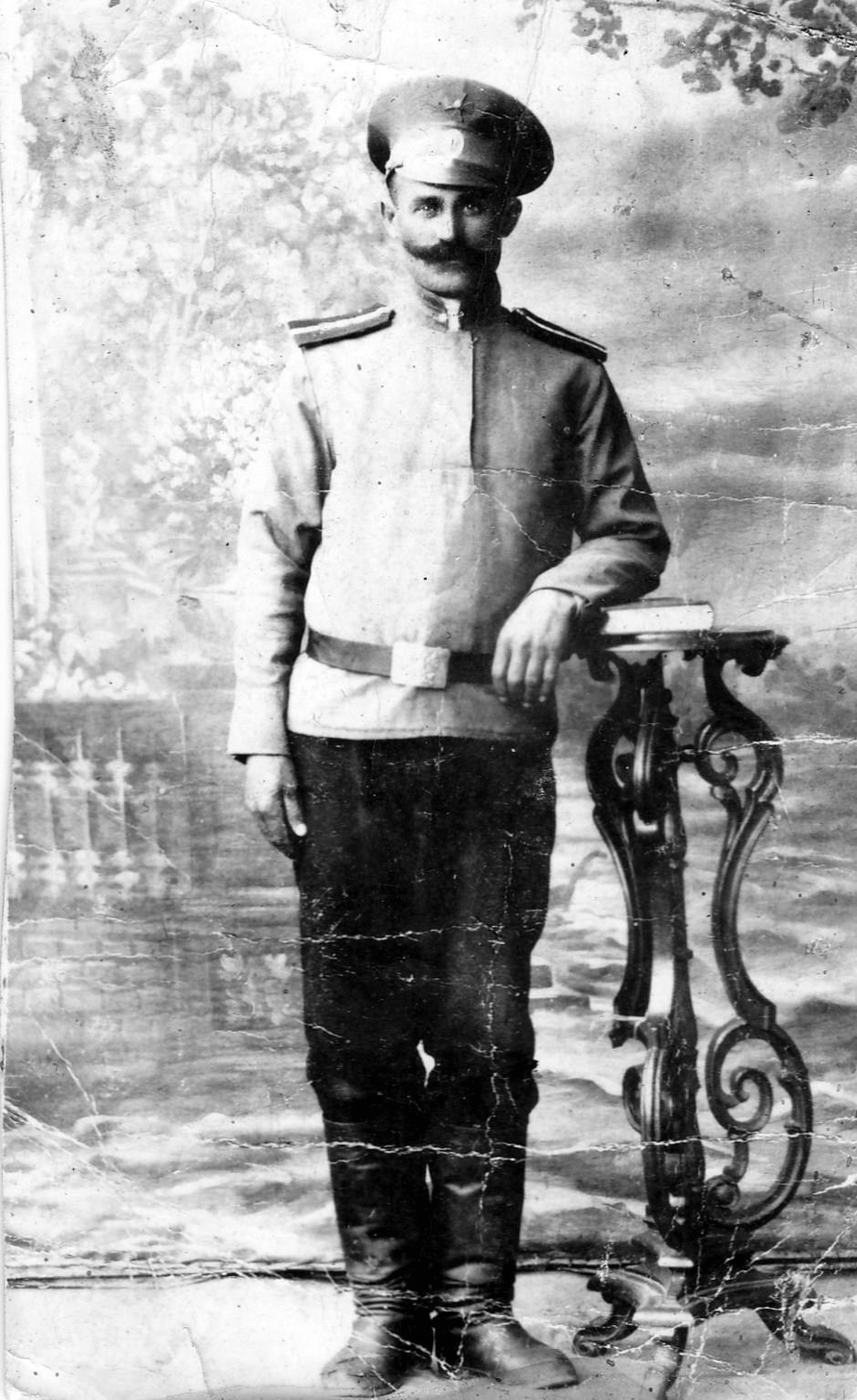
Ivan Ryaboshtanov during military service
The whimsical silhouette of the former dacha of the tobacco manufacturer, Karaite Yosyp Stamboli, is one of the "visiting cards" of the city. Stamboli's Dacha is often depicted on postcards, postage stamps, calendars, and in all publications without exception dedicated to Feodosia.
The construction of the dacha took four years — from 1910 to 1914, with large capital investment and solid scope. The mansion-palace cost its owner a "cosmic" sum at the time — 1 million 100 thousand rubles.
The owner of the dacha lived in the newly built mansion for only three years. Having learned about the Bolshevik coup, Yosyp Stamboli and his family left Feodosia and emigrated to Turkey.
Stamboli's dacha is surrounded on all sides by a row of evergreen cypresses. Nearby in the park, an interesting servants' house has been preserved — another architectural monument of Feodosia — the "Gardener's House."
It was in this house that the Ryaboshtanovs lived. The mother passed on to her daughters a love of cleanliness and tidiness. They knew how to set the table, knew the rules of etiquette, etc. Daughter Vira graduated from 4 classes of the Feodosia gymnasium. When the owners left, Ivan and Paraskoviya looked after the order of the entire estate.
Around 1915, Ivan Ryaboshtanov was drafted into the army. He even managed to spend time in German captivity. He returned to Feodosia by 1917.
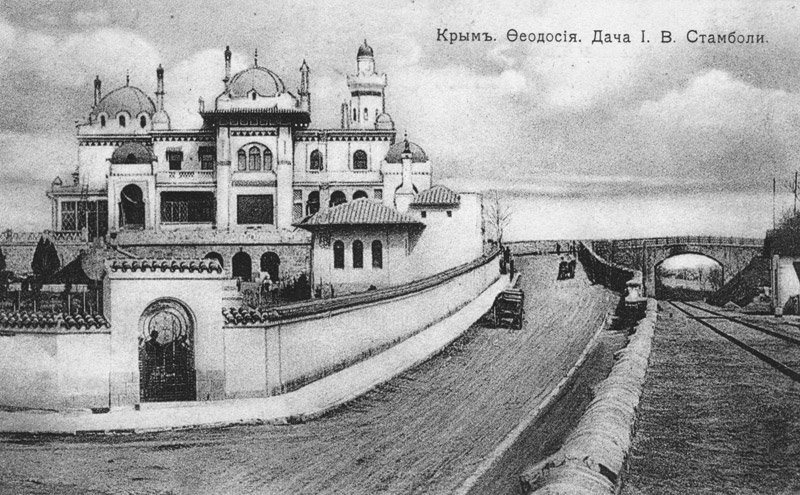
Dacha of Yosyp Stamboli
After the Stamboli family left Feodosia, gardener Ivan Ryaboshtanov and his family returned to Nasypkoy, where he built his own house (it was finally dismantled in 2016). But the plot itself, now with a new house, still belongs to the Ryaboshtanovs.
Ivan Heorhiyovych worked as a farm manager in Nasypkoy before the Second World War. After the war began, fearing repression from the Germans, Paraskoviya Antonivna Ryaboshtanova burned the family documents and buried the photos on the plot. In 1941, the former gardener of Stamboli's dacha was evacuated to Kuban with his wife, daughters, and grandchildren (from Feodosia to Temryuk, and further to the village of Illinka, 35 km from Krasnodar). They lived in Illinka for 4 years. There, Ivan Heorhiyovych fell seriously ill and, upon returning to find his house ruined and facing postwar hunger, died in July 1945. He is buried in the cemetery in Nasypne.
His son Mykhailo died of a heart attack before the war. Son Anton was the chairman of the village council in Nasypkoy until 1941. He went to war and was a sailor. Red Navy sailor. Killed on June 19, 1942 (both of his legs were blown off, he died of blood loss). He is buried in Sukharna Balka in Sevastopol. He is included in Volume IV of the "Memory Book of the Hero-City of Sevastopol" (Simferopol: "Tavrida", 1995. - p. 258). Anton Ryaboshtanov's family did not go into evacuation; they remained in the village.
His son Hryhoriy, after returning from the front, was appointed chairman of the collective farm in the village of Shubine in the Kirovske district. After the death of his father Ivan, Hryhoriy brought his mother, his sisters Vira (with her family) and Anna to Shubine. Paraskoviya Antonivna Ryaboshtanova (Shandyba) died in June 1969 and is buried in Shubine. Hryhoriy Ivanovych (died in the 1980s) and Vira Ivanivna (died March 18, 2000) also lived their lives and died there. Anna Ivanivna spent the last years of her life in the village of Pervomaiske in the Kirovske district (died May 6, 1998).