The State of Horticulture and Viticulture in Crimea in the First Post-war Decade
The horticultural sector in the post-war Crimean Oblast.
Petro Volvach, Full Member of the Shevchenko Scientific Society (NTSh), member of the National Writers' Union of Ukraine (NSPU), Honored Worker of Science and Technology of the AR of Crimea, Crimean resident with 60 years of experience. "Krymska Svitlytsa" newspaper, 2017, Issues No. 9 – 10
Since the end of the 19th century, horticulture and viticulture in Crimea had been leading sectors of the economy. According to the evidence of one of the best researchers of Crimean horticulture, the world-famous Ukrainian scientist, horticulturist, and pomologist Levko Simyrenko, in years favorable for horticulture, as early as the late 1870s, up to 7 thousand tons of mainly apples and pears, 2 thousand tons of nuts, and 70 thousand barrels of table grape varieties were sent from Crimea to the mainland (mainly to St. Petersburg and Moscow). Every year (up to 1917), the volume of products grown in Crimean orchards increased.
However, later the lack of scientific support for the horticultural sector and the Michurinization of science and production caused great damage to Crimean and Ukrainian horticulture, and before the Second World War it never managed to reach the level of 1913. However, the real decline of horticulture and viticulture — sectors traditional for Crimea — occurred after 1944.
Unfortunately, due to hidden political motivation, modern historical and horticultural science has not yet subjected the reasons for this very unfortunate phenomenon to an unbiased investigation. Traditionally, even professional historians associate the degradation of horticulture and viticulture, as well as the entire Crimean agriculture, with the war and the German-fascist occupation of the peninsula. But this is only part of the truth. Indeed, compared to 1940, the area of orchards in all categories of farms, including the private sector, decreased by 6 thousand hectares.
A large number of orchards and vineyards were left without proper care and perished. Part of the plantings suffered from the cutting down of trees for heating. In fact, during the years of the war and post-war hardships, Crimea lost its once powerful chayir (forest) horticulture. In all years, it was this sector that to a large extent supplied high-quality, ecological products for the canning and processing industry. While before the war the area of chayirs in the foothill and mountainous zones of Crimea was over 5 thousand hectares, in the post-war years statistics on chayirs are completely absent.
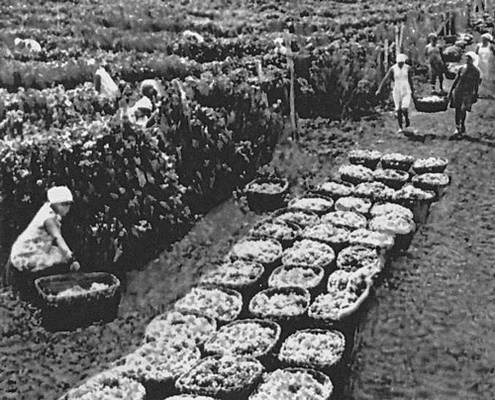
Grape harvest in Balaklava, 1952 р.
After the deportation of the Crimean Tatar and other peoples from Crimea, horticulture and viticulture degraded in a few decades. In what state were these once leading sectors before the transfer of the Crimean Oblast to Ukraine? The answer to this question is provided by several important documents stored in the Central State Archive of Public Organizations of Ukraine (TsDAHOU) and in other archives of the country. The most important of them is the Memorandum submitted to the First Secretary of the Central Committee of the Communist Party of Ukraine, Oleksiy Kyrychenko, in January 1954, that is, a few months before the transfer of the Crimean Oblast was carried out.
A large part of it is taken up by an analysis of the state of agriculture in the Crimean Oblast. A deep analysis of the state of horticulture and viticulture in the collective farms of the Crimean Oblast in the first year of its transfer to Ukraine is given in the memorandum of the Administration of Affairs of the Council of Ministers of the Ukrainian SSR to the Council of Ministers of the republic.
The memorandums state: "Horticulture and viticulture in many farms of the mountainous and foothill zones of Crimea account for a significant share. According to the All-Union Census, 248 farms were engaged in growing fruits and grapes. And grape growing was concentrated in 256 farms."
The ten-year post-war statistics of the total area of orchards and vineyards are quite disappointing. Over the ten post-war years, the region never managed to reach the pre-war level (1940 by all statistical reporting indicators). While in 1940 the area of commercial plantings in the farms of Crimea was 12,300 hectares, in 1946 there were almost 3.7 thousand hectares less. Even ten years after the end of the war, the authorities did not set themselves the task of bringing the area of orchards at least to the level of 1940. Plans for 1954 envisaged bringing the area of orchards in Crimea to 10,676 hectares.
The situation in Crimean viticulture was even more critical. While in 1940 the area of vineyards in the region was almost 9 thousand hectares, in 1946 it was reduced to 5 thousand hectares, that is, reaching only 57% of the pre-war level. According to annual reports, the area of vineyards in Crimea in 1952 was already almost 9 thousand hectares, and in 1953 — over 9.9 thousand hectares, but according to census data for September 1953, there were only 7,041 hectares. Such a sharp reduction in indicators testifies to obvious falsification in annual statistical reporting. That is, even in 1954, when Crimea was transferred to Ukraine, the region did not reach the pre-war level in terms of vineyard area.
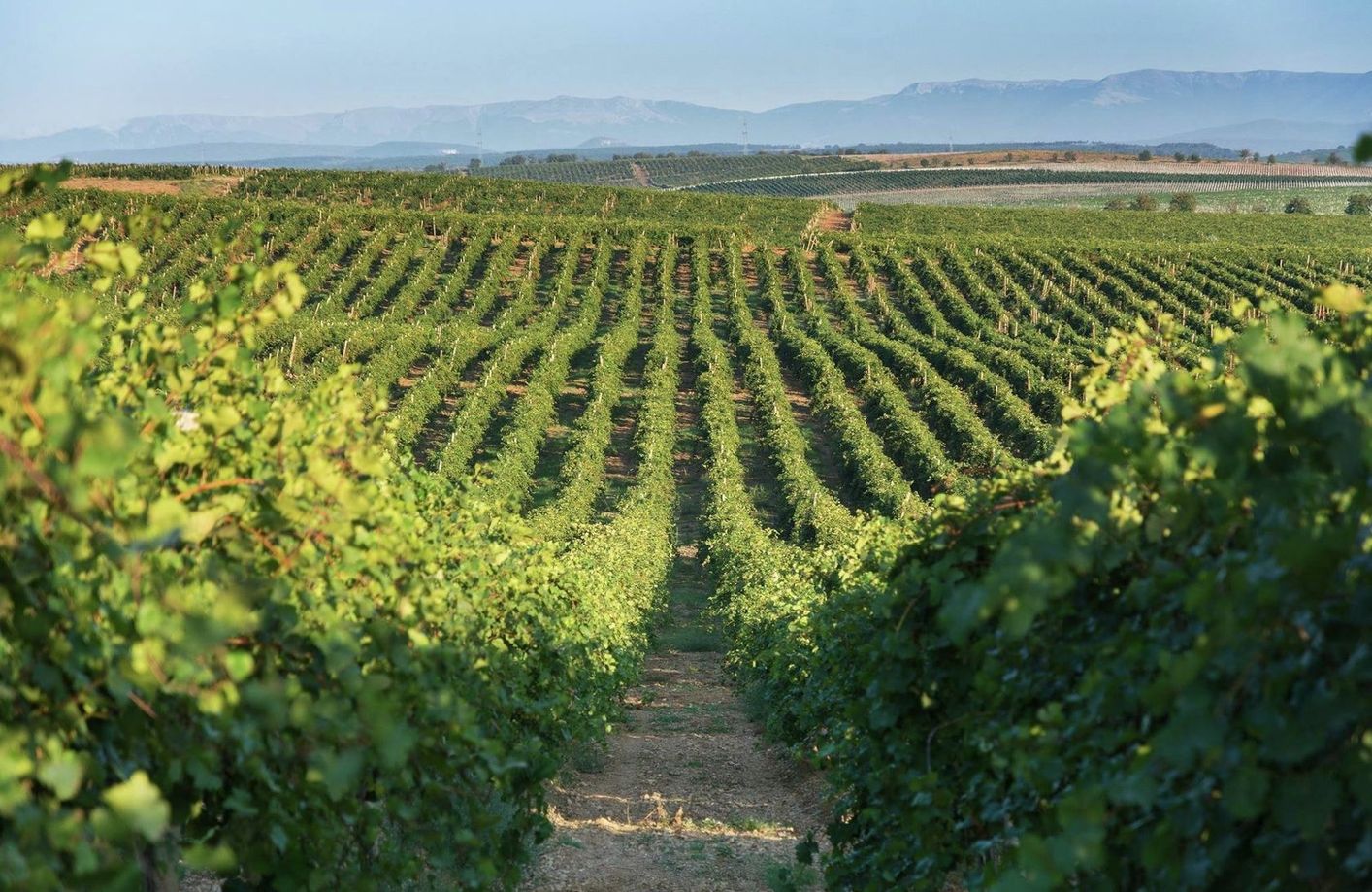
Until 1951, year after year, the region did not fulfill the plan for planting new vineyards. Only in 1952 and 1953 were Crimean winegrowers able to fulfill planned tasks — they planted 800 hectares of new plantations. The report notes that in the region, the pre-war areas of orchards and vineyards in the traditionally horticultural and viticultural districts of the region: Bakhchysarai, Kuibyshevske, Alushta, Yalta, and Oktiabrske, are reviving at a very slow pace.
In 1953, the plan for planting new vineyards in the collective farms of the Balaklava district was fulfilled by only 46%, Sudak — by 40%, Prymorske — by 46%, and Dzhankoi — by 44%. In the collective farms of the Zuya district, not a single hectare of the planned 20 hectares of vineyards was planted. In the collective farms of the Oktiabrske district, it was planned to plant 10 hectares of orchards, but not a single tree was planted.
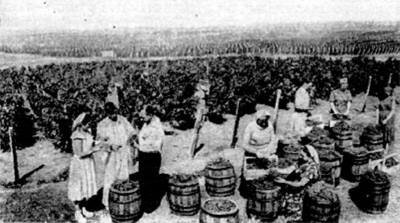
Grape harvest in Yalta. Southern Coast of Crimea
The vast majority of once fertile valley orchards were in a deplorable state. Trees left without care became unproductive and soon dried up. The thinning of orchards reached almost 25%. The total number of fruit trees in Crimean commercial orchards in 1952, compared to the 1945 census, remained at the level of 12.5%. While in 1945, on each hectare of commercial orchard, there were 116 pome fruit trees and 137 stone fruit trees, in 1952 these figures decreased to 92 and 122 trees per hectare, respectively.
Due to the severe thinning of plantings in post-war Crimean orchards, almost 300 thousand trees were missing, which was equivalent to the loss of 1.8 thousand hectares. It was due to the huge thinning of plantings, the lack of proper care for them, the lack of qualified labor, the acute shortage of technical means, and most importantly — the lack of irrigation, that the productivity of commercial orchards was quite low.
Even in traditional, once leading districts (Bakhchysarai, Kuibyshevske, Bilohirsk, and Simferopol), during the first post-war decade, orchard yields failed to reach the figures of 1940.
Only in 1952, several districts highly favorable for horticulture were able to approach the pre-war level in terms of orchard yield.
In that year, only a few farms in which old horticultural personnel had been preserved were able to overcome the 100-centner yield threshold. However, the fruits grown in Crimea were barely enough to supply high-ranking Kremlin officials and the party-economic elite.
The development of horticulture in the region was largely hampered by an extremely weak nursery base. In addition, the existing nurseries grew quite low-quality and unapproved orchard material. Collective farm nurseries suffered from this especially. They often grew widely advertised Michurinist apple varieties, which, of course, should not have been spread in Crimean orchards.
It was due to all the listed reasons that the gross harvest of fruits during the ten post-war years did not reach the pre-war level (4,442.5 tons) and, depending on the weather conditions of the year, varied from 12,380 tons (in 1951) to 35,407 tons in the most favorable year for horticulture, 1952.
The sale of fruits to the state compared to 1940 decreased three to four times compared to the pre-war level during the last years of the Crimean Oblast's presence in the Russian Federation. Given the rate of increase in the area of commercial orchards and low yields, there were no prospects for the revival of horticulture in the next decade.
An even more disappointing situation developed in viticulture. Compared to 1940, when the area of commercial vineyards was almost 9 thousand hectares, during the war years it was cut almost in half and in 1946 was only 5 thousand hectares. That is, as in orchards, annual statistics showed a certain increase in the area of grape plantations in the post-war years.
But the official report of the Administration of Affairs of the Council of Ministers of the Ukrainian SSR refutes the official statistical indicators. Thus, according to statistical reports for 1952, the area of vineyards in Crimea was more than 8.9 thousand hectares, and in 1953 it exceeded the pre-war figure by almost 1 thousand hectares. However, according to the report of the Administration of Affairs of the Council of Ministers of the Ukrainian SSR dated October 1954, the area of commercial vineyards in 1953 was only 7,041 hectares. In 1954, they were supposed to increase by 20 hectares.
Plans for the creation of new grape plantations were not fulfilled year after year, and this deprived the viticultural and winemaking sectors of prospects for further development.
The annual death of a large number of vines on grape plantations in most viticultural districts of Crimea occurred due to the lack of proper care. The reason for this destructive phenomenon for the viticultural sector lay both in the acute shortage of labor and in the low qualification of the first wave of settlers from mainland Russia.
The development of Crimean viticulture on the peninsula was largely constrained by a quite weak nursery base. While the cultivation of fruit seedlings was concentrated in specialized nursery farms and research institutions, the provision of planting material for the creation of vineyards was shifted to the farms themselves. Crimean vineyards at that time were not affected by phylloxera (root louse), and the planting of new plantations occurred mainly with cuttings (unrooted sections of grape vine shoots). They were harvested from local vineyards in late autumn before the onset of severe frosts. Approbation of plantings was not carried out, so the planting material was contaminated with a diverse mixture of varieties.
Thus, in the first post-war decade after the deportation of the Crimean Tatar population, Greeks, Bulgarians, and Armenians from the peninsula, a complete destruction of the most important sectors of the Crimean economy took place: horticulture, viticulture, winemaking, and the fruit processing industry.