Saky: Wide Steppe, Great Chemistry, Ancient Animals
Saky — healing springs and a resort area.
Valeriy Verkhovskyi. "Krymska Svitlytsa" newspaper, 2019, Issues No. 43-44
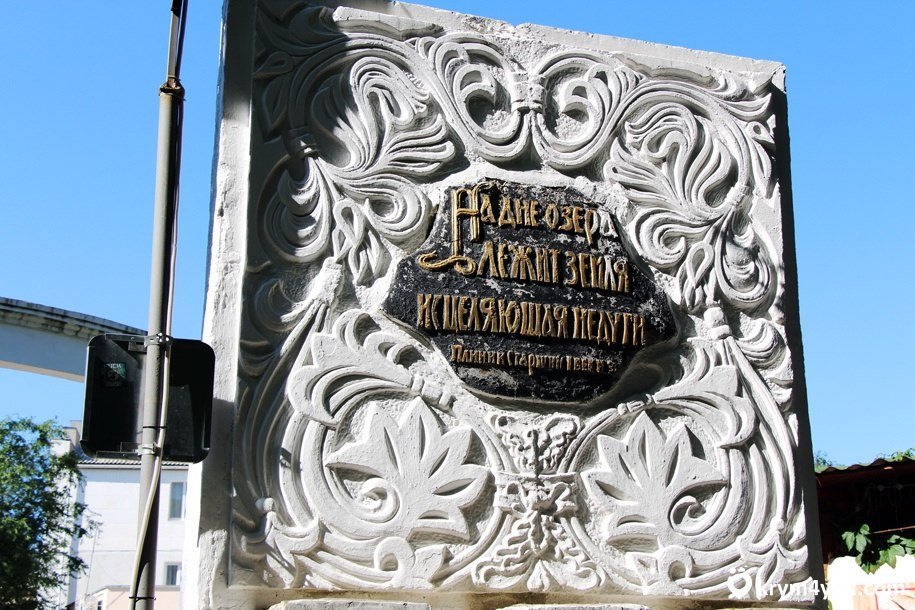
Saky has been known since the times of the Crimean Khanate, but people knew about the healing springs and muds of Western Crimea even two thousand years ago: the ancient Roman writer and scientist Gaius Plinius Secundus (1st century) and the Greek geographer Claudius Ptolemy (2nd century) were the first to write that the Saky land "heals all kinds of wounds." Not far from Saky are the ruins of Kara-Tobe, a hillfort founded before our era. It was conquered by Rome and later fell into decline.
However, the fame of Saky as a resort began two hundred years ago. In the first half of the 19th century, a military hospital and the first health resorts appeared here.
During the Crimean War, the settlement of Saky suffered significant destruction, because nearby, right on the coast known today for its beautiful beaches, the Anglo-French landing force disembarked, and fighting took place near Saky. After the war, the Crimean Tatar population mostly emigrated to Turkey, and this place remained depopulated until Ukrainian peasants from the Poltava province began to resettle here. As long as chumak trade existed, Ukrainians extracted and hauled salt from Lake Saky.
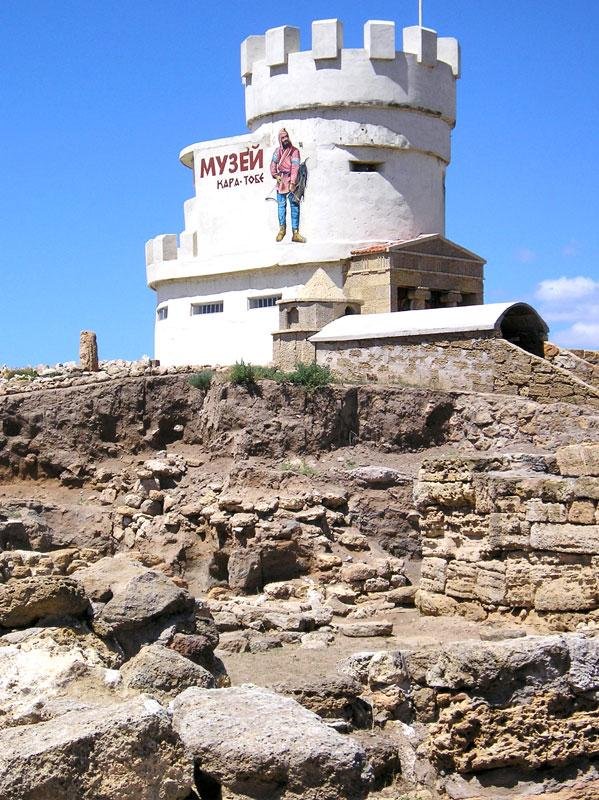
Kara-Tobe Hillfort
The healing muds attracted people, including famous ones who suffered from severe illnesses. Gogol and Voloshin were treated here, and Lesya Ukrainka first went to Crimea precisely here, to Saky. This happened in 1890, but unfortunately, the medicine of that time prescribed a course of treatment and Saky muds that were destructive for her illness, which only harmed the girl's health instead of improving it. Here she had no time for poetry, and not a single poem by the poetess is dedicated to this town.
Saky officially became a settlement only in the 1930s, and they received the status of a town in 1952. This is the only place in the world where a resort existed next to a chemical plant for almost a century, where bromine, chlorine, potassium permanganate, copper sulfate, magnesium, zinc, rare earth metals, and barium were obtained from brine... In 2000, chemical production stopped due to bankruptcy. However, salt extraction from Lake Saky continues to this day.
The town of Saky can be considered exemplary in terms of care for wheelchair users — it is 80% equipped with ramps. In Crimea, almost every city, at least the resort ones that accept people for recreation or treatment, differs from others and has its own "highlights." In Saky, this "highlight" is a park with dinosaurs.
Interestingly, the first dinosaur in Crimea was dug up only in 1934. But the dinosaur in Saky appeared two years earlier. In the early 1930s, a self-taught sculptor from Yevpatoriya, a paleontologist by training, Serhiy Lykhosherstov, created the sculptural business card of Saky: four representatives of the dinosaur family famous in antediluvian times. The official name is "The Struggle of a Brontosaurus with Ceratosaurs." A huge brontosaurus, made by the sculptor in life size, was attacked by four-meter toothed predators — ceratosaurs.
There is a legend that at the turn of the 1920s-1930s near Mykolaivka, a storm washed away a section of the shore and exposed the fossilized bones of long-extinct animals. A lecture on the importance of such finds was organized for local residents. This event may have prompted the local authorities of Saky to include Lykhosherstov's proposal regarding antediluvian monsters in the plan of monumental propaganda.
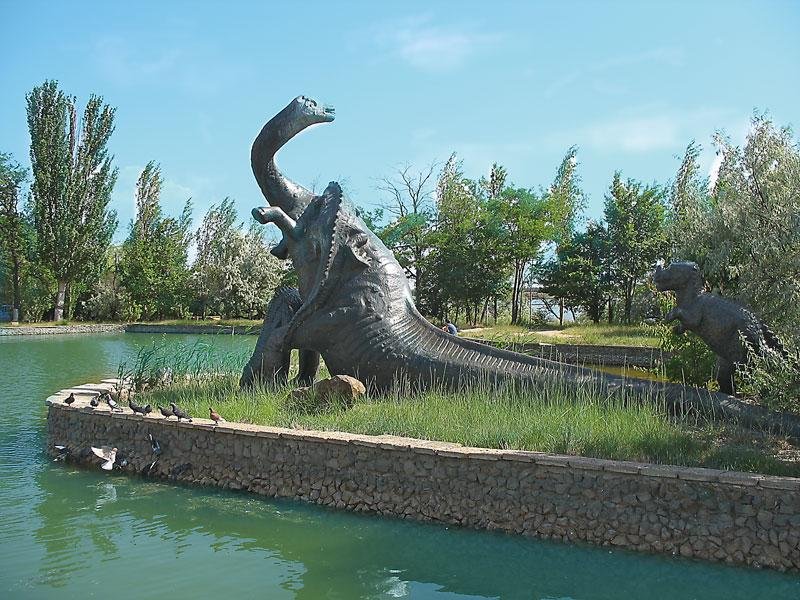
The famous "Brontik"
Very little is known about the author of the sculpture: he was born in Sevastopol and studied at Kharkiv University in the natural sciences faculty. Paleontology was his specialty, but life forced him to engage in other occupations. From 1920, Lykhosherstov lived in Yevpatoriya and worked as a teacher. In the 1930s, he managed in some amazing way to push through the idea of an unusual sculptural composition, having previously, to please the ideology, built a bas-relief on the monument to Lieutenant Schmidt in Sevastopol (which has survived to this day), as well as a monument to liberated labor in Saky: a hammerer smashes the chains girdling the globe with a sledgehammer.
Lykhosherstov invented the material for making the dinosaurs himself — sawdust mixed with magnesium cement, which was produced at the Saky chemical plant in those days.
At that time, this composition in no way correlated with the Bolshevik plan for the development of monumental art, because at that time monuments to the leaders of the world proletariat and numerous, though monotonous, girls with oars were being erected.
Perhaps the officials of ideology and culture were struck by the deep symbolism, and they decided that it meant class struggle or reflected the complex international situation before the new world war? The struggle of species according to Darwin's theory? The favorite tool of socialist realism — the struggle of the good with the better? The Second World War caused significant, but not devastating, damage to the sculpture. "Brontik" was quietly decaying throughout the post-war period, and they only dared to restore the sculpture in 1982. New dinosaurs were recreated in accordance with Lykhosherstov's design, but this time from concrete. And in 2005, the city council approved the silhouette of the prehistoric giant on the coat of arms of Saky.
Western Crimea, with its wide steppe and salty winds, begins with the Saky district. Perhaps this land did not inspire artists with picturesque landscapes in the way the Southern Coast did, but it has its own unique face. And it has something to be proud of.