Samokysh or Samokysha: Returning the Real Name
The unknown life of a famous person.
Serhiy Konashevych. "Krymska Svitlytsa" newspaper, 2017, Issue No. 3
On January 18, 1944, at 9 o'clock in the morning in Simferopol, which was still under the yoke of Hitler's troops, Mykola Samokysha — a Ukrainian graphic artist, battle painter, and master of the animalistic genre — fell asleep easily and peacefully forever in his 84th year. His departure to the afterlife was announced by the press not only of occupied Ukraine, but also of Germany. The obituaries read as follows: "He was popular among both the civilian population and the military. During the war years alone, he painted hundreds of paintings that spread far beyond the borders of Ukraine and Crimea. His name, his many works of art will be an eternal pride for Ukrainian art, for Ukraine" ("Do Peremohy", Lviv, No. 9, 02.03.1944); "The death of the Europeanly known battle painter is a great loss for Ukrainian culture" ("Holos", Berlin, No. 9, 27.02.1944).
However, the pro-Russian press of the occupation period, after Samokysha's death, called him a "great Russian artist," in whose person "Russian art lost a talented master"; however, it was noted that his paintings, brilliant in technique, stood out favorably at Soviet exhibitions among the "miserable canvases of Soviet 'battle painters'." "Already lying on his deathbed, he was still drawing and finding friendly words for the students he loved so much. Everyone in Crimea knew him and was proud of their famous compatriot," wrote the Mykolaiv "Novaya Mysl" (No. 11 (32), 30.01.1944). Unlike the Russian tradition, in Ukrainian publications the artist's surname in the nominative case is given as "Samokysha": this word in Sivershchyna referred to sour milk. This is exactly how the master signed his letters.
He was born on October 25, 1860, in the village of Nosivka, Nizhyn district, Chernihiv region, into a poor family of a village postman and a Cossack woman. From his grandfather, with whom he lived, he inherited stories about the glorious Cossack times, inspired by which he made "weapons" and "commanded" his peers. At the age of 10, with the help of his uncle, after a two-year school, he entered the Nizhyn Classical Gymnasium at the Bezborodko Lyceum. As an 18-year-old youth, he began to visit the workshop of the professor of battle painting B. Villevalde in St. Petersburg.
While studying at the St. Petersburg Academy of Arts (1879-1885), he belonged to a pro-Ukrainian circle of young artists (it also included S. Vasylkivskyi, P. Martynovych, and O. Slastion), whose goal was to recreate historical events and national features from the life and everyday life of the Ukrainian people. This circle was patronized by the famous writer and expert on the history and life of the Ukrainian people, Danylo Mordovets. Mykola Samokysha graduated from the Academy, winning two silver and two gold medals. Interestingly, when entering the academy for the first time, the future outstanding artist failed the entrance exam... At the same time, he embarked on the path of study contrary to the will of his father, who wanted to see his son as a wealthy lawyer, not a "starving painter."
In 1886-1889, together with S. Vasylkivskyi, he went on a scholarship trip to Paris, where he studied under the guidance of the battle painter E. Detaille. From 1890, he worked as an artist at the military department; in the same year, for the painting "Herd at the Watering Hole," he was awarded the title of Academician of Painting. In 1900, he received a prize at the World Exhibition in Paris.
In 1894-1917, he directed the battle workshop of the St. Petersburg Academy (in 1913 he became its professor and full member). In 1918, he settled in Yevpatoriya, and in 1922 moved to Simferopol, where he created his own art studio, later transformed into the art college bearing his name.
Samokysha never broke ties with his homeland. In the late 1890s and early 20th century, he often visited Ukraine, in particular Kharkiv, and participated in exhibitions. Since 1898, together with S. Vasylkivskyi, he worked on an album that was to be a continuation of Shevchenko's "Picturesque Ukraine" — "From Ukrainian Antiquity," with text by Prof. D. Yavornytskyi (published in 1900). The second album — "Motifs of Ukrainian Ornament" (1902) — Samokysha compiled himself. In the early 1900s, the artist participated in the painting of the Poltava Provincial Zemstvo.
Since 1911, he worked in Ukraine every summer, completing a long-conceived cycle of works on Ukrainian history and Cossack wars: "Entry of Bohdan Khmelnytskyi to Kyiv in 1648" (1929), "Battle of Zhovti Vody," "Boarding of a Turkish Gallery by Zaporozhians" (1930), "Battle of Ivan Bohun near Monastyryshche in 1653" (1931), "Battle of Tsarychanka in 1709," "Zaporozhian Campaign to Crimea" (1934), "Destruction of Baturyn by Menshikov," "Kost Hordiyenko Destroys Kempel's Dragoons," "Battle of Maksym Kryvonis with Yarema Vyshnevetskyi" (1934), "Kharkiv Fortress of the 18th Century" (1936), "Dispersal of a Demonstration in Kyiv on the Centenary of Shevchenko's Birth" and "Tsarist Gendarmes Take Shevchenko into Exile" (1938), "Bohun under Berestechko," "Avenger Bohun," "Cossacks on Guard," "Zaporozhians having Dinner," "Famine in Crimea 1921-1922," and others.
On November 14, 1929, in a letter to the writer Maksym Lebid, who would become a victim of Bolshevik terror almost 10 years later, Mykola Samokysha, mentioning also his comrade Serhiy Vasylkivskyi (written as Serhiy Vasylevsky in text, but let's keep the translation faithful to the text: Serhiy Vasylevsky), wrote: "From the very graduation of the Academy of Arts until now, all our art was for Ukraine. Even if we happened to do what was not our Ukrainian, it was done for money, but our soul was in Ukraine." The poet and playwright Kost Bureviy, who also died in the dungeons of the NKVD, noted: "Samokysha was never a Russian patriot, and therefore, quite naturally, did not throw himself into the arms of Russian hurrah-patriotism and did not humiliate his art with 'victorious' trash."
In October 1935, the Lviv newspaper "Dilo" reported that a whole committee was formed in Simferopol to celebrate the 50th anniversary of Mykola Samokysha's artistic work.
From 1937 to 1941, the artist directed the battle-historical workshops of the Kharkiv and Kyiv Art Institutes.
During World War II, Samokysha, already old and frail, refused to evacuate from Crimea. On December 30, 1942, the occupation newspaper "Golos Kryma" reported that in Simferopol, to organize artistic life and improve the working conditions of individual artists, an art council was formed under the sub-department of arts, which included Mykola Samokysha along with almost four dozen artists and sculptors. The council had the following duties: evaluation of artists' works, supplying them with necessary materials for work, assistance in selling paintings, providing assistance to prominent artists, organizing art exhibitions, etc. "Among the Ukrainian artists who did not take the opportunity given to them by the m*skals to flee to the depths of Muscovy and remain, mention must be made first and foremost of Mykola Samokysha, one of the best Ukrainian and world battle painters."
"Back in 1905, he produced a series of famous drawings from the Russo-Japanese War, where he was a war correspondent. From Ukrainian history, Samokysha worked on the Cossack era. Under the Soviet regime, our artist was forced to draw not the proletariat at all, but drawings that would show the unity of the Russian Empire and the heroism of wars 'for the motherland.' Now the old 80-year-old artist is in Simferopol," wrote "Krakivski Visti" in 1942.
In the spring of 1942 in Simferopol, members of the Southern Expeditionary Group of the OUN(b), to legalize their activities and help local Ukrainians, organized a consumer cooperative "Ukrayinskyi Konsum," thanks to which it was possible to establish food supply for the intelligentsia, who suffered the most from the hungry winter. Thus, Mykola Samokysha also received material assistance. At the end of June, a special commission was opened under the main city police department to correct the passports of those Ukrainians who were registered as Russians (in a short time, about 4 thousand documents were reissued). Whether the artist was among these persons can only be assumed.
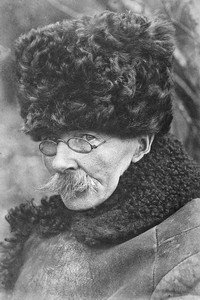
"Gentle eyes look out from under small glasses. A white Cossack mustache and a small white beard; the same white hair, carefully combed. A red woolen coat and boots. Mykola Samokysha sits on a stool and draws." In these features Mr. O. Masyukevych describes the great Ukrainian battle painter, whom he visited in Simferopol in 1942. He tells of the artist's attentiveness and politeness to everyone, of his tireless work, and of his great popularity among the population and military personnel who visit him time and again, bringing or taking away their orders.
The artist's wife speaks of his stay abroad, of individual works and workshops left in Leningrad and Kharkiv, and it is unknown what happened to them," wrote the Lviv organ of the German occupation period "Do Peremohy" literally a few days before the master's death (No. 1 of 06.01.1944).
In total, over 60 years of creative activity, Mykola Samokysha created 11 thousand paintings, drawings, etchings, and book illustrations, which are kept in museums of Ukraine and Russia and in private collections. Many of them were lost; many, made for money or under compulsion, perished forever with their commissioners. In the artist's heritage remained numerous graphic works, a significant part of which are on battle themes, executed in watercolor, ink, and pencil. He executed several thousand book illustrations, using painterly means in them; in particular, he illustrated Ukrainian books: stories by Marko Vovchok, the story "Mykola Dzherya" by I. Nechuy-Levytskyi, "Taras Bulba" by M. Gogol, and others. These illustrations were published in various journals. Samokysha's works are characterized by multi-figure and dynamic composition.
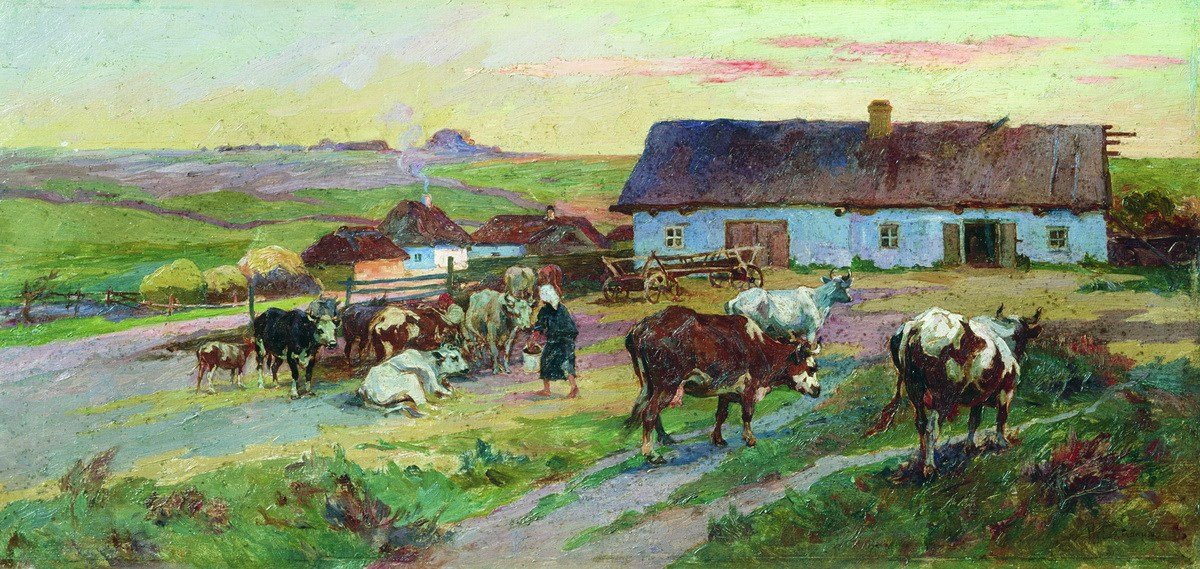
Mykola Samokysha, "Evening in Crimea". (Year unknown. Oil on canvas.) Chernihiv Historical Museum
Until his last day, the Ukrainian artist worked tirelessly at the easel for 10 hours daily. Two days before his death, he drew a fragment for the painting "Kryvonis's Battle" with a pen.
Soviet criticism, like pre-revolutionary criticism, very carefully hushed up the artist's Ukrainian work, and if this "slippery" topic was discussed, it was only in the tone of arrogant lectures. Thus, criticizing perhaps his best work — "Entry of Bohdan Khmelnytskyi to Kyiv in 1648" — the journal "Obrazotvorche Mystetstvo" (No. 9, 1940) emphasized: "It seems to us that Samokysh often chooses a less significant episode. For 'Bohdan Khmelnytskyi,' for example, such a more significant moment could be the episode of Ukraine's unification with Russia. Perhaps that is why Samokysh's works are becoming smaller in theme." This is mentioned in the Berlin "Holos" (No. 37(132), 12.09.1943).
After Mykola Samokysha's death, the German occupation command of Simferopol decided to rename Kooperatyvna Street, where he lived, in his honor. After the capture of Crimea by the Soviet army, this directive was canceled. In addition, the red authorities decided to investigate whether the artist had collaborated with the Germans; additionally, Samokysha's young widow began to actively accuse him of all mortal sins — a phenomenon inherent in any change of any government. In 1960, on the occasion of the master's 100th anniversary, the street was renamed again.