The Deadly Gift of the Sea
The tragedy of the seiner 'Shkval' in the Black Sea in 1998.
Valeriy Verkhovskyi. "Krymska Svitlytsa" newspaper, 2018, Issue No. 29
The Black Sea was cleared of mines more than once even after that single airship expedition, but still, decades later, naval battles echo...
Twenty years ago in the Black Sea near the shores of Crimea, a tragedy occurred that became a continuation of the Second World War. On July 22, 1998, the seiner "Shkval," registered at the port of the urban-type settlement of Chornomorske, was fishing near Cape Lukul, twenty miles northwest of Sevastopol.
The events were reconstructed, at least approximately, thanks to the sole witness of the tragedy — cook Andriy Mozhaiskyi, who was the only one left alive from the entire crew of the seiner. On that day, Mozhaiskyi went out to the lifting of the trawl to take some fish from the catch for the crew's lunch and saw that the sailors had raised not only fish from the depths, but also a black metal barrel. Not even a few minutes passed before it exploded with such force that the shock wave blew off the wheelhouse and killed everyone who was on deck. Mozhaiskyi was saved by the fact that he returned to the galley at the moment of the explosion. The ship went rapidly to the bottom in a matter of seconds, and Mozhaiskyi found himself in the open sea.
The surviving sailor was unable to send any signals — there was nothing to send them with; but the explosion did not go unnoticed: the pilot of a passenger plane flying on the Simferopol – Istanbul route saw a flash below and immediately reported it to the ground, and simultaneously the passenger ship "General Vatutin" radioed about the explosion — the coordinates of the place where the disaster occurred coincided, so there could be no mistake. Immediately, a diving boat of the Ukrainian Navy set off for this area.
At 5 p.m., the rescuers finally found Mozhaiskyi in the sea. As the sailor later admitted, he would not have been saved if not for the ship's dog Manya — the only living creature besides him that survived after the explosion. The animal, guided by a "compass" known only to it, determined where the shore was and directed the human towards it: "At first I swam in a completely different direction, but the dog persistently pulled me back," Andriy said.
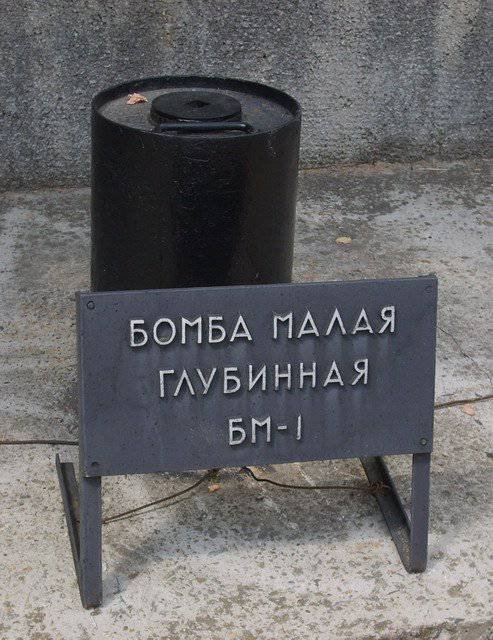
Later, during the investigation, Mozhaiskyi had to visit the Navy Museum, where he recognized the "barrel" — it was a large depth charge. Such charges were used by submarine chaser ships to sink submarines during World War II. The investigation revealed that for almost half a century, this area of the water near Cape Lukul was closed not only for fishing, but also for civil navigation in general, and allocated as a testing ground for the USSR Black Sea Fleet. In the 1990s, the ban was hastily lifted... For which not only the sailors from the "Shkval" paid with their lives, but also their colleagues from the fishing vessel SAOR in 1996. The Cape Lukul area was compared in the press at the time to the Bermuda Triangle.
According to the instructions, if a dangerous object is raised by a trawl, the entire trawl with the catch and the mine (torpedo or bomb) must be immediately cut off, and the vessel must move away to a safe distance at full speed. Mozhaiskyi recalled that the captain of the "Shkval," Khrushchev, called the black barrel "an old acquaintance." Obviously, the captain hoped to carefully remove the catch of fish and throw the bomb back into the sea; it is possible that he had already done this before. But the sea does not forgive negligence and mistakes...