Shevchenko and Crimea
Historical connections of the Kobzar with the Crimean Peninsula.
Serhiy Konashevych. "Krymska Svitlytsa" newspaper, 2018, Issue No. 10
There is a myth that at least until 1954, when Khrushchev "gifted" Crimea to Ukraine, no resident of the peninsula was even acquainted with Taras Shevchenko's work, let alone knew who he was, and that the local population was allegedly forced to study his poems only after 1991. This poem written by a Crimean resident, which recently turned 110 years old, is the brightest proof of the absurdity of such claims.
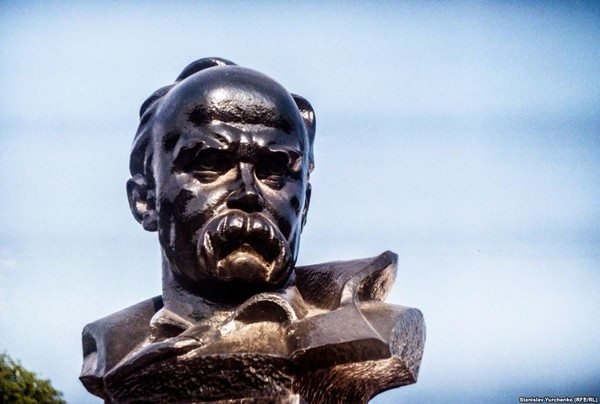
T. Shevchenko Monument in Simferopol
"KOBZAR" BY T. SHEVCHENKO
In an hour of sorrow I wander With my thoughts somewhere in the unreachable; Then the "Kobzar" I open And, as with a father, consult with it. It guides my feelings, "Kobzar" knows how to play healingly, – Though I shed tears, I do not grieve, I am glad even to sorrow with it!...
I sorrow with it for Oksana And for the ruined Vilshana, And for Yarema Halaida, To the "holiday" I go with it, And at the feast in Lysianka I look at the Haidamak dances, I bury my sons with Gonta, I beat the enemies for their abuse; I see the unfortunate Kateryna And Ivas, her child, – I see them all before me – And so I would wish with my soul That freedom ruled everywhere And with it truth and love, That a better fate would shine And blood would pour no more; That the struggle for existence Would not lead people to injustice, That brotherly love would embrace All thoughts and aspirations. Shevchenko played this ceaselessly With weeping on the kobza... He loved freedom to the end – And bequeathed us to love it!
Valentyn VIICHENKO, Feodosia "Ridnyi Krai" (Kyiv) – No. 9 – 20 (7) March 1908
Taras Shevchenko was well known in Crimea both during his lifetime and after his death. In the 19th – early 20th centuries, teachers of Crimean gymnasiums privately introduced their pupils to his works, and quotes from his works even became epitaphs on the gravestones of figures of Ukrainian cultural life on the peninsula.
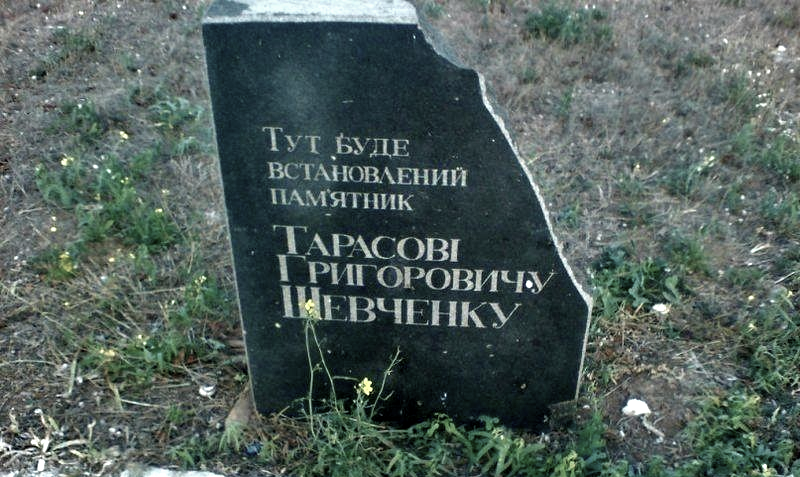
Foundation stone in Novoozerne
Articles and poetry dedicated to Shevchenko by both local and "mainland" authors were published in the Crimean press ("Krymsky Vestnik", "Yaltinsky Vestnik", "Krymsky Kuryer", "Tavrychanin", "Krym") — in particular, by the prominent writer Oleksandr Konyskyi. In those days, Ukrainians in Crimea traditionally gathered in temples and community centers of the peninsula (Simferopol, Sevastopol, Yalta, Yevpatoriya, Feodosia) to honor the memory of the Kobzar on the anniversaries of his birth and death, organizing religious and cultural events, despite sanctions from both civil and spiritual authorities.
In the final years of the Russian Empire, any public commemoration of Shevchenko was under ban: it was not allowed to name educational institutions and streets after him, or to conduct any events related to him and collect funds for them. However, despite this, the Ukrainians of Feodosia and Yalta maintained relations with the united committee for the erection of a monument to Shevchenko in Kyiv, making donations to this cause.
During the Soviet era, cases of erecting a monumental image of the Kobzar in Crimea were rare (e.g., in the village of Slovianske in the Rozdolne district, in the cinema named after him in Simferopol, etc.); at the same time, his name was given to individual toponymic and cultural objects. Monuments to Shevchenko appeared in major cities of the peninsula during the period of Ukraine's independence. It was planned to erect monuments in Dzhankoi and the urban-type settlement of Novoozerne (Yevpatoriya region), but these plans were prevented by the Russian occupation of Crimea. Moreover, the memorial stone in Novoozerne had been dismantled as of 2015. The fate of the bust of the Kobzar on the territory of the headquarters of the Ukrainian Navy in Sevastopol, seized by the occupiers, is also unknown.
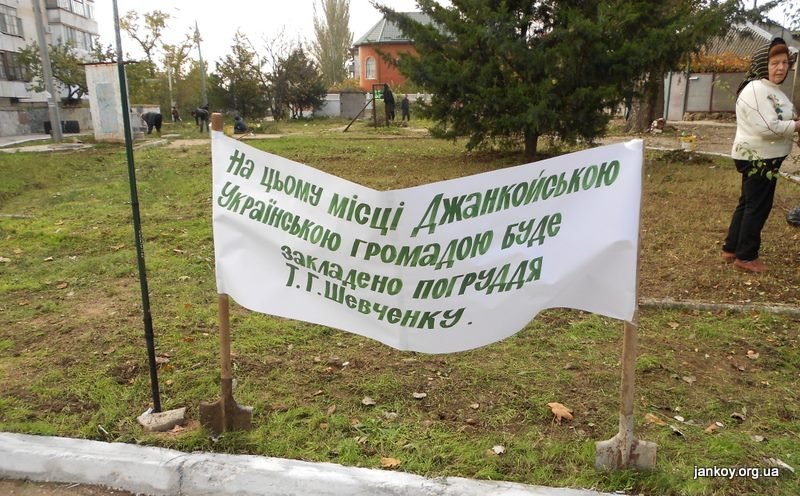
Place in Dzhankoi where the monument to T. Shevchenko was to be erected