The Ten-Year School Catastrophe
Educational problem of the Crimean Peninsula.
Petro Volvach, Full Member of the Shevchenko Scientific Society (NTSh), member of the National Writers' Union of Ukraine (NSPU), Honored Worker of Science and Technology of the AR of Crimea, Crimean resident with 60 years of experience. "Krymska Svitlytsa" newspaper, 2017, Issue No. 17
World experience shows that after destructive wars and natural disasters, civilized countries and responsible authorities organize, first of all, the housing and life of people, and revive medicine and schooling. Without this, no state or human community has prospects for its development.
Unfortunately, in the totalitarian Soviet society, these areas, like the entire humanitarian sphere, were never priorities. So, as was sung in one paraphrased Soviet song — "First of all, tanks and planes," and human life and domestic problems for later.
This is exactly the opinion you reach after getting acquainted with archival materials, but not with the victorious reports at conferences, party activist meetings, and on the pages of communist newspapers. By the way, their totality and victorious rally rhetoric from the district, regional, republican, and union levels were always the same.
And what was actually in real life? And what successes did Crimean schooling achieve in the first post-war decade, that is, when the Crimean Oblast was part of the RSFSR?
The critical state of Crimean schooling as of the beginning of 1954 is eloquently spoken of by several reports of the department of party organizations of the Crimean Regional Committee of the Communist Party of Ukraine (CPU). They were prepared at the request of the Central Committee of the CPU in August 1954, that is, before the beginning of the new school year. The very fact that they were all prepared at almost the same time convincingly testifies to the extremely neglected state of Crimean schooling at the time of the transfer of the Crimean Oblast to Ukraine.
During this period, the Crimean Oblast did not reach the pre-war level in terms of the number of schools. While in 1940 there were 1,284 schools in the Crimean ASSR, ten years after the end of the war their number decreased to 1,056. 99 of them were secondary, 334 — seven-year. The most numerous were primary schools — 623. The total number of students was 136,157 people, which is almost 60 thousand fewer compared to 1940.
In grades I-IV, 5,164 students studied, in V-VII — 62,286, and in VIII-X only 22,177. At the beginning of the new school year, almost 400 people were not covered by general education, which is 220 more than in 1953. The real scourge for Crimean schools was the high turnover of students. Thus, according to one of the reports, in 1953, 8,032 students suspended their studies at school during the year, or almost 6% of the total contingent.
Due to the lack of premises, in almost all urban and rural schools, classes were conducted in two shifts. In the first shift, almost 80 thousand children studied, and in the second — over 56 thousand. In three schools of the town of Dzhankoi, 130 students studied even in the third shift.
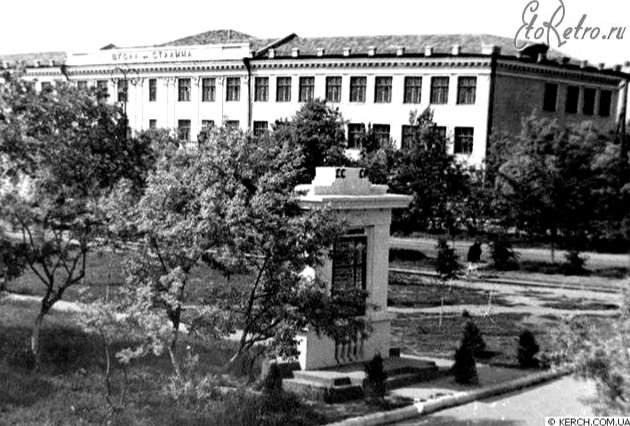
Stalin School, Kerch
In addition to general education schools, there were another 32 schools for working youth (mainly V-X classes), 22 schools and 29 separate classes for rural youth in the region. 1,572 students studied in them. There were 18 orphanages, schools for deaf-mute and blind children, and two auxiliary schools in the region with a total contingent of 1,917 students. Out-of-school education was also handled by stations of young technicians, naturalists, and tourists, 6 district pioneer houses, and only 2 sports schools.
The construction of new schools was quite slow. Throughout 1953, the construction of only 3 urban and 2 rural schools was completed. Even those small funds that were allocated for school construction were not developed by construction organizations year after year. In 1953, their development in cities was only 76.2%, and in rural areas this figure was 88.5%. In 1954, incomplete transitional construction, revival, and reconstruction of 13 schools with a total of 3,830 places were envisaged.
The construction of rural schools was quite unsatisfactory. The annual plan for their construction for seven months was completed by only 27%.
In all Crimean schools, there was a shortage of qualified teachers. Of the working teachers (5,369 people), almost half had only a secondary education. As noted in the report: "Many leading workers in schools and bodies of public education do not have the proper training necessary for the successful performance of their duties. Out of 623 heads of primary schools, only one person had a higher education, 7 — incomplete higher, and 27 teachers did not even have a secondary education..."
Of the 29 heads of departments of public education, only 3 people had a secondary pedagogical education. Therefore, the education of Crimean children was taken care of by party nominees, retired political instructors, cashiered NKVD officers, and former prison guards who had strayed into Crimea.
The unsatisfactory state of staffing of Crimean schools with pedagogical personnel is evidenced by the devastating statistics given in the August report of the Central Committee of the CPU of the Crimean Regional Committee: "Of the 99 directors of secondary schools, 9 people do not have the appropriate education and do not ensure work; of the 334 directors of seven-year schools, 98 do not have the appropriate education, 10 of them have no pedagogical education at all; 44 heads of primary schools do not have profile education, and 27 of them did not even have a general secondary education..."
So it is not surprising that as of 1954, the success rate of students in Crimean schools was the lowest. It was 84.3%. At the same time, the average in Ukraine was 89.2%.
"An especially unsatisfactory situation with student success developed in the schools of Pervomaiske, Rozdolne, Chornomorske, and other districts." They were populated by settlers from Ukraine. And all Ukrainian-speaking children were forced to study all subjects in incomprehensible Russian. In addition, it was in rural schools that there was a shortage of qualified pedagogical personnel and a huge turnover of teachers was observed. The living conditions of teachers in rural areas were terrible, so self-respecting specialists did not stay there for long. The Crimean Pedagogical Institute existing in Simferopol was unable to fully satisfy the needs of local schools for teachers.
Summarizing all the above, it can be argued that the RSFSR and the local Crimean authorities in the first post-war decade failed to cope with the revival of schooling and the educational sector. And by all educational indicators, the Crimean Oblast as of 1954 had not reached the pre-war level. Therefore, Ukraine also had to revive the educational sector.
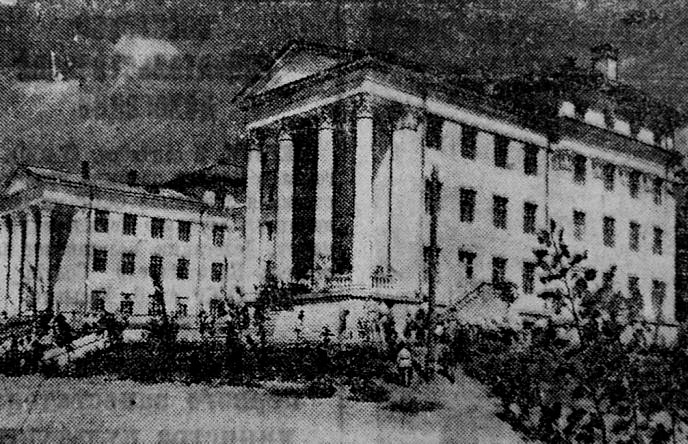
School No. 25, Yalta