The Legacy of the 'Moscow Cuckoo' in Crimean Schooling
Implementation of the construction of educational institutions in post-war Crimea.
Petro Volvach, Full Member of the Shevchenko Scientific Society (NTSh), member of the National Writers' Union of Ukraine (NSPU), Honored Worker of Science and Technology of the AR of Crimea, Crimean resident with 60 years of experience. "Krymska Svitlytsa" newspaper, 2017, Issues No. 42 – 43
During the first post-war years, the RSFSR did not build any significant social facilities — schools, kindergartens, and hospitals — in either Crimean cities or villages. And there were several weighty reasons for such neglect of the social sphere. First and foremost, the Soviet authorities never considered the financing of housing, education, and medicine as a priority direction of state policy. All the leaders created by the Communist Party considered the militarization of the country and the building up and strengthening of the repressive apparatus as priority tasks. Therefore, the first post-war decade in the country was no exception.
Social sphere in Ukraine, completely destroyed by two waves of the "military tsunami," was financed in the post-war years on a residual basis. The situation was no better in Russian Crimea. By special government decisions, the material and financial resources of not only the RSFSR, but also of all other union republics, were thrown into the restoration of the Black Sea Fleet, its supporting infrastructure, and the city of Sevastopol as the main naval base.
Due to the catastrophic decrease in the population in Crimea (more than threefold compared to the pre-war period), the problem of building schools, children's institutions, and hospitals on the peninsula in the first post-war decade was not yet so acute. The Russian authorities fully used the material assets of their predecessor — the Crimean Autonomy. At that time, tens of thousands of settlers from Russia settled down quite well in the houses of deported Crimean Tatars, Armenians, Greeks, Bulgarians, and Germans. Large houses of the deportees also housed primary schools, hospitals, and kindergartens. In addition, in most districts and settlements, quite a few, albeit small, old schools and first-aid stations survived.
The mass resettlement of labor already at the beginning of the 1950s forced the Crimean authorities to think about solving urgent social problems. For the children of local residents, settlers from Russia and Ukraine, the existing network of schools, kindergartens, outpatient clinics, and hospitals was not enough. Back in August 1954, the Council of Ministers and the Central Committee of the CPU adopted Resolution No. 1261, which dealt not only with urgent measures for the further development of villages, cities, and resorts of the Crimean Oblast, but also with social construction. These issues were never systematically considered during the period when the Crimean Oblast was part of the RSFSR.
In 1955, a multi-profile team of the State Planning Committee of the Ukrainian SSR verified the implementation of government Resolution No. 1261. The authoritative commission summarized the results of this painstaking work in a special report (Doc. No. 97 of 25.05.1955 "Crimea in the conditions of socio-political transformations (1940-2015)", Kyiv, "Klio" Publishing House LLC, 2016, p. 97). The said resolution in 1955 envisaged building 50 objects in Crimea at the expense of the republican budget with a total volume of work of 24.5 million rubles. Of these, only under the Ministry of Education was it planned to finance 26 objects for a total sum of 10.6 million rubles.
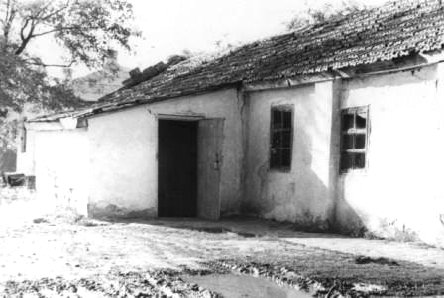
Building of the first regional House of Pioneers and Pupils, urban-type settlement of Lenine. Early 1960s.
In fact, by the national economic plan for 1955, the Crimean Oblast was allocated only 5.2 million rubles. However, these capital investments were mainly directed towards completing the construction of facilities started back in 1954. Therefore, of the facilities envisaged by government Resolution No. 1261, only the Schmidt school in Kerch was included in the plan of capital works for the sum of 1.26 million rubles. However, even in four months of 1955, Crimean construction organizations managed to develop only 320 thousand rubles. It turned out that all the schools that were supposed to be built by this Resolution were not provided with technical documentation at the time of the State Planning Committee check.
And the technical documentation of almost all schools prepared by the RSFSR turned out to be outdated. Therefore, there arose a need to update it, which to a large extent affected the construction schedule of many schools.
The government resolution envisaged completing the preparation of project documentation in 1955 for the construction of two secondary schools in Simferopol and Dzhankoi, and a kindergarten in Kerch. "For another six schools and two kindergartens, which already had project tasks but did not have project documentation, it is necessary to achieve the allocation of limits for 1955 in the sum of 87 thousand rubles," the report said. Thus, only in 1955 did the Ukrainian authorities ensure financing for the preparation of technical documentation for 9 schools and 3 kindergartens. Capital investments for this construction were planned to be allocated only in 1956.
The Ukrainian government insisted that a whole series of union and union-republican ministries also join the school construction in Crimea. Thus, in the settlement of Krasnyi Perekop, the USSR Ministry of Chemical Industry was to begin the construction of a secondary school. For this, the Resolution envisaged allocating 0.5 million rubles from the Ukrainian budget. But Ukraine was never able to allocate money for this due to the lack of technical documentation, which was supposed to be prepared in Leningrad.
By the Ukrainian government resolution, the union ministry of industrial food goods was to ensure the construction of 4 secondary schools for the sum of 3.9 million rubles. However, funds were allocated only for the construction of one school in Yalta, in the area of the Magarach settlement, in the sum of 1.6 million rubles. In four months of the current year 1955, Crimean construction organizations developed only 700 thousand rubles for this school.
A whole series of ministries of republican subordination also failed to cope with the plans of school construction in Crimea. Thus, the Ministry of Meat and Dairy Products of the Ukrainian SSR during 1955 was to build a seven-year school on the state farm "Pryvolnyi" in the Krasnoperekopsk district and 3 kindergartens in the region with a volume of work of 960 thousand rubles. However, no capital investments were allocated for any of these facilities due to the lack of prepared technical documentation. The Ministry of State Farms of the Ukrainian SSR in 1955 was to build 5 schools in the farms of its system, and four of them, for 280 students each, were to be put into operation during 1955.
For this construction, the ministry planned to allocate almost 5 million rubles. In fact, funds were allocated for the construction of only two schools, which were planned to be put into operation only in 1956. Builders began to develop the allocated funds only in May — due to the lack of the necessary documentation. An almost identical situation developed in the Ministry of Industrial Goods of Wide Consumption. It was to begin the construction of two kindergartens in Simferopol and Kerch in 1955, for a total sum of 800 thousand rubles. But no capital investments were allocated for this construction during the year.
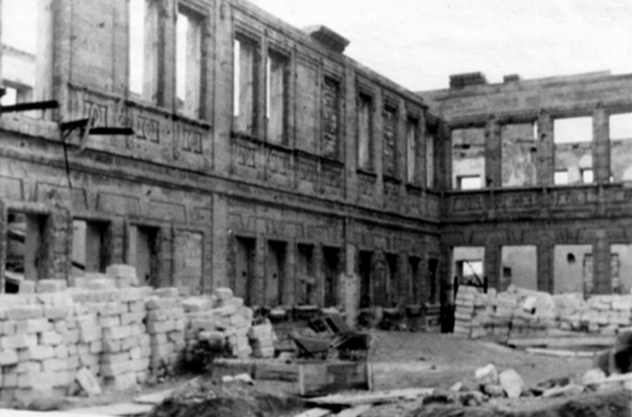
The Schmidt School in Kerch was completely destroyed during World War II (1942). Rebuilt in 1956.
The commission stated that Resolution of the Council of Ministers of the Ukrainian SSR No. 1261 of 26.08.1954 on the construction of schools and kindergartens in Crimea was being implemented unsatisfactorily. Thus, of the 50 facilities with a total volume of 24.5 million rubles, only 4 were built in 1955 (volume of work of 3.24 million rubles). In four months, 1.02 million rubles were developed. And of the 22 schools and 4 kindergartens that the Ministry of Education was to build, only one school, the Schmidt school in Kerch, was included in the construction plan for 1955. And such union ministries as railways, chemical industry, construction, and republican ones — meat and dairy products and industrial goods did not implement the said resolution at all.
For a significant part of the facilities, some ministries (industrial, food goods of the USSR and the republican one — state farms) did not even provide technical documentation and did not allocate the necessary limits.
Plan of capital works for the Crimean Oblast for 1956 envisaged allocating funds for the construction of 9 schools and 3 kindergartens. The total volume of financing was 10 million 800 thousand rubles.
By the same Resolution, the Ministry of Education was allocated additional funds for 1955 for compiling project-estimate documentation for the construction of a secondary school in Simferopol, a secondary school in Koreiz, a Morske seven-year school in the Sudak district, a Krasnoarmiiske secondary school in the Staryi Krym district, and kindergartens in Yevpatoriya and Feodosia. The volume of financing limits for the production of technical documentation for each facility varied from 10 to 14 thousand rubles.
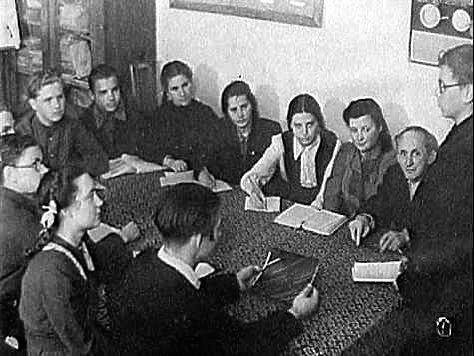
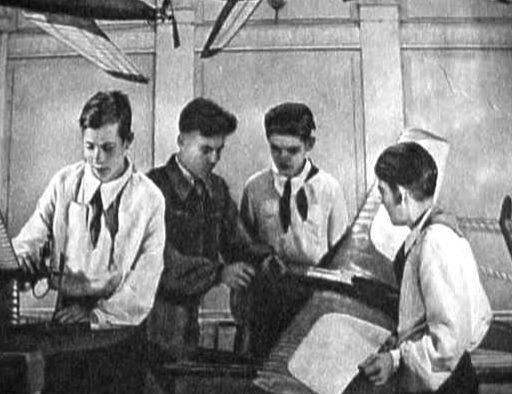
Pupils of the "Children's Academy of Sciences," which was created in Simferopol after the union of young technicians, naturalists, and local historians.
The construction of schools in Crimea after 1954 was under the strict control of central republican authorities, first and foremost the Council of Ministers. Almost a year after the adoption of the already cited resolution of the Council of Ministers of the Ukrainian SSR and the Central Committee of the CPU of August 26, 1954, the Ministry of Education prepared a progress report for the Deputy Chairman of the Council of Ministers, M. Hrechukha, on the work performed by this department (Doc. No. 103. Ibid. p. 465-467).
The Minister of Education, H. Pinchuk, reports to the government "that the Resolution, which is extremely important for the development of Crimean schooling, is being implemented, and the annual plan for the construction of schools for 1955 is 5 million 920 rubles." As of the first half of 1955, 9 schools were being built in Crimea. The Ministry of Education is concerned about the unsatisfactory pace of school construction and insufficient control over the implementation of the resolution by local authorities. As of June 1, 1955, the annual construction plan was completed by only 54.9%. That is, construction organizations were able to develop only half of the allocated funds, while according to the plan for this period, 75% of the allocated amount was to be used.
"Construction was carried out especially unsatisfactorily," the report noted, "in the Alushta, Simferopol, Nyzhniohirskyi, and Balaklava districts and the cities of Feodosia and Kerch."
The Ministry sharply criticized the activities of the Crimean authorities, primarily the executive committee of the regional council and the regional department of public education, for the unsatisfactory construction of schools in the region and significant shortcomings in the organization of school work, class size, organization of extracurricular activities with students, and the lack of necessary premises for conducting them. It was emphasized that the regional station of young technicians was located in a room of 60 m2, the station of young naturalists had only one room, and the excursion-tourist station had no premises of its own at all.
The report did not only note negative facts in the development of Crimean schooling, but also proposed a radical change in the attitude towards Crimean education: "To ensure the putting into operation of schools and kindergartens in accordance with the list approved by the Council of Ministers of the Ukrainian SSR and the Central Committee of the CPU, it is necessary to envisage for the Crimean Oblast for 1956-1957 a volume of capital investments of 45 million rubles," the memorandum stated.
There is no doubt that school construction in Crimea was financed in such huge volumes in subsequent years as well. Indeed, soon dozens of schools and hundreds of kindergartens appeared throughout the region. It was after this resolution that the station of young technicians, young naturalists, and resort tourism was built in Simferopol. Thus, there is every reason to assert that the powerful material and technical base of Crimean education arose after 1954, that is, after Crimea's incorporation into Ukraine.