Cultural Heritage of Ukraine in the Occupied Crimea: Provisions of the Hague Convention for the Protection of Cultural Property in the Event of Armed Conflict of 1954
Provisions of the Hague Convention for the Protection of Cultural Property in the Event of Armed Conflict of 1954
Mykola Yakovyna, Honorary President of the Ukrainian National Committee of ICOMOS. "Krymska Svitlytsia" newspaper, 2019, issue No. 27-28
Threats to the cultural heritage of Ukraine in Crimea arose from the very first days of the occupation of the peninsula by the Russian Federation. In accordance with modern treaty and customary international law and the national legislation of Ukraine, all cultural property that was and continues to be located on the territory of the temporarily occupied Crimean Peninsula by the Russian Federation remains Ukrainian.
Moreover, this is also confirmed by the latest international legal acts, in particular, the UN General Assembly Resolution A/RES/68/262 of March 27, 2014, adopted in the immediate aftermath of the aggressor state's actions, which supported the unity of Ukraine and called upon all states, international organizations, and specialized agencies not to recognize any alteration of the status of the Autonomous Republic of Crimea and the city of Sevastopol and to "refrain from any action or dealing that might be interpreted as recognizing any such altered status." In this situation, one of the most important instruments for repelling aggression is the Ukrainian state's strict adherence to the norms of international law, which, in the field of protecting cultural property, prohibits the appropriation of property in occupied territories, including the property of religious, artistic, educational, and scientific institutions.
Ukrainian experts Kateryna Busol and Dmytro Koval, who study this issue, refer to fundamental acts of international law, in particular to Article 56 of the Hague Regulations of 1907, which equates the specified categories of property—even if it belongs to the state—to private property. Thus, the inviolability of such property is emphasized, since private property has long been defined as inviolable during armed conflict. Furthermore, according to Rule 41 of the Customary International Humanitarian Law study compiled by the International Committee of the Red Cross, the occupying power must prevent the illicit export of cultural property from occupied territory and is obliged to return illicitly exported cultural property to the competent authorities of the occupied territory.
Other international acts were based on these provisions. In particular, in the period between the two world wars, the Treaty on the Protection of Artistic and Scientific Institutions and Historic Monuments of April 15, 1935 (also known by the name of its initiator as the Roerich Pact or by its place of signing as the Washington Pact) was concluded. Currently, of particular interest is the Convention for the Protection of Cultural Property in the Event of Armed Conflict, concluded in The Hague in 1954 (hereinafter referred to as the 1954 Hague Convention), which is the result of the development of international law in the post-World War II period, in a post-Yalta world, so to speak, giving it a symbolic significance in the context of recent events in Ukraine.
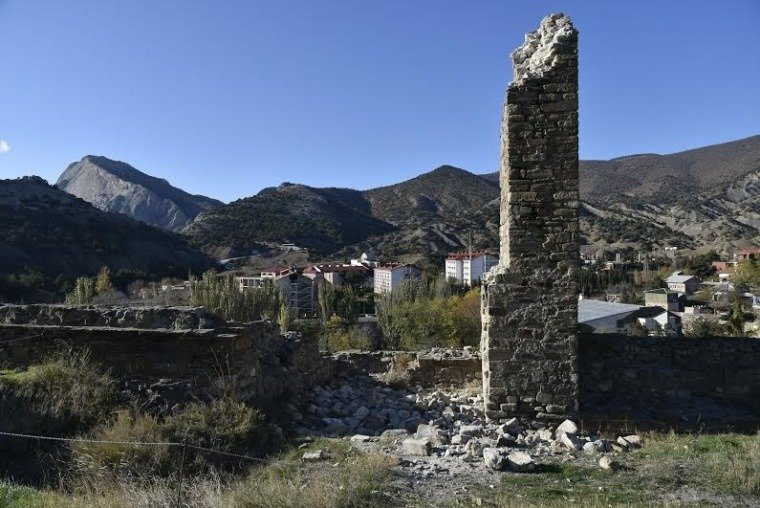
In 2015, a part of the ancient tower of the Genoese Fortress in Sudak collapsed
The 1954 Hague Convention obliges the occupying forces to support the national authorities in securing the protection and preservation of their cultural property (Art. 5.1). Thus, Russia, as an occupying power, is obliged not only to refrain from any unlawful acts regarding cultural property, but also to assist representatives of the state to which they belong (i.e. Ukraine) in ensuring their safety.
The scope of application of this act, specified in Article 18 of the Convention, is important: "1. Apart from the provisions which shall take effect in time of peace, the present Convention shall apply in the event of declared war or of any other armed conflict which may arise between two or more of the High Contracting Parties, even if the state of war is not recognized by one or more of them. 2. The Convention shall also apply in all cases of partial or total occupation of the territory of a High Contracting Party, even if the said occupation meets with no armed resistance."
The Convention contains a number of provisions regulating international and domestic procedures regarding actions with cultural property, namely: defining lists of cultural property, localizing their whereabouts (including topographically), organizing constant monitoring of the situation, applying to the International Register of Cultural Property under Special Protection (UNESCO), outlining certain temporary shelters and routes for potential transport, authorizing special staff, appointing a Commissioner-General for Cultural Property, appealing to Protecting Powers, etc. The latter two provisions should be of the greatest interest to Ukraine, since they make it possible to appeal not only to UNESCO, but also provide the right to approach one of the countries that is a party to the 1954 Hague Convention with a request to assume the mission of a so-called "Protecting Power", whose functions include a wide range of actions both in the occupied territory (appointment of the aforementioned special staff and Commissioner-General, compilation of inventories, localization of property, etc.) and intermediary diplomatic actions.
Referring to these provisions of the Hague Convention, and seeking to accelerate the state's measures to protect cultural heritage from the aggression of the Russian Federation in Crimea, the Ukrainian National Committee of ICOMOS addressed an appeal dated March 4, 2014, to the Minister of Culture of Ukraine, Y. Nyshchuk.
However, during the first year of the war, no measures, at least in the public sphere, with the publication of official statements, the adoption of acts to implement the provisions of this document, or initiatives by the Ministry of Culture or the government as a whole, were observed. The second government after the Revolution of Dignity did not address these problems properly either—an appeal was sent to the Deputy Prime Minister and Minister of Culture V. Kyrylenko, which also contained a call to facilitate Ukraine's accession to the Second Protocol to the 1954 Hague Convention.
Some attention to this issue was shown by the National Commission of Ukraine for UNESCO—the issue was included in the commission's work plan for 2014. But that was as far as it went. The following year, in 2015, the National Commission, not having received clear explanations from the Ministry of Culture regarding the situation with accession to the Second Protocol, again left the issue in the work plan as follows: "To study the issue of Ukraine's accession to the Second Protocol to the Hague Convention for the Protection of Cultural Property in the Event of Armed Conflict of 1954".
And in 2016, the Ministry of Culture, only under the third post-Maidan government and in the third year of the war, issued a statement on cultural heritage in Crimea.
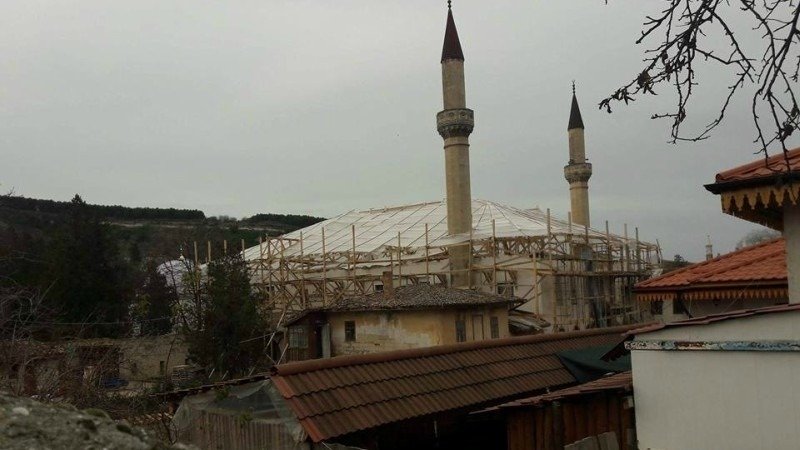
"Restoration" of the Khan's Palace in Bakhchysarai
In the National Commission for UNESCO, the issue was moved to both the 2016 and 2017 work plans. A shift in the position of the National Commission of Ukraine for UNESCO occurred after a special thematic meeting on the protection of cultural heritage in Crimea on January 19, 2018, where a decision finally emerged "to start consultations on enhanced protection of monuments in Crimea in accordance with the Hague Convention for the Protection of Cultural Property in the Event of Armed Conflict of 1954" and "to conduct public hearings and expert consultations on the application of the mechanisms and procedures of the 1954 Hague Convention". The responsible executor was the Ministry of Culture, with the deadline "during 2018".
And on May 14, 2019, in the sixth year of the war, the Verkhovna Rada of Ukraine adopted Resolution No. 2716-VIII "On the Recommendations of Parliamentary Hearings on the Topic: "State, Problems, and Prospects of Cultural Heritage Protection in Ukraine"" with a clause, in particular, "1. For the President of Ukraine to ensure the submission to the Verkhovna Rada of Ukraine of a draft Law of Ukraine on Ukraine's accession to the Second Protocol to the Convention for the Protection of Cultural Property in the Event of Armed Conflict, signed in The Hague on May 14, 1954".
The fact of the delay is surprising, as the parliamentary hearings took place a year before this resolution—on April 18, 2018. Moreover, during the parliamentary hearings, the proposal to join the Second Protocol to the Hague Convention was made at the beginning of the session in the speech of the Minister of Culture of Ukraine, Y. Nyshchuk. What prevented the minister from exercising his powers without waiting for the parliamentary hearings? The question is rhetorical, because there can be only one answer—a lack of will, a lack of responsibility for the sphere entrusted by the government. Because according to the regulations on the Ministry of Culture, this agency "is the main body in the system of central executive authorities that ensures the formulation and implementation of state policy in the fields of culture and arts, protection of cultural heritage..."
And Y. Nyshchuk personally did not lack authority, because (we read further): "4. The Ministry of Culture, in accordance with the tasks assigned to it:
2) drafts laws and other regulatory acts on matters within its competence;
7) participates, in accordance with legislation, in the preparation of draft international treaties of Ukraine, prepares proposals for the conclusion and denunciation of such treaties, concludes international treaties, and ensures the implementation of Ukraine's obligations under international treaties on matters within the competence of the Ministry of Culture." Therefore, the Minister of Culture Y. Nyshchuk did not need to wait for the 2018 parliamentary hearings to complain to the public about the unsatisfactory state of affairs in the sphere entrusted to him; instead, he should have initiated, as quickly as possible and in the established manner, a legislative act on Ukraine's accession to the Second Protocol to the Hague Convention for the Protection of Cultural Property in the Event of Armed Conflict, signed in The Hague on May 14, 1954.
What would such accession provide? Firstly, it should be taken into account that since 1954, changes have occurred, in particular, the improvement of international law. Therefore, after a series of significant losses of cultural property for humanity at the end of the 20th century, the international community supplemented the 1954 Hague Convention with new provisions, which formed its so-called Second Protocol. These are new elements of cultural property protection, such as:
-
Personal criminal responsibility and punishment for violations of this Protocol—intentional and conscious damage to cultural property is treated as a war crime.
-
The concept of 'military necessity' and other formulations used in the text of the Convention have been clarified.
-
A new type of 'enhanced protection' has been introduced, which is very important for Ukraine.
-
An institutional body of the Convention has been designated—the Committee for the Protection of Cultural Property, and the list of measures related to the protection of cultural property carried out in peacetime has been expanded, the so-called preparatory measures in time of peace, which, in particular, creates opportunities for the involvement of experts and activists from non-governmental organizations.
It is needless to emphasize that in the case of the Khan's Palace in Bakhchysarai, the Ministry of Culture could have acted proactively to prevent the egregious acts of vandalism that occurred as a result of the so-called restoration initiated by the occupying administration.
Of course, there will be punishment for the aggressor one day. However, a high international tribunal that will in the future consider the case of illegal actions against the cultural heritage of Ukraine resulting from the occupation of the Autonomous Republic of Crimea and the city of Sevastopol by the Russian Federation, in addition to qualifying the criminal actions of the organs and persons of the aggressor state, will raise the unambiguous question of responsibility for the inaction of the state institutions and officials of the Ukrainian state.
Supported by the Ukrainian Cultural Foundation.