Decade-Long Stagnation of the Crimean Sanatorium and Resort Industry
A bleak picture of the state of the Crimean resort economy in the Crimean Oblast during the post-war period.
Petro Volvach, Full Member of the Shevchenko Scientific Society, Member of the National Writers' Union of Ukraine, Honored Worker of Science and Technology of the AR of Crimea, Crimean resident with 60 years of experience. "Krymska Svitlytsia" newspaper, 2017, issues No. 13 – 14
According to statistical data, in the mid-1920s, more than 300 thousand people rested and received treatment on the South Coast. In general, over the almost 20-year period (from February 1921 to 1940) of the activity of various sanatorium-resort and health facilities, according to official statistical data, about 3.5 million people received treatment and rested.
Back at the end of December 1920, to implement Lenin's decree 'On using Crimea for the treatment of working people,' a commission arrived on the peninsula, headed by the People's Commissar of Health Nikolai Semashko, to organize the protection of palaces, hotels, and former private villas suitable for medical institutions, sanatoriums, and rest homes. In Yalta alone, the resort administration registered 65 buildings, including 24 for sanatoriums and 41 for rest homes (History of Towns and Villages of the Ukrainian SSR, Crimean Oblast, p. 203). There were plenty of facilities suitable for organizing sanatoriums and rest homes in other South Coast settlements as well. Thus, the authorities did not have to spend heavily to create sanatorium-resort facilities.
Before the war, only a few large sanatorium-resort facilities were established in Crimea, mainly on the South Coast: 'Dolossy', 'Zolotyi Pliash' (Golden Beach), and 'Kuropaty'. In Gurzuf, departmental sanatoriums of the Red Army were created on the already existing base. A notable achievement of the authorities of that time was the organization in 1925, on the initiative of Deputy People's Commissar of Health Z. Solovyov, of the 'Artek' camp-sanatorium. It was located in a picturesque area between Bear Mountain (Ayu-Dag) and Gurzuf. Later, after the transfer of the Crimean Oblast to Ukraine, thanks to constant party attention, 'Artek' would be transformed into a powerful International Children's Health and Education Megapolis.
However, the existing sanatorium-resort base, created through the predatory nationalization of estates and villas, was insufficient. Moreover, with each passing year, the worker-peasant contingent of the sanatoriums and rest homes was sharply reduced. It was displaced by the party-state nomenclature, the military, NKVD agents, judges, and prosecutors. The most prestigious sanatorium-resort facilities were turned into government and party residences and rest homes for the elite of that time.
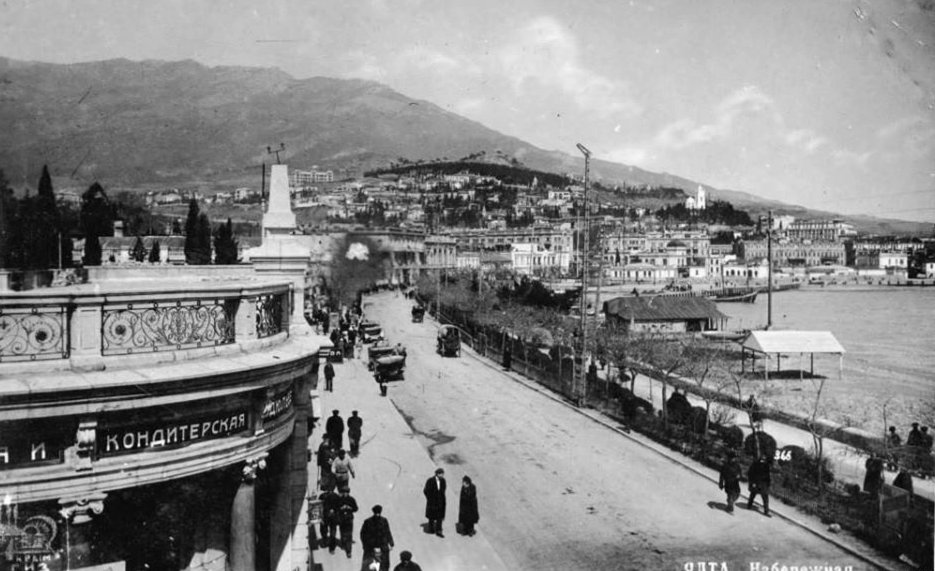
Yalta, embankment, 1933
Unfortunately, the Nazi German occupation and the almost 4-year war in Crimea, and later Stalin's deportation of the Crimean Tatar people and other national minorities, caused enormous damage to the peninsula's sanatorium-resort economy. In Yalta alone, the occupiers destroyed and looted 20 sanatoriums, the Institute of Medical Climatology and Climatotherapy of Tuberculosis. Livadiya itself and the Livadiya sanatoriums also suffered huge losses.
In Livadiya, the fascists stationed units of coastal, field, and anti-aircraft defense, and a Romanian rifle battalion. 'The occupiers burned the Small Livadiya Palace, destroyed the furniture in the Great Palace and damaged the sleeping and medical buildings of the sanatorium, and cut down many trees of valuable species in the park,' as noted in the already cited work (p. 749). In 1940, there were 195 sanatoriums in Crimea, which annually served almost 370 thousand people. During the war, 109 of them were destroyed.
The post-war revival of the sanatorium-resort sector in Crimea was painful and slow. The Great Livadiya Palace, preparing for the meeting of the heads of state of the anti-Hitler coalition, was restored during the summer of 1944. The residences of Kremlin leaders and the departmental sanatoriums of the Ministry of Defense, the NKVD, and other law enforcement agencies were restored at a fairly rapid pace. The sanatoriums of trade unions and branch ministries were rebuilt much more slowly.
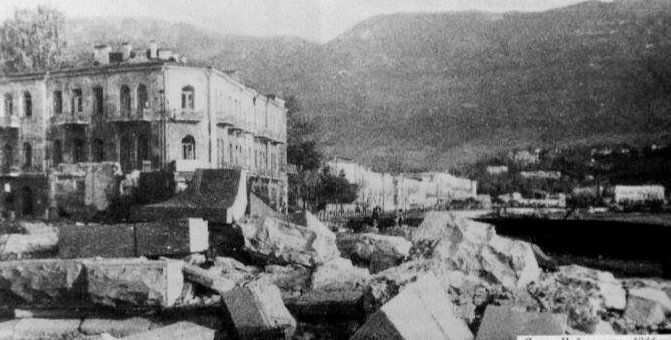
Yalta embankment during the war
Materials available in Ukrainian archives (above all, a brief note by V. Chernyshov, head of the architecture department under the Crimean Oblast Executive Committee, dated March 18, 1954) prove that the master plans for the construction of most Crimean resort towns (Yalta, Yevpatoriya, Feodosiya, Alushta, and even Simferopol) were developed only in the late 1940s and early 1950s. It is quite clear that without master plans, it was impossible to develop both urban and resort construction across the entirety of Crimea. We also learn that the construction of the sanatoriums of the Soviet Prosecutor's Office, the Ministry of Coal Industry, 'Kastropol', 'Komunist', and the Aviation Industry, planned several years prior, had still not begun in 1954.
The leadership of Ukraine repeatedly considered the state of the sanatorium-resort economy at government meetings. Thus, in the explanatory note to the draft resolution of the Council of Ministers of the Ukrainian SSR of April 7, 1954, 'On measures for the further development of agriculture, cities, and resorts of Crimea,' it was noted that at that time there were 160 sanatoriums operating in the oblast. They were able to accommodate only 250 thousand people per year. In other words, the number of vacationers had decreased by 120 thousand people compared to 1940.
Many health resorts were located in unsuitable premises that did not meet medical and therapeutic requirements. 'Until now,' the report note states, 'general resort treatment facilities have not been restored everywhere: mud and water therapy rooms, polyclinics, dietary canteens, guesthouses, beaches; therapeutic and sports facilities are lacking.'
'Resort towns and settlements are unsatisfactorily supplied with water, lack central sewerage networks and waste disposal facilities,' the note points out. Crimean towns and resorts at that time suffered from a constant deficit of both drinking and technical water. At most Crimean resorts, only 40-50 liters of drinking water per day was allocated per vacationer.
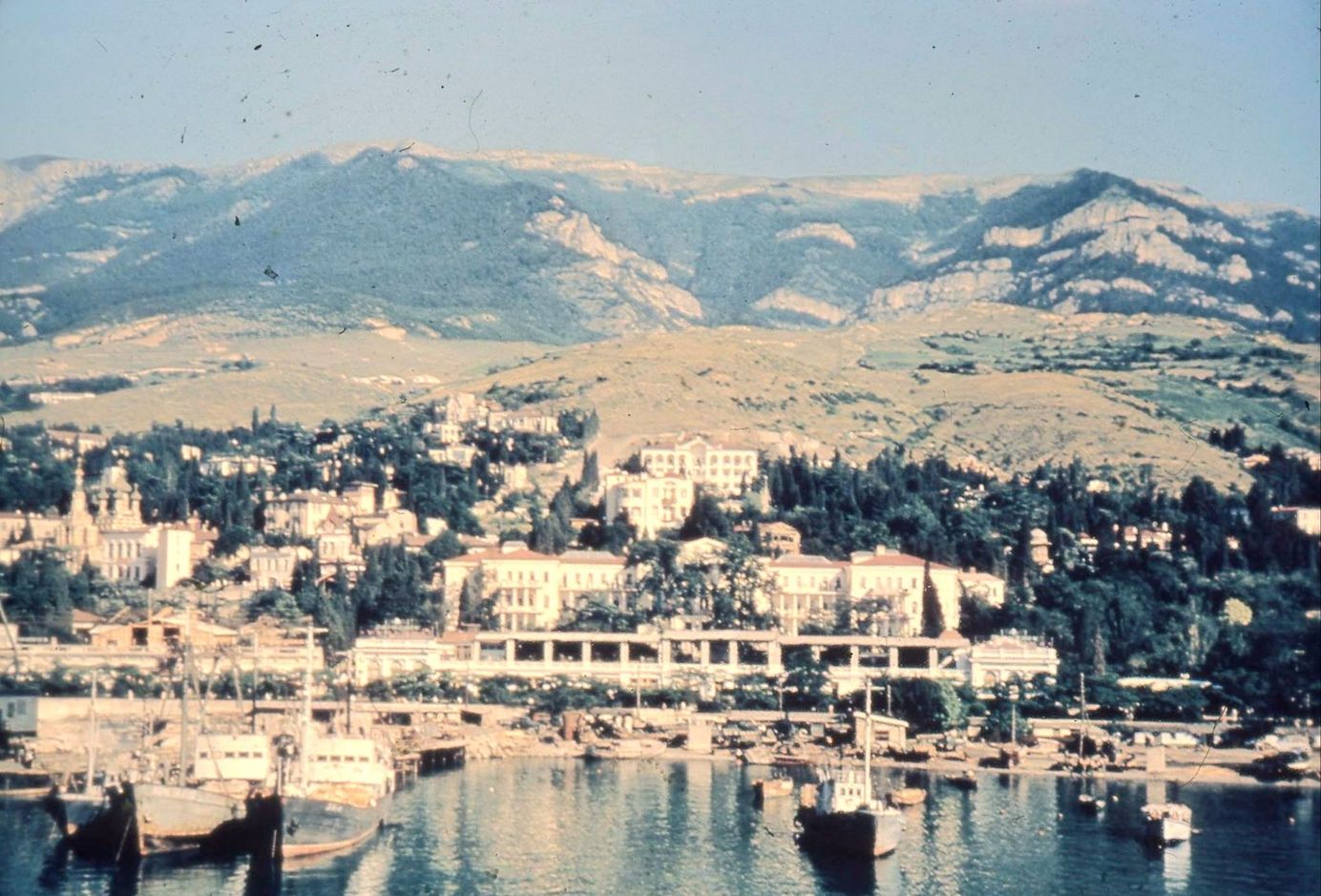
1950s - vessels of the Yalta fishing collective farm against the backdrop of the undeveloped city
A rather bleak picture of the state of the Crimean resort economy in the first year after the transfer of the oblast to Ukraine is recorded in the Report Note of the Head of the Directorate for Architecture under the Council of Ministers of the Ukrainian SSR, V. Orekhov, to the Council of Ministers of the Ukrainian SSR on the state of planning of development and landscaping of cities and resorts of the Crimean Oblast dated July 26, 1951 (TsDAVO of Ukraine. – F. 4906. – Op. 1. – Case 719. – Sheets 75-88).
The commission that prepared this report note concluded that in most Crimean cities and towns it had not yet been possible to overcome the consequences of the war. Meanwhile, the level of landscaping and greening of cities (with the exception of the resort zone) remained unsatisfactory. 'In some cities,' the report note states, 'there is no comprehensive sewerage solution. There are cases when sewage pollutes the beaches (Feodosiya, Kerch, Alushta – Rabochiy Ugolok [Workers' Corner])'. The commission certainly varnished the situation regarding the state of Crimean beaches and sewerage at the resorts. Indeed, from other documents we learn that sewage at the resorts was discharged not only into coastal waters but also onto the beaches themselves. Therefore, swimming in the sea was extremely dangerous due to the high content of infectious pathogens.
Here are some of the commission's observations regarding the architectural arrangement and state of landscaping in certain cities.
Simferopol. The city center is insufficiently reconstructed. The drainage system in the city is unorganized; as a result, the low-lying areas of the city suffer periodic flooding. The master plan of the city center is poorly designed. The embankment of the Salhyr River is neglected, and the city park of culture is quite small in area and poorly maintained. The old part of the city is also in disarray, and most of the buildings in it are in a state of disrepair.
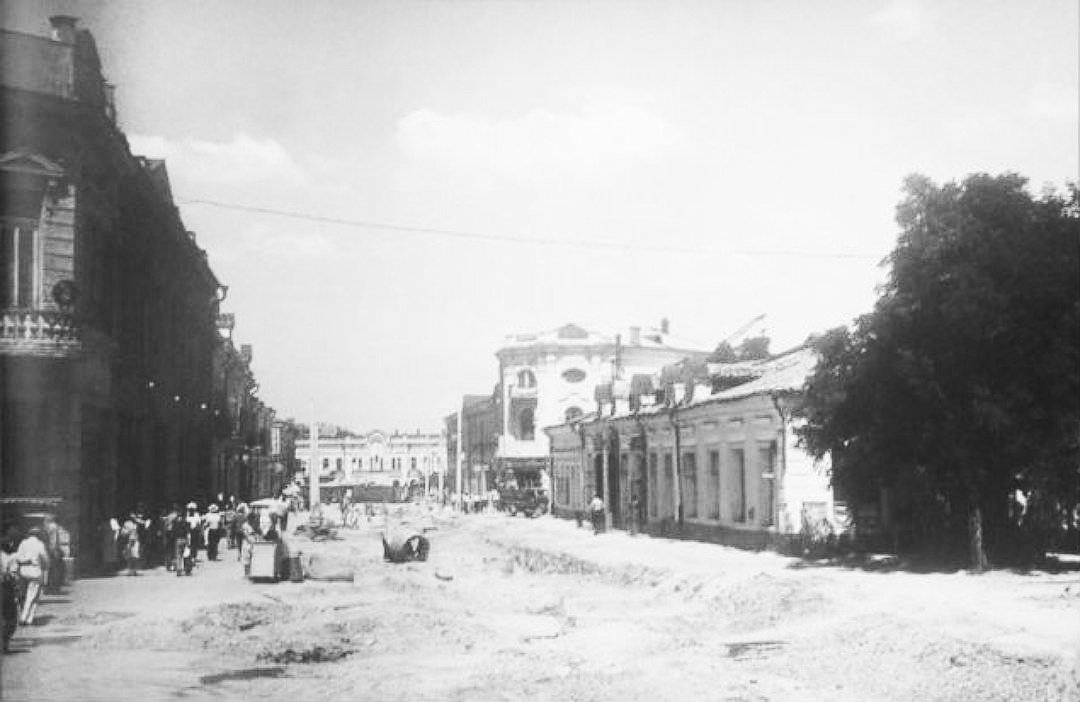
Simferopol, 1950s. Kirov Avenue
Feodosiya. In the central part of the city, there are still many traces of wartime destruction. City organizations have only just begun organizing the restoration and reconstruction of the city. The city is cut off from the sea by the railway and port facilities. The embankment, beaches, and the adjacent part of the city are neglected. Some quarters of the city are walled off from the sea by high fences of the Ministry of Defense sanatoriums. The sanatorium beach is neglected, and the embankment adjacent to the sanatorium and neighboring streets are in a state of disrepair.
The bed of the Baibuha River is unchannelized, which causes part of the city to be flooded periodically. The water of this river is not even used for watering green spaces. The road to the so-called 'Zolotyi Pliash' (Golden Beach) is unpaved, and no proper conditions have been created for vacationers on the beach itself.
Planerske (Koktebel). Significant areas of coastal plots suitable for sanatoriums and rest homes are not used due to the lack of water. The military department (PO Box No. 46) extracts marine gravel on the beach, which threatens its destruction.
Krymske Prymoria. The expansion of construction of already existing sanatoriums is carried out without a general plan for the resort, and the preparation of project documentation is unreasonably delayed. The road to the resort is completely unpaved.
Sudak. The town is completely neglected and has very few green spaces. The town lacks a park and beaches. The historical and architectural monument—the Sudak Fortress—is neglected and unprotected.
Alushta. In terms of landscaping, it is in a satisfactory state. The former VTSSPS (All-Union Central Council of Trade Unions) sanatorium 'Metalist' is not restored and lies abandoned. To date, there is no planning and development project for 'Robochiy Kutochok' (Workers' Corner), which delays the improvement and development of the entire Alushta resort area. The reconstruction of the bus station is not completed, and the construction of the seaport is unjustifiably delayed.
Frunzenske (Partenit). This resort is in a neglected state. The beach, which is the best in all of Crimea, has been turned into a storage site for stone (diorite) extracted from a quarry near the beach itself. Gravel is transported from it for construction, which threatens to destroy the unique coastline. There is no decent access road to the resort. The resort territory itself is also neglected. Greening of the resort is not carried out.
Gurzuf. The rural part of the settlement is in a neglected state; it is neither landscaped nor greened. The road leading to the resort is quite narrow. There is no convenient access to the embankment. There are still many unrestored buildings left in the settlement, in particular, the premises of the former restaurant. The general resort Gurzuf Park, with Alexander Pushkin's house and other monuments, is closed to the general public and is at the disposal of the Ministry of Defense and the Supreme Soviet of the USSR. The Gurzuf embankment and the general resort beach are in an abandoned state.
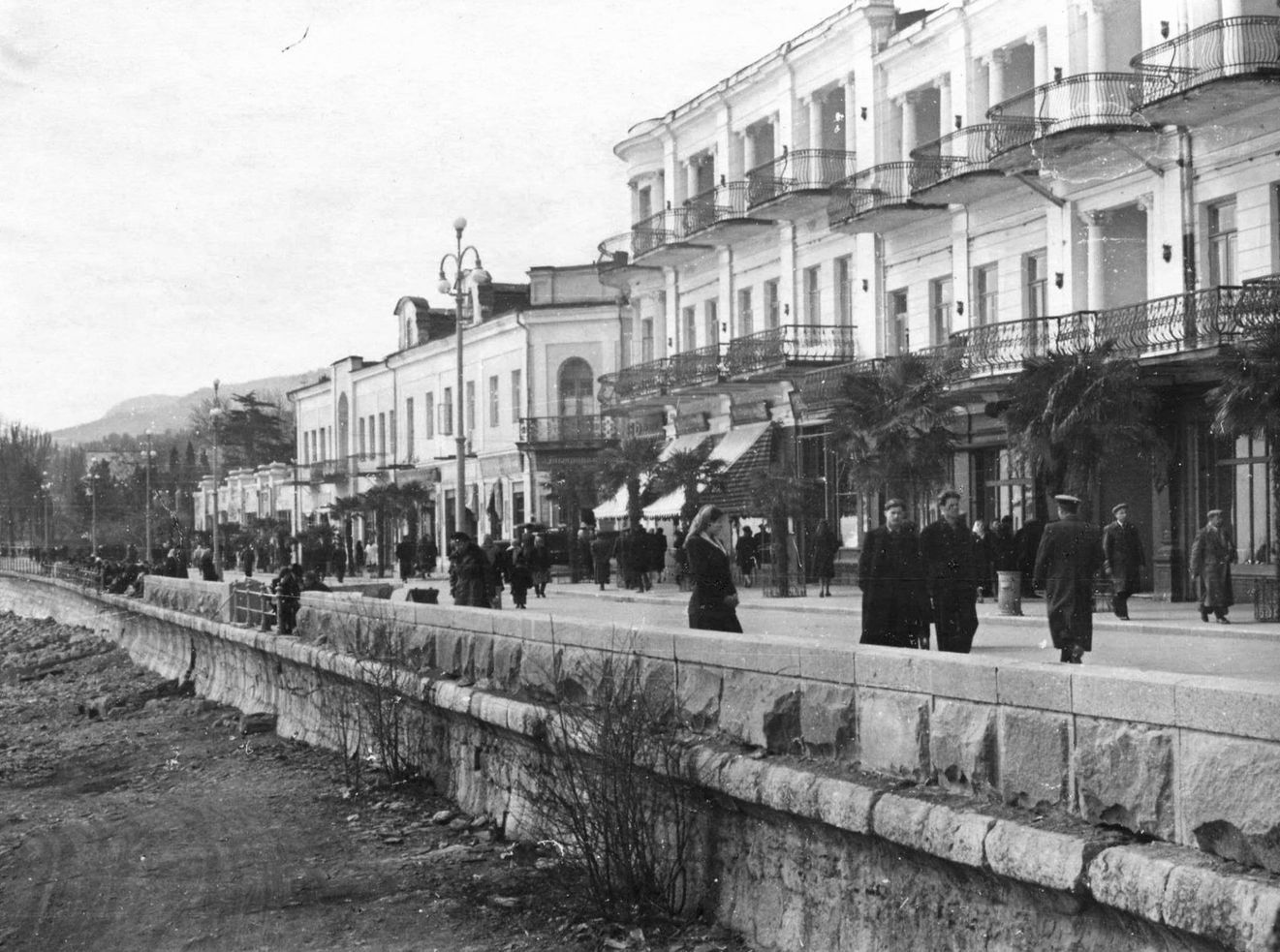
Yalta, 1950s. The Lower Embankment will appear soon
Yalta. The commission noted that the reconstruction of the central part of the city was proceeding satisfactorily and in accordance with the project documentation prepared by the local branch of Krymoblproekt. In the commission's opinion, the new central square was being built up quite satisfactorily. The commission also considered successful the widening of one of the city's central thoroughfares—Chekhov Street. However, the entire transit traffic flow was routed through quite narrow streets through the city center, which overloaded city traffic and caused accidents.
The commission focused attention on the neglected and unsanitary state of the Massandra beach used by local residents. The beach was located near sewage outlets and was completely neglected. The reconstruction of the Seaside Park had not been completed, especially in the part bordering Livadiya.
Bakhchysarai. Although not a resort town, it is of great interest to and serves vacationers. The commission drew attention to the unsatisfactory state of its landscaping, especially the central Lenin Street. After all, it is through this street that the path lies both to the Bakhchysarai Khan's Palace and to the cave city of Chufut-Kale. The report notes that numerous monuments of material culture (with the exception of the Bakhchysarai Palace) were not protected, were in a neglected state, and were decaying. The Chufut-Kale reserve was in the same state.
Other historical and architectural monuments and famous places were in no better condition. Tourist trails and routes on the South Coast and in the Foothills were not maintained and were kept unsatisfactorily. For example, the tourist base on Ai-Petri was cluttered with ugly temporary and permanent structures scattered throughout the territory.
Thus, in almost ten post-war years, the irresponsible and incompetent Russian leadership proved incapable not only of reviving but even of creating the most important sector for the peninsula's economy—the sanatorium-resort industry. Therefore, after 1954, Ukraine had to revive and build it almost from scratch.