Prime Minister of the Crimean Regional Government Suleyman Sulkevich
The first Crimean Regional Government headed by Suleyman Sulkevich.
Tetiana Bykova, Candidate of Historical Sciences, Researcher at the Institute of History of Ukraine of the National Academy of Sciences of Ukraine. "Krymska Svitlytsia" newspaper, 2018, issue No. 24
June 5, 2018, marked 100 years since the creation of the first Crimean Regional Government headed by Suleyman Sulkevich. The figure of this historical leader is so outstanding that it deserves a separate discussion. Suleyman (Matvii) Sulkevich was born on July 20, 1865, in the village of Kemeishi of the Lida district of Vilna Governorate (on the territory of modern Lithuania) in a noble family of Lithuanian Tatars. He was the son of a military man, and from childhood he chose the same destiny for himself.
In 1883, Sulkevich graduated from the Voronezh Cadet Corps, in 1886—from the Mykhailivske Artillery School, and in 1894—from the Mykolaiv Academy of the General Staff. He began his service in the army in 1883. He participated in the Chinese expedition of 1900-1901, the Russo-Japanese War, and the First World War. From 1915, he was already a lieutenant general. From 1916 to early 1918, he served as the commander of the First Muslim Cavalry Corps within the Russian army.
After the occupation of Crimea by German troops, General R. Kosch on June 5, 1918, entrusted Sulkevich, whom he appointed Prime Minister, with the formation of the regional government. During the first half of June, Sulkevich actively formed his cabinet, and on June 21, the composition of the Crimean Regional Government was published in the newspapers. Sulkevich himself held the positions of Prime Minister, Acting Minister of Foreign Affairs, and Minister of Internal, Military, and Naval Affairs.
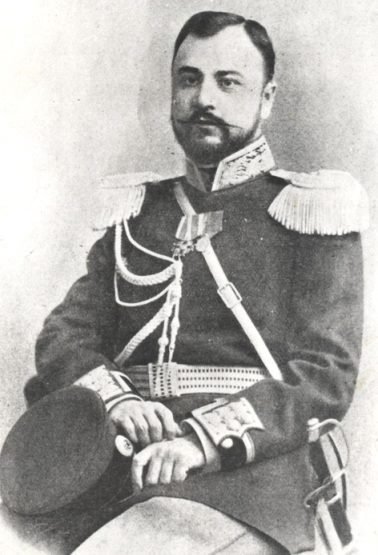
Suleyman Sulkevich
In addition to Sulkevich, the government included representatives of three nationalities: Tatars, Germans, and Russians. However, according to their political preferences, they were clearly divided into two camps. Given the opposing political orientations of the individuals who joined the regional government, one cannot help but make a pessimistic conclusion regarding the longevity of its existence. In the regional government, there were two groups that envisioned the future of Crimea differently.
The first group was represented by S. Sulkevich, D. Seydamet, A. Akhmatovych, and their supporters from the so-called 'German group,' who in the long run envisioned Crimea as a Crimean Tatar state independent of Russia. The second group united other ministers (V. Tatishchev, S. Gorchakov, V. Nalbandov, etc.), who viewed the independence of Crimea as a temporary phenomenon and hoped for the restoration of a united Russia after the expulsion of the Bolsheviks. Such contradictions could not fail to lead to a split eventually.
The first order published by S. Sulkevich stated: 'With the permission of the German command, I assume the administration of Crimea and the formation of a government with the aim of leading the country to a regional parliament. I set as the first task the restoration of the normal operation of all government and public institutions...'. Speaking of the main principles by which the new government should work, S. Sulkevich noted: 'I intend to involve broad social elements in the work. The central government organized under my leadership will make every effort to eradicate interethnic friction and weaken class antagonism; in the administrative sphere, a broad decentralization of power will be carried out; in the sphere of foreign policy, we will maintain strict neutrality.'
From the moment of his appointment, Sulkevich immediately approached the leadership of the Crimean Tatar Kurultai with a request to provide him with a candidate for the post of his own state secretary to help the Prime Minister manage Tatar affairs. This secretary was to be not only a delegate of the Kurultai but also in close connection with its leadership. Sulkevich emphasized: 'Only under such conditions will I always be able to have accurate data regarding the wishes, needs, and moods of the people related to me, so as not to lose their vital interests in administering the region.'
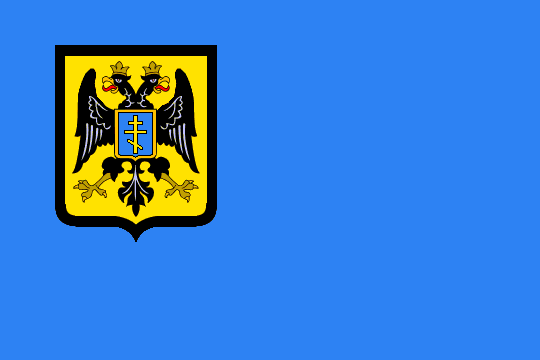
Flag of the first Crimean Regional Government
Having become the head of the Crimean Regional Government, Suleyman Sulkevich immediately began active work on creating the order he considered best. According to the observations of O. Fedyushin, Sulkevich 'was a figure best suited to govern this occupied territory until a further program of action was worked out for it. But the German leadership did not take into account (or did not understand) what turned out to be the most important political fact—Sulkevich's own aspirations and his serious intentions to defend the interests of Crimea, as he understood them, everywhere and in everything.'
The years 1917-1918 were the time of the highest flourishment of the Crimean Tatar movement. S. Sulkevich, who was himself a Lithuanian Tatar by nationality, could not fail to understand this. The kinship of national aspirations led to the fact that the new premier wished to achieve two results simultaneously: to take into account the interests of the Crimean Tatars, who were seriously determined to achieve their own Crimean state, and, through joint efforts with the German leadership and representatives of other nationalities and parties, to build an order on the peninsula that had to satisfy representatives of such different political forces. Obviously, under the conditions of the existence of two political camps within the Crimean Regional Government, this task was impossible to perform.
During the entire existence of the Crimean Regional Government, significant arguments took place between the ministers, but on September 11, a government crisis broke out, resulting in the resignation of all Cadet ministers.
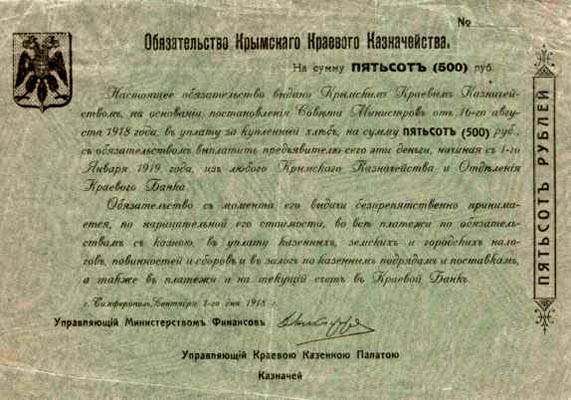
After the departure of the German troops, S. Sulkevich's government was left without support, face to face with the population of the peninsula, among whom it had no support, and the approaching Soviet troops. Opposing views matured within Sulkevich's government. In October, the Simferopol City Council decided to seek the resignation of the government. After some time, similar demands were put forward by the dumas of other cities on the peninsula. On November 14, Sulkevich's government resigned.
After the fall of the cabinet, S. Sulkevich moved to Azerbaijan in December 1918, where he was appointed Chief of the General Staff of the Armed Forces. It was he who initiated the peace treaty signed between Azerbaijan and Georgia in July 1919.
When the Bolsheviks seized Azerbaijan in May 1920, he was arrested in Baku and imprisoned in the local jail. On July 15, Suleyman Sulkevich was executed by the Bolsheviks. Mammed Amin Rasulzade recalled: when Sulkevich was called from his cell to be led to the execution, 'he anticipated us and said in a quiet but confident voice words I will never forget: "I am happy to die as a soldier of a Muslim army. Farewell!"'...