Labor Carved into Eternity
Biography of the great scientist-gardener Levko Simyrenko, the father of Crimean commercial fruit growing.
Petro Volvach, Academician of the Ukrainian Ecological Academy of Sciences, Full Member of the Shevchenko Scientific Society, Simyrenko researcher, laureate of the L. P. Simyrenko Prize of the National Academy of Sciences of Ukraine. "Krymska Svitlytsia" newspaper, 2017, issue No. 8
February 18, 1855—Levko Simyrenko was born on the Mliiv estate (Cherkasy region)—Ukrainian pomologist, the father of Crimean commercial fruit growing, who dedicated a quarter of a century of work to Crimea. Killed by Chekists on January 6, 1920.
"...In the hands of not only Crimean, but also southern fruit growing in general, this edition will serve as a guide, a reference book, and, finally, a source of pleasure provided by the elegance of style, imagery of presentation, and artistic execution of everything that illustrates the book. In every library, the work of L. P. Simyrenko will be a rich acquisition; it will be a precious gift and prize for a worker in the orchard who lacks the means to purchase this edition.
Happy is the country in which live and work such laborers as L. P. Simyrenko..."
From the review of the work "Crimean Commercial Fruit Growing" by the secretary of the Russian Imperial Society of Horticulture, General Vasily Gomilevsky, 1912.
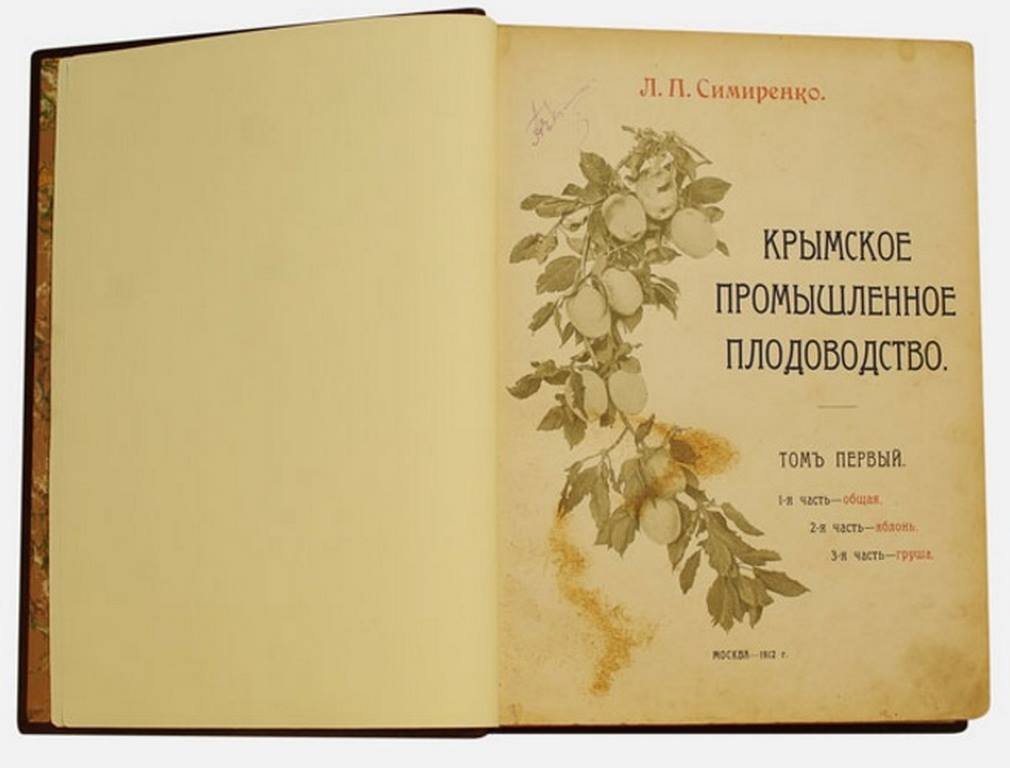
The book "Crimean Commercial Fruit Growing", volume 1
Philosophers note that time is always the most objective and impartial judge of human affairs. The 'classics of Soviet agrobiology' artificially created by the official authorities, after whom not only streets and scientific institutions but also villages and towns were named during their lifetimes, have faded into oblivion. The pompously published multi-volume works of the 'lights' of science, in whose honor agricultural laboratories were set up in every village and school and faceless, primitive monuments were erected, are forgotten.
However, time has passed, common sense has prevailed in society, the destructive processes of the politicization of domestic science have ended, and not a trace is left in science and human memory of the former mythical greatness of the 'leading lights of Soviet agrobiology.' But we also have the exact opposite: scientific works once banned by the Bolshevik regime, which were confiscated from libraries and burned on inquisitorial bonfires, are coming back to life today. They are being transformed into peculiar textbooks for current generations. The fact that there are many such works and authors today in historical and humanitarian sciences is not surprising. After all, during the Soviet era, they were the most politicized and falsified.
A unique example of scientific longevity in the field of applied natural sciences is the fundamental work of the world-famous Ukrainian scientist-gardener and pomologist L. P. Simyrenko, 'Crimean Commercial Fruit Growing.' The fate of this immortal work turned out to be as tragic as the fate of the brilliant scientist himself. He became one of the first victims of the bloody Bolshevik terror against the Ukrainian intelligentsia, initiated at the direct command of the Kremlin criminals Lenin, Trotsky, and Dzerzhinsky in the first years of the establishment of the totalitarian regime in Ukraine.
After the arrest in 1933 of Levko Platonovych's son, Volodymyr Simyrenko, who was professor and scientific director of the All-Union Institute of Southern Fruit and Berry Crops in Kyiv, all of their scientific works, including 'Crimean Commercial Fruit Growing,' were confiscated from scientific libraries across the country and destroyed. Until the mid-1960s, when the famous dynasty of Ukrainian scientists-gardeners was rehabilitated, their scientific works were banned, and their names were erased from domestic science.
Today, through the titanic efforts of enthusiasts, the Simyrenkos and their magnificent creative heritage have once again become the property of the Ukrainian people. The fundamental scientific work of L. P. Simyrenko, 'Crimean Commercial Fruit Growing,' even a century after its publication, remains highly relevant and in demand by modern horticultural science. Today, just as one hundred and five years ago, it is highly valuable not only for scientists but also for the general reading public. The book is read and appreciated by specialists of various professions: gardeners, historians, local historians, ethnographers, and cultural figures.
The work also attracts the modern reader because it summarizes the rich polyethnic horticultural history of Crimea and the Northern Black Sea region. The list of domestic and foreign literature cited by the author is very rich and diverse. In preparing the said work, L. P. Simyrenko made use of the rich scientific collections of the library of his alma mater, the Novorossiysk (Odesa) University, and the 'Tavryka' Crimean studies library in Simferopol.
The author knew the main subject of his research, Crimean horticulture, deeply and thoroughly. Indeed, during his annual multi-month expeditions around Crimea, the researcher visited every Crimean orchard over the course of twenty-five years. He was well acquainted with the horticulture of not only the South Coast but also the orchards of the entire Crimean Foothills. Local gardeners and the Taurida Zemstvo Administration constantly invited the authoritative expert on Crimean horticulture, an expert of the richest department of fruit growing, to almost annual provincial agricultural exhibitions.
Levko Platonovych was a frequent guest of many Crimean gardeners and at the Nikita Botanical Garden. The scientist made a lot of efforts to organize in 1913 in Simferopol the first Salhyr Pomological and Horticultural Research Station in the Russian Empire. Unfortunately, on the eve of its glorious centenary anniversary, this institution was liquidated by modern 'reformers and optimizers of science.'
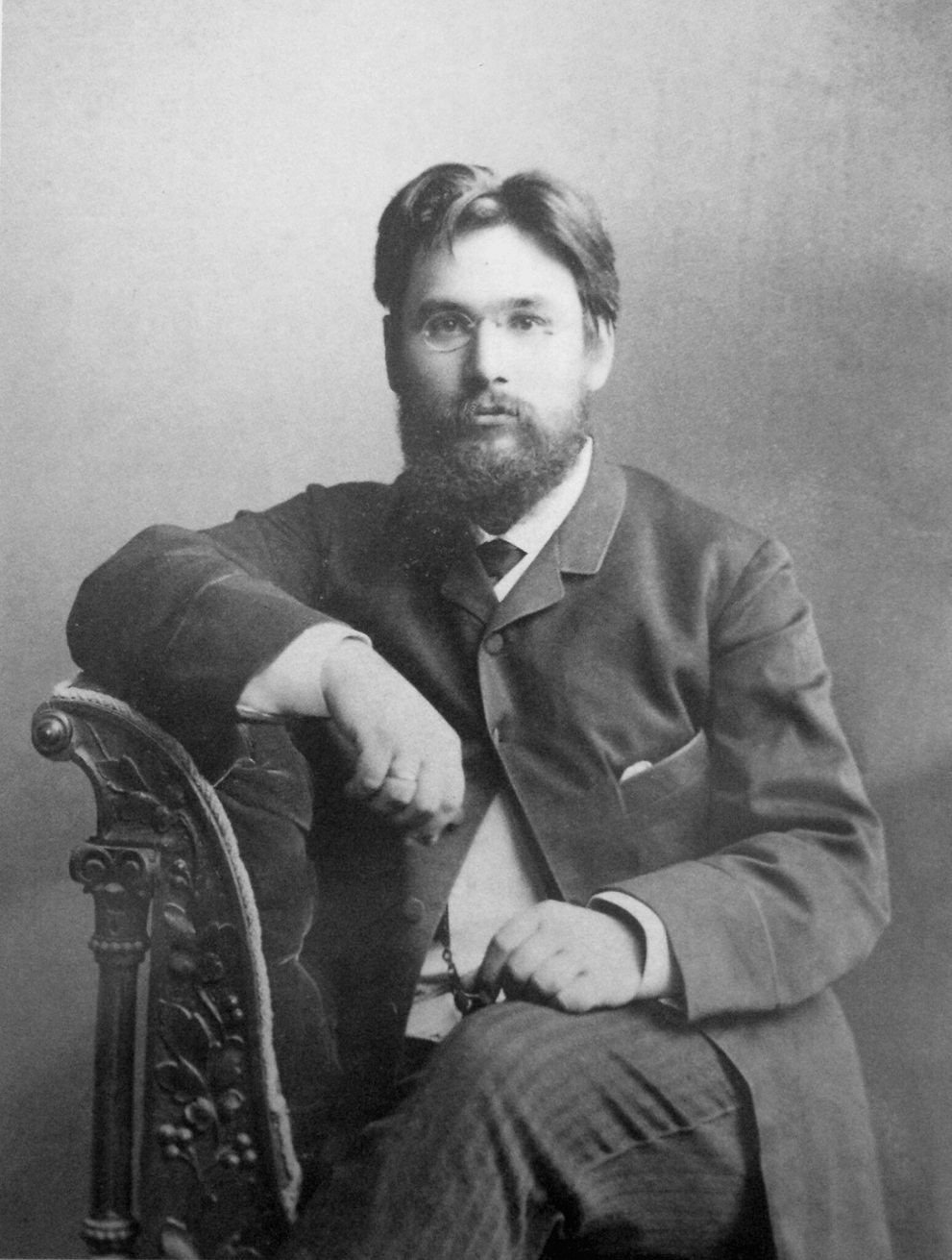
Levko Platonovych Simyrenko
L. P. Simyrenko published the results of his research annually in leading domestic and foreign journals. In 1891-1892, the scientist published such summarizing works on the study of Crimean horticulture as 'An Attempt to Study Crimean Commercial Fruit Growing' and 'Materials on the Question of Crimean Commercial Fruit Growing'. They received high praise from the global scientific community. Encouraged by success and public support, Levko Platonovych set about preparing a capital work dedicated to the horticulture of Crimea. At the end of 1907, it was completed. The scientist submitted the manuscript, with a total volume of over 2000 pages of typescript, to a competition announced on the occasion of the 50th anniversary of the establishment of the Russian Imperial Society of Horticulture.
The work of the prominent Ukrainian researcher won the Great Gold Medal and valuable awards from the imperial family. It became a subject of discussion at one of the meetings of the Simferopol branch of the Russian Imperial Society of Horticulture. Enthusiastic Crimean gardeners, having listened to the information of the scientific secretary, the well-known doctor and gardener V. V. Tayursky, unanimously decided to publish this work. The publishing committee regularly met in the building of the Taurida Provincial Zemstvo Administration (now the building of the Presidium of Crimean Advocates, 17 Karla Marksa St.).
The famous 'Tavryka' Crimean studies library was located there as well. L. P. Simyrenko used its collections while working on his book. Thus, this building is the true cradle of the famous Simyrenko work, 'Crimean Commercial Fruit Growing.'
The publication of the first volume of this work became the most significant event in the global horticultural science of that era. For several years, both in our country and abroad, leading horticultural publications published enthusiastic reviews. Pomological and horticultural societies of Italy, Germany, France, Belgium, and other countries proposed to republish Simyrenko's work. However, the outbreak of the First World War in 1914 crossed out these intentions and the author's plans.
In the Munich publishing house of Bruckmann, the third volume, 'Atlas of Fruits', disappeared without a trace, and in the Moscow printing house of M. I. Kushnarev, the manuscript of the second volume was lost during the war years. A sad fate also befell the first volume of the brilliant scientist's scientific work, published in 1912: in the inquisitorial bonfires of the NKVD during the 1930s, almost the entire edition of the first volume of 'Crimean Commercial Fruit Growing' of the 1912 edition was destroyed.
Considering the exceptional importance of the immortal work of the prominent scientist L. P. Simyrenko for the development of modern horticulture and honoring the 150th anniversary of his birth, in 2001, with the active support of the public, we published a reprint edition of the first volume of 'Crimean Commercial Fruit Growing'. According to experts, the revival of this outstanding work became one of the most significant events in the history of domestic horticultural science in recent decades. The second volume of the work, unfortunately, the author was unable to publish during his lifetime. As already noted, its manuscript was lost in the publishing depths of Moscow.
As a result of many years of painstaking searches in the archives and collections of the Simyrenko Family Museum in the Cherkasy region, we managed to find scattered fragments of this work. It took almost 10 years from finding the modest remnants of the work to its reconstruction and publication of the second volume of 'Crimean Commercial Fruit Growing' in 2008 under the state program 'Ukrainian Book'.
In his immortal work 'Crimean Commercial Fruit Growing,' L. P. Simyrenko left touchingly tender, charming lines about Crimea: 'I am more than indifferent to Crimea, to its picturesque nature, to its mountains and air... I have unforgettable memories associated with it, and with each new encounter with this magical land, I find myself again and again in the grip of some poignant, intoxicating feelings, just like during my first visit here.
Crimea, and especially the South Coast with its sea, sky, and sun, always evoke in me a sort of enthusiastically elevated, exciting mood, and I repeat after another ardent friend of this South, Evgeny Markov: "He who breathes Crimea, breathes the joy of life, poetry, and longevity. Hurry to Crimea, those who can, those who still have time."