Pride of the Nation: Crimean Tatar Folk Dance
The multifaceted Crimean Tatar culture that takes your breath away.
Lenura Khalilova – culturologist, teacher. Elnara Abdullaieva – artistic director of the Crimean Tatar ensemble "Badem". "Krymska Svitlytsia" newspaper, 2016, issue No. 50
Today, the time has come when the Crimean Tatar people are intensely trying to preserve their cultural heritage, living both in Crimea and far from their homeland. We are rebuilding brick by brick what our parents built over 20 years after returning to the homeland.
Our culture is multifaceted, our music takes your breath away, and our dances are mesmerizing. Each Crimean Tatar dance is a reflection of the uniqueness, traditions, and customs of our people, which is why the audience always watches the performance with interest. If we trace the origins of folk dance, we can find that in the past, Crimean Tatars did not have stage dances. First of all, this is due to the fact that people usually gathered at celebrations and simply improvised to the music, for example, at weddings. Among the rituals of the Crimean Tatars, the wedding occupies a special place, as it is an important event dedicated to the formation of a new family.
Weddings were always cheerful, with live music and dancing. Some sources say that in the past, women and men danced in different parts of the house during weddings. Ethnographers describe an ancient tradition: money for a good performance was placed under the hat of the best dancer, and after the event, it was given to the musicians. It was in this case that a unique professionalization of the dance as such was observed, because the dancer performed it not only for themselves but also for the audience. As a result, all the masters of Crimean Tatar choreography received their choreographic education precisely at weddings, becoming the pride and heritage of our nation.
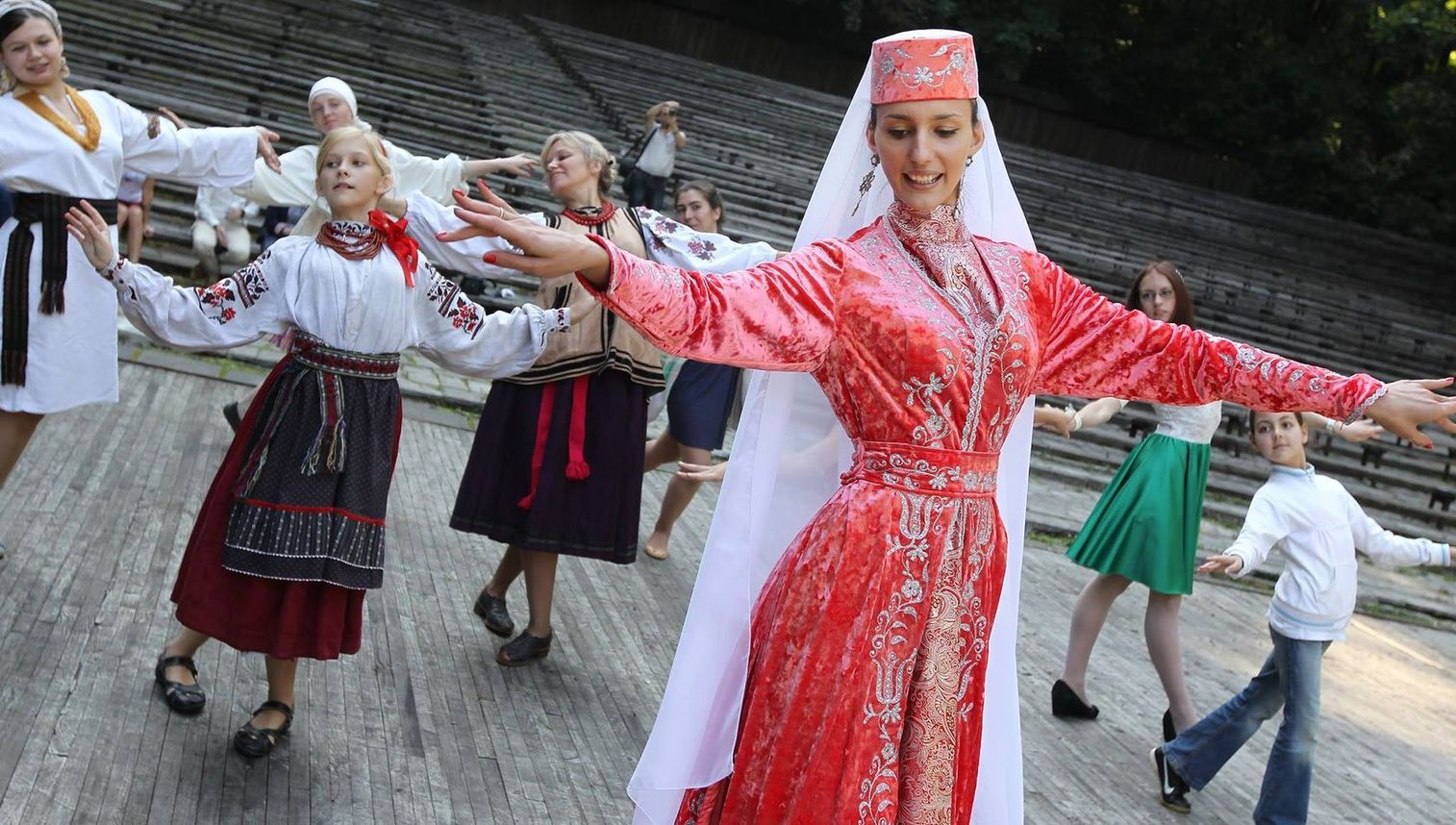
Crimean Tatar choreography is very untypical, diverse, and exciting. The main elements of the choreographic art of the Crimean Tatars include the absence of very sharp arm movements. Men's dances, which praise bravery, strength, and military skill, are characterized by a wonderful temperament. A stately, slender torso, arms spread in different directions, and elbows bent in half are the main positions of the Crimean Tatar men's dance. Soft, wave-like movements of the hands in front of oneself, as well as rotational movements of the wrists, are used. For women, the torso is slender, graceful, and majestic. Arms are spread apart, slightly below the shoulders, and soft wave-like movements of the hands in front of oneself and from right to left are used. The main leg movements are an alternating step on the toes.
Crimean Tatar dances are rich in torso turns for both women and men. The most popular dances now are 'Khaitarma', 'Khoran', 'Agyr Ava ve Khaitarma', 'Yavluk Avasi', 'Tym-tym', 'Emir-Dzhelyal', and the men's dance 'Choban Avasi'. For example, at a wedding, guests always perform the 'Khoran' dance. The bride and groom stand in the center of the circle, surrounded by a round dance of dancing girls and boys. With its pattern, this dance represents the sun, while the dancers, holding each other by the shoulders, move in a circle. The center of the circle symbols the center of the Universe. In the past, as noted by ethnographers, this dance was performed to lyrical musical accompaniment: 'In the Cornel Forest' or 'Varyrach'.
The 'Khaitarma' ('Return') dance reflects the image of an ordinary person, so the dancer's movements must be restrained. Many performers participate in this dance, and to this day 'Khaitarma' remains the most favorite dance of the Crimean Tatars. Usually, various versions of 'Khaitarma' are played at weddings or celebrations of folk customs; it is demonstrative and is often performed by two or three couples of dancers. 'Agyr Ava ve Khaitarma' is very solemn and graceful; its first part is more static, slow, and smooth, while the second part is temperamental, fast, and cheerful.
In ancient times, this dance was called 'Akai Avasi'—a men's dance, and it was danced only by men in pairs or individually. 'Akai Avasi' expressed the strength and dignity of a man. After some time, it began to be danced by both a man and a woman, or several couples at once. Locally, the shortened name of the dance 'Karshylama' is common, which translates as 'face to face'.
Almost no wedding takes place without the solo dance 'Tym-tym', which originates from Feodosiya. This dance has no mandatory figures, so dancers very often improvise freely. Since ancient times, 'Tym-tym' was danced by men, but later women also began to dance it. The main and most difficult movement of this dance is the trembling of the wrist, where every bone of the hand makes its own tiny movement. According to legend, each movement of the fingers should correspond to the sounds of the violin strings, telling the story of a violinist in love with a beautiful girl named 'Tym-tym'.
Interestingly, all couple dances at weddings are accompanied by the gifting of money, but this is not a demonstration of wealth; it is a symbol of transferring positive energy through money. The delicate female dance 'Emir-Dzhelyal' shows the figure of a beautiful Crimean Tatar girl, who slowly seems to float to the music, performing gentle wave-like movements with her hands. Like 'Agyr Ava ve Khaitarma', this dance also consists of two parts, slow and fast. The main movements of the slow part of the dance are small pliés and wrist turns. The turns are performed directly at the moment of the plié on the strong beats of the music.
'Choban Avasi' is a traditional men's dance that embodies the stateliness of the image of a proud Crimean Tatar. 'Choban Avasi' is a shepherds' dance, very expressive and precise in the performance of leg and arm movements; it is in this dance that the guys seem to compete in their skill and agility. If a shepherd suddenly loses a sheep, everyone else will look for it, and when they find it, they will gladly rush into dance.
The peculiarity of this dance is that it is performed with an object, namely a shepherd's staff. 'Yavluk Avasi' is a dance with a headscarf, often performed at weddings and holidays. In this dance, the guys seem to invite the girls, who are a bit shy at first but later also join the dance. Each girl in the dance carefully lays a headscarf on the floor so that the guy has the opportunity to pick it up. But not just pick it up. Pick it up, for example, from a split position, or by making a rotational movement of the torso over the head onto the feet, without using hands.
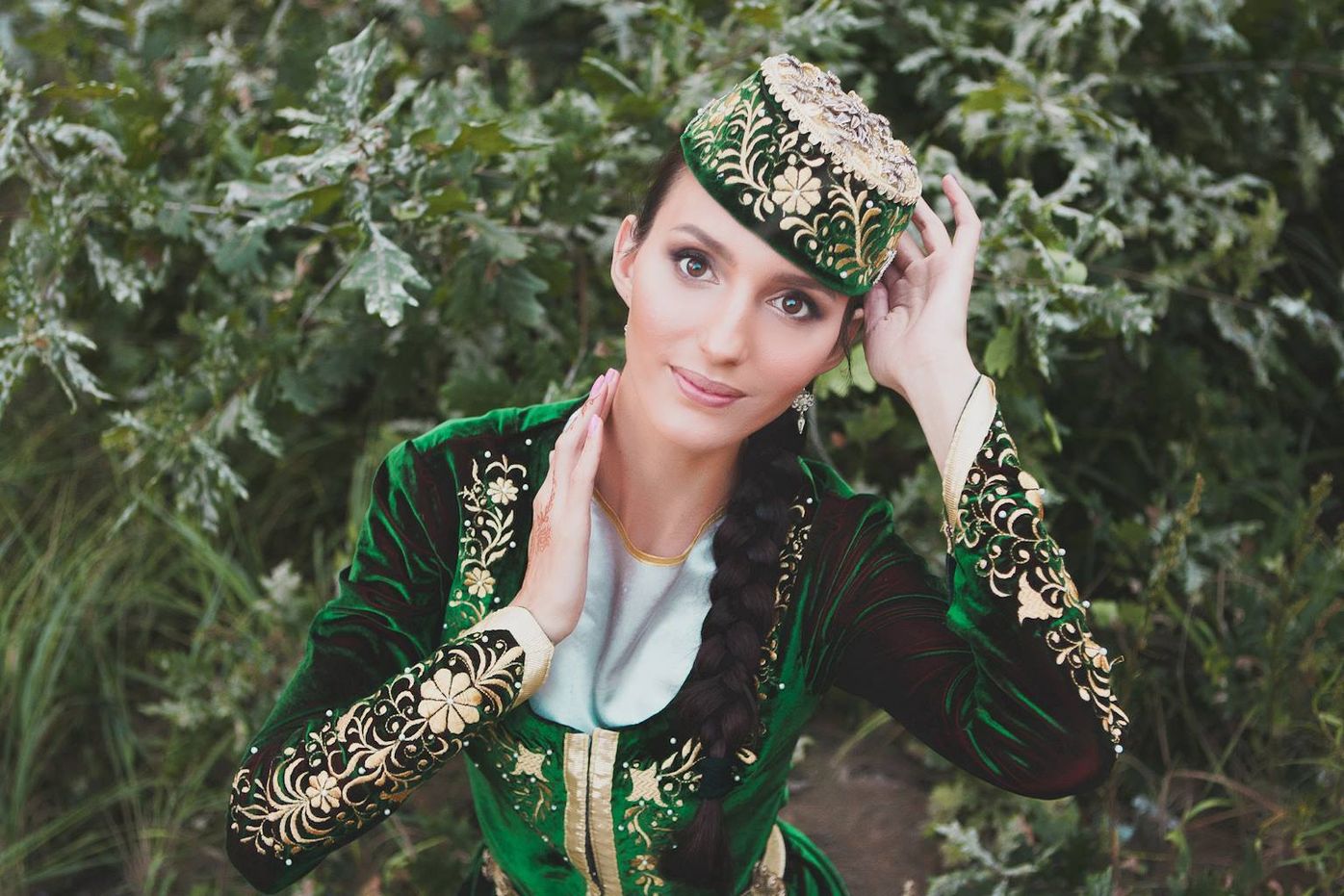
The unique traditional dance 'Dzhyyin' is performed during the pre-wedding ritual Kyna Gedgesi (henna night), when the bride's hands are decorated with henna. It is believed that the more decorated the bride's hands are, the wealthier the young couple's life together will be. As noted by ethnographers, in the past 'Dzhyyin' was performed by both girls and boys, but the girls were in a separate room and sang along, while the boys danced on the roof to instrumental accompaniment. Moments of improvisation are also present in Crimean Tatar choreography, but they do not change the traditional movements.
Among the Crimean Tatars, there is a tradition of teaching their children to dance from early childhood. Some become great dancers, while others learn just for themselves. Therefore, almost all Crimean Tatars know how to dance and move gracefully to music. The structure of the Crimean Tatar dance is designed so that proper breathing and the ability to hold the torso correctly are formed from childhood. Each Crimean Tatar family, despite the difficulties of moving and returning to their homeland in the 90s, tried to preserve the traditions, lifestyle, and culture of their people. And now, many efforts are being made for the development of choreographic art by such masters as Usein Bakkal, Selime Chelebiieva, Rustem Gaziev, Remziie Bakkal, Enver Alimov, Khairi Emir-Zade, Shakhzade Mamutov, Akim Dzhemilev, and Refat Asanov.
Information provided with the assistance of the State Enterprise "Crimean House"