Mysterious Tash-Dzhargan
The history of the lesser-known Crimean mountain Tash-Dzhargan.
Yeva Khvylia. "Krymska Svitlytsia" newspaper, 2018, issue No. 6
Bored at home, I set out on a short trip around the outskirts of Simferopol. The choice fell on the lesser-known mountain Tash-Dzhargan.
The journey began in the Fontany microdistrict, where I am lucky to live. The end of May delighted with warm, sunny weather—not as hot as it is in summer, but not as cold as it is in early spring. So, having passed through an unremarkable residential area, I found myself on a dusty road near the stop of bus 78. For some reason, I always feel uncomfortable being near the roadway, which is why I went down as quickly as possible to a picturesque pond—a favorite spot for fishing enthusiasts. Its right side was completely covered with gray, holey boulders, in which snakes often hide, and it's worth noting that there are quite a few of them here. The left part was overgrown with lush grass, where local shepherds graze cattle.
The water in the pond is emerald green, but near the shore, due to the abundance of limestone, it looked cloudy white. Having crossed the asphalt dam, I found myself on the other side above the pond. An immense field opened up before me, and somewhere far away, the rumble of passing cars carried from the Sevastopol highway. It was enough to walk a little along a beaten path to see a small forest on the left. Tall evergreen spruces hung heavy branches over the road, behind which one could see the Kholodna Balka (Cold Ravine) overgrown with coniferous forest at the foot. Continuing along the dirt road, one comes across a fork: a narrow path led like a thin snake into a small grove, but I decided to continue along the wide road, deeming it safer.
After half an hour of leisurely walking, enjoying the fresh air and the aroma of blooming May plants, I found myself on the home stretch—at the edge of the southern slope with an incredibly breathtaking view of the mountain range covered with turquoise forests; the weather was clear and opened up an excellent view. Ahead lay a plateau covered with a soft green carpet. Along the way, there were fragrant dogwood bushes, bright yellow Adonis flowers, and sometimes incredibly beautiful Crimean peonies.
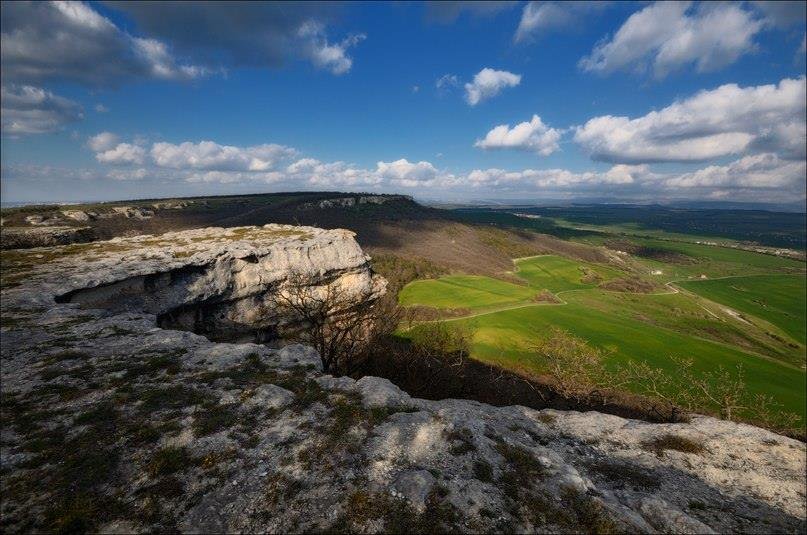
Finally, I reached my goal—the Tash-Dzhargan tract. This name translated from Crimean Tatar means 'split stone.' The place amazed me with an indescribable view of unique Crimean nature. Its object contour consisted of steep, weathered cliffs, giving it a unique, incomparable shape. To the right began a dense, difficult-to-pass forest. Later, I looked up information about the Tash-Dzhargan tract, which has a truly rich and interesting history: ancient settlements of the Scythians and Tauri were located here, and during archaeological excavations, ancient Taurian burial grounds were discovered.
The main and most prominent attraction can rightly be considered an amazing creation of nature—a huge through-hole over the cave, called Teshkly-Koba, or 'Holey Cave.' Seeing it, it is hard not to be amazed and believe that this is not man-made. A legend is also associated with it, telling how the Tauri used the sinkhole for sacrifices.
Nothing can explain the unpopularity of this place, as the amazing nature here has remained untouched. I fully enjoyed the beauty, but decided to take a risk and go down to the village of Malynivka through that same impassable forest. However, a path was still found, although at first I had to walk bent down, because twisting branches got in my eyes and grabbed my clothes, trying to hinder my walk through the forest. Soon it became much easier to step, and in the end, I found myself on a wide road leading to plowed fields.
I had to cross them for at least an hour, sometimes even losing hope of getting out of this wilderness. But as the saying goes: 'The road will be conquered by the one who walks.' Tired but happy and filled with positive emotions, I found myself in Malynivka. An old bus that took me home ended this simple journey, filled with the spring Crimean wind, picturesque views, and the ancient past.