The Speed of Light in the Kingdom of Darkness
Crimea and Albert Einstein's Theory of Relativity.
Valerii Verkhovskyi. "Krymska Svitlytsia" newspaper, 2018, issue No. 33
"If my theory of relativity is proven successful, Germany will claim me as a German and France will declare me a citizen of the world. Should my theory prove untrue, France will declare that I am a German and Germany will declare that I am a Jew."
Albert Einstein
Crimea was supposed to play a leading role in proving the theory of relativity, but the story of the attempt to verify Albert Einstein's theoretical conclusions by astronomical means suddenly turned from epic to farcical.
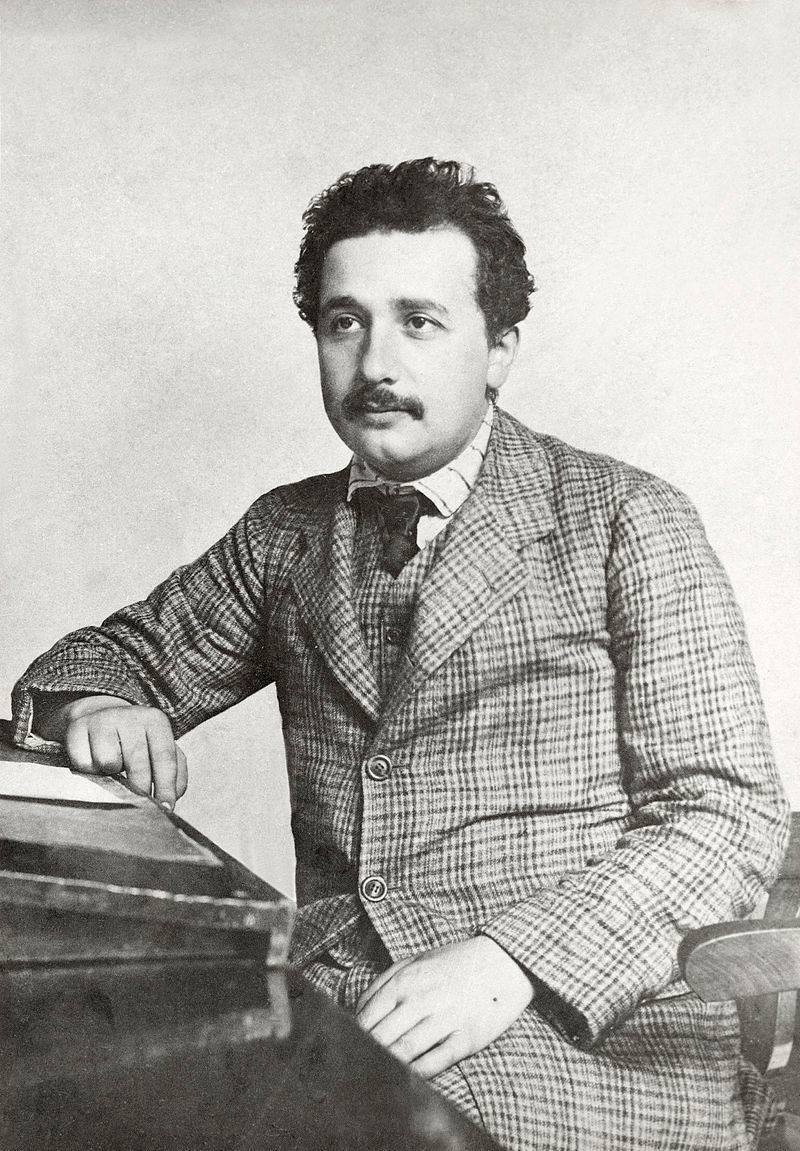
Albert Einstein
Even a century ago, the theory of ether (a certain invisible substance filling the vacuum of the Universe) was seriously considered in the scientific community. It is a little-known fact that Mendeleev, in his periodic table of elements, allocated a 'zero' place before hydrogen to an element he named newtonium, after Isaac Newton. The term 'ether' was introduced by Descartes, and Newton argued that light and other electromagnetic waves are oscillations in the ether; the ether theory explained electromagnetic phenomena and gravity, but questions remained, and by the beginning of the 20th century, a great many of them had accumulated.
Bringing together several facts unexplained by physics theories, along with the results of tests and experiments, the young Albert Einstein reached unexpected conclusions. The theory became a sensation... but remained only a theory. It required testing in practice, for which, in Einstein's opinion, it was sufficient to measure the angle of deflection of starlight passing near the Sun. If the theory is correct, space is curved by the mass of a body, and this will be noticeable when light rays pass near a celestial body of large mass.
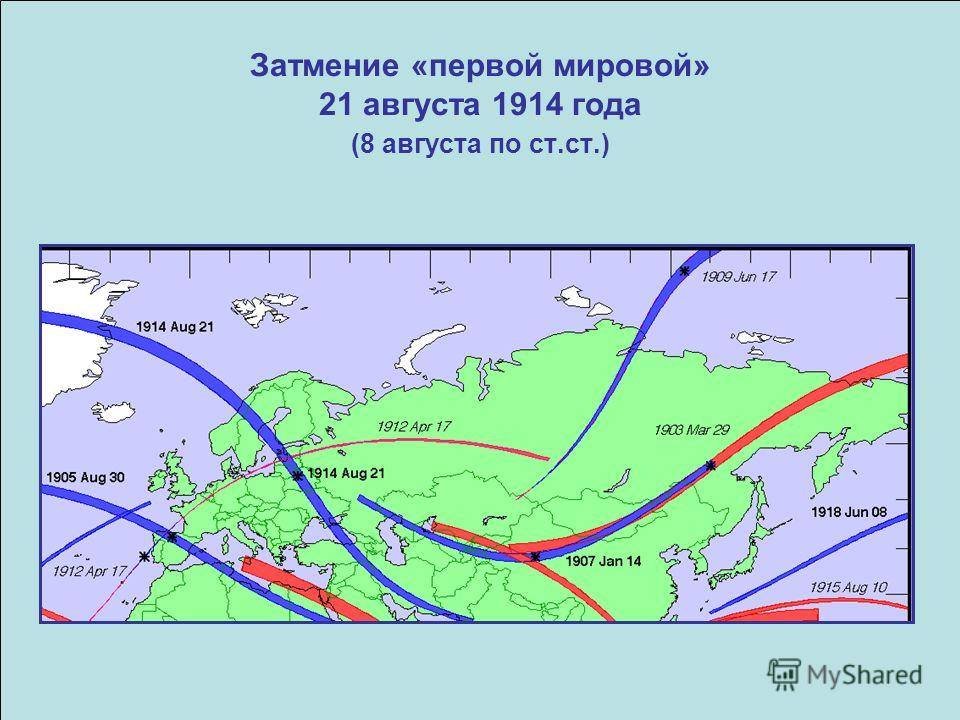
Making such observations is only possible during the day; of course, observing stars in the daytime sky is only possible during a solar eclipse. After fierce attacks from colleagues and as a result of his own doubts, Einstein needed to obtain observational results, and the nearest solar eclipse was to occur on August 21, 1914. The Moon's shadow during this celestial phenomenon was to pass across the European continent from north to south: from the Scandinavian Peninsula to Crimea; it was in the Crimean Mountains that observing the eclipse was best. Thus, this required organizing an expedition to Crimea, where the eclipse was to be total.
Erwin Freundlich, a young astronomer from Berlin, having read Einstein's 1911 paper with this thesis, decided to prove him right and eagerly volunteered to lead the expedition. Einstein wrote to Freundlich: 'The theorists can do nothing more. In this matter, only you, astronomers, are in a position next year to render a simply priceless service to theoretical physics.'
But the expedition still had to be prepared and funded. Einstein was ready to make the first contribution.
'It was at this time that Planck and other scientists were trying to lure Einstein from Zurich to Berlin, promising him membership in the Prussian Academy, so Einstein took advantage of the situation and wrote a letter to Max Planck proposing to fund Freundlich's expedition to test the theory,' writes Walter Isaacson in his biography of Albert Einstein. Fortunately, they managed to raise the funds without draining Einstein's account—enough donations came from private individuals, and most importantly, from the Krupp foundation.
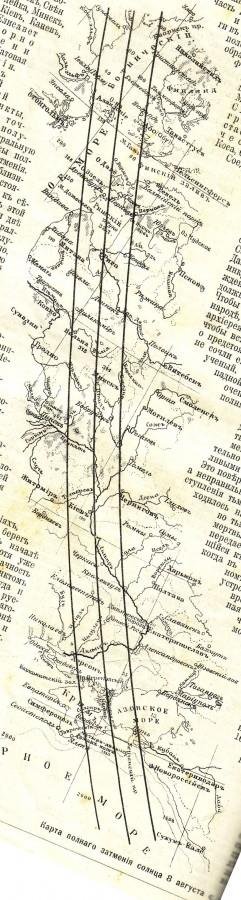
Path of the solar eclipse
On July 19, Freundlich and two colleagues left Berlin. In Crimea, they were to join forces with Argentine astronomers from the Córdoba Observatory. As it turned out, the scientists, far from politics and absorbed in their research, did not take into account the 'eclipse' of relations between Germany and the Russian Empire, which led to war. And it began on August 1 (according to the Julian calendar, the Russian calendar at the time), which was August 14 according to the Gregorian calendar used by Germany and the rest of the civilized world.
The inspection of the baggage of the seemingly innocent travelers by the Russian military shocked Russian military counterintelligence: they found powerful optical instruments in it! The Germans' explanations about the principle of relativity, the deflection of starlight, a train moving at the speed of light, and relativistic time dilation were resolutely rejected. The astronomers were suspected of espionage and detained 'pending clarification'.
In the TV series 'Genius' based on Isaacson's book, the arrival of the Germans in August Crimea is shown exactly as can be seen in the illustration. This is a frame from the film shot by the National Geographic Channel...
However, even the American group of astronomers, who managed to enter Crimea without hindrance and observe the solar eclipse of August 21, 1914, lost one of the two minutes during which our luminary was in the shadow of the Moon due to unexpected cloud cover, so common for the capricious Crimean weather. The captive scientists were soon exchanged through the mediation of the Red Cross for Russian subjects detained in Germany. However, as it turned out, the failure of the expedition saved the theory of relativity from being discarded and Einstein himself from disgrace. There was an error in his calculations, which he noticed and corrected only a year later.
The angle of deflection of the star beam, according to his calculations at the time, turned out to be half as large as it actually was. Had the data obtained by the expedition in Crimea differed from the calculations, the fate of the theory and of Einstein himself, as well as the entire development of theoretical physics, would have turned out differently. In this story, advanced materialistic science is closely intertwined with an amazing mysticism of coincidences that cannot be explained by rational thinking: the line along which the Moon's shadow glided across the Earth's surface on August 21, 1914, marked the future fronts of the First World War like a black marker. Photo from open sources