Crimea in Works of Foreign Literature: Jack Ryan Saves Ukraine
Crimean history in the literary works of world writers.
Valerii Verkhovskyi. "Krymska Svitlytsia" newspaper, 2018, issue No. 11
Tom Clancy, the American 'master of bestsellers' and a world-famous thriller writer, was born in Baltimore, Maryland, in 1947. From childhood, he prepared himself for military service, but poor eyesight did not allow him to make a career in the army. Clancy made his literary debut at a rather mature age (at 37), but his first novel became a bestseller and was adapted into a movie—referring, of course, to 'The Hunt for Red October'.
This book started a major series about Jack Ryan, a man who rose from a CIA analyst to the President of the United States. Several books in the series became famous movies: the aforementioned 'The Hunt for Red October', 'Patriot Games', 'The Sum of All Fears', 'Clear and Present Danger', and in 2018, the 'Jack Ryan' TV series hit the screens. It is still unknown whether the novel 'Command Authority', co-authored with Mike Greaney in 2012, in which, according to the plot, the Russian president, seeking the restoration of the USSR, seizes Crimea, after which Russian troops begin a full-scale offensive in eastern Ukraine…
So, Russian President Volodin, a former KGB officer, is ready for anything: even the assassination of his own SVR director Biryukov and retired FSB officer Golovko (radioactive polonium—sounds familiar?). The third victim of the Kremlin revanchist's ambitions is Ukrainian politician Oksana Zuieva, leader of the pro-Russian bloc in the Verkhovna Rada.
The scenario plays out like clockwork: 'The situation in Kyiv seemed to be getting worse. What started as a series of daily speeches by Ukrainian nationalists on Maidan Nezalezhnosti turned within a few days into a ten-thousand-strong rally filled with anti-Russian slogans...'.
However, the reaction in the eastern regions and in Crimea was lightning fast: 'In Sevastopol, in Crimea, skinhead gangs from the Russian majority broke shop windows belonging to Ukrainians and Crimean Tatars, set fires, and beat up random passers-by.'
But CIA agents working in Ukraine ultimately found out that: 'The Russians organized bus convoys from the pro-Russian east filled with paid trade union activists and dropped them off in Kyiv. At the same time, they secretly financed media outlets that expressed nationalist views. If this was indeed the case, it meant that the Russians in Kyiv were not interested in winning minds and hearts, but in chaos and discord... It was clear that the FSB had deployed activity all over Crimea, fueling interethnic hostility by all possible means.'
It turns out that behind this action stands the crime boss Hlib Rizanyi: 'He was born in Dzhankoy, in Crimea. This is Ukraine, but he is an ethnic Russian. He moved to St. Petersburg in the early 1990s... He operated in a high position in one of the largest Slavic groups—the "Seven Bogatyrs" gang.'
Meanwhile, the CIA special group 'The Campus,' the West's advanced combat unit, arrives in Kyiv. They did not stay long in the capital—they headed to Crimea. In Sevastopol, with the knowledge of the Ukrainian authorities and under the nose of the Black Sea Fleet, the so-called 'Lighthouse'—a secret CIA intelligence facility—operates. 'The Campus' was to secure the evacuation of the staff. However, people in civilian clothes appeared, but they were well-armed and trained.
'Midas' was at this time with Bixby in the radio center on the second floor. 'The fire is too accurate for a bunch of untrained civilian idiots,' he noted. Bixby agreed.
'They could be deserters from Berkut or the army, or militants trained by the FSB.' And he added: 'Damn, it could even be a special unit sent from Russia to destabilize the situation.'
The Russians shoot at the Americans, the Americans shoot at the Russians; a couple of Ukrainian helicopters flew to the 'Lighthouse' to evacuate the Americans—the 'civilians' shot down one Mi-8 with a shoulder-fired surface-to-air missile, while the second returned to base, not risking repeating the fate of the first.
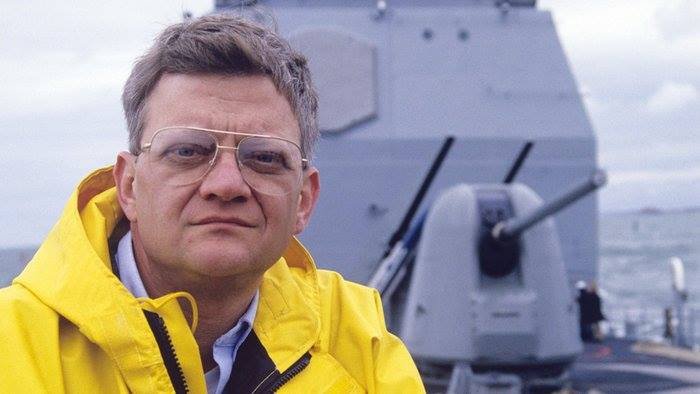
Tom Clancy
President Ryan scrambled a couple of MV-22 tiltrotors from the Marine Corps base in Łódź (Poland), and for cover, sent a flight of four F-16 fighters stationed in Turkey to Sevastopol. The Americans, of course, pull their people out of the Crimean trap.
When Crimea is dealt with, Russia begins a full-scale, non-hybrid offensive in eastern Ukraine: 'Although Russia completely occupied Crimea on the second day of the invasion, casualties mounted after the capture of Luhansk and Donetsk oblasts as they advanced westward. And toward the end of the day, the offensive was slowed down by bad weather, which kept most Russian helicopters grounded... The Russians were approaching, and by all accounts, they intended to reach Kyiv itself.'
However, the Ukrainian state is saved from complete destruction by the banal greed of the Kremlin regime. Fortunately for us, behind the imperial ambitions and Ukrainophobia stand not fanatics, but swindlers and robbers. The 'gold of the party'—or rather, two hundred million dollars stolen by the 'Chekists' back during Perestroika—as it turns out, resurfaced in the first commercial bank founded by Volodin in the 1990s.
Roman Talanov (the current head of the FSB) was directly involved in the theft of these funds; moreover, by capturing Hlib Rizanyi, Ryan obtains compromising material on his Russian counterpart. After a conversation between the two presidents, Volodin becomes less bellicose, and Talanov, who organized the assassinations of Golovko, Biryukov, and Zuieva, is killed himself.
Although Volodin has to pull out of Ukrainian territory... Crimea still remains part of Russia.
The outcome, although regrettable, is fair... If not fair, then at least natural—for a state that neglected its defense capabilities for many years, relying on empty promises, downsized its army, and sold off armaments all over the world. The price must be paid in territories.