Ukrainian Toponyms of Crimea
Names of Crimean cities and towns of Ukrainian origin.
Yevhen Rehushevskyi, Doctor of Philology, Professor. "Krymska Svitlytsia" newspaper, 2016, issue No. 38
In official Russian, and later Soviet science, the problem of 'Ukraine and Crimea' was considered only in terms of Russia's relations with Crimea. However, as historical facts and documents testify, Ukrainians had close relations with Crimea and lived in Crimea long before the unification of Ukraine with Russia. As the Turkish traveler and historian, author of the 10-volume 'Book of Travels', Evliya Çelebi, testifies, according to the census of 1666, 1 million 120 thousand people lived in the Crimean Khanate. Of these, almost 920 thousand were Cossacks (that is, Ukrainians), including 120 thousand girls and 200 thousand children.
In the 14th century, an Orthodox church operated in Kaffa (Feodosiya), and in the 17th-18th centuries there were about 50 winter quarters and other Cossack (that is, Ukrainian) settlements on the lands of the Crimean Khanate. According to the census of 1897 (100 years ago), Ukrainians were the dominant ethnic group in the Taurida Governorate.
The first population census in Crimea after 1917 (in 1921) had a clear political basis: all Ukrainians in Crimea were registered as Russians. Only in the 1926 census did Ukrainians reappear in Crimea; in 1930, 10 Ukrainian village councils operated in Crimea, and in 1939, over 150 thousand Ukrainians were registered. However, this figure does not correspond to reality, just like the data of the 1989 census, according to which official sources gave three figures—625, 725, and 900 thousand. In reality, before the war and today, over 1 million Ukrainians lived and live in Crimea. According to sad statistics, among the Crimeans killed in the last war, almost 80% were Ukrainians.
The presence of such a large number of Ukrainians who permanently lived and live in Crimea has also left its mark on the toponymy.
In the Ukrainian toponymy of Crimea, two historical groups are clearly distinguished: toponyms that existed before 1954, and toponyms that arose after the transfer of Crimea to Ukraine.
The oldest Ukrainian toponyms include most of those associated with geographical features. These are the names of the villages: Hlybokyi Yar, Zelenyi Yar (two villages), Bilohlynka, Levadky, Balky, Karpova Balka, Zatyshne, Vyshniakivka, and Kopani. The village of Mazanka has existed for almost two centuries, founded, according to legend, by retired Cossacks of the Chernihiv Regiment who took part in Russia's war for Crimea. The villages of Zoryane, Zorya, Kolosky, Chobotarka (two villages), and Chervone are traditionally considered Ukrainian.
Some Ukrainian hamlets in Crimea are remnants of former Cossack winter quarters. Almost all of them that did not grow into villages have been destroyed. These are: Bashtanivka, Velykyi (Bolshoy) Kut, Velykyi (Bolshoy) Yar, Kozachyi Yar, Malyi Yar, Horlytsia, Zaporizke, Kozache (two villages), Zelenyi Hai, Otary, Pokosy, Kalachi, Krynychne, Krynychky, Lepetykha, Khmelnytske, and others.
The new Ukrainian toponyms that appeared after the war include most of the names of the so-called resettlement villages. A number of names appeared to honor famous pre-revolutionary Ukrainian writers and public figures, as well as Ukrainian figures of the Soviet era: Bohdanivka, Doroshenkove, Shevchenkove, Osypenko, Lytvynenkove, Babenkove, Bondarenkove, and others.
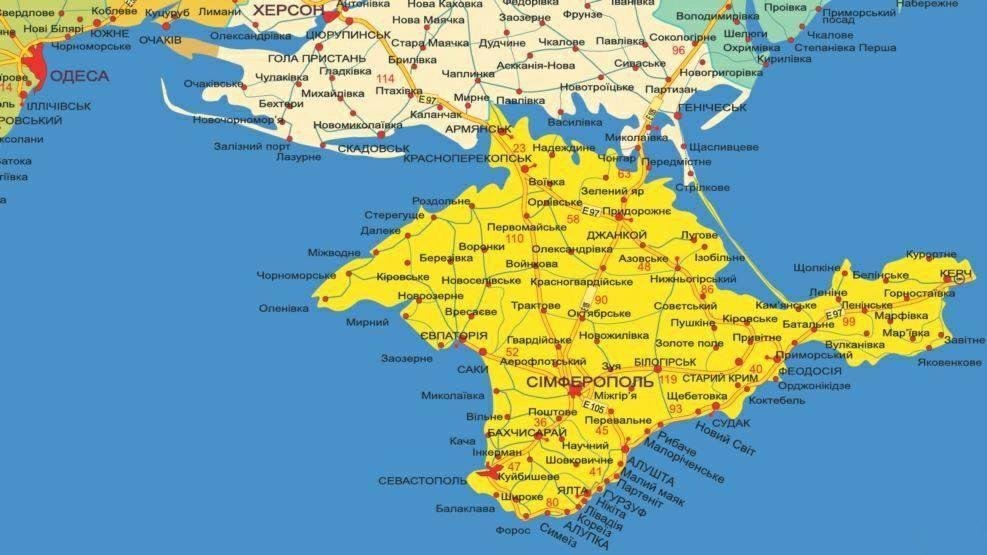
A significant part of the new names indicates the previous place of residence of the first settlers: Dniprovka, Vinnytske, Ukrainske, Ukrainka, Poltavka, Poltavske, Lebedynka, Shepetivka, Sumske, Nizhynske, and others.
The main body of ancient Ukrainian toponyms of Crimea consists of toponymized common words: Kalachi, Balky, Stavky, Krynychky, Kopani, Levadky, Pokosy, Kolosky, Vyselky, Otary, Yar, Kut, Hai, Mazanka, Horlytsia, Zorya, and others. Some of these names are accompanied by specifying adjectives that indicate characteristics or ownership: Yar (Hlybokyi, Zelenyi, Malyi, Kozachyi), Kut (Velykyi), Balka (Karpova, Hlyboka), and others. A smaller group among these toponyms consists of substantivized adjectives that were once part of a two-word name: Kozache, Zaporizke, Krynychne, Khmelnytske, Chumakove (formerly 'Kozache Selo', 'Chumakove Selo', etc.).
The vast majority of new Ukrainian toponyms of Crimea are substantivized adjectives with the primary meaning of possessiveness (Shevchenkove, Doroshenkove, Bondarenkove, etc.) and belonging (Vinnytske, Ukrainske, Poltavske, Sumske, Nizhynske, etc.).
Thus, the traditional, comprehensive relations of Ukraine with Crimea from the most ancient times, and the permanent residence of Ukrainians on the territory of the peninsula, led to the consolidation of a significant number of Ukrainianisms in the toponymy of Crimea.
Information taken from: Culture of the Peoples of the Black Sea Region. – 1997. – No. 1.