"Russian" Cemetery in Crimea... with Cossack Crosses
The last resting place of Ukrainian Cossacks on the Crimean Peninsula.
Serhiy Konashevych. "Krymska Svitlytsia" newspaper, 2017, issue No. 7
While searching for illustrations for an article on the history of medieval Crimea, there was no better decision than to accompany it with drawings by the Italian artist Carlo Bossoli, who traveled across the entire peninsula in 1840-1842. The result of these travels was the publication of a limited edition of the album of colored lithographs 'The Beautiful Scenery and Chief Places of Interest throughout the Crimea' in 1856. Some of these works captured Crimean landmarks that, unfortunately, have not survived to our day.
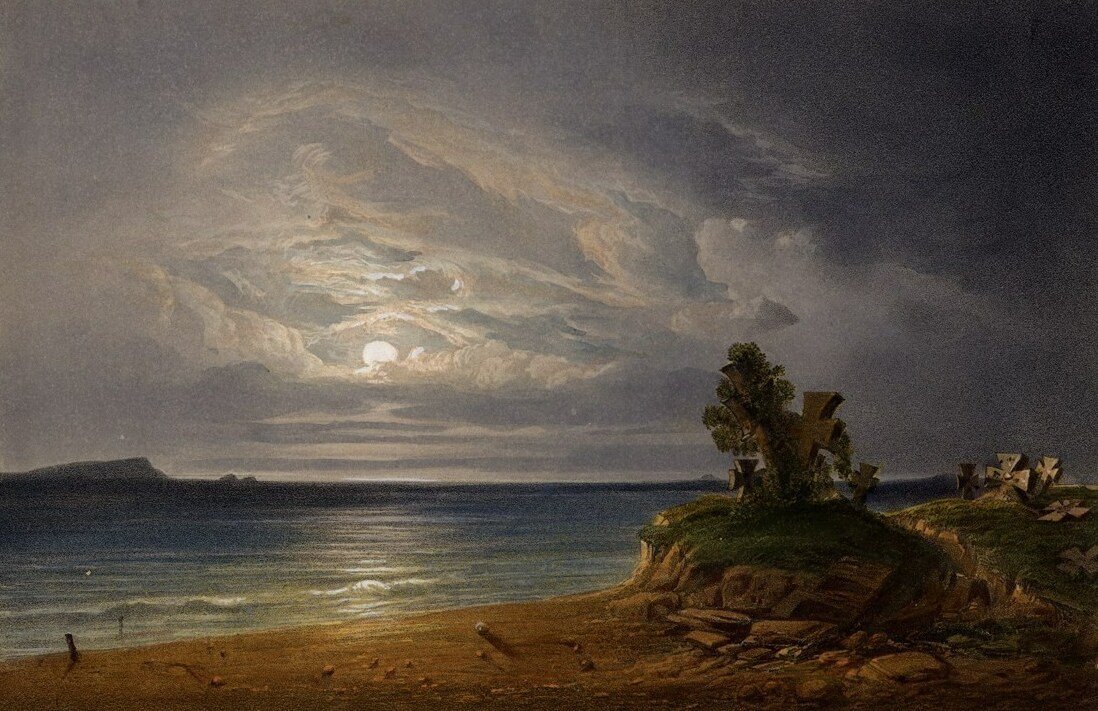
Carlo Bossoli – Cossack Cemetery
Before the publication of the album, Carlo Bossoli visited Crimea during the war, in 1855. This visit resulted in several dramatic paintings depicting military actions on the peninsula. However, the London publishing house 'Day&Son' decided to choose drawings of the 'peaceful' Crimean series for printing. The artist himself selected 52 works for the edition and determined their sequence: in this way, he tried to create a single work that would capture both the richness of Crimean nature and the diversity of the cultural heritage of the peninsula's peoples.
Particular attention was drawn to the second-to-last picture in the album, signed as 'Russian Burial-Ground. On the shores of the Putrid Sea, near Perekop.' It depicts an old cemetery with tilted and fallen stone crosses.
However, if one knows the history and traditions of Ukraine even superficially, looking at the crosses in this 'Russian cemetery' on the coast of Syvash, one can tell immediately: under them, the Zaporozhian Cossacks found their last resting place.
This is also mentioned in occasional annotations to Bossoli's works. This is also discussed by social media users who share memories of seeing similar crosses in the locations of ancient Cossack settlements.
In reference books, we learn that the Cossack cross was depicted on the seals, banners, and coats of arms of the Zaporozhian knighthood. Similar-looking trefoil crosses have survived to this day in the ancient Cossack cemeteries near Shkodova Hill in the vicinity of Odesa—Kuyalnyk, or Sotnykivskyi (where one of the first graves dates back to 1791—4 years before the name of Odesa itself appeared), and Usatove (both near the Khadzhibey Estuary), as well as in the villages of Kurisove (former Petrivka) near the Tylihor Estuary and Hlyboke on the shores of the Sasyk Estuary. Historians claim that the descendants of the Zaporozhian Cossacks lived in these places, having settled in the Black Sea steppes after fighting the Ottomans and later participating in the development of the region.
Incidentally, we can see several interesting parallels with Crimea here: 1) Carlo Bossoli's family moved to Odesa from Swiss Lugano when the future artist was only 5 years old; 2) in the village of Usatove, there are cave dwellings similar to those found in the mountainous areas and sea coasts of Crimea: their front walls were whitewashed like traditional Ukrainian houses, and some of them were inhabited by people until they were forcibly resettled in the early 1980s.
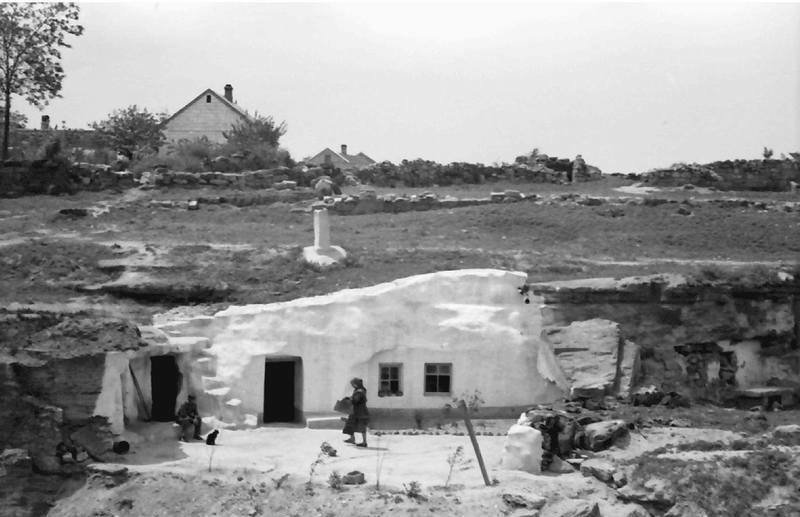
Usatove caves
And finally, it is worth noting that in late autumn 2016, in the village of Stavky in the Kherson region, not far from the 'border' of Crimea with mainland Ukraine, another Cossack cross appeared: in memory of Crimeans who died defending Ukraine in its southern and eastern regions.
As long as the memory of Cossack glory lives, our people will have their defenders who will continue the cause of their forefathers.
Let us remember this.