And Kings Have No Power Over Me
Cinematic landscapes of the Crimean Peninsula during the filming of "The Andromeda Nebula".
Valerii Verkhovskyi. "Krymska Svitlytsia" newspaper, 2018, issue No. 5
Half a century ago, in 1968, at the science fiction film festival in Trieste (Italy), a special award went to the movie 'The Andromeda Nebula', shot at the Dovzhenko Film Studio by director Evgeny Sherstobitov. In the decade that passed between the publication of Ivan Yefremov's novel (1957) and the appearance of the film (1967), a great deal had changed in the perception of ideological tenets and the image of the 'bright future,' which makes the film significant.
Paradise on Earth?
Dreaming of a better future is natural; the desire to organize the world 'reasonably' and 'conflict-free' stems from a longing for the lost Paradise. Ivan Yefremov's novel shows an alluring era, distant by three or four millennia, where nations have been abolished and a single language for the entire planet has been introduced, rivers have been redirected, and the population size has been 'optimized.' Inexhaustible sources of energy 'Ku' and 'F' have been discovered (without even the slightest explanation by the author of what they are). It is immediately noticeable that the book was written by a scientist—everything is governed not by ministries, but by Councils and Academies; there is even an Academy of Sorrow and Joy. There is no violence in this world—probably for the reason that it has already occurred: the characters resemble robots, positively programmed, but robots, not humans.
The inherent flaws that could be glimpsed in the book made themselves felt in the film shot in the late 1960s by the Kyiv Dovzhenko Film Studio. Even the performance of wonderful actors forced to deliver empty and clichéd lines (Vija Artmane, Nikolai Kryukov, Sergei Stolyarov) could not save the film; the elevated tone of the entire action looked unnatural, making the non-viability of the communist ideology obvious...
The Land Where They Filmed About Paradise
Nevertheless: beautiful Crimean landscapes and an amazing futuristic aesthetic—this is what this film is remembered for. And also because much of Yefremov's novel is absent from it, while one can see something that was not in the book...
The alien landscapes were filmed in Crimea: Ai-Petri, Alushta, Novyi Svit, and the Kapsel Valley (Sudak). For the filming, the mountains were even painted red... Meanwhile, the then newly built structures of 'Artek' (the 'Morskyi' camp and the Central Stadium) embodied the vision of the architectural style of the bright future.
Only the first part of the film dilogy was shot. The plans were shattered by the unexpected death of Sergei Stolyarov, who played Dar Veter—the main character of the novel. Therefore, the film does not show the storyline of Ren Boz, who ventured a risky experiment with teleportation; the leitmotif of the film was the adventures of the starship 'Tantra' and the story of the relationship between Niza Krit and Erg Noor. Young Niza, trying to save Erg, almost dies herself and ends up in a coma. In the book, 'Tantra' returns to Earth, where the miracles of communist medicine save the girl; in the film, however, the viewer is left in the dark about what will happen to her.
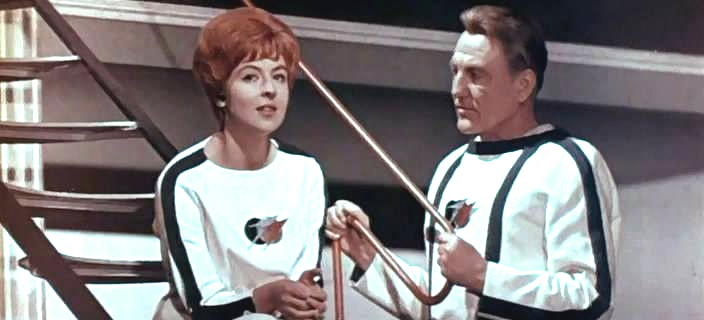
Niza Krit (T. Voloshyna) and Erg Noor (M. Kryukov) — film still
The Paradise That Is Always with You
Niza Krit is in love with the stern, overly restrained star commander Erg Noor, and strives to always be near him. She looks like she arrived from another world, perhaps even from the past—emotions exist there, and Niza is almost the only living person in a row of biorobots. A small book of Shakespeare's poems, which Niza gave to Erg Noor, appears in the film; this is not in the novel. An antique volume of poems presented by her to her beloved man (this was not in Yefremov's work!)—it is as if she brought this rarity from her era of the 'imperfect' past. And when Niza finds herself between life and death, the commander is offered to erase the unnecessary feeling... Saying, why love in the absence of the 'object' of feelings? This is what happens in the book: 'Erg Noor raised his eyebrows. Luma Lasvi felt that she was speaking in too much detail and for too long.
— I want to say that medicine has the ability to affect those brain centers that control strong experiences. I could... Understanding flashed in Erg Noor's eyes and was reflected in a short smile.
— You suggest affecting my love," he asked quickly, "and thereby freeing me from suffering?'
If in Yefremov's novel Erg Noor rejects the opportunity with the decisiveness and uncompromising attitude of a starship commander who is used to giving orders in extreme situations, in Sherstobitov's film, this scene turned out to be not only the climax, but it also pulls everything together. But this is Ukrainian cinema: the character played by Nikolai Kryukov first agrees to the treatment for love, and then a minute later suddenly interrupts the 'therapy' session, quoting the 29th sonnet from the volume of poems by a forgotten poet of the 'Dark Ages' given to him by Niza:
'For thy sweet love remember'd such wealth brings That then I scorn to change my state with kings.'
The Muse
So who was Niza Krit for him, Evgeny Sherstobitov?
They met in Kyiv in 1963, but it was Crimea that brought them together. The director came to the capital of Ukraine to shoot the film 'The Cabin Boy of the Schooner Columbus'—based on the famous story by Trublaini.
At the film studio (now the Dovzhenko Film Studio), he met a young assistant with a unique name, Zhemma, and invited her to go with him to Crimea to shoot a new film; she agreed. Evgeny Firsovich recalled it like this: 'She had just finished working on two films by Parajanov and really wanted to go on vacation, but with my arrival, I ruined all her plans. And what was left for me to do to make it up to her? Just get married!'. Ahead were forty-five years of life together, children and grandchildren, ahead were films—and again and again Crimea, where 'Scuba Diving at the Bottom', 'The Andromeda Nebula', and 'Project Alpha' were filmed...
Sherstobitov loved Crimea very much, and when he died in 2008, according to his will, his ashes were scattered in the very places where 'The Andromeda Nebula' was shot—over the Black Sea near Sudak.