Uch-Bash at the Inkerman Galleries: The Last Refuge of the Unconquered
The story of the Crimean town of Uch-Bash.
Evelina Kravchenko, Candidate of Historical Sciences, Senior Researcher at the Institute of Archaeology of the National Academy of Sciences of Ukraine, Head of the Inkerman Expedition of the IA of the NASU. "Krymska Svitlytsia" newspaper, 2019, issue No. 35-36
"...When we had run into the fair haven, whereon a sheer cliff rises all around on either side, and jutting headlands over against each other stretch out at the mouth, and the entrance is narrow, then all the others steered their curved ships in..." — it is this passage from Odysseus's tale related to us by Homer that comes to mind at the first glance at the upper reaches of the Sevastopol Bay. To the left, on the cliffs above the Inkerman valley, the towers of Kalamita, the fortress of the Gothic principality of Theodoro, still stand, while to the right, a sheer cliff with traces of a gigantic landslide, still visible today, hangs over the valley. This is Uch-Bash.
The tragic history of this place is known to all residents of Sevastopol. In the 1930s, an entire underground town was built here on the site of a champagne winery, known as 'Special Combine No. 1'. In the galleries formed by the extraction of stone from which Sevastopol itself was built, there were military warehouses, a hospital, a medical unit, a plant for the production of certain types of ammunition, dormitories, and a kindergarten—a completely autonomous world designed for the long-term containment of the enemy in the event of war.
With the start of the war, the Moscow command established a stronghold for the Black Sea Fleet in this very part of Crimea, which they had no intention of surrendering. In early 1942, a decision was made to move all ammunition of the Black Sea Fleet to the Inkerman galleries. The lost campaign of the defense of Sevastopol in 1942 led to the tragic events of that summer, when the entire Primorsky Army perished or was captured on the Heracles Peninsula, and the Inkerman galleries, with the remnants of the civilian population, the wounded, and the staff, were mined and blown up on June 28, 1942, by order of the Commander of the Black Sea Fleet, Admiral F. S. Oktyabrsky, in execution of an order that came from Moscow.
In Soviet times, it was reported that an evacuation had been carried out in the galleries, placing the number of dead at up to a hundred. Following the publication of some documents from a closed conference of 1963 in Moscow, gathered to investigate the events of June 1942 on the Heracles Peninsula, it became clear that far more people were buried alive in the galleries, possibly exceeding several thousand, and no evacuation of people had been carried out. This place remained known to Sevastopol residents as the 'accursed Champagne' after the end of the Second World War.
A place that was not only the witness of a terrible tragedy and a war crime, but also contained the entire ammunition supply of the Black Sea Fleet for 1942, since the ammunition depots generally did not detonate when the galleries were blown up. In what condition the ammunition was, how to extract and neutralize it—all this was unknown and remained a closely guarded secret for more than half a century after the end of the war.
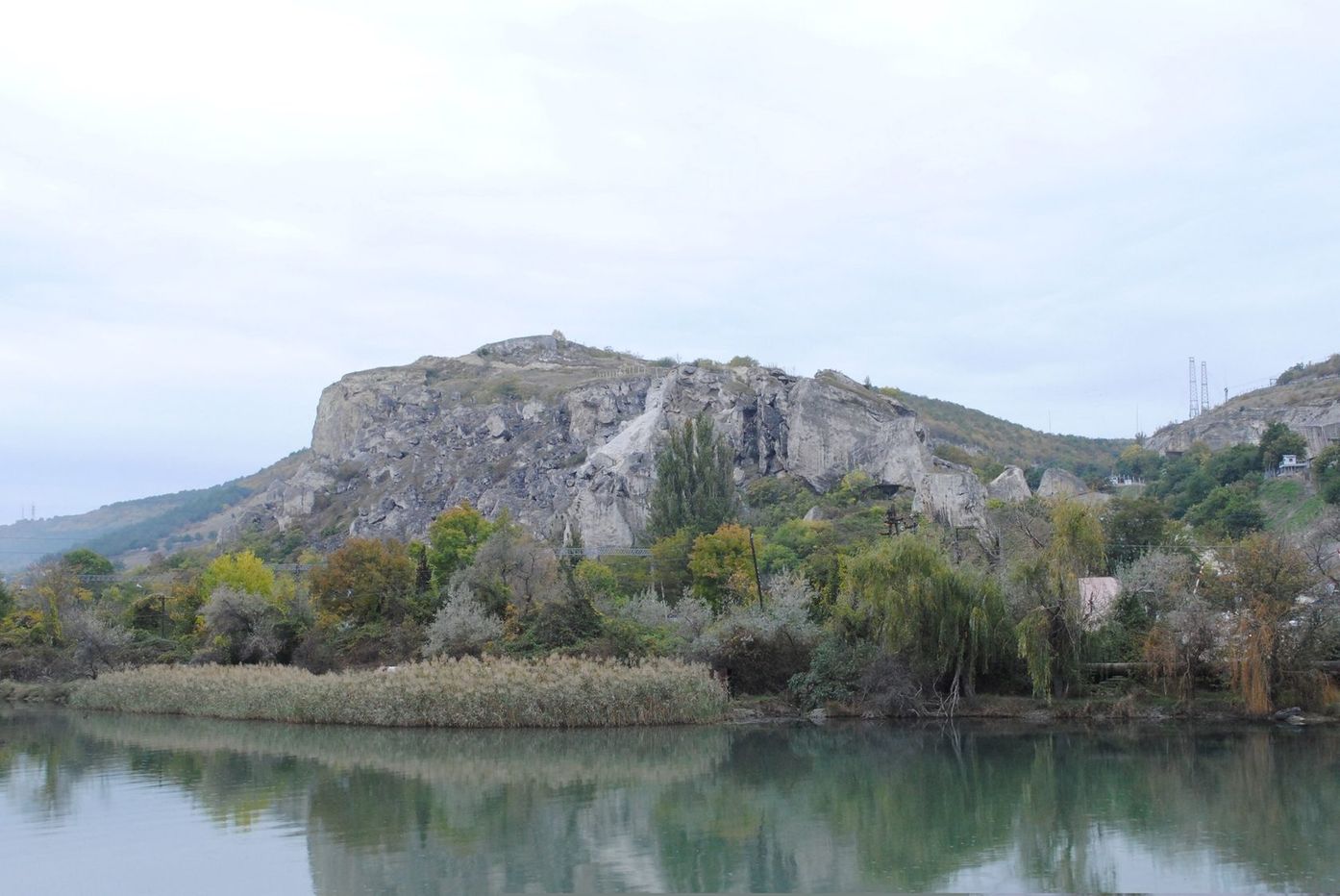
Chortove Horodyshche (Devil's Hillfort) with the settlement of Uch-Bash. View from the mouth of the Chorna River. Photo by R. Lysenko. 2012.
In archaeological research in the 1920s, this place received the name Chortove Horodyshche from its first researcher L. M. Solovyov (it had this name in the local toponymy because the hill on which the fort is located is bordered from the south by Chortova Ravine). Being a staff member of the Museum of Local Lore, L. M. Solovyov conducted collections of archaeological material there. Excavations began only after the Second World War by the then acting director of the Chersonesos Museum, S. F. Strzheletsky.
He was a vivid representative of his time, collaborated with the NKVD, and with his assistance, L. M. Solovyov, who discovered almost all the archaeological sites of Sevastopol and its environs known from the 20th century, was transferred to work in Sukhumi, while another researcher of the antiquities of the Inkerman Valley—O. K. Takhtai—was accused of collaborating with the occupiers and sentenced under the article 'treason to the Motherland'.
In 1952-1953, S. F. Strzheletsky conducted excavations at Chortove Horodyshche, giving it another name—Uch-Bash, in order to confirm the results of his dissertation. But the excavation results were so unexpected that their interpretation had to be postponed. The material obtained by the researcher did not fit into the general Marxist-Leninist scheme; it showed that it was inhabited not by primitive Tauri, hunters and herders, as indicated in museum guidebooks, but by craftsmen and farmers with complex skills and abilities, including, as established by the work of our expedition, the mastery of the process of obtaining iron from ore, a process that ushered in a new era of human history—the Iron Age.
Since then, the material lay in the collections of the Chersonesos Museum and remained unanalyzed and unpublished for a very long time. I saw these collections completely by accident. A former Soviet, and in 2001—already for a long time an American archaeologist, Professor O. M. Leskov of the University of Pennsylvania (Philadelphia, USA), in a conversation with the head of the Ukrainian-American project for the study of Chersonesos and its chora, director of the Institute of Classical Archaeology at the University of Texas (Austin, USA), Professor J. Carter, mentioned that when he was a graduate student, S. F. Strzheletsky had shown him very interesting materials from Inkerman. At my request, the staff of the Chersonesos Museum showed me these collections; from the visual inspection of the shelves alone, I lost the power of speech, because before me stood not even our North Pontic pre-Scythian pottery, but something of much higher quality and in the quantity of thousands of storage units.
Subsequently, the Inkerman detachment of the Sevastopol Archaeological Expedition of the National Preserve 'Tauric Chersonesos' was created, and later we separated into the independent Inkerman Expedition of the Institute of Archaeology of the NASU. Over a full 8 years of excavations at Uch-Bash, we established three excavation areas and studied the site in new sectors—west and north. The western sector, particularly rich in archaeological material and features, contained in its stratigraphic sequence layers of the Second World War, the Crimean War (Battle of Inkerman), the 7th-14th centuries AD—the time of operation of the Christian monastery, and several stages of the existence of the settlement of the final Bronze Age to early Iron Age.
The upper layer is an ash heap (refuse deposits) of the late 8th to early 7th century BC, underlain by the destruction layers of the fort's fortifications around the mid-8th century BC. The remains of the defensive walls overlay a filled-in center of iron metallurgy—one of the most powerful and earliest in the Northern Black Sea region, which stood on even earlier defensive structures: a ditch with an ancient entrance bridge.
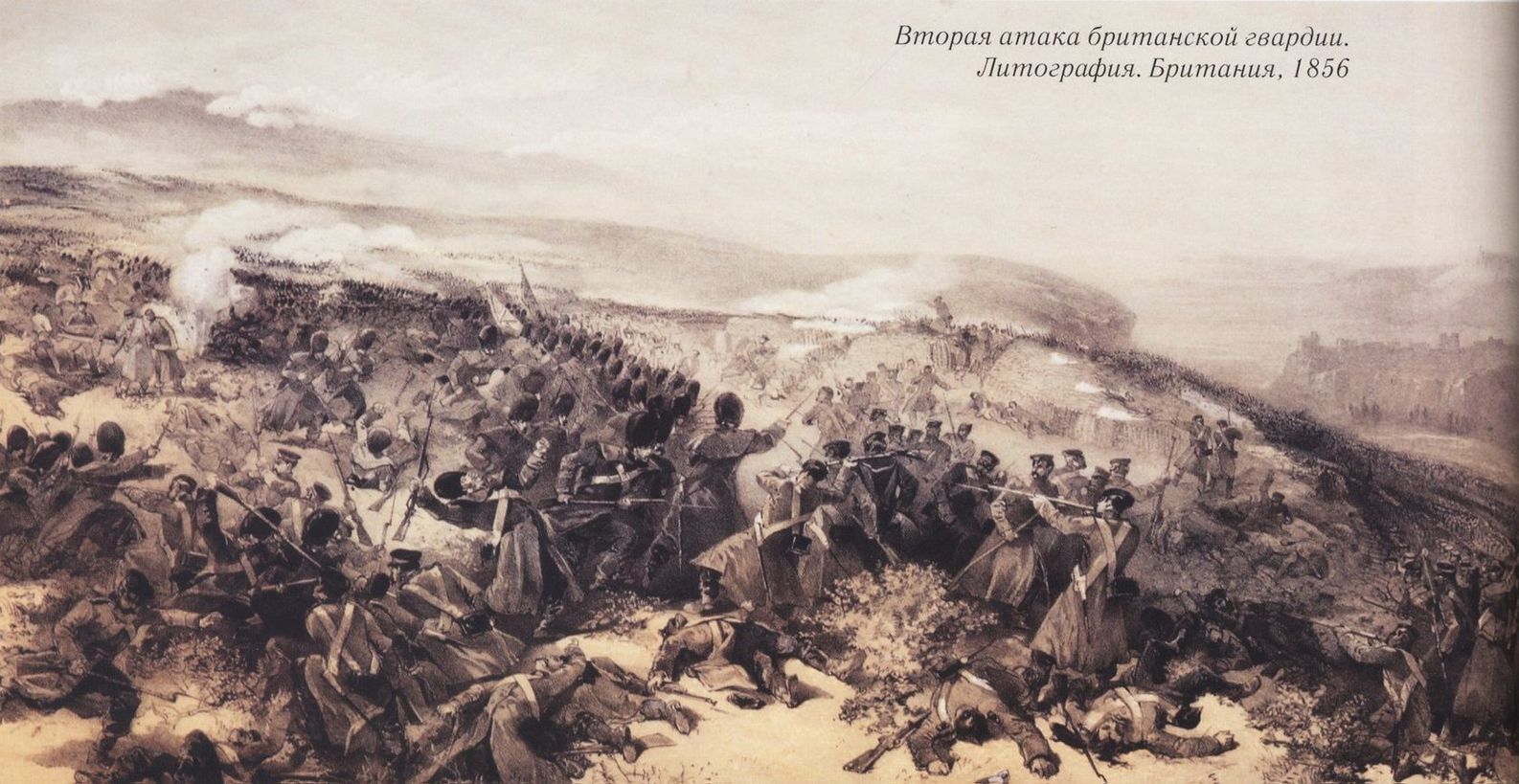
The plateau of Chortove Horodyshche – Uch-Bash (in the far perspective). The Second Attack of the British Guards. Lithograph. Britain, 1856. Sheremetyev Collection.
At the current stage of research, we can say that the settlement was founded around the late 12th century BC. This was a time of significant changes in the history of Southern Europe and the Mediterranean: it was then that the conquest of Troy took place, the Sea Peoples terrorized Egypt, and a new powerful union of tribes emerged in the Balkans, which received the name Thracian thalassocracy in historiography. The tribe that founded this new settlement in the upper reaches of the Sevastopol Bay is related to the population of the cultural circle of the so-called Thracian or Eastern Hallstatt, and it is possible that the very appearance of this and other settlements of the final Bronze Age in the Northern Black Sea region is an echo of these global processes.
The first residents brought with them a whole range of knowledge and skills regarding grain growing, house building, pottery and bronze casting, processing of crystalline stone, as well as the sea and its resources. Remains of all these branches of economy are demonstrated by the earliest archaeological complexes of Uch-Bash. Already in the next horizon of the settlement, objects appear whose method of production corresponds to the previous horizon, but typologically gravitates toward the Bilozerka archaeological culture, widespread in the south of the territory of Ukraine.
At the turn of the 2nd and 1st millennia BC, events occurred at Uch-Bash that led to destruction and fires. In the ruins of one of the buildings, excavations revealed a fragment of a bone cheekpiece typical of Chornohorivka sites, which are associated with the first nomads, also known as Cimmerians. Several bone arrowheads were also found in synchronous complexes, dating back to the time when the Chornohorivka people appeared in the Black Sea steppes.
However, the destruction and fires did not stop life at the settlement. On the contrary, the subsequent period is represented by perhaps the richest archaeological complexes of the pre-Scythian era in this part of Crimea. This is due to several factors: the earliest nomads opened land contacts to the settlers, horse riding stimulated exchange processes and the speed of movement, and later, in the second half of the 9th century BC, an ironworking workshop arose at Uch-Bash. This is one of the earliest centers of iron production in the Northern Black Sea region, utilizing a method that spread here already in its developed form from the Western Caucasus.
The appearance of the center at Uch-Bash is not accidental—here, next to the hill of Chortove Horodyshche across the Chortova Ravine, outcrops of hematite ore deposits in limestone strata are still visible today. These are high-quality ores, where the iron content exceeds 50% with a minimum of impurities harmful for forging, primarily phosphorus. In addition, the clay layers of Chortove Horodyshche contain bentonite clay, which is fireproof and coking, extremely valuable for metallurgy. All these factors, as well as the fairly high level of social development of the inhabitants of Uch-Bash, became the key to the emergence of the ironworking center here.
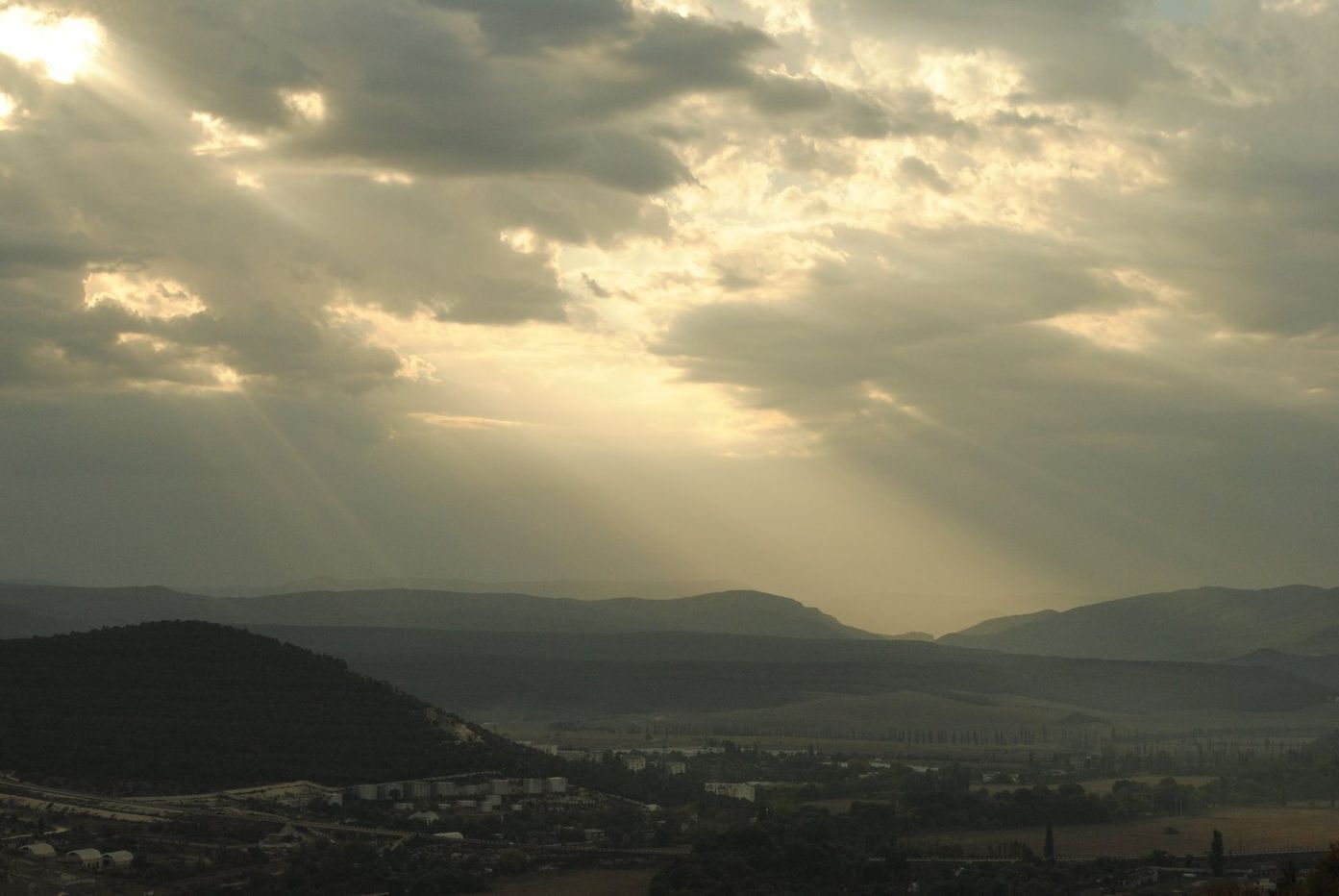
Inkerman and Kara-Koba valleys. Photo by R. Lysenko, 2010.
In the mid-8th century BC, events occurred in the Black Sea steppes that initiated a new order in the region—the early Scythian period began. During this period, the entire fortification at Uch-Bash was hastily rebuilt, the furnaces of the ironworking workshop were filled in, and a powerful defensive wall was built on top of them, probably with towers and combat platforms, parts of which were uncovered by excavations in the 1950s and 2000s. The construction of the new defensive structures, despite the emergency pace (there were footprints of its builders in the foundation trench of the wall, indicating construction under heavy rains when the bentonite completely softens), was not finished.
The fortress did not withstand the assault and fell; numerous arrows, fragments of cheekpieces, broken battle axes and maces, split war hammers, ruins of ceramic vessels on the outer side of the walls, sling stones, hacked skulls, and frontal parts of horse skulls were found at the breach sites. A compact group of items from the assault site points to their belonging to nomads associated with Novocherkassk antiquities, which are also identified with Cimmerians. The closest Novocherkassk burial to Uch-Bash is the grave of a noble warrior or chieftain in the Zolnyi Mound near Simferopol, possibly an eyewitness to or participant in those events.
After these events, although life on the hillfort eventually resumed, very few of its former inhabitants returned to the old ruins. The skills of most crafts were lost, and the economy degraded somewhat. Pottery, the clearest indicator of ethnic origin, changed radically. The incredible variety of ceramic types and their identity with completely different regions of the Black Sea area, from the Middle Dniester to the Don region, shows that after the rapid passage of Novocherkassk nomads through the steppes, the remnants of many burned and looted hillforts gathered in Crimea.
Life at the settlement did not last long; already in the early 7th century BC, people descended from the top of the hill into the river valley, where several settlements arose at once, the material of which typologically corresponds to the last post-pogrom horizon of Uch-Bash. These tribes were later, in the 6th-5th centuries BC, named Tauri by the first Greek settlers.
Actually, even in earlier times, Uch-Bash was not the only settlement in the Inkerman Valley. On the opposite bank of the Chorna River, opposite the old ford across it, there was another synchronous settlement—Sakharna Holovka (Sugar Loaf) on the slope of the mountain of the same name. It arose when Uch-Bash already existed, and the similarity of material culture in these settlements may indicate that this small settlement on the opposite bank of the river was established not by accident, but precisely by the people of Uch-Bash to control the ford. For further in the mountains behind Sakharna Holovka, a direct passage to the Crimean steppe began.
It is likely that another colony of Uch-Bash residents was in Balaklava, but the lack of materials about it leaves everything at the level of assumptions. Its researcher, O. K. Takhtai, was repressed in the 1950s, and his entire archive is still kept in the materials of his case in the archives of the current FSB in Simferopol.
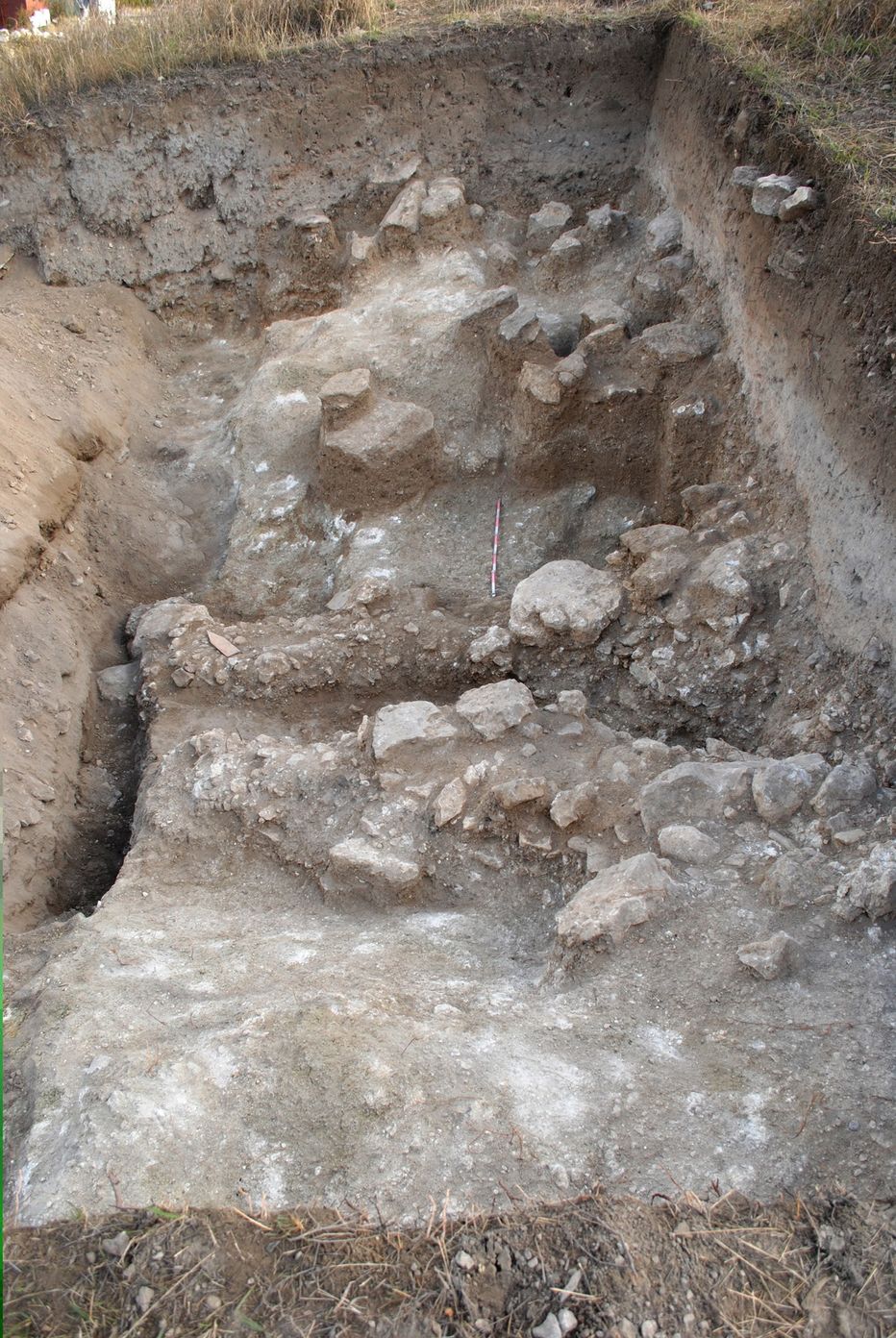
Remnants of Uch-Bash fortifications. Photo by E. Kravchenko, 2010.
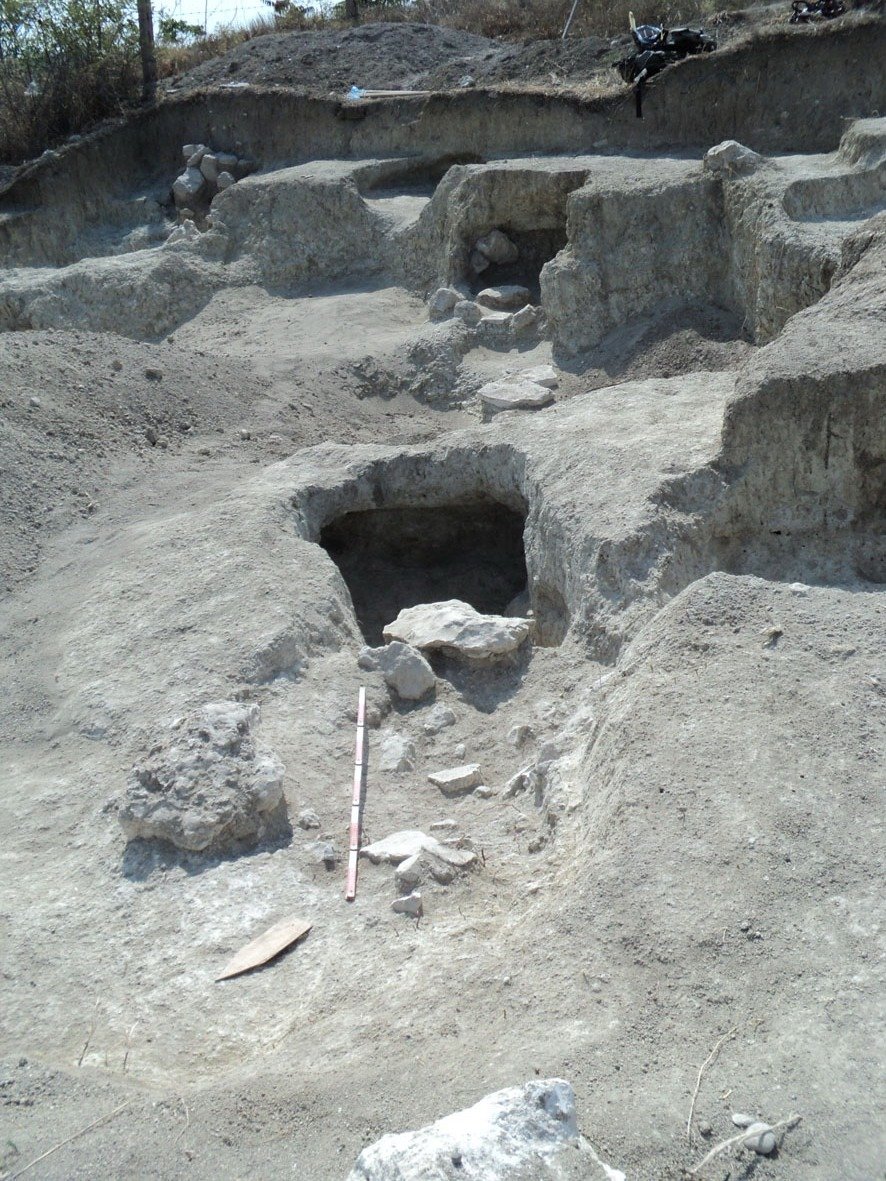
Northern excavation of Uch-Bash. Household complexes – cellars. Photo by E. Kravchenko, 2012.
Uch-Bash has not only told us the history of the Black Sea region, unknown to written sources, but has also provided numerous archaeological materials now kept in the collections of the National Preserve 'Tauric Chersonesos' and the Institute of Archaeology of the National Academy of Sciences of Ukraine. The progress of mine clearance in the galleries and our research made the creation of a museum at this complex site with a tragic and heroic history quite realistic in the near future.
To this end, a new exhibition had been prepared for the renovated ancient hall of the Chersonesos Reserve, a new concept had been written, a plot of land with the archaeological monument had been prepared for documentation, and registration documents had been drawn up for the monument of national significance Uch-Bash (protection No. 270011-N by Cabinet of Ministers of Ukraine resolution No. 928 of September 3, 2009). But 2014 arrived on Crimean land. Instead of archaeologists, 'little green men' appeared on the plateau of Chortove Horodyshche; instead of a museum, they started talking again about closing this part of Inkerman and creating a powerful military base of the Russian Federation, as if the archaeological monument had not been blown up along with people, as if there had been no war crime, none of those victims in 1942...
Such a future for Uch-Bash looks cynical and wild, as if someone decided to repeat the tragedy that has already happened here several times. Despite this, our work and efforts to preserve and study Uch-Bash cannot be ignored, since more than a thousand artifacts of exhibition value obtained during the 2006-2013 excavations are kept in the collections of the National Preserve 'Tauric Chersonesos', and about 15 thousand units of the scientific collection from these excavations have been transferred for storage to the collections of the Institute of Archaeology of the NASU in recent years; over 20 articles and two monographs dedicated directly to Uch-Bash have been published over the last 15 years.
All this allows us to speak with arguments about the need to preserve the archaeological monument as a unique archive, and in the future to create a museum complex—an open-air museum (scansen) and a memorial to the victims of the Second World War on its excavated plots. After all, only memory can protect us from the repetition of tragedies. Let us remember and not let it be repeated!
Supported by the Ukrainian Cultural Foundation.