Crimea in Works of Foreign Literature: Why Did You Kill Me?
The novel of the Italian writer 'Noble Madness,' which tells the story of an Italian whose fate was ruined by Crimea.
Veronika Zhuravel, Valerii Verkhovskyi. "Krymska Svitlytsia" newspaper, 2019, issue No. 31-32
The writer Igino Ugo Tarchetti (pseudonym—Ugo Tarchetti, 1839-1869) is a classic of Italian literature and a participant in the literary and artistic movement 'Scapigliatura'. During his short life, he managed to write only a few books, but they became milestones for all of Italian literature. Unfortunately, his works have not yet been translated into Ukrainian; the only opportunity to get acquainted with his work is the film 'Passione d'Amore' (1981), which is a film adaptation of the novel 'Fosca'. And although the writer had never been to the Crimean Peninsula, one of his best novels, 'Noble Madness' (the book had another title—'Dramas of Military Life'), tells the story of an Italian whose fate was ruined by Crimea.
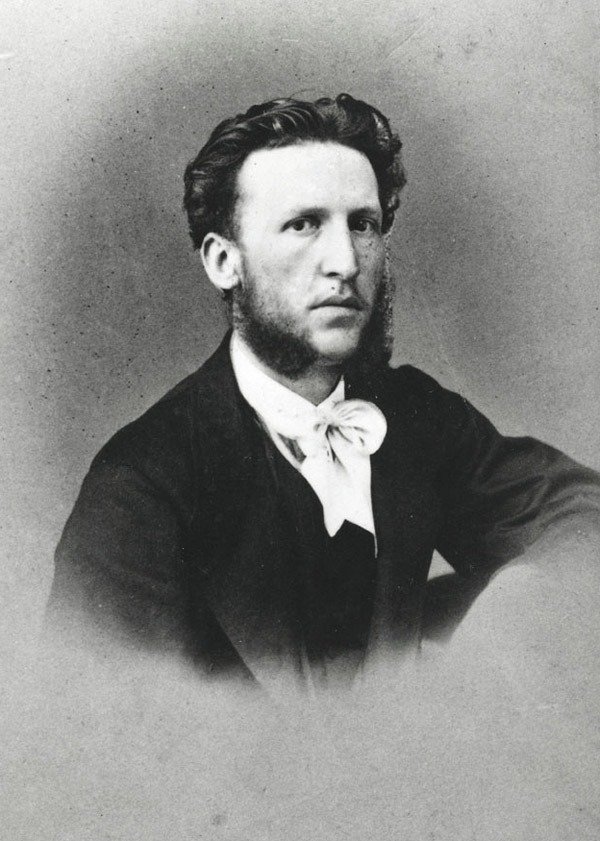
Ugo Tarchetti
The story is told in the first person, but on behalf of several narrator-characters whose stories intertwine. Thus, from the story of Vincenzo D., we learn that, constantly fleeing from creditors, he settled in one of the small towns in Piedmont, northern Italy, where he accidentally met his namesake, also Vincenzo D. So, an acquaintance began between the two young men, which later developed into friendship. A strange friendship, because the namesake, Vincenzo-2, almost immediately admits that sometimes his mind is clouded, and then he loses his memory for a while. And this partial clouding of consciousness began, according to him, as a result of the war.
So, the real name of this second Vincenzo, by his own admission, is Filippo Sporta, an orphan raised in a monastery. In his youth, he showed talent as an artist and received recognition; the girl he fell in love with in childhood reciprocated; the young man's life was just beginning and had every chance of being happy, if not for the army draft: 'Where the will is broken and a soldier trained to kill is born, the man dies.' Service in those times in the Sardinian army lasted as long as eight years.
Outside the walls of the military unit and barracks, arrogance and rudeness of officers, godlessness and corruption, drinking and gambling, senseless and merciless soldier drill under complete lawlessness of soldiers, contempt and humiliation of human dignity prevailed. But the worst awaited Filippo ahead—the Crimean War coincided with the years of his military service.
The climax of the work is a detailed description of the bloody battles of the Crimean War. In particular, the ground slaughter, in conditions of thick fog, under Inkerman, which received the name 'Slaughterhouse'; the bloodiest naval battle of Sinop, where a dozen Turkish ships were smashed and sunk, and the bottom of the port was literally strewn with corpses; counterattacks and battles near Silistria, Varna, Alma, Balaklava, on the Chorna River, and on Sapun Mountain; naval battles and the sinking of ships in the bays of Yevpatoriya and Kherson.
The battle for the Malakhov Kurgan broke out shortly afterwards, literally before the eyes of Filippo Sporta, who was at the highest point of the regimental positions at the outpost. The former artist had made a grand, as it seemed to him, and firm decision for himself not to shoot at the enemy soldiers, who, in his opinion, were probably just as unfortunate as he was.
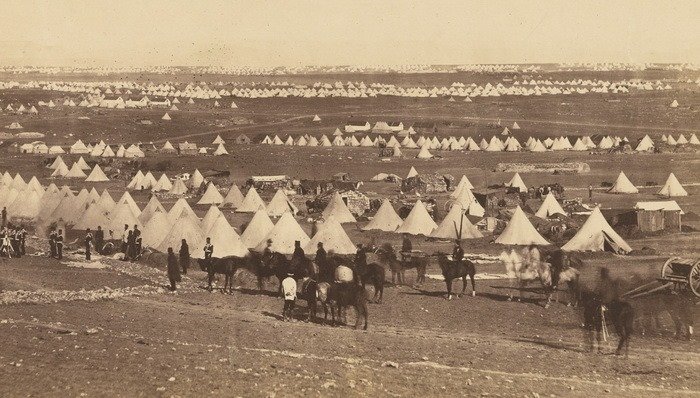
Balaklava. Crimean War, 1855. Source: getty.edu
The author spares no black colors in describing the war: 'It was as if the defenders of Crimea and nature conspired against the combined forces of Europe and fought back together...'; the climate of southern Crimea is not at all like the Italian one—here it is winter, icy wind, and cholera. The war is not at all like an exciting adventure with a happy ending; the scene when the positions of the troops are reinforced with... corpses is particularly striking, first dead horses are dragged instead of sandbags, and then human bodies, of both their own and enemy soldiers.
Despite his reluctance to kill people, the development of events leads to him having to shoot an enemy cavalryman, and he will atone for this for the rest of his life.
However, the 'Russian' he killed did not die immediately. He managed to ask Filippo: 'I feel you are a decent person, you have a noble heart... Why did you kill me?'; it turned out that this boy, of his killer's age, was a Pole, forcibly drafted into soldiering as a punishment, that their fates were very similar, and both were ruined by a war that was unnecessary and incomprehensible to them.
The death of the enemy soldier finally turned Filippo away from the war, prompted him to desert from the army, hiding at first in Crimea in Tatar homes, then illegally returning to Italy, living there under the false name of Vincenzo D. until he happened to meet the man whose name he had stolen.
Upon meeting, both Vincenzos became friends: one was almost driven mad by the horrors of the war, and the other was a debtor hiding from creditors, hoping to improve his financial situation at the expense of... some wealthy but lonely lady.
Filippo-Vincenzo committed suicide by shooting himself in the face, so that there would be no doubt as to the identity of the deceased, meaning that officially it was the real Vincenzo D. who died, and along with him, all his debts disappeared. This man gets the opportunity to start life anew at the cost of the suicide of his namesake—a mad but noble act.