Prosperity in Unity... of Ukraine and Crimea
Economic and social relations between Ukraine and Crimea in the 20th century.
Inokentii Korelych. "Krymska Svitlytsia" newspaper, 2017, issues No. 19 — 20
"Taking into account the common character of the economy, the territorial proximity and the close economic and cultural ties between the Crimean Oblast and the Ukrainian SSR, the Presidium of the Supreme Soviet of the Union of Soviet Socialist Republics decrees: To approve the joint presentation of the Presidium of the Supreme Soviet of the RSFSR and the Presidium of the Supreme Soviet of the Ukrainian SSR on the transfer of the Crimean Oblast from the Russian Soviet Federative Socialist Republic to the Ukrainian Soviet Socialist Republic..."
Decree of February 19, 1954
On the Crimean Peninsula, the occupying authorities and local collaborators today try in every way to erase from history the six decades of Crimea's presence in the USSR. But it is impossible to erase it, so everything that was done here by Ukrainians is painted in black colors—of course, against the background of the bleak grayness of Russian life, they have to invent something worse than it. But in the 20th century, the direct connection between Ukraine and Crimea can be traced even before February 19, 1954...
Armed Forces
For example, we often mention the daring raid of Colonel Bolbochan, who—even if symbolically—annexed Crimea. But we should also not forget what was happening on the Red side.
Thus, in the 1920s, the 'Armed Forces of Ukraine and Crimea' existed. After the liquidation of the last pocket of resistance—Wrangel's Crimea—the Southern Front of the Red Army was transformed by order No. 2660/532 into the Directorate of the Armed Forces of Ukraine and Crimea. First, the Taurida Governorate was included in the Kharkiv Military District, and then one Ukrainian Military District was formed from two districts of the Ukrainian SSR, headed by Mikhail Frunze, whose position was officially styled 'Commander of the Armed Forces of Ukraine and Crimea.' The remnants of the Black Sea Fleet, the so-called Naval Forces of the Black and Azov Seas, were also subordinate to this command.
The formulation 'Ukraine and Crimea' fully reflected the state of affairs: even the Bolshevik Ukrainian SSR did not agree to give Crimea and the Kuban to the RSFSR, while 'brotherly Russia' generally viewed the existence of a separate Ukrainian SSR only as a tactical move, a temporary phenomenon, for a transitional period before the complete absorption of Ukraine. The years 1920-1922 were a period of internal Bolshevik struggle for the existence of Ukraine, so to speak, 'socialist or nothing.' And even after the formation of the Autonomous Republic within the Russian Federation from the Crimean counties of the Taurida Governorate on November 18, 1921, the military units of the Red Army remained subordinate to the districts: Ukrainian, Kharkiv, Kyiv, Odesa...
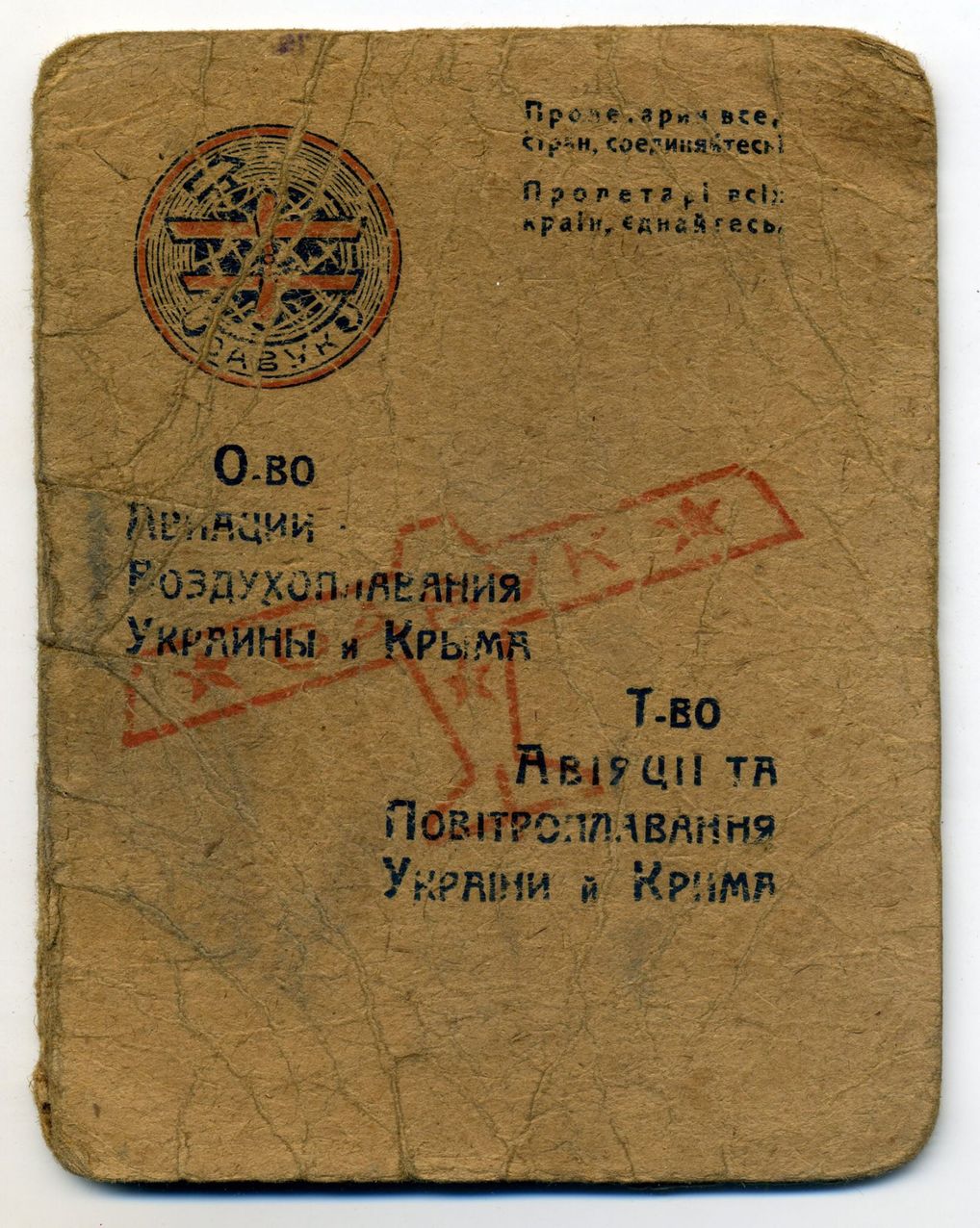
TAPUK (OAVUK) membership card
TAPUK — Wings of Ukraine... and Crimea
In the capital of the Ukrainian SSR, Kharkiv, the Society of Aviation and Aerial Navigation of Ukraine and Crimea (TAPUK) was created in 1923. Crimea fit quite organically into this structure.
Here is what is said in the Ukrainian Soviet Encyclopedia: 'TAPUK was a patriotic defense union of amateur aviation and aerial navigation enthusiasts. Founded in 1923 in Kharkiv on the initiative of the government of Ukraine and the military command. G. I. Petrovsky was the head of the Council of TAPUK, and his deputy was M. V. Frunze, later V. P. Zatonsky. The purpose of the society was to assist in the development of the country's air fleet and to involve the broad masses of working people in this cause.
The society numbered (in 1925) 416 thousand members, united in 7,115 circles. It founded the Central Aeroclub and an aviation school in Kharkiv, a school for glider sports instructors in Kyiv, 72 gliding and 97 aeromodelling circles, and opened 1,475 aviation libraries. Members of the society raised over 1.5 million rubles for the development of the air fleet, participated in numerous competitions, and established regular airlines in Ukraine. In 1925, TAPUK and the "Ukrdobrokhim" society were merged into the Society of Friends of Aviation and Chemical Defense and Industry ("Aviakhim")'.
Heorhiy Fedorovych Proskura became the initiator of the creation of this public organization. Kharkiv, which previously had nothing to do with aviation, owes its current fame as the country's aviation capital to this man. While teaching at the Kharkiv Polytechnic Institute, Proskura organized and headed the aero-section. On his initiative, in 1923, members of the aviation section secured the opening of an aviation specialty at the mechanical engineering faculty. Heorhiy Fedorovych began to deliver an elective course on aerial navigation. Soon he created an aerohydrodynamics laboratory, which in 1930 was transformed into the Kharkiv Aviation Institute.
Through the joint efforts of TAPUK and the Main Directorate of the Air Fleet of the Red Army, the joint-stock company 'Ukrpovitroshlyakh' was established, from which all civil aviation of Ukraine began.
KPI student Serhiy Korolyov was one of those 416 thousand 'TAPUK members,' and it was in Crimea that he took to the sky on the wings of a glider of his own design—this happened, of course, in Koktebel.
Subsequently, TAPUK merged with the 'Dobrokhim' society and—already at the All-Union level—transformed into 'Osoaviakhim' (later DOSAAF, later TSOU).
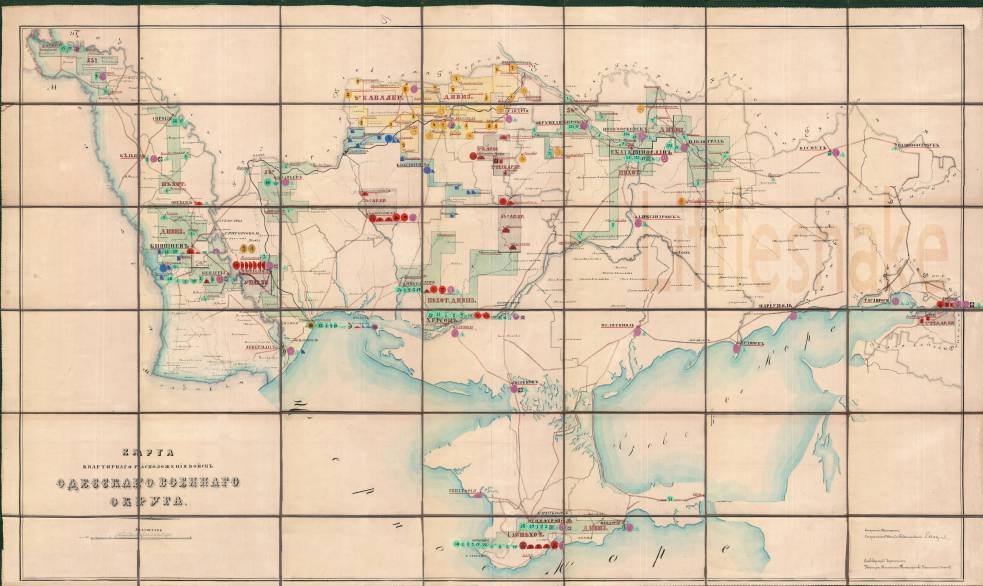
Map of the quartering of troops of the Odesa Military District
Military District
The Odesa Military District existed in the Russian Empire in 1862-1917 and included two governorates (Taurida and Novorossiysk), as well as the Bessarabian province.
On October 11, 1939, the Odesa Military District was created anew from five oblasts of Ukraine, as well as the Moldavian and Crimean Autonomous SSRs. Such decisions are not made on a whim of the military leadership; they reflect changes in strategic plans. Indeed, for the General Staff of the Red Army, the entire territory of the Soviet Union was a single whole, and military strategists did not think in terms of administrative-territorial units, but in categories of directions of attack. With the beginning of an aggressive, offensive war, the military district transforms into a front, its troops are mobilized and set off on a 'liberation campaign.'
The first blow was to be dealt to Romania, because at that time it was the only oil-producing country in Europe and the only source of oil supply for the Wehrmacht, and Hitler chose for his troops the doctrine of 'blitzkrieg' (that is, a variation of the mobile warfare doctrine of the British military theorist J. Fuller). And this mass of tanks, airplanes, and automobiles needed gasoline, while a thousand German submarines needed diesel oil. A strike against the eternally weak Romanian army would drain the Axis troops, and thus the offensive against Berlin would develop uncontrollably and lightning-fast.
The troops of the Odesa District prepared precisely for this. Controlling the offensive from Odesa was, of course, much more convenient than from Kyiv, Kharkiv, or Simferopol. And judging by historical documents, significant troops were gathered: eleven rifle divisions, a mechanized corps, five artillery regiments, three aviation divisions (and two more were being formed)...
In 1945, after the terrible war, Stalin began to prepare for a new war for the redistribution of the world: he was attracted to Iranian Azerbaijan and Turkish Armenia. In all seriousness, having received East Prussia, the Soviet delegation demanded Italian colonies in Africa. This became if not the cause, then the pretext for the Cold War. Fortunately, not a 'hot' one. Then, the Taurida Military District was created, consisting of only two oblasts: Kherson and Crimean. The headquarters was located in Simferopol. But the district did not exist for long.
In 1956, the Soviet Union abandoned Bolshevik plans for world conquest, moving on to building a bright future in a single, separately taken country. Simply the appearance of powerful nuclear weapons and missiles that could reach not only European countries but also the overseas United States changed all ideas about the means and methods of warfare, and thus broke the entire concept of 'world revolution.' The army was reduced, and expensive projects were shut down, including the construction of aircraft carriers and landing submarines. The Taurida District was liquidated, and Crimea returned to the Odesa MD. But no one seriously considered any strategically expedient possibility of fitting the Crimean Peninsula to the North Caucasus (as they are trying to do today) or forming a separate Crimean MD.
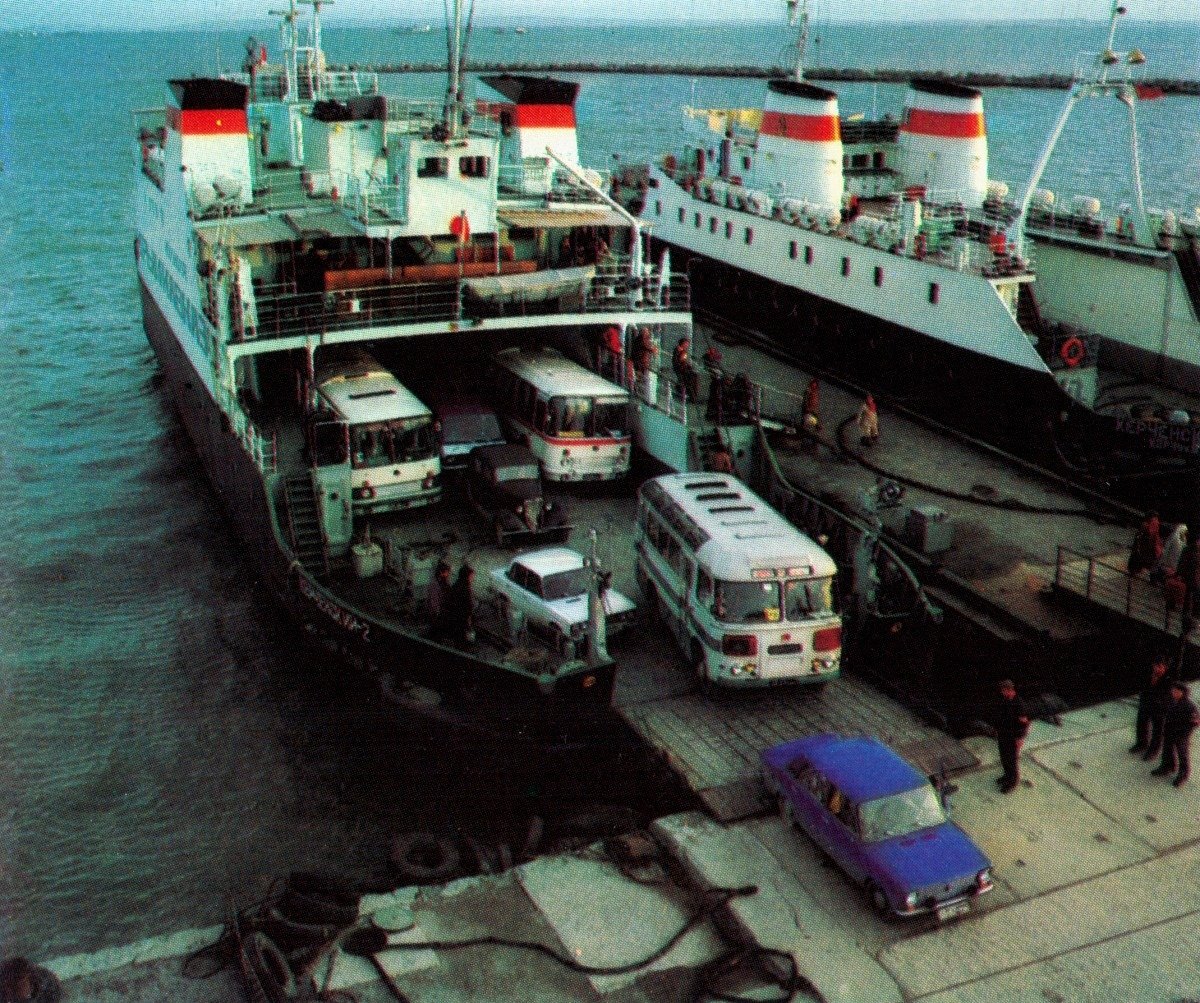
Kerch ferries of the Soviet period
Voluntarism — The Bright Past
The following year, 1957, reforms began in the Soviet Union in the civil sphere as well. Khrushchev once belonged to the Menshevik faction, and former Mensheviks do not change: forty years after seizing power, it dawned on the communists that it was impossible to build paradise on earth on an empty stomach. Shying like a collective farm horse from one extreme to another, Khrushchev declared excessive decentralization. Decentralization was also supposed to lead to the debureaucratization of the economy. Indeed, very often enterprises of different industries located in the same region or even city had to coordinate cooperation all the way in Moscow, which did not contribute to the development of the economy and the building of the future—whether bright or dark.
Ideology prevented the Soviet leadership from deciding on real economic reform at that time. Experimenting on how to reconfigure the planned economy so that it worked, so that the shoemaker would not sit without shoes, and the achievements of the national economy could be seen not only at the exhibition in Moscow but also in the refrigerator of a Soviet worker, the leaders of the USSR went for the creation of economically independent provinces: Councils of National Economy (sovnarkhozes).
This step made some sense: it was clearer locally how and which industry to develop. At the same time, branch ministries were liquidated at the Union level. The Kherson Sovnarkhoz initially consisted of three oblasts: Crimean, Mykolaiv, and Kherson. Kherson remained the 'capital' of this 'economic autonomy' until 1962, when 'centralization' began, and with the annexation of the Odesa Oblast to it, the Black Sea Sovnarkhoz was formed (before that, the Odesa Oblast was an independent Odesa Sovnarkhoz) and its administrative center was located in Odesa.
No one thought of the crazy idea of creating a separate Crimean Sovnarkhoz—the Odesa Oblast had the potential to be an independent economic unit for five years, the Moldavian SSR had it too, but Crimea did not. Because Crimea, in economic, transport, and military-strategic terms, is an integral part of Ukraine, not the North Caucasus. And let's not forget another fact: the Kharkiv Sovnarkhoz in this period was also headed by a Crimean—a native of Zheliabovka in the Nyzhniohirskyi district, Oleh Soich.
Ports of Crimea
The naval base in Donuzlav, where the Ukrainian Navy was persistently relocated at one time, became a trap for our ships in 2014. But this place was not originally intended for military needs.
When the project for the Donuzlav civil port was developed in the 1960s, Novoozerne was supposed to become a town of thirty thousand inhabitants, and to export goods, a section of railway track was to be laid from Yevpatoriya. Today, in occupied Crimea, this project was recalled: a 'territory of priority development "Chornomorske"' and a project of a railway to Donuzlav have been announced. In the project, however, nothing is said about where the goods will come from under transport sanctions (from South Ossetia and Nagorno-Karabakh?), nor—most importantly—for whom these goods will be intended.
If for Crimea, then there is already a powerful port infrastructure on the peninsula, redundant for its internal needs. If for Russia, then it is easier to unload ships in Novorossiysk than in Crimea, because then all this has to be transported across the Kerch Strait—if you wanted to be called an island, then experience the charms of island life... Therefore, the only sense of the existence of Donuzlav, as well as of all other Crimean ports, is serving the needs of the mainland part of the country or transit through Ukraine to other states (Belarus, the European Union). And the capacities of Odesa, Chornomorsk, Mykolaiv, and Kherson are generally sufficient not to 'choke' in this industry without Crimean ports.
After all, it was not for nothing that the Decree of the Presidium of the Supreme Soviet of the USSR of February 19, 1954, 'On the transfer of the Crimean Oblast to Ukraine' stated: 'Taking into account the common character of the economy, the territorial proximity and the close economic and cultural ties between the Crimean Oblast and the Ukrainian SSR...'
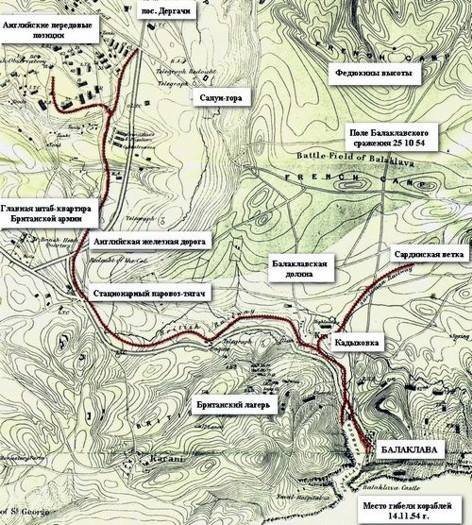
Map of the English railway track near Balaklava
The desire to erase six decades of Ukrainian Crimea today on the occupied peninsula resembles a comedy of the absurd: on the reinforced concrete fences of railway stations, the logo—the letters 'UZ'—is smeared with cement mortar. It is not funny, unfortunately. Smearing history is business as usual for the Kremlin, but the 'UZs' still show through the layers of Putin's madness.
However, the invaders fear the Ukrainian railway for a reason. Railway tracks are one of those components that inextricably linked both parts of Ukraine: the peninsula and the mainland.
Everything for the Front, Everything for Victory!
The history of railway communication in Crimea (for real: with steam locomotives and a timetable) begins in 1854, when the British built a rail track and ran steam locomotives between Balaklava and Sapun Mountain.
Even when the British come for a year and a half, they bring the British way of life with them anywhere. Balaklava during the Crimean War resembled an English town. The English built an embankment, opened shops and hotels. Cargoes necessary for the active army were successfully brought and unloaded in the Balaklava port, but the obstacle to supplying them just a dozen kilometers away was the lack of roads. Exactly the same problem befell the Russian troops on the other side of the front line.
But the British treated the proposal to construct a temporary military railway with all due seriousness and brought rails, sleepers, and steam locomotives to Crimea. The French also planned to lay their railway, but their plans remained plans.
However, they did not decide to build the railway immediately, because the terrain through which the line was to run did not look suitable for setting up a railway: threatening steep slopes, climbs that exceeded the maximum allowable for locomotive traction at that time, and soils that carried the danger of landslides. However, all pros and cons were weighed, measured, and decided in favor of the railway, and on January 27, 1855, construction began. A hired team of railway specialists was brought from England, and by the end of March, the road was laid to the plateau, and by May, the rail track covered the shores of Balaklava Bay, stretched to the village of Kady-Koy, and then in a northerly direction to the headquarters of the British army and ended on the Vorontsov Road. From Kady-Koy, a separate branch was extended to the Italian allies—the location of the Sardinian army.
In total, the length of the military-field road was twenty-three kilometers. Every day, this road transported 250-300 tons of cargo to the front line. Trains ran from seven in the morning to seven in the evening strictly according to schedule—every hour. For the first time in history, a sanitary train was formed on this railway.
After the war ended, the British exported the railway, taking with them almost two hundred wagons, four locomotives, and two stationary steam engines, and the rail track itself became almost the only Russian trophy of the Crimean War. It was carefully dismantled... and sold to the Turks.
Before leaving Crimea, the British installed a marble memorial plaque on the cliff of Kady-Koy to honor the construction of the railway. But by the personal order of Governor-General Stroganov, the memorial sign was torn down and smashed. At least some victory over European civilization!
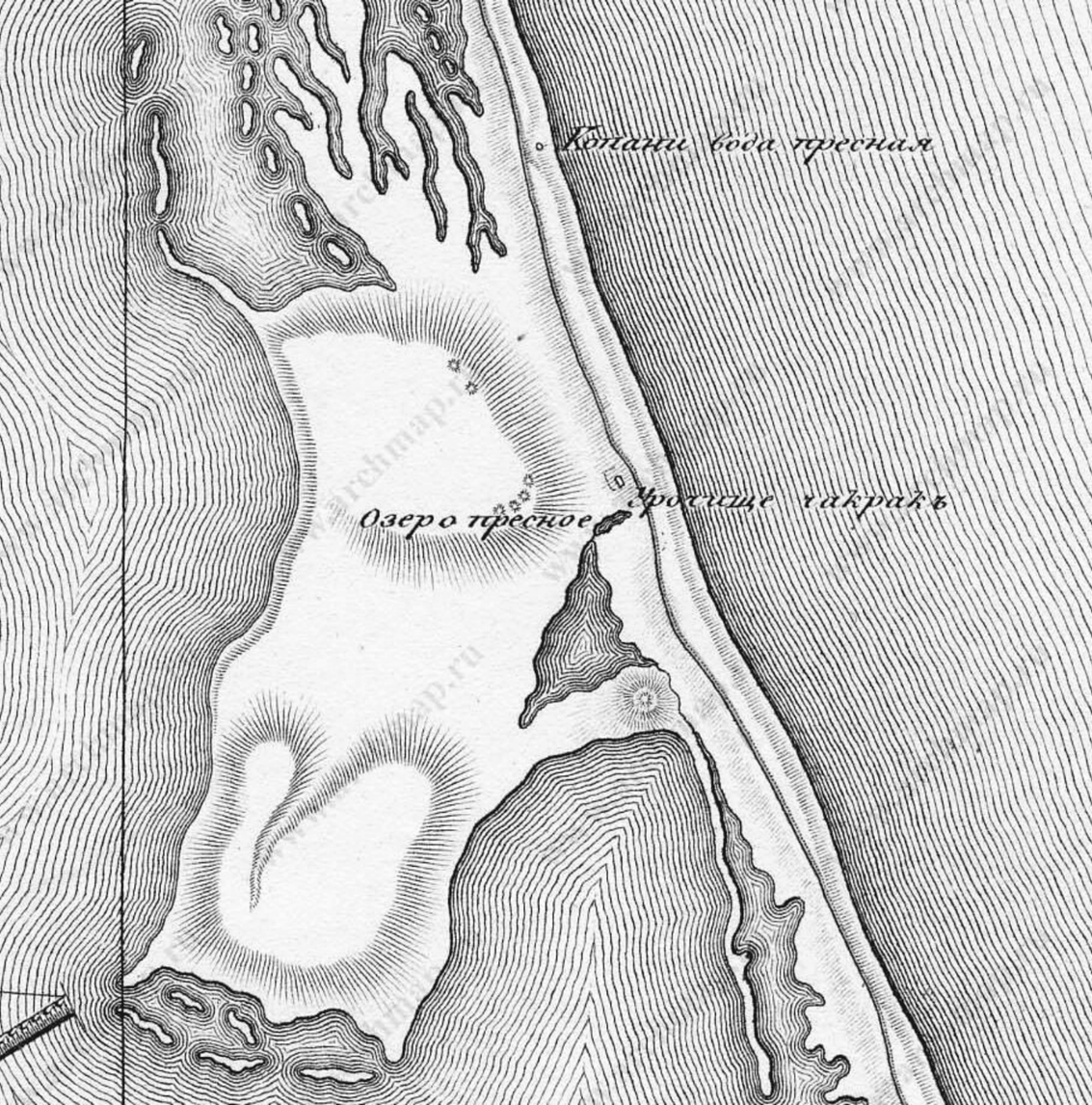
Railway in the north of Arabat
Seriously and for a Long Time
But few know that even before the British, railway tracks were laid for the first time on the Crimean Peninsula—and, by the way, in Ukraine in general—near Sevastopol in the area of Inkerman in 1843. It was built by retired midshipman Dmitry Volokhov. However, this was only a narrow-gauge railway about one kilometer long, designed for horse-drawn removal of stone from the Kameno-Lomny Ravine to the pier in the South Bay. In 1873, a section of the Lozova-Sevastopol railway was laid here. It ran along the old railway and right under the Monastyrskaya Cliff.
The beginning of the so-called 'Southern Line' was laid by the Moscow-Kursk railway (1864-1868), built at state expense. Its continuation was the already private Kursk-Kharkiv-Azov railway, which connected Slobozhanshchyna with the Priazov region.
In 1874, the concession for the construction of the road from the Lozova station to Sevastopol was granted to Pyotr Gubonin. The first train arrived in Simferopol in 1874. This Lozova-Sevastopol railway, completed in 1875 to Sevastopol, was later bought by the state treasury.
At the same time (in 1882-1902), the Katerynoslav (Catherine) railway was built to serve the rapidly industrializing Dnieper region. In February 1934, the Southern Railways were split into two independent ones—Southern and Donetsk.
In the Soviet era, the railway was called Stalin's (from 1936), and in 1961 it received the name Prydniprovska (Dnieper). This railway included some sections of the Lozova-Sevastopol road, i.e. practically the entire railway that was on the peninsula.
However, never in the history of railway communication has a separate Crimean railway existed.
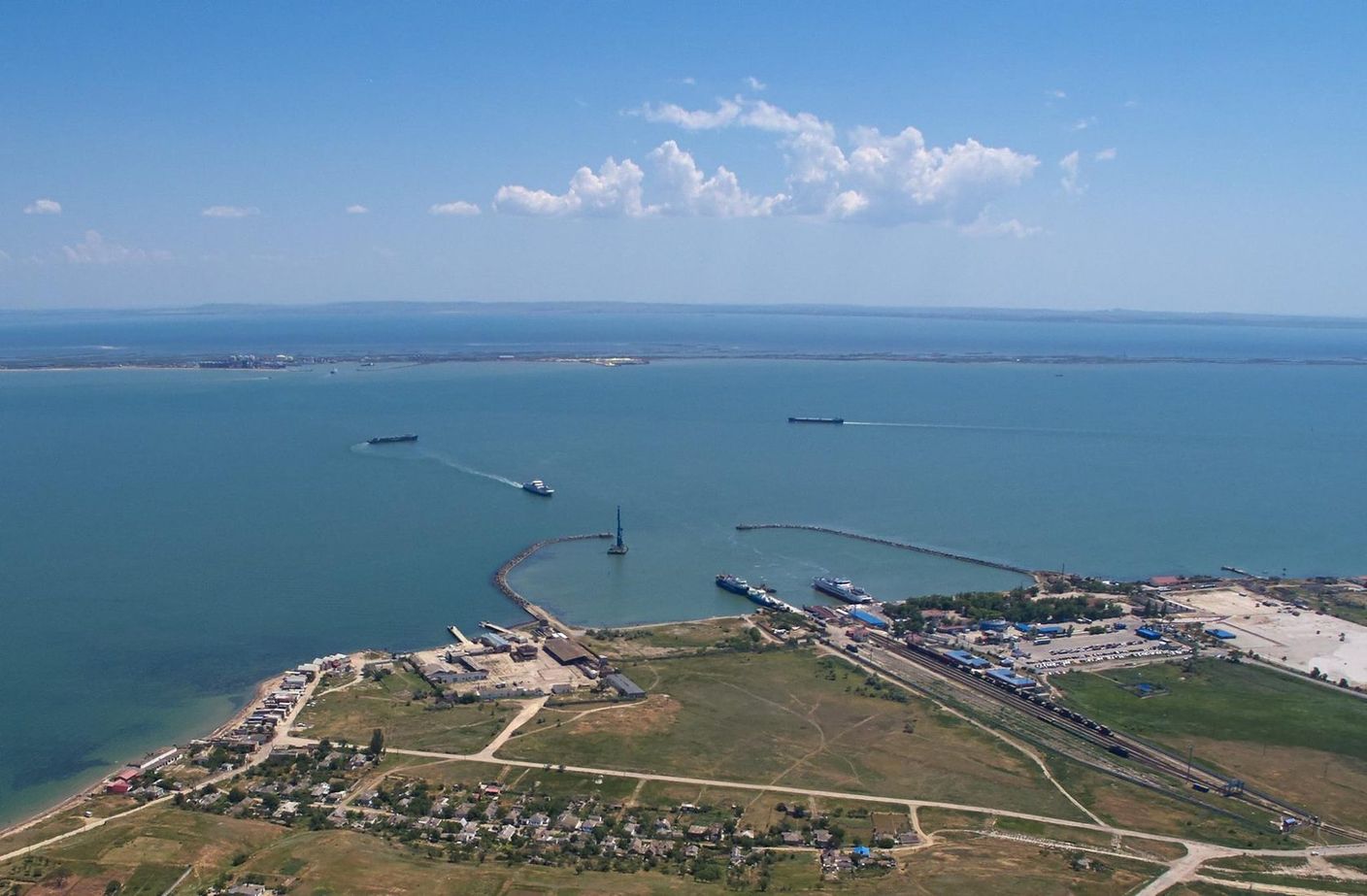
Kerch ferry crossing, view from the Crimean shore
The idea of bringing a railway line to Yalta arose long before 1940, when the quoted lines of Trublaini's novel were written. Since the 1880s, the necessity of this became obvious to everyone on whom the development of railways depended. F. Batalin's project, for example, envisaged laying a line from Sevastopol to Yalta with eleven tunnels and a ninety-kilometer embankment along the coast. And von Hartmann chose the Bakhchysarai-Yalta route for his project, but he failed to raise the necessary funds. In 1902, a state interdepartmental commission was formed to approve the south coast railway project.
Mikhailovsky was appointed chief engineer of the commission—he is also the famous Russian writer Garin-Mikhailovsky, a well-known figure in the development of railway communication in the Russian Empire. Unfortunately, this man died in 1906, without completing two of his most important tasks: without finishing the novel 'Engineers' and without building the railway to Yalta. Garin-Mikhailovsky considered the Sevastopol-Yalta-Alushta route best, with the prospect of extending it to Feodosiya. Then the Simferopol-Alushta-Yalta project appeared, as well as Siuren-Yalta and again Bakhchysarai-Yalta.
Debates continued until 1915, and then, already during the First World War, settled on the Sevastopol-Alushta variant. 'Ukrzaliznytsia' also planned to extend the railway line in Crimea. In the long term, the Prydniprovska railway was to receive a new line along the entire Southern Coast of Crimea—from Yevpatoriya to Yalta, and later, possibly, to Alushta, Sudak, and Feodosiya. In the 1960s, a line was to be built between Henichesk and the Valok station on the Kerch Peninsula. The railway was to run along the Arabat Spit.
Previously, a forty-four-kilometer railway branch led from Henichesk to the Arabat Spit. On maps of the 1950s, this railway was still marked. Today, the rail track at the entry from the Henichesk side to the Arabat Spit still survives. This railway was dismantled in the 1960s. The 'Tsar Bridge'—the Kerch Bridge with a rail track—already existed, constructed (first the cable crossing, then the automobile bridge) by the German occupiers. Shortly after their expulsion from Crimea, the bridge was completed, rails were laid, and trains were run.
The construction, which according to Soviet tradition was carried out mainly by the slave labor of GULAG prisoners, was completed at a rapid pace to report 'by the great holiday of the 27th anniversary of the Great October Revolution.' The quality of the structure was corresponding. So this monstrosity did not exist for long. For example, icebreakers were not provided for any of the bridge's piers. The bridge collapsed—in February 1945, a flow of ice floes from the Azov Sea destroyed thirty-two bridge piers in a single day. After the war, a project for the construction of the Kerch Bridge was prepared and submitted for 'highest' consideration.
According to legend, Deputy Commissar of Railways Gotsiridze described the project as follows: 'This will be a Tsar Bridge.'
To which Joseph Stalin replied that the tsar was overthrown back in 1917. The cost of the project was two billion rubles, which under those conditions did not fit within the limits of the Soviet economy; it was cheaper to run trains in a detour. The leader decided that a ferry crossing would be sufficient for the Crimea-Caucasus line. After that, trains and motor transport were delivered to the neighboring Kuban coast and in the opposite direction by means of ferries. In 1954-1987, traffic at the Kerch ferry crossing was very intensive.
In 1987, by decision of the commission created after the crash of the steamship 'Admiral Nakhimov,' when almost five hundred people drowned in the Black Sea, passenger train traffic through the Kerch ferry crossing ceased. But freight trains were still transported by ferry until the early nineties. Following the occupation on March 26, 2014, the self-proclaimed Crimean leadership transformed the local directorate of the Prydniprovska railway into the so-called 'Crimean Railway.' Still, 'Ukrzaliznytsia' managed in the spring of that year to evacuate to the mainland all the new equipment, including electric locomotives, track machines, and wagons of new series.
From December 2014, first freight and then passenger communication between Crimea and the mainland of Ukraine ceased. Let me remind you that before the occupation, in 2013, the Crimean railway, on serving Crimean ports alone, ensured an annual cargo turnover of eleven million tons. Tens of thousands of tons. Sensu in that, to reload overseas cargo first, say, in Feodosiya, and then through a ferry crossing to carry these cargoes to the mainland part of Russia, there is no point; it is easier to unload at a port on the Kuban coast.
And this is even assuming that the sanctions prohibiting the entry of ships of civilized countries into Crimean ports will one day quietly cancel themselves. Of course, transport communication was one of those factors that led in 1954 to the decision to transfer Crimea to the Ukrainian SSR. Currently, for 'convenience,' or rather for security reasons, train passengers are transferred to passenger ferries, and on the Crimean coast, they transfer to other vehicles. But this is a seasonal service: it operates from April 30 to September 30. Crimea and the Black Sea are gentle only in summer.
The lack of passenger and cargo flows after 2014 on the peninsula was decided to be compensated for by the 'Victory Train.' I don't know what this is—surrealism, postmodernism, or symbolism? Previously in the USSR, the symbols were a rocket, a satellite, the 'Antey' airplane, but what does the eternally nostalgic Kremlin have?
Perhaps this is a sort of black comedy show, a traveling circus on rails: the steam locomotive is supposed to symbolize the absence of a future in Russia under the Putin regime, the 1930s-model cannons to testify to the readiness to fight NATO, and the teplushkas (freight boxcars), exactly like those in which the deported were taken away in the terrible year of 1944, seem to say: 'We can repeat it'…