The Thorny Path of the Formation of the Ukrainian Theater in Crimea
Development of the Ukrainian Drama Theater: life under the close control of the Soviet government.
Petro Volvach, full member of the Shevchenko Scientific Society (NTSh), member of the National Writers' Union of Ukraine (NSPU), Honored Worker of Science and Technology of the Autonomous Republic of Crimea, a Crimean with 60 years of experience. "Krymska Svitlytsia" newspaper, 2017, issues No. 37 – 38
Ukrainian theatrical art has long enjoyed great demand and popularity among Crimean audiences. The liberalization of national policy in the late 1880s and 1890s revitalized the activities of individual theatrical troupes in Ukraine. The most famous among them were the professional troupes of the Ukrainian coryphaei: Mykhailo Starytsky, Ivan Karpenko-Kary (Tobilevych), Panas Saksahansky (Tobilevych), and Marko Kropyvnytsky. They entered the theatrical history of Ukraine as the Theater of Coryphaei.
Their tours in Crimea convincingly proved that the Crimean population, especially Ukrainians, many of whom lived on the peninsula, welcomed the Ukrainian theatrical troupe with great interest, enthusiasm, and love. The famous Ukrainian scholar, literary critic, and researcher of Crimean theater, Professor Petro Kyrychok, studied the Crimean tours of the Ukrainian theatrical troupe in detail. He prepared and published several significant scientific works on this issue. They testify that the echoes of the successful tours of the Ukrainian theatrical troupe persisted even in the post-war years, although before the war the Russian authorities tried not to notice the presence of Ukrainians on the peninsula. It was believed that there were no Ukrainians in Crimea.
Therefore, the question of creating a Ukrainian theater in Russian Crimea never existed for the authorities. The need to populate the peninsula with settlers from Ukraine forced the rulers to take a slightly different approach to the problem of creating a Ukrainian theater in Crimea. After all, in addition to the 200,000 Ukrainians already living there according to official statistics, in the first post-war decade, several tens of thousands more ethnic Ukrainians were resettled from Ukraine to Crimea. And after 1954, when the Crimean Oblast was transferred to Ukraine, the resettlement gained rapid momentum and grew with each passing year. Therefore, the proportion of Ukrainians in Crimea at the end of the 1950s increased significantly and amounted to over 700,000.
In Kyiv, Communist Party leaders and government officials were well aware that attracting a stable workforce from Ukraine was only possible by creating basic social, domestic, and cultural conditions for the settlers. After all, in addition to their hard work in rebuilding cities, factories, working in fields, orchards, vineyards, and livestock farms, people also needed to satisfy at least some basic cultural needs. In the absence of television and with insufficient radio coverage of towns and villages, this mission was fulfilled by cinema clubs, a few community centers, and amateur arts circles set up at factories, community centers, and village clubs.
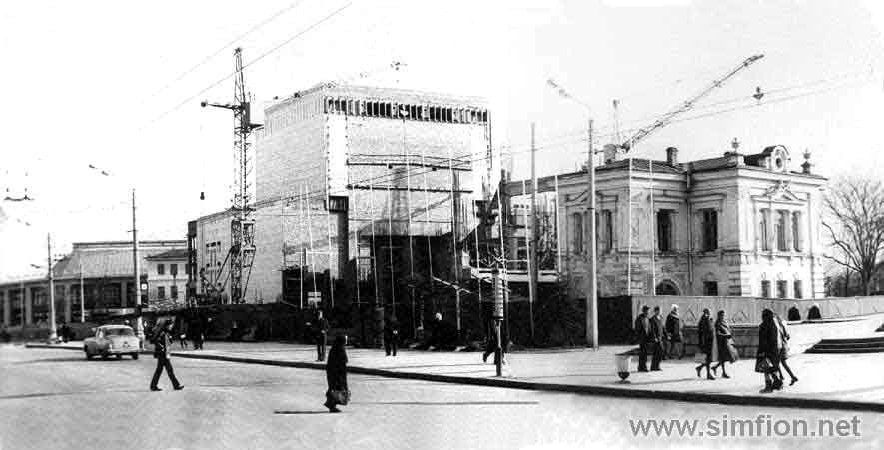
Construction of a new building for the Ukrainian theater in the center of Simferopol, 1970s
In post-war Crimea, only two theaters operated, both Russian, in Simferopol and Sevastopol. In militarized Crimea and, above all, in Sevastopol, the ideological and promotional role was traditionally performed by the song and dance ensembles of the Black Sea Fleet and the Taurida Military District. The Ukrainian countryside and the residents of Crimean cities and districts found themselves in a cultural and ideological vacuum. Therefore, in the very first months after Crimea became part of Ukraine, the idea of creating a Ukrainian theater in one of the Crimean cities arose in the party and government structures of Kyiv. The successful tours of many Ukrainian theaters, chapels, bands, and artistic groups in Crimea convinced everyone that Ukrainian theatrical art was in demand on the peninsula, enjoyed huge popularity among the local population, and had prospects for its development.
The issue of creating a Ukrainian theater in Crimea was discussed in Kyiv several times during 1954–1956. In the republican party archive (now the Central State Archive of Public Organizations – TsDAGO of Ukraine), researchers found several important documents regarding the theater. The first of them is a letter from the Secretary of the Crimean Regional Committee of the Communist Party of Ukraine (CPU), Dmytro Polyansky, to the Central Committee of the CPU, dated October 2, 1954, on the need to establish a permanent Ukrainian musical comedy theater in Simferopol (Doc. No. 3, "Crimea in the Context of Socio-Political Transformations (1940-2015)" – K., 2016. – LLC "Klio Publishing House". – P. 363).
The letter quite reasonably justified the advisability of creating such a theater in Crimea. The Crimean authorities even proposed using the premises of the club of the regional Directorate of the Ministry of Internal Affairs (MVS) in the city center (3 Mendeleeva St.) for the future theater. On the same day, the bureau of the Crimean Regional Committee of the CPU adopted a resolution "On the establishment of a Ukrainian musical comedy theater in Simferopol" (Doc. No. 74 of October 2, 1954, ibid.).
At the beginning of December 1954, Yefymenko, head of the science and culture sector of the Central Committee of the CPU, prepared and submitted to the Central Committee of the CPU a report "On the relocation of a mobile Ukrainian drama theater to Simferopol" (Doc. No. 84, ibid., – pp. 390–391).
The report states: "The Ministry of Culture of the Ukrainian SSR considers it inappropriate to open a Ukrainian musical comedy theater in Simferopol, and instead proposes to relocate one of the mobile Ukrainian drama theaters to the Crimean Oblast, which will make it possible to more widely acquaint the workers of the region with Ukrainian drama," the memorandum said.
As early as June 17, the responsible officials of the department of science and culture of the Central Committee of the CPU provided information to the Central Committee of the CPU regarding the relocation of the Kyiv Oblast Mobile Theater to the Crimean Oblast (Doc. No. 104, p. 467, ibid.):
Information from the responsible officials of the department of science and culture of the Central Committee of the CPU to the Central Committee of the CPU regarding the transfer of the Kyiv Oblast Mobile Theater to the Crimean Oblast, Kyiv, June 17, 1955.
As reported by the Ministry of Culture of the Ukrainian SSR, the resolution of the Council of Ministers of the Ukrainian SSR of May 21, 1955, "On the transfer of the Kyiv Oblast Mobile Drama Theater from Kyiv Oblast to Crimean Oblast" has been implemented. The theater has already been transferred to Simferopol, and until the reconstruction of the new permanent building is completed, it is located in the Dzerzhinsky Club.
The Secretary of the Crimean Regional Party Committee, Comrade Klyaznyka, reported that the theater troupe had arrived, the employees were accommodated in apartments, and on June 16, the theater opened with a performance of "Strong in Spirit." The Crimean Regional Party Committee and the Regional Executive Committee are preparing proposals to the Council of Ministers of the Ukrainian SSR to convert the Simferopol Shevchenko Cinema into a theater building.
In connection with the implementation of the resolution on the transfer of the Kyiv Mobile Theater to Crimea, the consideration of this issue is considered completed. Head of the Sector of the Department of Science and Culture of the Central Committee of the Communist Party of Ukraine Yefremenko; Instructor of the Department of Science and Culture of the Central Committee of the Communist Party of Ukraine Korniienko (TsDAGO of Ukraine. – F. 1. – Op. 31. – Case 19. – Sheet 138. Original).
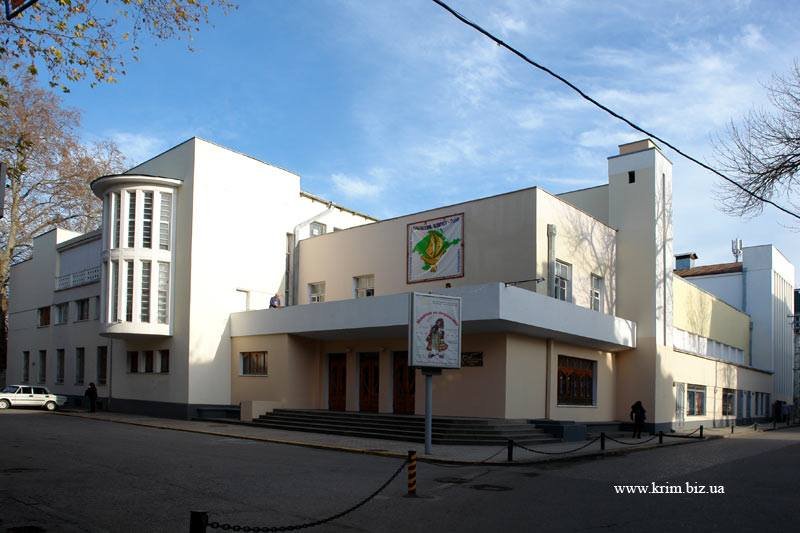
Former club of the regional Directorate of the Ministry of Internal Affairs, since the 1990s — Crimean Tatar Academic Musical and Drama Theater
The activities of the Crimean Oblast Ukrainian Drama Theater were under the close control of both the Central Committee of the CPU and the Ukrainian government. Almost a year after the relocation of the Kyiv Mobile Theater to Crimea, on December 6, 1956, the Presidium of the Central Committee of the CPU adopted a resolution "On a comprehensive study of the activities and existing problems of the newly created Crimean Ukrainian Drama Theater." A special party and government commission took a highly professional and responsible approach to carrying out this task.
"The inspection showed that with the arrival of the theater in the region, the regional organizations of Crimea (the regional committee of the CPU and the regional executive committee) did not show the necessary care for it; in particular, they failed to ensure the creation of potential conditions for production and creative work, as well as living conditions for the theater workers," stated a letter from the First Deputy Chairman of the Council of Ministers of the Ukrainian SSR, M. Hrechukha, to the Presidium of the Central Committee of the CPU. The commission's conclusions regarding the inactivity of local authorities in creating appropriate conditions for establishing the Kyiv Mobile Theater in its new location were harsh but fair.
After all, in the building promised to the theater — the House of Culture of the regional Directorate of the Ministry of Internal Affairs on Mendeleeva Street — the theater troupe was allocated only five rooms. Even for these poorly adapted premises, the theater had to pay a huge sum of money — 1,500 rubles per month. In addition, for each performance, the management of the police House of Culture demanded another 700 rubles from the theater, and for daytime rehearsals, the theater had to pay an additional 100 rubles daily. Obviously, the financial state of the young theater did not allow it to agree to such enslaving rental conditions.
The leadership of the Crimean Regional Executive Committee also took a rather formal approach to meeting the domestic and housing needs of the theater workers. When adopting the resolution to relocate the Kyiv Mobile Theater to Crimea, the Ukrainian government allocated funds for the construction of four 8-apartment prefabricated houses for theater workers. However, Crimean officials did not fully implement the government's decision. As a result, 10 actors of the theater were left without housing.
The commission noted that it was precisely because of this attitude of local authorities toward solving the theater's economic problems and the living conditions of its employees that the vast majority of theater workers left their jobs, and the artistic staff was almost completely renewed. According to the commission's assessment, "the first performances of the Ukrainian theater turned out to be rather mediocre in artistic quality." The commission also had major complaints about the unsatisfactory artistic design of the performances.
"The main reason for the insufficient artistic quality of the performances of the Crimean Ukrainian Theater," according to the commission, "is the lack of a permanent base in the regional center, Simferopol, where the theater could conduct serious rehearsal work. To a certain extent, it is also a consequence of decreased standards within the theater troupe itself, due to the fact that it conducts its work on small, unadapted stages in village clubs: out of 362 performances by the theater during the 10 months of 1956, 360 were performed outside of Simferopol." Thus, for almost a year, the theater's creative team was constantly on the move, unable to conduct stationary rehearsals.
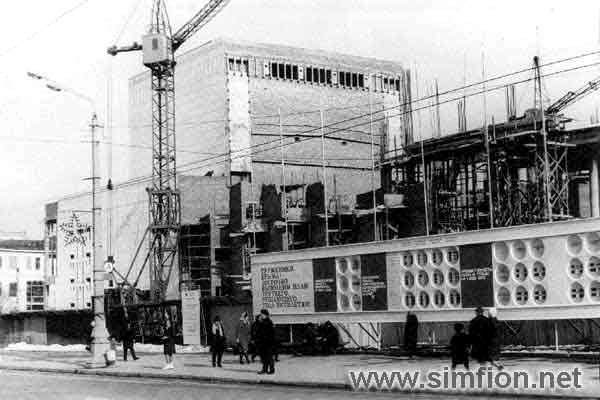
Construction of the new theater building
The commission drew a well-founded conclusion that "the continuation of the work of the Crimean Oblast Ukrainian Theater under the conditions mentioned above threatens a further dangerous decline in the artistic quality of its performances and could compromise the Ukrainian theater in the new oblast of the republic." The government commission ordered the Ministry of Culture to provide comprehensive support to the Crimean theater. To improve its activities, it was proposed:
-
To establish a permanent base for the institution in Simferopol, and to serve the towns and villages of the region with touring parallel performances.
-
To transfer the House of Culture of the regional Directorate of the Ministry of Internal Affairs at 3 Mendeleeva St. in Simferopol to the permanent use of the theater.
-
The resolution defined the main direction of the activities of the Crimean Ukrainian Theater as a musical and drama theater and approved its name — "Crimean Oblast Ukrainian Musical and Drama Theater." It was to be urgently staffed with appropriate artistic personnel.
-
The Ukrainian government obliged the Ministry of Culture, together with the Crimean Regional Party Committee, to improve the theater's repertoire and supplement it with plays on contemporary themes.
Kyiv officials set a task for the creative team: to create a fully-fledged, highly professional theater in Crimea in a short period. As time and the subsequent activities of the troupe showed, the theater successfully coped with this task. The first creative decade of the theater proved particularly fruitful. It should be noted that in the entire history of the Crimean Ukrainian Musical and Drama Theater, the government resolution of 1956 was the most significant and productive. For many years, it defined the main task of the theater — the promotion of Ukrainian theatrical art, above all, Ukrainian classics.
The golden fund of the creative team of that glorious decade included the performances "Marusia Bohuslavka" by Mykhailo Starytsky, "Give the Heart Free Rein, It Will Lead to Bondage" by Marko Kropyvnytsky, "The Handmaiden" and "The Ill-Fated" by Ivan Karpenko-Kary, "On Sunday Morning She Gathered Herbs" after O. Kobylianska, and the opera "Kateryna" by M. Arkas.
At various times, the theater staged the opera "Natalka Poltavka" by Ivan Kotlyarevsky, the comic opera "A Zaporozhian Beyond the Danube" by Semen Hulak-Artemovsky, the musical comedy "Sorochyntsi Fair" by O. Ryabov, "May Night", a stage adaptation after Nikolai Gogol, the musical comedies "Chasing Two Hares" by Mykhailo Starytsky and "Shelmenko the Batman" by Hryhoriy Kvitka-Osnovyanenko, "The Warden's Daughter" by Marko Kropyvnytsky, "The Loose Woman" by Panas Myrny, and many other famous plays.
Over the years, many famous directors worked in the theater: Honored Artist of Ukraine Ye. Stepanov, S. Boiko, V. Nedashkivsky, Honored Art Worker of Ukraine V. Lenohorodsky, People's Artists of Ukraine V. Anosov, and S. Smiian.
During the first two decades of the theater's activity, a whole galaxy of outstanding artists formed within it, most of whom became Honored Artists of Ukraine: M. Andrusenko, S. Botvyn, I. Burmystrenko, S. Valdanovsky, V. Veremeienko, E. Vorosova, O. Hryhorenko, Z. Demydenko, V. Didusenko, Y. Dobrovolsky, and many others.
Throughout its almost 60-year existence in Crimea, the Ukrainian Theater repeatedly changed its name, updated and modernized its repertoire, and rotated its acting staff, but it can be unequivocally stated that it was and must remain an important center of Ukrainian identity on the peninsula. Therefore, after the inevitable liberation of Crimea from the Russian occupiers, the primary task must be the revival of the theater as a leading center of Ukrainian culture on the peninsula.