Whose Language and Education, Their State: First Attempts at Ukrainization in Crimea
Ukrainian educational activities in the Soviet Crimean Oblast.
Petro Volvach, full member of the Shevchenko Scientific Society (NTSh), member of the National Writers' Union of Ukraine (NSPU), Honored Worker of Science and Technology of the Autonomous Republic of Crimea, a Crimean with 60 years of experience. "Krymska Svitlytsia" newspaper, 2017, issue No. 32
Despite the fears of a part of the party and economic elite regarding the inevitable large-scale Ukrainization of Crimea, which manifested itself at the highly confidential March party conference in 1954, the leadership of the republic still dared, at least for form's sake, to take the first tentative steps towards giving the peninsula a Ukrainian face. In the first year after Crimea became part of Ukraine, the Ukrainian government and the Central Committee of the CPU adopted a series of important resolutions relating not only to the economic sector but also to the humanitarian sphere.
To familiarize the Crimean population with Ukrainian theatrical art, the government planned summer tours by the best Ukrainian ensembles: the Kharkiv Opera and Ballet Theater, the Odesa Musical Comedy Theater, the State Ukrainian Choir, the State Bandurist Chapel of the Ukrainian SSR, the Dance Ensemble of the Ukrainian SSR, the Bukovyna Folk Choir, the Transcarpathian Folk Choir, a bayan quartet, and a group of leading artists. The population met this event with enthusiasm and pleasure. Undoubtedly, such steps contributed to the spread and strengthening of Ukrainian sentiments on the peninsula, introducing the local population to Ukrainian culture.
A group of Ukrainian writers led by Mykola Bazhan was sent to Crimea to introduce Crimeans to Ukrainian literature. Together with the Crimean branch of the Writers' Union of the USSR, the Ukrainian delegation took part in commemorating the 50th anniversary of the death of Anton Chekhov. This trip prepared the ground for creating a branch of the Writers' Union of Ukraine in Crimea.
Similar trips during 1954 were made by the Unions of Artists and Composers of Ukraine. Soon, branches of these unions would be created in Crimea as well. To update the Crimean cinema network, in the very first year the Ukrainian government allocated free of charge 99 wide-film and 5 narrow-film mobile cinema installations, along with two types of various power stations.
In the same year, the introduction of the region's population to the achievements of Ukrainian science and the study of the state of scientific research in Crimean scientific institutions began. The educational sphere was not neglected either.
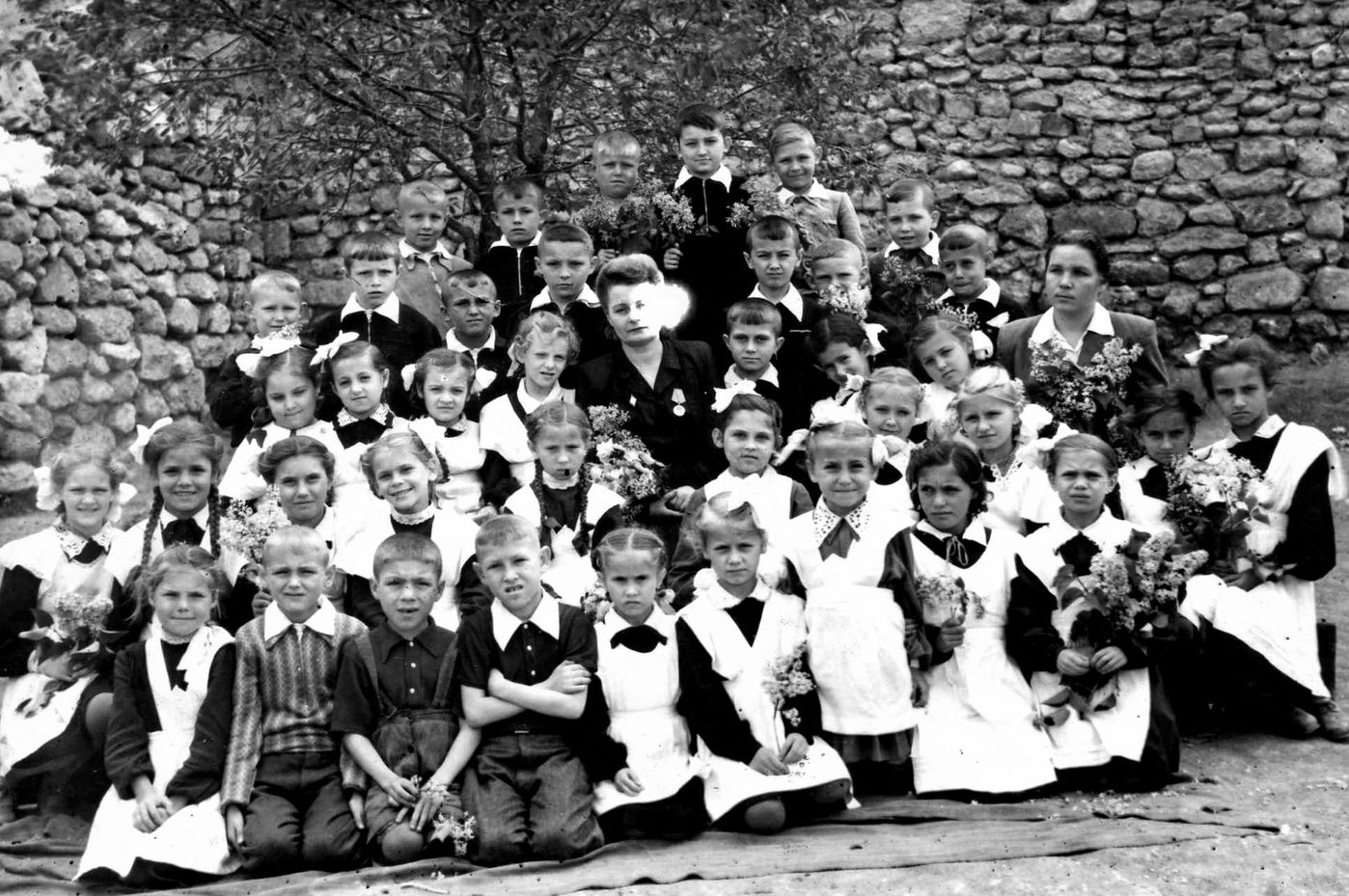
Second-graders in Simferopol, 1955
In the summer of 1954, an exchange of pedagogical staff was initiated between the Crimean Oblast and higher education institutions in Ukraine. Throughout 1954, retraining was organized for almost 1.5 thousand teachers at the Crimean Pedagogical University and the regional institute of postgraduate education. School principals underwent retraining in Kyiv. At the same time, a large group of employees from the Ministry of Education of the Ukrainian SSR was sent to Crimea.
The preamble to the "memorandum of the Crimean Regional Committee of the CPU" states: "In connection with the transfer of the Crimean Oblast to the Ukrainian SSR, the Crimean Regional Committee of the CPU considers it necessary to introduce the study of the Ukrainian language and literature in the 1955-1956 academic year and requests the Central Committee of the CPU to consider the following proposals on this issue" (Crimea in the Context of Socio-Political Transformations (1990-2015). Kyiv, "Klio", 2016. – Document No. 66. – pp. 331-332.).
"In order to provide students of Crimean schools with systematic knowledge of the Ukrainian language and literature, thereby ensuring that their graduates have the opportunity to continue studying in specialized secondary and higher educational institutions of the Ukrainian SSR, to introduce the study of the Ukrainian language and literature from the 2nd to the 8th grade inclusive in all schools of the region starting from the 1955-1956 academic year," the memorandum noted.
The introduction of these subjects only from September 1955 was justified by the lack of teachers of Ukrainian language and literature. After all, out of the 2,193 primary school teachers in the region, only 94 spoke Ukrainian, and even they did not have the necessary experience in teaching it. To ensure the educational process and meet the specified requirement, it was necessary to prepare about 1,500 Ukrainian-speaking teachers in the region. This is considering only the teaching of "Ukrainian language" and "Ukrainian literature" in schools. There was no question of teaching other subjects in Ukrainian in specialized classes.
For the 320 seven-year and 140 secondary schools in the region, even considering providing each school with a single teacher of Ukrainian language and literature, about 600 teachers were needed. The region did not have such a number of specialists. Therefore, the Crimean leadership appealed to the Central Committee of the CPU requesting it to instruct the Ministry of Education to send 600 teachers of Ukrainian language and literature to Crimea to teach these subjects in Crimean schools.
Due to the fact that in some seven-year schools teachers of the Ukrainian language and literature in the 1955-1956 academic year would not have a full weekly 18-hour load, the Crimean Regional Committee of the CPU requested the government to allow the implementation of hourly pay for one year.
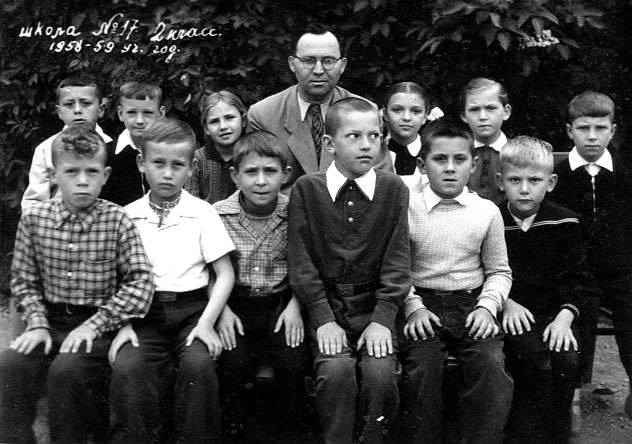
Partenit schoolchildren, 1958-1959 academic year
The Crimean Regional Committee and the regional education department proposed organizing courses for primary school teachers to study the Ukrainian language during the 1954-1955 academic year. For this purpose, the Ministry of Education of Ukraine was to develop and propose a curriculum for these courses, ensure funding, and establish a teaching and methodological base for teachers.
It was also proposed, in order to provide methodological assistance to teachers of Ukrainian subjects and monitor the quality of teaching, to establish three posts of inspector-methodologists in the staff list of the Crimean Department of Public Education, and to introduce one inspector-methodologist to the staff of Sevastopol, Simferopol, Kerch, Yalta, Yevpatoriya, Feodosia, Dzhankoy, Bilohirsk, Saky, and Krasnohvardiiske districts. At that time, it was also proposed to create a cabinet of the Ukrainian language and literature at the Crimean Oblast Institute of Advanced Studies, with the employment of a head and a methodologist, respectively.
Over the next 5–6 years, the Central Committee of the CPU and the Crimean Regional Committee repeatedly addressed the problem of studying the Ukrainian language and literature on the peninsula.
Despite this, during Crimea's 60-year stay within Ukraine, the Russian Federation continued to hold the peninsula in a "tight 'brotherly' embrace" ideologically, educationally, and culturally. And the annexation of Crimea by the RF in 2014 only proves the truth of the famous saying: "Whose language and education, their state."