Church Union in Medieval Crimea
Catholic traditions on the Crimean Peninsula.
Serhiy Konashevych. "Krymska Svitlytsia" newspaper, 2017, issue No. 6
One can often come across the assertion that there was no Eastern Rite Catholic Church (or Orthodox Church in communion with the Apostolic See) on the territory of the Crimean Peninsula until the late 1980s, when communities of the Ukrainian Greek Catholic Church appeared in Crimea. However, the existence of Greek Catholic churches in Crimea is documented in publications of the early 20th century. For example, the Polish researcher Stanisław Bendlewicz, in his work "From a Journey Through Crimea and Ukraine," mentions one such church in Yevpatoriya; today, the St. Nicholas Cathedral is likely located on its site.
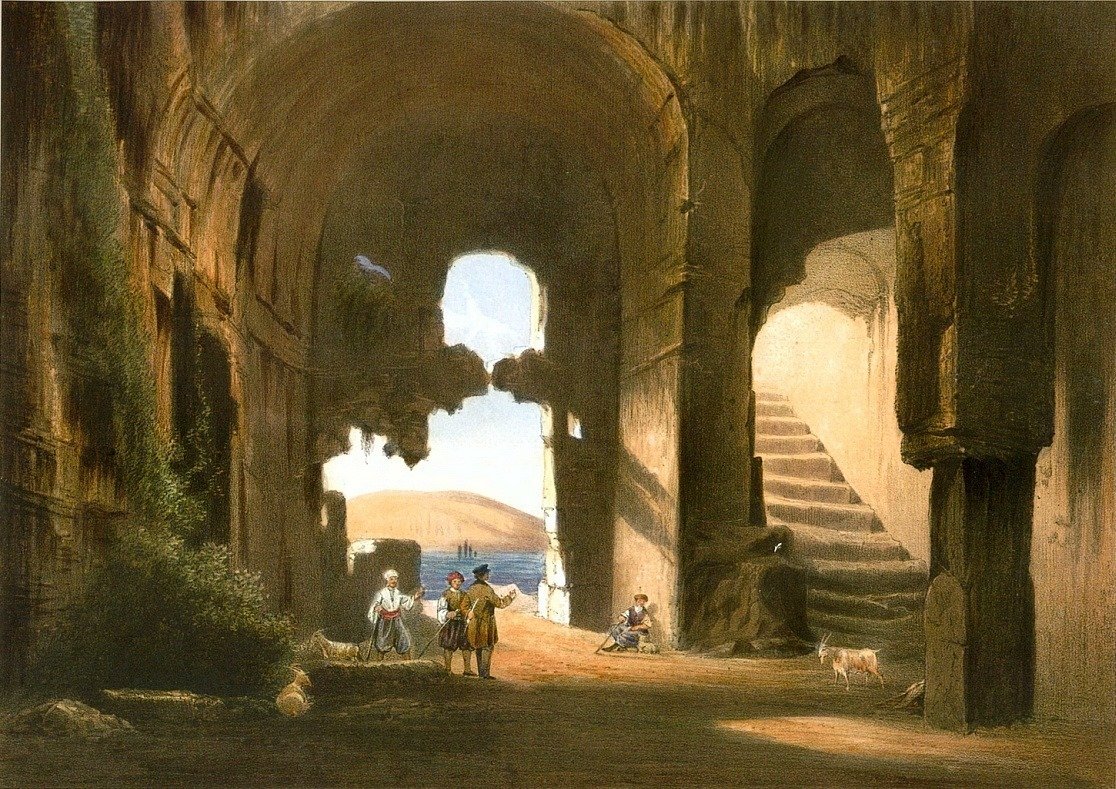
Carlo Bossoli. Early Christian Church in Inkerman. Crimea. 1840-1842.
In his works, historian Aleksandr Berthier-Delagarde notes that in the mid-15th and early 16th centuries, the Kherson Eparchy was headed by a "Uniate" metropolitan. At that time, the eparchy included only the city of Chersonesos, which had become deserted. The metropolitan, however, lived in the surrounding villages belonging to the Genoese. In the 15th century, due to its decline, the Kherson Eparchy merged with the Gothia Eparchy. The scholar also mentions two Phullae eparchies in his studies — Orthodox and "Uniate." The first written mention of the former appears at the end of the 9th century; around 1156, it merged with the Sugdaia Eparchy, after which both were elevated to the status of a metropolitanate.
In the 12th–15th centuries, the population of Genoese settlements in Crimea, especially Caffa (modern Feodosia), was predominantly Armenian (this ethnic group was numerically dominant) and Greek. The authorities, given the small number of newcomers from Italy and economic expediency, tried to be lenient towards the religious feelings of Greeks and Armenians, while warning Catholic bishops against interfering in their affairs. The local Orthodox hierarchy retained its titles and dependence on the See of Constantinople. However, as a result of long coexistence, the dominant Catholicism became more influential, albeit softer.
As a result, a significant portion of local Armenians recognized the primacy of the Pope (outside Caffa, the Armenian Patriarch recognized this as early as 1141), and attempts at a church union between Rome and Constantinople found prepared and favorable ground among the Greeks. The final attempts of the declining Byzantine Empire to secure European support against the Turks at any cost, even by recognizing the primacy of the Pope, made themselves felt in Crimea. On December 12, 1452, the Union of Florence, proclaimed as early as June 6, 1439, was confirmed in Hagia Sophia, but this did not save Constantinople, which the Turks captured on May 29, 1453. This union gave the Genoese a free hand to influence the Orthodox population in their Crimean possessions, where it was received leniently.
Soon, an Eastern Rite bishop consecrated by the Pope began to be appointed for the Orthodox Greeks in Caffa, which nominally belonged to the Sugdaia Eparchy. This appointment was initiated through the direct mediation of the instigator of the Union of Florence — Cardinal Bessarion, who had previously been the Orthodox Archbishop of Nicaea: born in Trebizond (modern Trabzon), he was connected to his homeland. At that time, Caffa was reluctant to submit to the ecclesiastical hierarchs of the impoverished Sugdaia (modern Sudak), where, along with all the surrounding villages, there were far fewer Orthodox Christians.
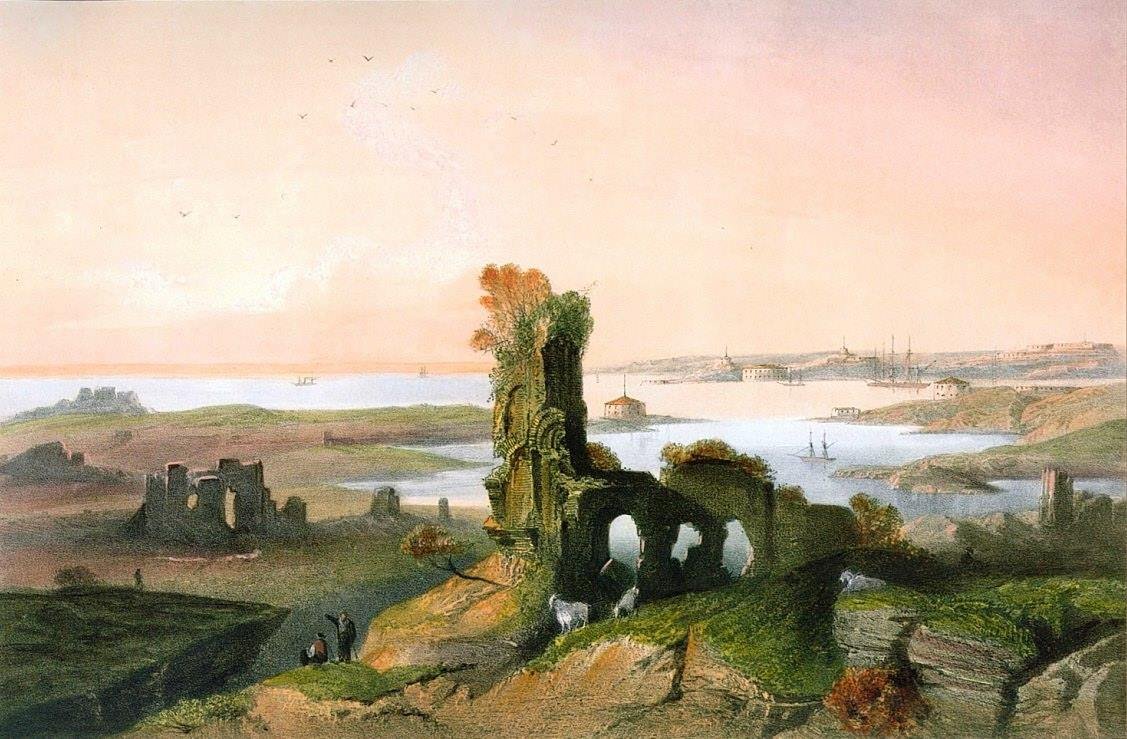
Carlo Bossoli. Ruins of Chersonesos. 1840-1842.
The first Uniate bishop of Caffa is mentioned anonymously in 1464–1465, after Bessarion became the titular Latin Patriarch of Constantinople. After this bishop's death in 1468, a new hierarch was to be elected by the clergy and the people; however, this task was entrusted to Pope Paul II, who came from Venice. The Pontiff appointed Pachomius, the former Archbishop of Amasya (Turkey), to Caffa. The new hierarch was killed by bandits while traveling from Rome to Caffa by land (arrival by sea was made impossible by Ottoman control over the Bosporus Strait). On July 6, 1472, Pope Sixtus IV, successor to Paul II, appointed the former local priest Mykolay to the episcopal see of Caffa by his bull; the latter arrived in the city at the end of 1474.
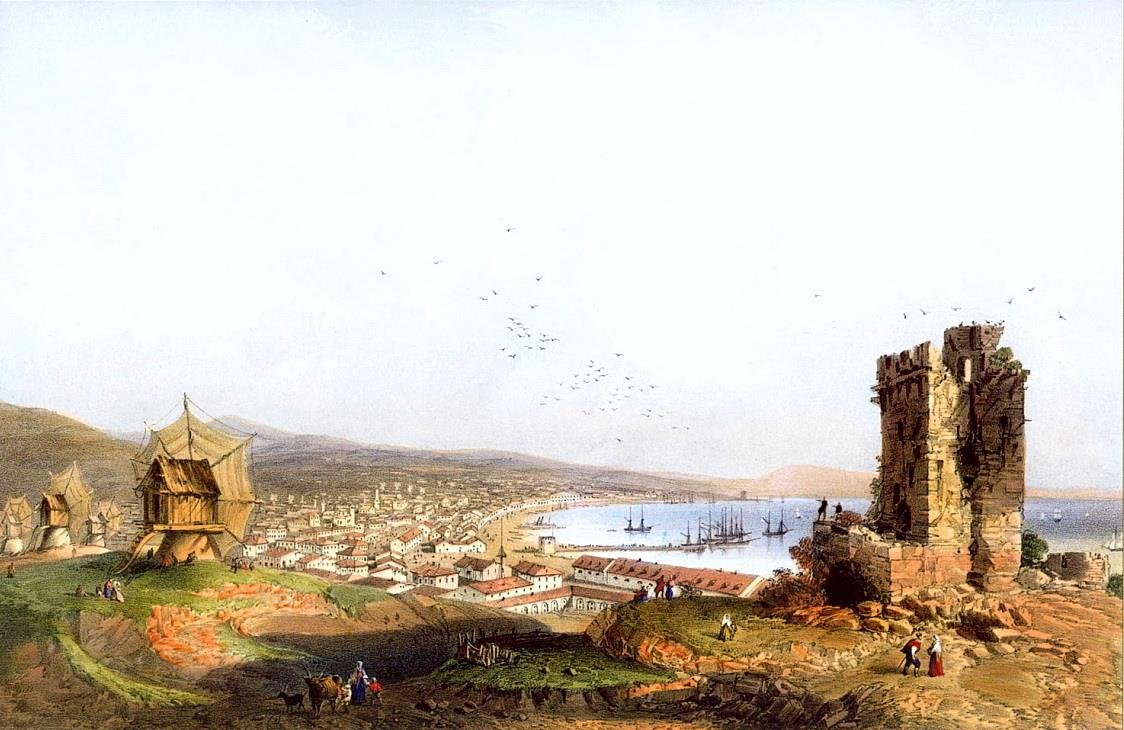
Carlo Bossoli. Caffa. 1840-1842.
In 1475, the Turks captured Caffa, making it the main city of their possessions on the peninsula. The last Uniate bishop of Caffa, elected by the population for the Greeks of Caffa and Soldaia (Sudak) as specified in Pope Sixtus IV's bull, held the title of Phullae; apparently, this name was given to avoid identification with the Roman Catholic bishops of Caffa and Soldaia. This title of the Uniate bishop is documented as late as 1484, when a synod against the union took place in Constantinople.
From then on, the functioning of Armenian and Catholic religious communities and hierarchs in Caffa became impossible due to the administrative dominance of Orthodoxy. During the 16th–18th centuries, the Catholic Church tried to regain its former influence in Crimea through missionaries and commercial consuls; during this time, the title of Bishops of Caffa was preserved (eight of them succeeded each other during the period 1493–1664), but without influence or significance in Caffa itself. At the same time, the city's Uniates retained their rights, supported by the Turks, to church and parish property.
Sources:
-
A. L. Berthier-Delagarde. Orthodox and Uniate Eparchies, Their Limits / Proceedings of the Taurida Scientific Archive Commission — No. 57 — Simferopol: Printing House of the Taurida Governorate Zemstvo, 1920. — pp. 35-66.
-
Stanisław Bendlewicz. Z podróży po Krymie i Ukrainie. — Poznan, 1910-1920 (?). — P. 22.